
HIPPOLYTUS OF ROME, Saint, Martyr. — Illustrious writer of the Roman Church in the 3rd century and the first antipope, of whom only a few and fragmentary biographical details are known. Even his works, written in Greek at a time when the Church of Rome was about to abandon that language, were little read or used in the West, while they enjoyed considerable diffusion in the East, where they were also translated into several languages.
I. LIFE
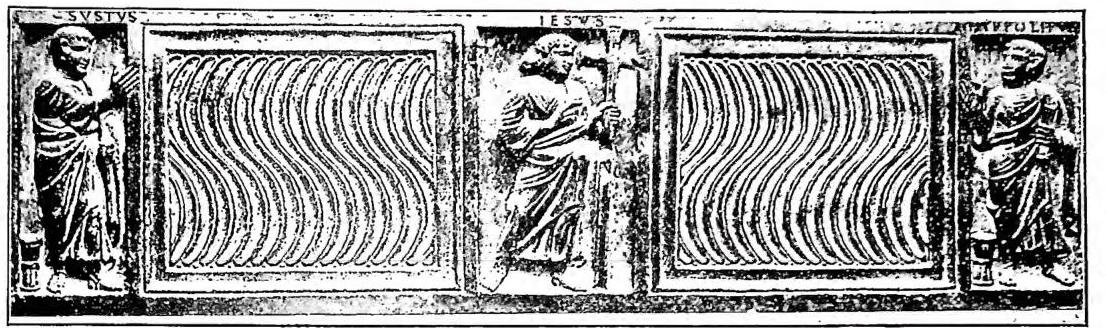
The principal source of information on St Hippolytus is the autobiographical notes contained in the Refutatio omnium haeresium, improperly called the Philosophumena, which modern criticism has restored to him. His literary output is listed on one side of the chair discovered in 1551 in the area above the cemetery of St Hippolytus, and by various authors, among whom the most important are Eusebius of Caesarea (Hist. eccl., VI, 20, 22, 46); St Jerome (De viris illustribus, 61); Phatius (Bibliotheca, cod. 48, 121-202, 232); Ebedjesu, a Nestorian of the end of the 13th century (G. S. Assemani, Bibliotheca Orientalis, III, II, Rome 1728, p. 15), and Nicephorus Callistus in the 14th century (Hist. eccl. IV, 31; PG 145, 1052). His exile in Sardinia is attested by the Liberian Catalogue (ed. Duchesne, Lib. Pont., I, p. 5), and his cult as a martyr by the Depositio Martyrum («idus Aug.: Ypoliti in Tiburtina et Pontiani in Callisti») and by the cemetery sanctuary on the Via Tiburtina, restored by the popes Damasus and Vigilius. The epigram of Damasus attests that towards the end of the 4th century in Rome the historical figure of the Roman writer was becoming obscured: he makes him, albeit with a «fertur», a priest who favoured Novatian and publicly reconciled with the Church (cf. A. Ferrua, Epigrammata Damasiana, Vatican City 1942, pp. 169-73). A few decades later, Prudentius in the Peristephanon (XI: PL 60, 530-36) would add to the Damasian epigram, which he knew, the description of the martyrdom of Hippolytus, which took place at the mouth of the Tiber, dragged like his namesake, the fabulous son of Theseus, by frenzied horses. With the legendary Passio Polychronii, which probably dates from the end of the 5th or the beginning of the 6th century, Hippolytus enters the hagiographical cycle of SS Sixtus and Lawrence (BHL, 3962; cf. H. Delehaye, Recherches sur le légendier romain. La passion de St Polychronius, in Anal. Boll., 51 (1933), pp. 34-98, see in particular pp. 59-68, 93-97) becoming a soldier who is converted by the deacon Lawrence and who dies dragged by horses. Thus transformed, Hippolytus, the doctor, passed into the present Roman liturgical books, the Breviary and the Martyrology (Hippolytus is particularly distorted here: cf. also 30 Jan. and 22 Aug.).The confusion regarding Hippolytus was further complicated when Rufinus (Hist. eccl., VI, 20), misinterpreting Eusebius (Hist. eccl., VI, 20), made him a bishop of Bostra in Arabia, and the Chronicon Paschale, at the beginning of the 7th century (ed. L. Dindorf, Bonn 1832, p. 12), a bishop of Porto at the mouth of the Tiber.
According to the most reliable data, sifted by modern criticism, the priest Hippolytus, a disciple of St Irenaeus, appears from the pontificate of Victor (189-99) as a leading figure among the clergy of Rome, on account of his vast learning, of which he himself was the first to be aware (cf. his commentary on Daniel, III, 16; ed. M. Lefèvre, Paris 1947, p. 233). Unfortunately his haughty character soon led him to overstep the just limits of controversy and turned him into a libeller. Hippolytus, who around 212 would have preached in the presence of Origen, deserves the credit, however, for having successfully polemicised against all heresies, especially those of his time, and for having championed the theology of the Logos against the Adoptionist (v. ADOPTIONISM) and Monarchian (v. MONARCHIANISM) doctrines which, since the pontificate of Pope Victor, had been disturbing the Roman community. It was precisely in this controversy over the Logos and, after the accession of Callistus to the pontificate, in disciplinary matters, that he was unable to remain within the proper limits: according to him Pope Zephyrinus should have acted energetically against the innovators, but he did not consider it opportune to take the measures demanded. Hippolytus then became embittered against Zephyrinus’s counsellor, the deacon Callistus, who accused him of ditheism, and, smarting under this, when he saw his rival succeed Zephyrinus (217), he separated from his communion, founding a schismatic sect of which he was the head with an episcopal character; indeed he himself declares in the preface to the Refutatio that he is «the successor of the Apostles, and a partaker of the same grace of the supreme priesthood and teaching». Hippolytus thus became the first antipope and persisted in his rebellious stance even under the pontificates of Urban and Pontian. The episcopal dignity which many authors, from the 4th century onwards, attribute to him, and indeed the very Roman see assigned to him by Apollinaris of Laodicea (cf. A. Mai, Script. veterum nova collectio, I, II, Rome 1881, p. 173), is the echo of his activity as antipope, which was brought to an end by the edict of persecution of the emperor Maximinus the Thracian, which chiefly struck the leaders of the Churches. Indeed the Liberian Catalogue attests that both Pontian and Hippolytus were deported to the «noxious» island of Sardinia; united in misfortune, they reconciled and both died for the faith. An echo of this reconciliation is found in the Damasian epigram and in Prudentius’s Peristephanon. From the Liber Pontificalis (I, p. 145) we know that Pope Fabian, after the persecution had ceased, had the body of Pontian brought to Rome; it is probable that at the same time provision was also made for the transfer of that of Hippolytus, since the Depositio Martyrum assigns the deposition of both to 13 August.
La théologie de St Hippolyte, Parigi 1906, pp. 215-20. Oltre la bibl. citata sotto si veda anche L. Duchesne, Histoire ancienne de l'Église, I, 3ª ed., ivi 1923, pp. 292-323; A. Puech, Histoire de la littérature grecque chrétienne, II, ivi 1928, pp. 543-77; H. Delehaye, Les origines du culte des martyrs, 2ª ed., Bruxelles 1933, pp. 269, 278-79, 294-97 e passim; Fliche-Martin-Fruta, II, pp. 87-107, 116-17, 395-400; E. Amann, Hippolyte, in DTHC, VI, II, coll. 2487-2591; G. Bovini, S. I. dottore e martire del III sec., Città del Vaticano 1943; A. Ehrhard, La chiesa dei Martiri, vers. II. di G. Marchi, Firenze (1947), pp. 139-40, 327-32, 375-76; B. De Gaiffier, Les orations de l'Office de St Hippolyte, in Mélanges Marcel Viller (Revue d'ascét. et myst., 1949), pp. 219-24; Martyr. Hieronymianum, pp. 68, 74, 421, 439, 457, 584; Martyr. Romanum, pp. 41, 336, 353; Synax. Constantinop., col. 431. A. Pietro Fruta
II. WORKS
1. He was above all an exegete. His exegetical writings survive in fragments and in a very small part in the original Greek, while the rest are preserved in Slavonic, Georgian, etc., translations. As with all of I.’s works, which were soon forgotten in the West, these were read and disseminated in the East. We possess, partly in the Greek text and partly in Slavonic translation, the Commentary on the Book of Daniel; partly in Greek and entirely in Georgian, that On the Song of Songs; likewise in Greek and Georgian, that On the Blessings of Jacob; and in Georgian, that On the Blessings of Moses—perhaps originally a single work—and that On David and Goliath. Among these, the most important are the commentaries on Daniel and on the Song of Songs: from the latter especially one can gain an idea of I.’s exegetical method, which was concerned with the typological sense of Scripture (the bridegroom is for him a figure of Christ, the bride the Synagogue from which the Church must emerge, the bridegroom’s leaps represent the Incarnation, the Crucifixion, the descent into hell, the Resurrection, and the Ascension; the title is explained as the song in which the essence of all the songs composed by Solomon is received). In the commentary on Daniel, certain historical questions about the family of Susanna and Joakim are resolved, and some allegorical interpretations are given: Susanna is the Church, the two elders are the two enemies of the faith, the Jewish people and the Gentiles; Daniel in the lions’ den is seen as the condition of Christians before persecutions, and the fourth beast of the vision is the Roman people. The other exegetical works, of which little or nothing survives, include commentaries on the Hexaemeron, on Exodus, on the Fragments of Ezekiel, on Genesis, on Zechariah, on the Psalms, on Isaiah, on the Apocalypse, on the Proverbs, on Ecclesiastes, on Saul and the Witch of Endor, noted by Eusebius and St. Jerome, and on Daniel the Small and Susanna, mentioned by Ebedjesu.Of the dogmatic works, brief fragments survive in Greek and Syriac of the treatise On the Resurrection; intact is the treatise On the Antichrist, in Greek. In this work I. sets out to examine what the Antichrist is, at what time his coming will occur, from which tribe he will come, what name he will bear, how he will deceive men, how the Savior’s return and the cosmic fire will bring his kingdom to an end, what the heavenly kingdom that follows will be, and how the wicked will be punished.
I. also composed works of a disciplinary nature. St. Jerome, in Epistle LXXI, 6, says that I. had written “on the Sabbath,” whether one should fast on that day, and on the Eucharist, “whether it should be received every day.” It is not possible to determine in which works he treated these topics, if indeed he did so in special treatises; the list on the statue mentions in sequence a Περὶ Χαρισμάτων and an Ἀποστολικὴ παράδοσις, which might even be a single work. This Apostolic Tradition has been identified by Connolly with the so-called Egyptian Church Order, which survives only in Coptic, Arabic, Ethiopic, and Latin translations (the Verona palimpsest, which contains various fragments of it). It deals—hence its documentary importance—with the ordination of bishops, priests, and deacons; it treats of confessors, readers, subdeacons, widows, and virgins; and it provides a great number of precepts and norms regarding ecclesiastical ritual and liturgy (Baptism, the agape, fasting, the Eucharist, prayer, the gatherings of the faithful, the catechumenate, the commemoration of the dead, etc.). Objections have been raised to the identification proposed by Connolly by various scholars, but it may be considered on the whole well founded, even though the entire problem of defining the relationships of dependence among the ancient disciplinary collections is far from having received a definitive solution. The view of those who see in I.’s Apostolic Tradition the oldest known constitution of the Church, and the source of Book VIII of the Apostolic Constitutions, of its Epitome, of the Testamentum Domini, and of the Canons of I., seems preferable to the opposing thesis.
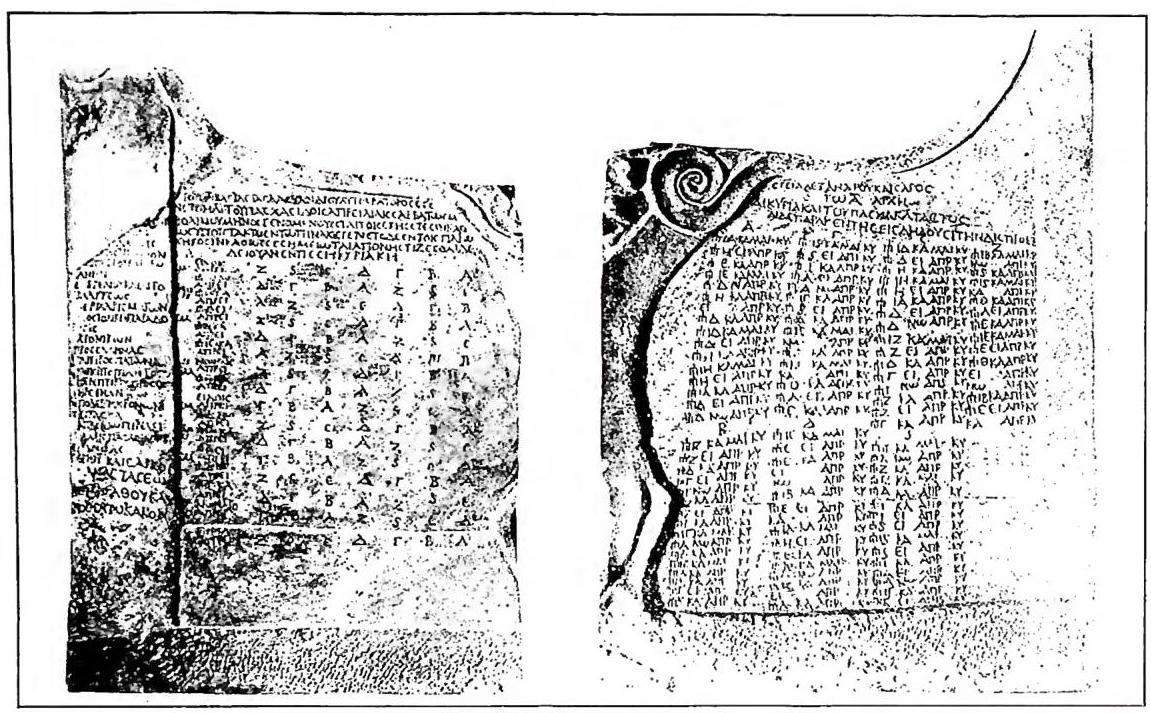
A work of chronology is probably the treatise On Easter, in which, according to Eusebius, the paschal cycle was established; a portion of it, relating to the years 222–23, was, as has been said, inscribed on the statue found on the Via Tiburtina.
The polemical works represent a significant part of I.’s literary activity. A disciple of Irenaeus, he continued the battle waged by his master against heresies, with objectives naturally different, as the positions of orthodoxy and heresy had changed in his time. The treatise Against Marcion may perhaps be identified with the treatise On Good and the Origin of Evil (which was one of Marcion’s most important tenets); a fragment survives of a Proof Against the Jews, but the authenticity of the work is doubtful. In a work entitled Apology for the Apocalypse and the Gospel of John, against the thesis of a Roman priest, Gaius (v.), who attributed these two writings to the heretic Cerinthus, he defended their authenticity; it is not certain that this work of I. should be identified with the Chapters Against Gaius, from which the Syrian Dionysius Bar Salibi, metropolitan of Amida, drew quotations for a commentary on the Apocalypse: it could well be two different works. Doubtful is the attribution to I. of the fragments cited by Eusebius as coming from a treatise Against Artemon, which may perhaps be identified with the Little Labyrinth cited by Theodoret. Entirely lost is the Treatise Against 32 Heresies: Συνταγμα κατὰ ἀπέρασον λῶ, thus cited by Photius, who calls it a “little book” (βιβλιδάριον); the refutation of heresies began with that of Dosithius and ended with that of Noetus; this writing was very probably the source of the Pseudo-Tertullian in the appendix to De praescript., of Epiphanius, Panarion, and of Filastrius of Brescia’s Liber de haeresibus, and on their basis it is partly reconstructible (this συντάγμα
It is the same thing, presumably, as the Πρὸς ἀπάσας τὰς αἱρέσεις mentioned by Eusebius and the treatise Adversus omnes haereses cited by Jerome. A lengthy fragment of a homily On the Heresy of Noetus is extant; it is probable that this constitutes the end of the σύγγραμμα, although it seems to conflict with the brevity with which the treatise on the σύγγραμμα must have been composed. To this list of works others might be added: those indicated in the list inscribed on the statue (the Chronicle, which exercised a wide influence on medieval chroniclers, the Protreptic to Severian, the Πρὸς Ἅλληνας καὶ πρὸς Πλάτωνα ἢ καὶ περὶ τοῦ παντός, the Ὡδαὶ εἰς πάσας τὰς γραφάς), and the Refutatio omnium haeresium. Of this work only Book I was known, under the title Philosophumena, attributed to Origen, until the discovery in 1842 by Minoide Mynas of a codex from Mount Athos containing the remaining books up to the tenth, with a lacuna at the beginning covering Books II and III. But to do this one would need to be quite certain that the statue represents Hippolytus and that the Refutatio is his. Both attributions are conjectural, even if supported by valid reasons.
Of the statue it has already been said: the attribution of the Refutatio to Hippolytus rests especially on the fact that the author is a contemporary and bitter enemy of Callistus, a rigorist founder of a Church in opposition to that governed by the successors of Callistus, and that this author appears to be a man of great learning, the famous author of numerous works—conditions which seem to suit none other than Hippolytus. Nevertheless, this attribution has not been made without controversy, and even recently, after general agreement had been reached on the name of Hippolytus, discordant voices have been raised which have somewhat shaken confidence in the attribution now generally accepted, even if the name proposed for the person represented on the statue and for the author of the Refutatio—a certain Josippus, indicated by Fazio as the author of a Περὶ παντός, which is Nautin’s thesis—falls far short of complete satisfaction (for even if substantial and formal divergences between the fragment against Noetus and the Refutatio are granted, one must still answer the simple question of how it is that this Josippus, alleged author of the Refutatio and of the works listed on the statue, a man of high standing, learned, founder of a schismatic Church, should have left no trace of his name save in the questionable attribution of a single work). All the same, it is not believed at present that one can speak of the Refutatio otherwise than as a work attributed to Hippolytus.
The work has a clear line of development in its purpose to demonstrate that the germ of all heresies lay in the doctrines of the pagan philosophers. Hippolytus is an exposition of the doctrines of the Greek philosophers; in the lacuna of two books following the first, there must have been an exposition of the rites of the mysteries; in Book IV astrology, geometry, and magic are treated; from Book V onwards he begins to expound and criticize the heresies; in Book X there is a recapitulation of the material dealt with in the preceding books and an exposition of the true doctrine. It is possible that—even without accepting the hypothesis of those who consider the author a victim of forgers—the sources of information are not always reliable, but in the exposition of the heresies closest to his own time the tone becomes more personal and the information richer, even if not always as objective as it should be: a work, in conclusion, of little originality and slight speculative vigour, but not devoid of historical interest and the merit of clarity, even if the author sometimes indulges in the effects of sophistic virtuosity.
III. JUDGMENT
Even from the works universally recognized as authentic, I. appears as a man of wide learning and varied interests, not, however, comparable to Clement of Alexandria and Origen (of whom he had direct knowledge and was an admirer; the influence of I. on Origen is treated by R. Cadiou, La jeunesse d’Origène, Paris 1935, pp. 63 sqq.). As an exegete, he is an allegorist, but with moderation: his exegesis is based on faith in the Incarnation of the Word; in Christ he finds the explanation of all that is in the Scriptures; this also gave him occasion for homiletic exhortations. As a theologian, he is in the line of the apologists of the preceding century and of Irenaeus, opposing the monarchians, who considered the Son and the Holy Spirit as modes of the activity of the Father and thought that the Father had suffered together with the Son, and against the Docetists he insists on the affirmation that Christ is both God and man. His doctrine of the unity of God does not exclude the distinction of the Father, the Son, and the Holy Spirit (the latter, like the Son, pre-existent). In the Refutatio, however, only the one God and His Word, the Father and the Son, are mentioned and distinguished, without mention of the Holy Spirit, whence the accusation of ditheism made by Callistus against its author. Salvation consists for him in deification: “If God had wished to make you a god, He could have done so; you have an example in the Word.” From this it appears how the anti-monarchian concern led the author of the Refutatio to the danger of appearing subordinationist. The reputation for uncompromising rigorism in disciplinary matters is especially attached to certain passages of the Refutatio. — V. tav. XI.IV. CEMETERY OF I
On the Via Tiburtina. Both the Depositio martyrum and the Martyrologium Hieronymianum under the date of the Ides of August (13th) indicate the dies natalis of I. on the Tiburtina without further specification; it therefore seems that the martyr himself gave his name to the cemetery that extends to the left of the said road, as indicated by the itinerary of Einsiedeln, on a hill not far from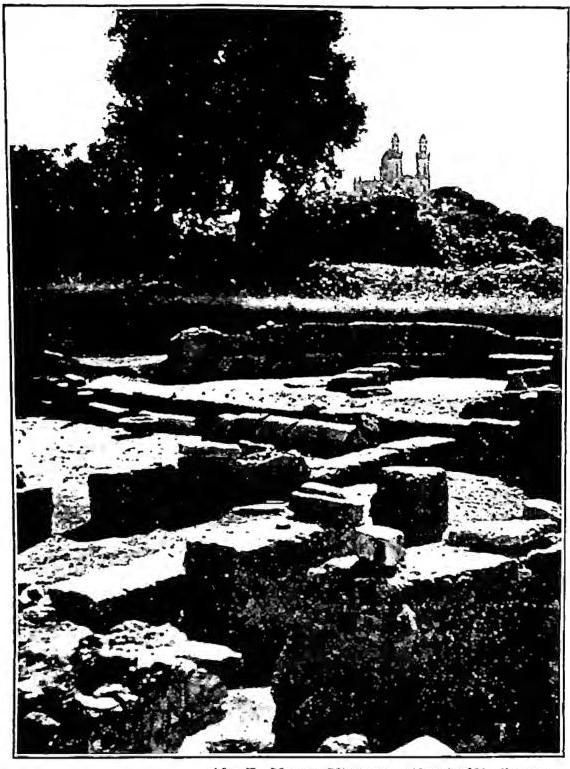
G. B. De Rossi also found in the crypt an inscription recording the works carried out there in the time of Damasus by a presbyter named Leo.
A. Bosio descended into a part of this cemetery, which he believed to be part of that of St Lawrence, and read the graffito: « Refr(i)geri tibi Domnus Ippolitus sid... » (Roma sotterranea, Rome 1632, p. 401); M. Boldetti removed many slabs (Osservazioni sopra i cimiteri, ibid. 1720, p. 568); in 1779 and 1829 the galleries were much devastated (G. B. De Rossi, Roma sotterranea, I, ibid. 1864, p. 61; III, ibid. 1877, pp. 641-42), other explorations were carried out in 1843 (G. Marchi, Monumenti primitivi del Cristianesimo. Architettura, ibid. 1844, p. 77), then in 1862 F. Gori, Della porta e basilica di S. Lorenzo... e delle catacombe di S. Ippolito, ibid. 1862); in 1881 M. Armellini and O. Marucchi penetrated there and read several graffiti by pilgrims and presbyters, including the invocation «Ippolite in mente (habeas) Petru(m) peccatore(m)». In 1882 excavations brought to light the apse belonging to the small underground basilica erected over the martyr’s tomb. The cemetery suffered greatly in the air raid of 19 July 1943.
Among the inscriptions then discovered are those recording a presbyter of the title of Prudentiana, a reader of the same title who died in 528; the mention of a presbyter of the title of Praxedes; from these two titles the cemetery was dependent. Among the Greek inscriptions, a notable one is that of a catechumen Victor, servant of our Lord Jesus Christ (G. B. De Rossi, Bull. di arch. crist., 2 [1883], p. 83). Besides the cemetery, in Rome itself in the 4th century there existed a memorial of the martyr Hippolytus at the vicus Patricius, as is evident from an inscription, now in the Lateran Museum, from which the existence of this memorial is deduced (O. Marucchi, I monumenti del Museo Cristiano Pio Lateranense, Milan 1911, tav. 45).