
ARABIA. – The largest peninsula on earth (2.8–3 million sq. km.), covering more than one quarter of Europe.
1. GEOGRAPHY
Arabia consists of a roughly rectangular massive plateau, which continues northward into Syria, overlooks the Irāqī depression (Mesopotamia) to the NE., and on its other sides is enclosed by an almost continuous raised rim, higher opposite the Red Sea and the Gulf of Aden. While the rim slopes gradually toward the interior, it descends steeply, in steps, above a more or less narrow strip of plain (Tihāmah), accompanied to the E. and W. by coral formations only partly joined to the continental body. All Arabia receives minimal and irregularly distributed rainfall, especially on the interior plateau, whose landscape—steppe-like in the higher zones or in the depressions where groundwater can be reached—is desert over very extensive stretches, with bare rock in the N. (Nefūd), and sands in the S. (Dahnā or Rub' el- Īālī). The higher peripheral zones, benefiting from the humid air of the surrounding seas and from an altitude that moderates the excesses of tropical heat, correspond to the economically productive and more densely inhabited sectors (Ḥiğāz, Jemen, Ḥaḍramaut, 'Omān). The coast, on the other hand, is arid and deserted; the interior is the realm of the nomadic herders (Bedouins) (sheep, camels, and horses—the latter of worldwide fame), intolerant of subjugation and devoted to plunder and war; the marginal regions are home to sedentary Arabs gathered in inhabited centers or engaged in seafaring activities. The total population is estimated at 9 million inhabitants, more than half of them on the elevated western fringe; they are predominantly Arabs, Sunnites or Shiites (Jemen), with minorities of Jews, Indians, and Ethiopians.Wild products (balsamic and gum-producing plants) or cultivated products (barley, date palms, bananas, sesame, sugar cane, tobacco, cotton, and coffee), together with hides, support a modest export trade, recently increased considerably by the extraction of petroleum (Bahrein Island). Communications take place along caravan routes; the railway running from Medina to the Palestinian frontier, intended chiefly for Muslim pilgrims, has not yet been restored to service.
Politically, Arabia has been almost entirely unified by the Wahhābites of the interior: since 1934, Saudi Arabia has comprised the Neğd, Ḥiğāz, and Asir (0.3 million sq. km., with more than 5 million inhabitants), with its capital at Rijād (30,000 inhabitants) and its more populous centers at Mecca (130,000 inhabitants) and Medina (30,000), the holy cities of Islam; and Gedda (40,000), the principal port on the Red Sea. Jemen is also independent (120,000 sq. km., 1 million inhabitants), the Arabia Felix of the ancients, notable for its coffee production: its capital is Ṣan'ā (30,000 inhabitants), and Ḥodeidah (30,000) is its busiest port.
The rest of the peninsula and the islands facing it (Curia Muria, Bahrein; the I. Ḥānīš, NE. of Assab, are of indeterminate sovereignty) are under the control of Great Britain (the sultanates of Ḥaḍramaut, 'Omān, the Pirate Coast, Qajar, Koweit, and the Bahrein Islands), which, interested in protecting the route to India, Aden (v.) and Perim.
2. RELIGIONS OF PRE-ISLAMIC ARABIA
The religion into which Muhammad was born, and which he abolished with Islam, is a polytheism containing animistic elements (the worship of stones, springs, and trees, and demonism). It also preserves, owing to the nature of the isolated region in which it developed, certain original features of the ancient Semitic religions, of which it is one of the principal manifestations; for this reason it is of great interest to historians of religion and students of the Bible.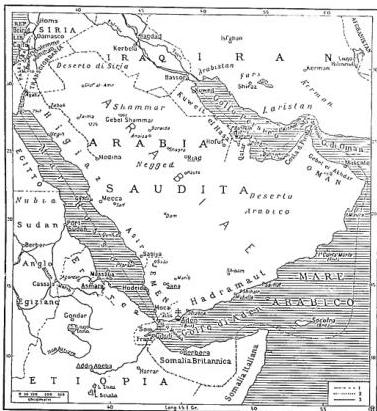
The Arab pantheon is numerous but not uniform: its deities are of various origins and natures; they are not exclusively astral, although the worship of the heavenly bodies is widely documented. Allāh “the goddess,” also widespread among the Nabataeans and Palmyrenians, is almost certainly to be identified with the sun; al-‘Uzzā “the most powerful” is the planet Venus; while Manāh, the third great female divinity, is fate. There is also Allāh (v.) “the god,” whom certain sure indications (invocations, oaths, and formulas used throughout A., the Qur’an) show to have prevailed among the Arabs; and in this connection one may ask whether the conception of a heavenly God, guardian and guarantor of the rules of law and morality, was not proper to the ancient Arabs. That this idea of Allāh served as an introduction to the Islamic concept of God seems certain: it nevertheless derives its force, truly active in the religious process that led to the formation of Islām, from the infinitely superior conception of Jewish and Christian monotheism, which Muhammad succeeded in inserting into an Arab framework inspired by the national tradition, in which the figure of the old Allāh also has its place.
In Arab religious life, beliefs concerning demonic beings (ginn), which animate nature and dwell in deserted places, also occupied a notable position; for the most part they were anonymous and of a malevolent disposition. This belief survives in Islām, which nevertheless distinguishes between good and evil ginn.
Worship. — The stone idol was originally carried by nomads in a red leather tent and followed the tribe’s wanderings. But in the various territories there was a fixed place of worship: the most famous of all was that of Mecca (the Macoraba of the geographer Ptolemy), a pilgrimage destination (hağğ) for all pagan Arabs, where the sanctuary, enclosed by a precinct (haram), consisted of a black stone, perhaps a meteorite, 30 cm. in diameter, now set into the eastern side of the Ka‘bah, a small cubic building 12 m. high. The idol of Hubal, the principal deity of the place, in human form, was contained in the Ka‘bah. Worship consisted of circuits and processions around the sanctuary, the kissing of the image, ritual races, loud invocations to the deity (Labbajha allāhumma: “at your service, O Lord”), and the throwing of stones onto heaps of other stones. The ceremonies were performed under specified conditions of ritual purity and with observance of fixed rules concerning dress and the cutting of hair, as well as rigorous prohibitions. An essential part of the rite was sacrifice, consisting of offerings of first fruits and agricultural products, especially pastoral products, and of the slaughter of animals, whose blood was sprinkled over the sacred stone. Persons served the sanctuary as custodians and diviners (sādin, pl. sadanah; kāhin, pl. kuhhān), the office being hereditary in distinguished families.
The annual religious festivals took place at the sanctuaries during the sacred months, which were originally connected with the seasons of the solar year and during which a truce prevailed among the tribes.
Circumcision, which was generally practiced, is almost certainly of ritual and religious origin. Very many names are theophoric, that is, they contain the name of a deity. Funeral customs too were imbued with a religious spirit, but although the notion of the soul, the breath (nafs) distinct from the body, was clearly defined, there is no concrete trace of belief in an afterlife. The eschatological part of the doctrine preached by Muhammad, namely resurrection and judgment, was the least acceptable and comprehensible to the pagan Arabs.
Idolatrous faith and practice were already in decline before
Muhammad: only the figure of Allāh was gaining prestige in relation to the old idols, while Christian missions and contacts with Syria and Byzantium warned the pagan Arabs living in the cities of the superior forms of life flourishing in so much of the East. Muhammad succeeded in interpreting these tendencies, which were especially alive among the so-called “pious men” (hanif), but he infused the new ferment into the tradition and thereby assured Islām’s success and vitality.
3. PRE-ISLAMIC A
1. A. in the Bible. — The Old Testament contains little that is specific concerning the Arabs. The name itself occurs only in the later biblical books and is used exclusively to designate the inhabitants of the territory southeast of Transjordan, and thus the region north of the Arabian Peninsula. The genealogical tables of Genesis contain names that clearly refer to the regions or ethnic groups of A.; this indicates that the Hebrews distinguished among the various tribes those related to them (descendants of Abraham).(property of Enc. Cutt.)
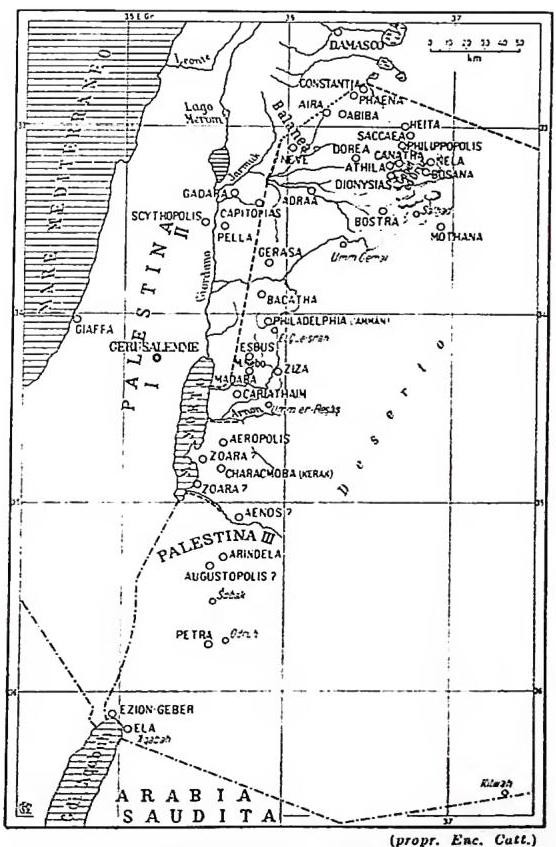
ARABIA - Roman province of A. after Diocletian, with the principal Christian centers.
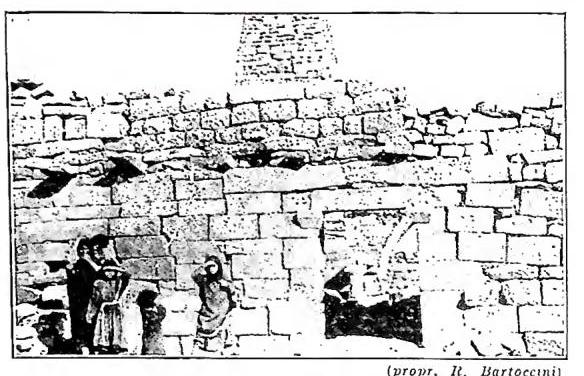
ARABIA - Christian basilica of Umm es-Surab (5th century).
The Midianites (v.) mentioned in the history of Moses (Ex. 2:15 ff., etc.) during the exodus from Egypt (Num. 25:14-18; 31:2), and finally in the account of Gideon’s victory (Iudc. 6-8), were Arabs of the north. Other biblical passages (cf. Gen. 37:25, 27 ff., 36), especially in the prophetic books, contain frequent allusions to the Arabs, mentioning their caravans, the products of their territory, and their customs. After the Babylonian exile, the Arabs were a serious obstacle to the restoration of Jerusalem (Neh. 2:19, etc.). Little by little they occupied the territories of the Edomites and others, forming a vast kingdom with its capital at Petra. kingdom (v.) played an important part in the political development of this region. These Arabs are said to have carried out the raid against Joram (II Par. 21:16); Uzziah defeated “the Arabs who dwelt in Gurbaal” (II Par. 26:7). In A.D. 105 Trajan reduced the kingdom to a Roman province.
2. Christianity in A. before Islām. - The origins of Christianity in A. are, unfortunately, extremely obscure. Since A. lay at the boundaries of the empire, it attracted little attention from historians. The few fragmentary traditions that have survived are not very accurate, as is shown by the fact that A., except for the small part included within the empire, was often confused in the minds of historians with India or Ethiopia. We can therefore derive very little certainty from them.
We shall leave aside the various legends concerning A., where St. Paul withdrew after his conversion (Gal. 1:17), since this refers to the region south of Damascus or, at most, to the Sinai peninsula; nor did Saul make any attempt there to evangelize the populations. The alleged sojourn of St. Bartholomew among the inhabitants of the Jemen is based chiefly on Eusebius’s assertion that the catechist Pantaenus, having gone as far as “India” to evangelize, found there a copy of the Gospel in Hebrew, brought there by the apostle.
The emperor Philip “the Arab” (244-45) may have been born to Christian parents. Around 244, Origen visited the “province of A.,” at the invitation of the governor of the district. He seems to have maintained prolonged contact with certain bishops of the various churches Bosra (v.). His help was requested to bring back to orthodoxy the bishop of Bosra, Beryllus, whom Eusebius called “bishop of the Arabs.” Many Christians of A. were martyred under Diocletian or condemned “ad metalla” in Sinai (303-305). Archaeological exploration, which has brought to light many remains of churches in the region of Jaurān, as well as hundreds of Greek and Latin inscriptions, confirms the tradition presenting Bosra as the center of a flourishing Christian community from the beginning of the 3rd century, and as the metropolis of some twenty bishoprics. Six or seven bishops of the province of A. were present at the Council of Nicaea (325). The Peregrinatio of Egeria (late 4th century) reveals the existence of monasteries erected on the sites of famous biblical episodes.
In the 5th century, the region of A., east of Syria, was usually assigned as a place of exile to heretics and ecclesiastics under suspicion. Nestorius too spent part of his exile at Petra.
These facts, with the exception of the tradition concerning St. Bartholomew, relate to the northwestern corner of the Arabian peninsula, and particularly to those Arabs who had adopted a sedentary way of life. In the 6th century this region became the center of the Christian dynasty of the Ghassanids. Placed directly under the influence of the Byzantine empire, it gradually experienced, through frequent contacts with the Christians of Syria, the penetration of the Christian faith among the pagan tribes.

Outside the Arabian peninsula, toward the east, we find another group of Christians whose center was at Hīrah, on the margins of Mesopotamia and under the sovereignty of the Persian empire. We do not know how Christianity penetrated among the Arabs of this region, who may have received it from a nucleus of converted Arameans. In 410 there was a bishop at Hīrah, Hōšā', and we know the names of seven of his successors (Nestorians), down to the year 600. Until the conversion of Abū Qābūs, shortly after 595, the region of Hīrah was governed by pagan princes dependent on the Sassanids. These governors did not hesitate to follow their sovereigns in persecuting Christians. Despite these and other difficulties, when Islām appeared after 632, the majority of the population was Christian, consisting largely of Nestorians with Jacobite representation. Christianity persisted in this region for a long time after the conquest of Islām; at the beginning of the 8th century we find mention of the Monophysite bishop George, who translated Aristotle’s Organon into Syriac.
To the south, the highlands of the Negd and the coastal region
ARABIA - Monolithic baptismal font in the vicinity of Kerak (6th century).
of the Ḥiǧāz remained virtually beyond Christian influence. Only toward the 6th century do we find traces of its presence in the Ḥiǧāz. At Mecca, for example, the Christian faith was introduced by slaves, mostly Abyssinian, and perhaps by soldiers of the same race. Numerous Christians were found among the Banū Tamīm, as well as among the Banū Kindah, Kalb, and Tajji'; but many of these tribes abandoned the ancient faith at the time of the Muslim conquest.
Because of their centers of dissemination, it was natural that these groups should belong either to the Nestorian or to the Jacobite sect. The effort of the Arian Teofilo was an isolated case; no similar initiative seems to have been undertaken by Catholics.
4. Arabic translations of the Bible
The close union existing between the Christian communities of A. and the centers of Christianity in Syria explains the absence of an Arabic version of the Bible during the first six centuries. During the period before the Islamic conquest, Syriac remained the official language of the Churches of A., which for the most part formed part of the ecclesiastical organization of Byzantium. Probably some religious writings were translated, but in general Christians depended on oral traditions passed down from one generation to another. L. Caetani states in this regard that Maometto cannot have derived his knowledge of the Scriptures from an Arabic text because “at that time there existed no Arabic versions of the Bible or the Gospel” (II, p. 704). It was only with the advent of Islām that Arabic acquired great importance and that Christians felt the need for a text in that language.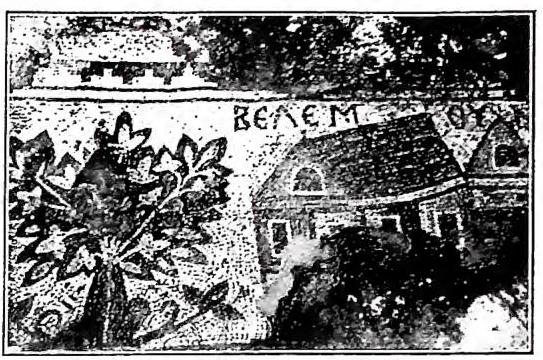
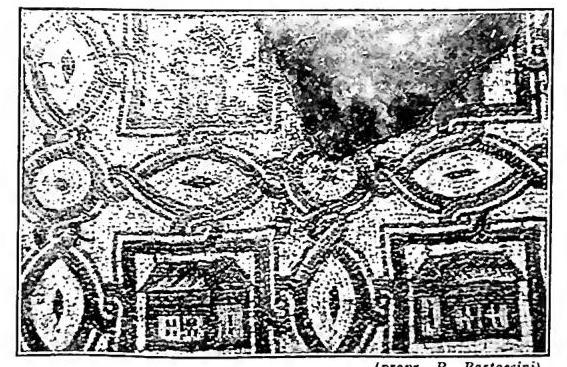
(courtesy of R. Bartocini) ARABIA - Pavement mosaic depicting the local church (6th cent.) - Mā'in.
Only in the 16th century did Christians begin to collect the partial versions of the Bible in order to produce a complete edition. The Jesuit Giovanni Eliano, papal legate to the Maronite nation, was charged by Pope Gregorio XIII (1572–85) with bringing to Rome a complete text of the Bible, so that it might be printed and arranged in conformity with the Latin Vulgate. The first printing of the whole Bible in Arabic took place in Paris in 1629–45.
In the mid-18th century a Coptic Catholic, Raffaele Tūki, translated the Bible on the basis of the Latin Vulgate. In the 19th century Protestant missionaries in Lebanon translated the entire Bible, basing themselves on the original Hebrew and Greek texts. In the middle of the 19th century two further versions appeared, one by the Dominicans of Mossul and the other under the direction of the Jesuits of Beirut.
2. L. Caetani, Annali dell'Islam, 10 vols., Milano 1904–1926 (important studies on the earliest sources of Arab history); L. Duchesne, Eglises séparées, 2nd ed., Parigi 1905, pp. 300–52; H. Lammens, Le berceau de l'Islam, Roma 1914; R. Aigrin, s. V. in DḤḤ, III, cols. 1158–1292 (with abundant bibliography); G. Graf, Geschichte der christlichen-arabischen Literatur, I (Studi e testi, 118), Città del Vaticano 1944.
3. I. Guidi, Le traduzioni degli Evangelii in arabo e in etiofico, in Atti d. R. Accad. d. Lincei, Roma 1888, I, p. 256 ff.; H. Hyvernat, s. V. in DB, I, cols. 845–56; P. Kahle, Die arabischen Bibelübersetzungen, Lipsia 1904; G. Graf, Die arabische Pentateuchübersetzung im cod. Monac. arab. 234, in Bibl. Zeits., 13 (1918–21), pp. 97–115, 193–212, 291–300; id., Arabische Übersetzungen der Apocalypse, in Biblica, 10 (1929), pp. 170–194; A. Vaccari, Le versioni arabe dei Profeti, in Biblica, 2 (1921), pp. 401–23, 3 (1922), pp. 401–23; id., Una Bibbia araba per il primo gesuita venuto al Libano, in Mélanges de l'Un. de St-Joseph (Beirut), 10 (1925), pp. 79–104; A. Nallino, Raccolta di scritti, III, Roma 1901, pp. 121–56; C. Peters, Probe eines bedeutsamen arabischen Evangelientextes, in Oriens Christianus, 38 (1936), pp. 188–211. Giacomo Finnegan
5. CHRISTIAN ARCHAEOLOGY
Arabia was the name given by the Romans to the province established in A.D. 106, by order of Traiano, comprising much of the territory south of Damasco as far as the Gulf of Ela ('Aqabah), bounded to the east by the Syrian desert and to the west by the Jordan valley; this territory is now for the most part included in the kingdom of Transgiordania. The milestones of the road then opened across the country, from north to south, bear the inscription redacta in formam Provinciae Arabiae, and a coin was minted to celebrate the event, with the personification of the Province, flanked on the left by a camel and bearing the legend Arabia adquisita. At the same time there came to an end the long line of kings of Nabatea, who, with Rome’s tolerance, had extended their dominion from their capital and original seat, Petra, over the northern part of the Arabian peninsula and then over the lands to the north as far as Damasco.Roman administration fostered the economic and architectural development of various cities besides Bostra, such as Canatha, present-day Qanawāt, Dionysias (Suweidā'), Salca (Salhad), Gerasa (v. present-day Geras), Philadelphia ('Ammān), and finally Petra itself, now uninhabited. Sabha, later called Philippopolis, owed its exceptional external splendour, certainly disproportionate to its real importance, to the fact that it was the birthplace of the emperor Filippo l'Arabo. But we have no certain information concerning Christian religious buildings prior to the 4th century; after that period, however, many arose everywhere, often richly decorated, especially with mosaics, even in places of secondary importance. In some cases they constitute the sole documentation of the existence and history of such localities, together with long and detailed dedicatory inscriptions, often an integral part of the floor mosaics themselves. The chronological references contained in them are always reckoned according to the era of Bostra, or of the eparchy (= province), which began in A.D. 106 precisely with its establishment. Churches were also built in certain fortresses of the Arabian limes; they have been identified at Odruh, east of Petra, at least three at Umm er-Rešā, at the latitude of Kerak, and one has been excavated on the acropolis of 'Ammān, fortified in the late Empire. Finally, mention should be made of certain Christian centres established about the middle of the 4th century on the very margins of the Syrian desert, rich in religious buildings that attest to a fervent spiritual life, in profound contrast with the silence that now hangs over their ruins. In one of them alone, Umm Gemal, in northern Transgiordania, no fewer than fifteen churches and a monastery have been identified. Necropolises, on the other hand, are rare, or at least hitherto unexplored, unless they too consist largely of uninscribed tombs. One of the few known, very extensive and with abundant inscriptions datable between the 5th and 7th centuries, was identified and studied by R. Canova in Transgiordania (v.). The language of the Christian communities was generally Greek; yet at el-Queisnah, a little south-east of 'Ammān, alongside an inscription in that language and in the same sacred building, there was another in Syriac. The Latin Christian inscription of a Bassus, civis Arabus, seems to come from one of the cemeteries of Trastevere in Roma (muso Cristiano Lateranense, wall XIII, no. 43). Among the rich harvest of mosaics discovered and studied in this country, a characteristic group depicts localities and churches of the region, seats of bishoprics of Palestina and A. not otherwise known; these thus supplement the incomplete episcopal lists of the written tradition relating to those ecclesiastical hierarchies, also providing us with the names of their incumbents and the period in which they carried out their mission, subject now to the patriarch of Antiochia, now to that of Gerusalemme (Notitia Antiochiae ac Yerosolymae Patriarchatum, ed. lat. of the second half of the 12th cent., edited by T. Tobler and A. Molinier, Itinera Hierosolymitana..., I, Ginevra 1880, p. 342 ff.; Mgr. Efrem Rahmani, I fasti della Chiesa patriarcale antiochena, Roma 1920, parts IV–V). Notable in this respect are Madaba (v.), attributed to the 6th century, though greatly deteriorated precisely in the part concerning A., and the border of the almost contemporary pavement of the church of Ma'in, unfortunately also partly lost. Nor were monastic centres lacking; of particular importance, because of the exceptional biblical event associated with it and the good state in which it has come down to us, is that of Monte Nebo.
We have reports in A. of martyrs prior to Eusebius (Hist. eccl., VIII, 12, 1), perhaps the very ones concerning whom the report has been transmitted that in Arabia civitate Filadelfia synodus martyrum celebratur (H. Delchaye, Les origines du culte des Martyrs, Brussels 1933, p. 215). Another great persecution is mentioned at the end of the 6th century (cf. Acta SS. Octobris, X, Paris 1869, pp. 662–762). About a century later the iconoclastic struggle raged throughout the country; evident traces of it remain in the mosaics of many churches, where all human or animal figures were systematically destroyed, though not always in such a way as to prevent some remnants from occasionally being recognized. The measure is attributed to ‘Omar II (Oct. 717–Feb. 720), but it does not appear that his successors pursued it, since the damage was soon repaired. Previously, and especially between the 6th and 7th centuries, perhaps in order to provide better for their own security, the Christian communities had begun to concentrate preferentially around Kerak and to the north of this locality. The Petrea had by then become a frontier region for common-law convicts and political exiles (among whom were those exiled for religious reasons). The mines of Phainō, on the slopes of the Gôr 16 km from Chobak, were sadly renowned for this reason; many Christians were sent there for forced labor, until their numbers became so considerable as to recommend the establishment on the site of a bishopric for their spiritual assistance. Petra, regarded as a place of exile, eventually came to be frequented also by anchorites, who left traces of their presence in crosses engraved inside and outside the rock-cut tombs; one of these, moreover, according to an inscription painted in red above one of the walls, was converted into a church and consecrated by Bishop Giasone in 447. The Arab invasion tolerated the free practice of Christianity in return for payment of a tax. Recently, a Christian monastic center has been identified in the Arabian Peninsula itself, where buildings of this kind had hitherto been unknown, at Kilwah; according to its discoverer (cf. N. Glueck, The other side of the Jordan, New Haven 1945, p. 44), it dates from around the year 1000. This would also represent a phenomenon of the persistence of isolated Christian groups in the Islamic world, such as had already been observed in the nearly contemporary cemeteries of Engila in Tripolitania and Kairouan in Tunisia. Archaeological investigation, however, has not uncovered documents useful for establishing the subsequent history of the Christians in the territory of the ancient province of A., by then included under the broader common designation of Syria. Even the chronicles of the Crusader period contain little information on this subject: only within the fortresses then built beyond the Jordan have churches also been identified.
6. THE APOSTOLIC VICARIATE OF A
Governed by the Tuscan Friars Minor Capuchin, the apostolic vicariate comprises, in addition to the desert and barren Arabian Peninsula, the English military station of Aden, with its waterless hinterland, and British Somaliland. The population is predominantly Arab; the remainder consists of Jews, Berbers, Indians, and Somalis—in all, approximately 7,500,000 souls. The predominant religion is Islam (Arabs, Somalis, and Berbers); the rest are pagans(Indians). It is therefore a field far from easy for the apostolate.
Originally the mission was limited to the fortress of Aden and was incorporated into the apostolic vicariate of Egypt and A., entrusted to the Servants of Mary (1841–49). Subsequently (1851–54), it formed part of the vicariate of the Galla, erected in 1846 and entrusted to Massaia; in 1854 the mission, made autonomous with the rank of apostolic prefecture at the designation of Massaia himself, had as prefect the Genoese priest Luigi Sturla, a refugee from the anticlerical revolution of ’47. He governed it for ten years, that is, until he returned to his homeland, at which point the mission, while remaining a prefecture, was annexed to the vicariate of Bombay. Having regained its autonomy two years later, it retained it for about fifteen years, until in 1875 it was again attached to the vicariate of the Galla, evangelized by the French Capuchins who had succeeded the Italians. Finally, in 1888, it was erected as a separate mission under the name of Aden and entrusted to the Ligurian Capuchins. Since, however, it was a mission in a territory too limited in extent, the following year the entire Arabian Peninsula was added to it, together with the islands of Perim and Socotra, and its name was changed to that of A. But since, in reality, apostolic activity throughout this territory sacred to Mohammed was prohibited, Somaliland, or British Somalia, was also annexed to the vicariate in 1891. The Italian Capuchins succeeded those of the Lyon province in 1910, and did so more completely in 1915 under Msgr. Vanni.
The mission is necessarily condemned to near sterility: the station of Hodeidah, on the Arabian coast, and those of Berbera and Shinbaralek, on the Somali coast, had to be closed—the latter in 1910 by order of the English authorities—so that in practice the Fathers occupy only Aden itself, namely, the new city (Stemar Point) and the old Aden Camp. On the coast of Somalia, where the Somalis today would not appear to be as hostile as formerly, the missionary travels only from time to time to minister to the few Catholics scattered here and there. In Aden the mission’s two schools, one for boys and one for girls, reasonably well attended, are open to children of every race and creed. The five Capuchin Fathers are assisted by a few Marist Brothers and by ten Franciscan tertiary sisters from Calais, one of them a native, who care for the girls’ orphanage. There are 1,479 Catholics, of whom 204 are Europeans.