
DAMASCUS. — The principal city of Syria, since 1946 the capital of the independent Syrian Republic. It currently has 346,000 inhabitants.
I. HISTORY
The name is Ti-mas-qu or Di-mas-qu in the temple of Karnak, Dimalq in an inscription of Salmanassar II (A. Amiaud and V. MERSCH, EMILE, Les inscriptions de Salmanassar II, Paris 1890, p. 6), Di-ma-af-qa or Di-maf-qa in the letters of d’Amarnah; in biblical Hebrew it is Dammééq, but the Aramaic form is Darmééq in I Por. 18:5 and II Par. 16:2; 24:23; 28:5, 23; the Talmudic form is Darmééq, Darmééq; the Greek Δαμασκός. In Arabic it is Dimaq or af-Sam. According to the tradition recorded by Flavio Giuseppe, D. was founded by Us (Gen. 10:23), son of(from C. Watzinger and K. Watzinger, Damasco, Berlin-Lippe 1931)
DAMASCO — Plan of the ancient city and its buildings.
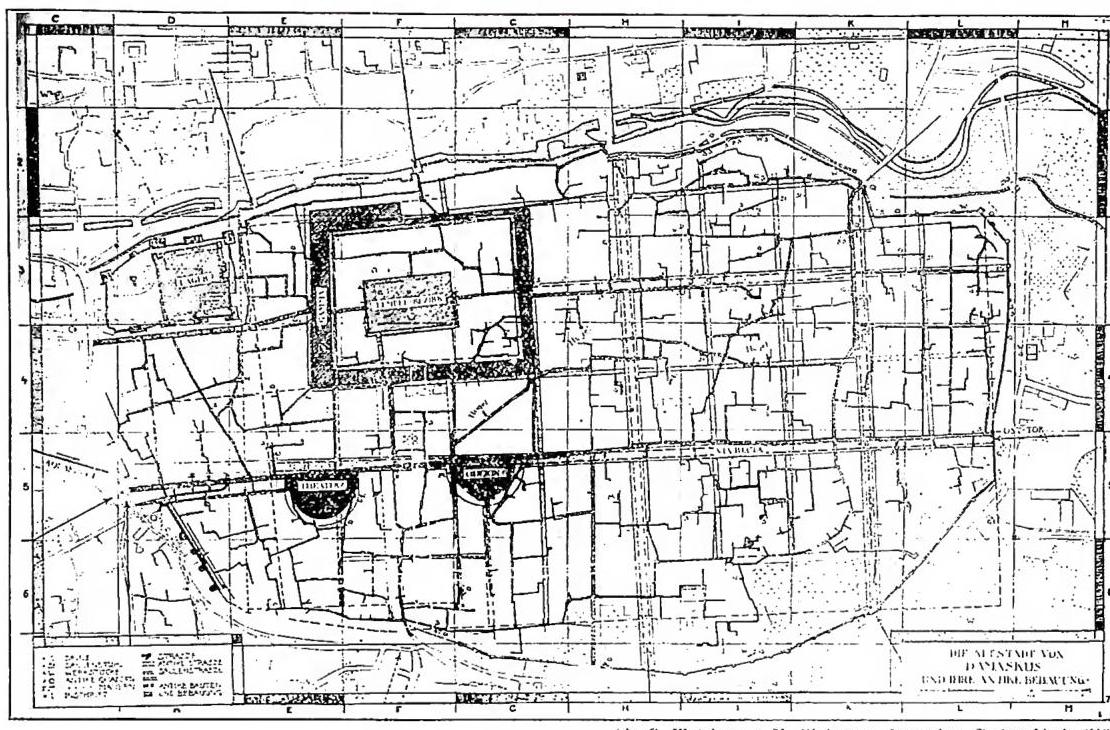
According to letters 197 and 53 of el-ʿAmārnah, in the violent struggle between Egypt and the Hittites to exercise influence over the intervening countries, Ettaqma, prince of Qadeš on the Orontes and a Hittite leader, attacked the region of D. Egypt, however, reestablished its influence. The power of the Hittites nevertheless increased until Ramses II won the battle of Qadeš (1294). D. is included in a list of Ramses III (1200–1163) among the cities he subjugated. But Egypt’s weakening became more pronounced, as, on the other hand, also occurred with the Hittites. Consequently, D. was able to enjoy a certain independence. Aram (v.) of D.; under the reign of Solomon, however, D. became independent again through the action of Razon (II Sam. 8, 5–9; I Reg. 11, 23–26). Asa, king of Judah, requested and obtained an alliance against Bassa (v.), king of Israel, with Benadad, son of Tabremon, son of Hezion (in the Septuagint: Εὐρῶμ), who then incorporated the northern provinces of Israel into his Damascene kingdom (I Reg. 15, 18–20), and maintained a quarter in Samaria (I Reg. 20, 34). Benadad II (Adad-idri in the cuneiform texts), defeated by Ahab, king of Israel, returned the provinces that his father had taken from Bassa and granted D. a quarter or trading post (I Reg. 20).
Shalmaneser II (860–825) resumed the campaign against D. that his father Aššur-nāšir-apli had begun and found several forces united against him, among them Adad-idri, or Benadad, king of D., and Ahab, king of Israel. These forces are listed on the monolith of Shalmaneser II; from it (lines 96 ff.) it appears that victory went to the Assyrians. Once the coalition had been dissolved, Ahab, together with Jehoshaphat, king of Judah, attacked the king of D., Benadad, at Ramoth-gilead, but was defeated (I Reg. 22). Benadad, however, was defeated in the campaign that Shalmaneser II conducted against Syria in 849, whose events are recounted on the obelisk of Nimrūd. In the campaign of 846, too, Shalmaneser II inflicted a disastrous defeat on the king of D. and his allies.
During the reign of Joram (853–842), Benadad II waged war against Israel but, through a miracle performed by Elisha, was forced to retreat. Later he besieged Samaria, but on this occasion too a miraculous intervention put him to flight (II Reg. 6 and 7). The change of dynasty at D. effected by Hazael (II Reg. 8, 7–15) is attested by inscriptions of Shalmaneser II and by an inscription carved on a sheet of ivory. Joram of Israel and Ahaziah of Judah waged war against Hazael but were defeated (II Reg. 8, 28, 29). In 842 and 839 Hazael withstood the assault of two Assyrian expeditions, which spread terror and devastation.
Under Jehu of Israel, Hazael attacked the kingdom of Israel along all its frontiers (II Reg. 10, 32 ff.) and attacked the kingdom of Judah under Joash, who, in order to placate him, sent him all the treasures accumulated by himself and his ancestors in the Temple and the royal palace (II Reg. 12, 17 ff.). Once the Assyrian campaigns against Syria had ceased, Zakir, who had organized the kingdom of Ḥamāh, was attacked by Benadad III, son of Hazael, and his allies, who were defeated. Joash, son of Jehoahaz of Israel, then recovered from D. the cities that Hazael had taken from his father (II Reg. 13, 25). Toward the end of the ninth century B.C., the Assyrian Adad-nirāri III defeated Mari, king of D., and made him a vassal.
Later, Jeroboam II of Israel (785–745) took further territories from D. (II Reg. 14, 24–28). Rasin (Heb. Rēšīn), king of D., allied himself with Pekah (Peqah), king of Israel, around 734 ACAZ (v.) of Judah, who requested assistance from Tiglath-pileser III. The latter devastated D. and deported its citizens (II Reg. 16, 5–9).
Under the Persians, D. was one of the most illustrious cities of Syria, as Strabo attests (XVI); before the battle of Issus (333 B.C.), Darius sent his family and treasure to D. for safekeeping. After Syria was occupied by the Macedonians, D. was governed by Parmenion, after which it belonged to the Seleucids, who took Antioch as their capital. Antiochus XII Dionysus, brother of Demetrius Eucarus, was defeated by Aretas III, king of the Arabs, who in 85 B.C. became king of D. and of all Coelesyria (Fl. Josephus, Antiq. Iud., XIII, 15, 1–2;
Bell. Iud., I, 4, 7–8). For the Romans, D. was conquered by Metellus (Antiq. Iud., XIV, 2, 3; Bell. Iud., I, 6, 2); in 64 B.C. Pompey received there the sumptuous gifts of the Egyptians, Jews, and Syrians (Antiq. Iud., XIV, 3, 1), and in 63 B.C. Syria was made a Roman province.
The Persians of Khosrow II occupied D. in A.D. 614 and afflicted it with plunder and deportations. Heraclius, however, took it from them during the campaign of 622–629. In 635 D. fell for the first time into Arab hands, and then definitively in 638. Unable to replace the Byzantine officials, the Muslim conquerors left them in their positions, and Manṣūr b. Sarǧān, grandfather of St. John Damascene, continued to administer the finances. Muʿāwiyah I was governor of D. from 638 to 660, when he was elected caliph and transferred the caliphate’s capital to D. Under al-Walīd I (705–715), Christians began to be removed from public administration, and under Marwān II D. ceased to be the capital.
From the philosophical-theological school of D. came St. Sophronius, St. Andrew of Crete, and, under the Arabs, St. John Damascene and his great disciple James of Edessa.
This school influenced Muslim culture, and many Syrian Christians were at the court of the Umayyads. At the court of the ʿAbbāsids, who had almost exterminated the Umayyads and even scattered the bones of all their dead, the Syrians were replaced by the Persians. The revolt of an Umayyad (809–813), who occupied D. and much of Syria, was unsuccessful. Aḥmad b. Ṭūlūn occupied Syria in 868 and died in 884. His dynasty became extinct in 905. After it, the dynasty of the Iḥāḍids established itself in D. (935–969). They were succeeded by the Fāṭimids of Egypt, who remained in D. until 1075, when the Turkish emir Atsīc conquered it for the Selǧūqids. The Crusaders besieged D. in 1148 for five days, but without success. In 1154 Nūr ad-dīn established himself in D. without encountering resistance. He founded schools and mosques there and made it a stronghold against the Crusaders. After his death (1174), Saladin (Ṣalāḥ ad-dīn), founder of the Ayyubid dynasty, who governed Egypt, also occupied D. The Christian Mongol Kitboghā then took D. for a short time; in 1260 it was taken from him by Baybars, who initiated the Mamluk succession. To prevent the return of the Crusaders, the Mamluks devastated the coastal cities. The Mamluks divided the country into twelve kingdoms or nijābāb (vicarates), of which D. was the center. The Mongol Tamerlane (1400–1401) occupied D.; after plundering it and deporting most of the population, especially the artisans, to Samarkand, he set it on fire and abandoned II.
Amid so many upheavals, intellectual activity did not cease in D. Abū’l-Fidāʾ (d. 1331), Sama ad-dīn ad-Dimašqī (1327), Ṣafadī (1296), Ṣāliḥ b. Jahjā (1436), and others flourished there.
The Ottomans occupied D. in 1516. The territories of Syria were then divided into pāšāliks or vilāyets, subdivided into sanjaks. From 1832 to 1840 D. was under Egyptian rule. After the massacre of Christians in 1860 and the ensuing European intervention, Syria was divided in 1864 into two vilāyets, subdivided into mutasarrifāts or prefectures, and these into qāʾimmaqāmāts or subprefectures. After the First World War, D. was under a French mandate.
II. ARCHEOLOGIA
Le memorie e i monumenti
cristiani di D., per quanto concerne l'epoca degli Apostoli, sono in relazione con le vicende della conversione di s. Paolo e della sua fuga dalla città (Act. 9, 3-25). È ancor oggi visibile nel suo tracciato la «Via diritta» (ῥύμη εὐθεῖα, vicus rectus, in arabo Darḥ al-mustaqīm), che attraversava da oriente ad occidente la città, in conformità al piano regolatore romano di divisione a scacchiera. Rimangono avanzi notevoli del doppio
(per cortesia del prof. E. Javi)
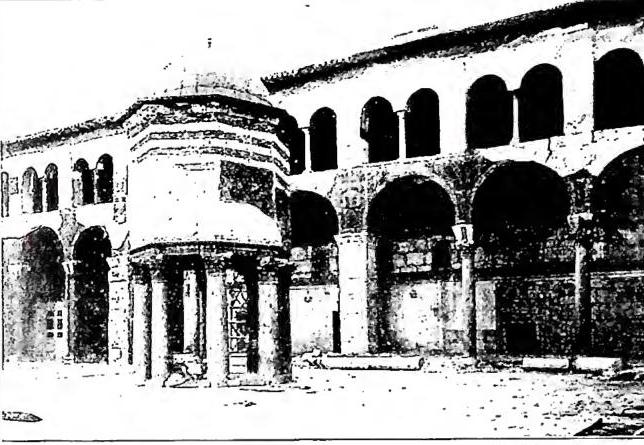
Clear archaeological evidence, including epigraphic evidence, exists instead for the church of S. John the Baptist, situated in the northern part of the city and preserving the relic of the Saint’s head; in Roman times the building had been the sanctuary of Jupiter Damascenus, with a distinctly Oriental ground plan consisting of two rectangular enclosures, the larger delimiting a vast square and the smaller containing the sacrificial altar and the cella; it was transformed into a church under Theodosius I (379–95); according to an inscription now lost and considered false by H. Dussaud, it was restored by Arcadius (395–408). At the end of the 4th century, the temple was first transformed into a three-naved basilical church, built along the length of the southern wall of the smaller enclosure, whose three-part doorway became one of the entrances. A definitive arrangement was then made in the 5th century, with a transept dividing the interior into two parts and resulting in the closure of two sections of the southern doorway. This doorway was dedicated to the Most Holy Trinity, as is shown by the two surviving Greek inscriptions carved on the first and second sections, taken from the Psalms and exalting the Father and the Son. Of interest is the fragment of a granite column, found approximately 380 m from the eastern doorway
(phot. Pont, Christian archaeological commission)
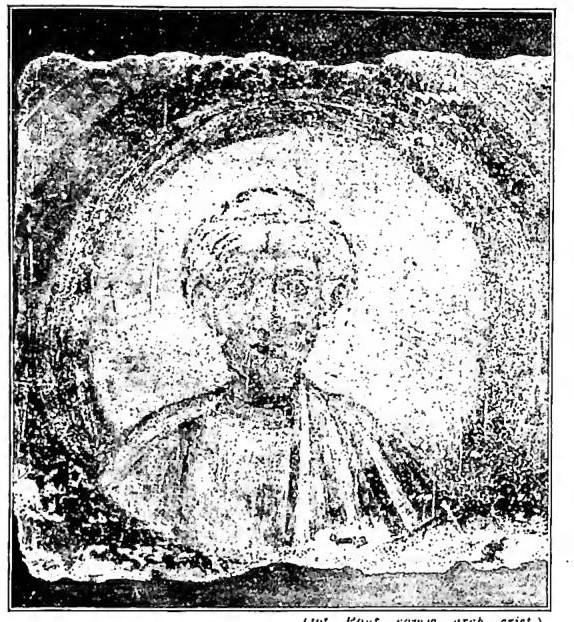
DAMASO I, PAPA — Portrait of Pope Damaso. Medallion from the series of the popes (9th century) in the basilica of S. Paolo — Rome.
of the mosque, with a Greek inscription establishing the limits of the right of asylum, formerly the privilege of the ancient pagan temples. The dedication of the Basilica to the Baptist probably dates to the 5th century, but Dussaud considers it late and only slightly earlier than the Muslim conquest. In 705 the basilica was transformed into a mosque by the caliph al-Walid I. The wall mosaics, certainly the work of Byzantine artists of the period, are noteworthy.
Luigi Maria Catteruccia
III. THE MARTYRS OF D
A group of eight Franciscans and three secular Maronites, killed for the faith at D. on the night between 9 and 10 July 1860. When the Muslim Druze, having risen up against the Christians, passed through the city, carrying out ruthless massacres, they shut themselves inside their convent, barring the doors and trusting in the strength of the walls. But a traitor let the persecutors in through a small door, which no one had thought of. Faced with the choice of adhering to Muhammad or losing their lives, they all chose death.Their names are: Emanuele Ruiz, superior; the fathers: Carmelo Volta, Engelberto Kolland, Nicanore Ascanio, Pietro Soler, Nicola Alberca; the lay brothers: Francesco Pinazo, Giangiacomo Fernandez; and the three secular Maronites, who remained with them and were brothers: Francesco, Abd-el-mooti, Raffaele Massabki. They were beatified by Pius XI on 10 October 1926. Feast day: 10 July.
In the 16th century, the dissident patriarchs of Antioch came to live in D., which had become the political center of Syria after the Turkish conquest. The Catholic Melkite patriarchs have resided in D. since 1834, although they have often also lived in Egypt. In D. there are 8,000 faithful, 13 parishes, 15 schools and institutes, and various religious works.
VI. D. OF THE SYRIANS. – There has been a Syriac Catholic bishop in D. since 1633. Today the faithful number 2,000, distributed among 5 parishes and educated in 4 schools.