
PALMIRA. – An oasis and ancient city in the Syrian desert, an important center on the commercial route that led from the East, through the Persian Gulf and the Euphrates, to Syria and thence to the Mediterranean. It was to this position that P. owed the great prosperity it enjoyed during the first three centuries of the Christian era, for the most part within Rome’s sphere of influence.
The origin of the name is uncertain. The Semitic forms Ta-ad-mar (Assyrian), Tadhmār (Hebrew: II Par. 8, 4), and Tadmur (Arabic) correspond to the Greek Παλμύρα and Latin Palmyra. Two explanations are offered for this fact: a) the Greco-Latin form derives from the Semitic through its assimilation by assonance to tāmār (Hebrew: “palm”); b) the Greco-Latin form derives directly from the Semitic, with alteration of certain consonants (t > p; d > l). The first explanation is supported by the biblical case of I Reg. 9, 18, in which hēthlōh Tāmār corresponds to qērē Tadhmār, but is hampered by the fact that there are no palm trees at P.; the objection is nevertheless answered by observing that the linguistic development may have occurred far from the city. The difficulty with the second explanation consists in the considerable alteration of the term.
The oldest mention of P. known to date is found in an inscription of Theglathphalasar I (late twelfth–early eleventh century B.C.), in which mention is made of “Ta-ad-mar which is in the land of Amurru” (cf. E. Dhorme, Palmyre dans les textes assyriens, in Revue biblique, 33 [1924], pp. 106–108).
(from J.-B. Chabot, L'hôte d'inscriptions de Palmyre, Paris 1911, fasc. I, fig. 1)
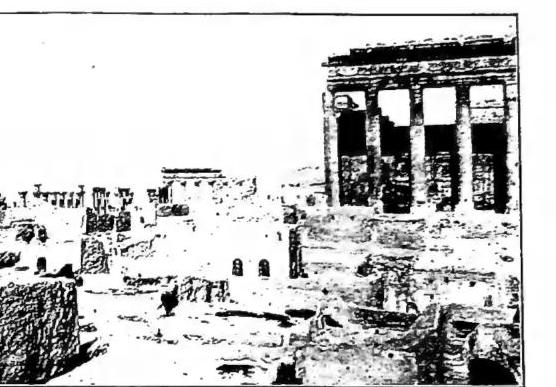
PALMIRA. — Temple of Bel. The esplanade is occupied by the Arab village. On the right, the Sanctuary.
One must wait until 41 B.C. for another mention of P., this time from a classical source: Appian (Bell. civ., V, 9) relates that Antonius plundered the city, giving as his reason its ambiguous attitude between the Romans and the Parthians.
Around the same period there are the two oldest inscriptions in the Palmyrene language, recently discovered (cf. J. Starcky, Les inscriptions palmyréniennes les plus anciennes, in Actes du XXI Congrès intern. des orient., Paris 1949, pp. 111–14): one of them is dated to 44 B.C. Toward the beginning of the first century A.D., the Palmyrene inscriptions, many of them bilingual (with Greek), increase in number; they continue until 274 (the latest so far discovered bears precisely this date: cf. J. Cantineau, Tadmorea, in Syria, 19 [1938], p. 163), numbering many hundreds (the most recent, discovered in H. Seyrig’s excavations in the years 1939–40, were published by J. Starcky, Incentaire... [V. BIBLICA.]). The script in which the inscriptions are written is of the Aramaic type; the language is likewise Aramaic (v. LINGUA), and may be defined as a continuation of ancient Imperial Aramaic (Reichsaramäisch), into which elements of Eastern Aramaic subsequently infiltrated (cf. J. Cantineau, Grammaire du palmyrénien épigraphique, Cairo 1935; F. Rosenthal, Die Sprache der palmyrenischen Inschriften und ihre Stellung innerhalb des Aramäischen, Leipzig 1936). Alongside the direct sources, the reconstruction of P.’s history from this period onward is supplemented by the increasing information provided by classical authors, culminating, for the war between Zenobia and Aurelian, in the Greek Zosimus and the Latin Vita Aureliani.
The city’s persistence in an intermediate position between Rome and the Parthians is attested during the first century A.D. by a passage of Pliny the Elder (Hist. nat., V, 88). At the same time, the inscriptions reveal an internal organization on tribal bases; the names of the tribes, like those of the persons, are predominantly Arab: this points to an Arab substratum, or at any rate an Arab element, in the population, upon which the Aramaic element, documented by the language, was grafted.
Probably (cf. J.-G. Février [V. BIBLICA.], pp. 19–24), annexation to Rome took place around 114, on the occasion of Trajan’s expedition against the Parthians. This brought about a change in the internal constitution, which became similar to that of the Greek cities of the Empire. Power was divided between the senate (βουλή) and the people (δῆμος): membership in the latter probably depended on a census criterion, which replaced the tribal principle. The senate was presided over by a πρόεδρος; executive power belonged to two ἄρχοντες, who in the third century changed their title to στρατηγός; financial administration was exercised by the δεκάπροται, together with the ἄρχοντες and the αὐδίκαι. At the beginning of the third century, a passage of Ulpian (D. 50, 15, 1) shows that P. was a colony iuris Italici: but it is difficult to say for how long.
The emperor Hadrian, who visited P. in 129, was pro-
Within the Roman orbit, the commerce of P. flourished increasingly; the end of the Nabataean Kingdom (A.D. 106) had, moreover, removed every competitor. The long peace that prevailed in the 2nd century A.D. between Rome and the Parthians favoured this development; as for the few military expeditions of the period, P. contributed its troops, particularly its archers, of whom inscriptions discovered in various parts of the Empire provide evidence.
The advent of the Sāsānids in Persia (A.D. 226) and their occupation of the mouths of the Tigris and Euphrates dealt a severe blow to the commerce of P.: the caravan transit route shifted northward, running up through Nisibis and Edessa toward Antioch. P. nevertheless reacted in alliance with Rome: it participated in the expedition of Alexander Severus (230), who established his headquarters there; it intervened subsequently after Valerian’s defeat at the hands of Sapor I (260) and decisively defeated the Persians. The author of this victory was Odenathus (Udajnat), who soon extended his authority over Palestine, Syria, Arabia, Mesopotamia and perhaps Armenia, assuming the title of king. When he fell victim to a palace conspiracy (267), together with his firstborn son Herodes (his identification with the Worād of the inscriptions is disputed), he was succeeded by his second son Vaballathus (Waballāt), under the tutelage of his mother Bat Zabbāj, called Zenobia in Greek. The power of P. continued to grow: in 270 the general Zabda occupied Egypt; he himself probably subsequently invaded Asia Minor, conquering Ancyra in Galatia and laying siege to Chalcedon.
Rome could not view this growing expansion without concern. Aurelian, who ascended the throne in 270, first concluded an agreement with P. in that same year; but when, in the following year, Vaballathus assumed the title of Caesar Augustus and minted coins solely in his own name, thereby formally repudiating the authority of Rome, Aurelian went to war against him and, advancing through Asia Minor, won decisive victories at Antioch and Emesa, conquered P. and captured Zenobia (272). A subsequent revolt was suppressed and led to the sack of the city.
Thus ended the independent history of P.: defeated militarily, and above all deprived of its function as a commercial base, it declined into a village, first under the Romans and then, from 634 onward, under the Arabs.
Corpus inscriptionum Semiticarum, II, III, Paris 1926; see also: J. Cantineau, Inventaire des inscriptions de Palmyre, I-IX, Beirut 1930-33; vol. X is by J. Starcky, Damascus 1949; R. Du Mesnil du Buisson, Inventaire des inscriptions palmyréniennes de Douro Europe, 2nd ed., Paris 1939. Further bibliography and information on the most recent discoveries can be found in S. Moscati, Bibliographie sémitique, which appears periodically in Orientalia. Sabatino Moscati
PALMYRENE DEITIES. - In the pantheon of Palmyra, which is rather composite and includes divine figures of diverse origins—thus eminently syncretic—two major groups of deities can be distinguished, distinct from the remaining gods: deities of Arab origin and those forming a group around the figure of the city’s principal god, Bēl. These latter are either of Canaanite origin or derive from Babylonia. The other gods are primarily Syrian.
Among the deities of the first group, the goddess Allāt enjoyed great veneration. A divine figure of the sky, beneficent, and one of the good deities, she was identified with the Greek Athena, depicted holding a scepter, with a nimbus and an eight-pointed star. She was also identified with the planet Venus. The god Azizu, "the strong," precedes the chariot of the Sun; a warrior and bellicose god, yet also beneficent, he often forms a pair with Monimos, who instead follows the Sun. Azizu is the morning star; he was assimilated to Ares. Together with Arṣu, the evening star, he is called a remunerative, merciful, and beneficent god; he is conceived as a boy, a puer. It has been suggested that the name Arṣu was merely a translation of Monimos, meaning "benefactor." Arṣu would thus be identical to Monimos. Of the god Ṣa' al-Qawm, "the protector of the people," it is said that he is good and does not drink wine, but his cult does not seem to have taken deep root in Palmyra. Of Arab origin is perhaps also the god Gad, Fortune, called in Greek Tyche and associated with a blessed spring, conceived moreover as the protective genius of the individual. The Tyche of Palmyra was later assimilated to Atargatis. The god Bēl, the Bēlos of the Greeks, is the central divine figure of the most important group, the θεοί πατρόοι, the most powerful god of the city, the Lord par excellence. This god should be distinguished from Bōl, though the two were later confused. Bēl is a solar god and was assimilated to Zeus. Sometimes he is depicted between Jarhibōl and 'Aglibōl, his paredroi. The wife of Bēl was Bēltis, and his messenger was Malakbēl. Jarhibōl was also a solar god, to whom the spring Efka was consecrated, and he is sometimes named together with 'Aglibōl, "bull or calf or chariot of Bōl," also of solar character. Šamaš was the sun god, propitious and one of the national deities. Atargatis was the paredra of Malakbēl; a female deity was Semia. Also venerated were Nabû, Nanai, and Tammūz of Babylonian origin. Bēlsamin was the god of the sky. A beneficent god was Sadrafa, Σατράπης.
The Palmyrenes often did not assign a particular name to their gods but preferred certain epithets that could be applied to various deities. Thus, inscriptions mention a good, merciful, remunerative god, "lord of the god," or "blessed be his name forever," without knowing precisely which deity is meant.