
ATENA ('Αθήνη). — Goddess of Greece. The name, probably pre-Hellenic, should perhaps be related to that of the Greek city that venerated her most, Athens: according to some, the goddess took her name from the city; according to others, the name of the city was formed from that of the goddess. The original nature of A. is uncertain: either a divinity of celestial phenomena or a lunar goddess. She would belong to the common heritage of the Greek tribes, and her cult would everywhere be equally ancient. For others, she is a meteorological divinity with features borrowed from the goddess Istar of Asia Minor, or an imported Oriental divinity. More recently, she has been interpreted as the Minoan household goddess, who later became the protectress of princely palaces and was armed by the necessities of the Mycenaean age. She is said to be depicted on a slab from Mi-
cenae, where, between two worshippers, there is a shield with female arms, legs, and head. According to others, she arose from the fusion of a virgin warrior goddess existing among the Greeks — Παλλάς, Pallas, “the virgin” — with the Cretan goddess of the palaces, from whom she would have taken her name. None of these hypotheses is satisfactory. What is certain is that the primitive nature and origin of A. elude us. The Minoan origin is not certain, because the goddess of the princely palaces is only a hypothesis and the cult of A. in Greece is not widespread and is late. In Homer, A. already has the characteristics of later ages: springing forth from the head of Zeus, she interprets the wishes of her father, who has granted her one of his attributes, the aegis; she is the protectress of heroes, mistress of every art, goddess of war and battles, and she who teaches the finest arts for attaining victory. She is the poliade goddess, protectress of the city and pledge of its fortune: it is strange, however, to find her as protectress of Ilion and not of the Greek cities.
Subsequently, the warlike nature of A. remained only in certain epithets (A. Prômachos). Instead, she became the goddess of the city in its broadest expression: the temple was often on the acropolis, and she was frequently called by the place where she was venerated: A. Alalcomena at Alalcomena in Boeotia, A. Itona at Itonia in Thessaly, A. Alea at Alea and in other places in Arcadia,
etc., but many times she is simply A. Poliade (Athens, Pergamum, Troezen, Sparta, etc.). This protection is embodied in the Palladium, pledge of the city’s existence. Anphes, Argos, Alalcomena, and other cities claimed to possess the original Palladium brought from Troy. She is the goddess of the arts and crafts, especially of women’s work; she protects potters and metallurgy, and is said to have taught Attica the cultivation of the olive. She watches over public health, good government, and the laws.
A. had a cult widespread throughout Greece, but its principal centre was Athens. The oldest seat of the cult was the Erechtheion, at the northern edge of the acropolis, where she was honoured together with Posidon and Erechtheus. There were the tokens of the disputes with Posidon over possession of Attica: namely, the salt spring that gushed from the rock at the god’s blow with his trident, and the olive tree, A.’s gift. In 447 the Parthenon was begun, adorned by the genius of Phidias. Festivals were numerous; the principal ones were the Panathenaea, with a procession from the Ceramicus to the Acropolis for the offering of the peplos to the goddess. Pergamum was Athens’ rival in the cult of A.: from the third century B.C. onward, A. was there the city’s sole and powerful protectress, celebrated in the Panathenaea and the Nikephoria. At Corinth, A. had festivals and torch races, perhaps of a lustral character; at Tegea, A. Alea was venerated together with Asclepius and Hygieia; the priestess was a young girl, but the inscriptions also mention a priest, and the temple had the right of asylum. Also at Tegea, in the temple of A. Poliatis, were the Gorgon’s hairs, which gave the city the assurance that it would not be conquered. At Argos, the principal seat of the Peloponnesian cult, there was a votive offering in the sanctuary on the acropolis: an ancient statue of Zeus with three eyes, which had already belonged to Priam. The goddess’s principal festival consisted of a bath prepared by young girls with water from the Inachus, a bath which men were not permitted to witness. In Elis, A. is called Μέγερ, “mother”: the women who prayed to her soon bore children; on this are based the views of those who see in A. a mother goddess. The cults of Boeotia and Thessaly appear to be ancient; in that of A. Lindia at Rhodes, fire was not used in the sacrifice.
Numerous are the myths connected with A.; the best known are her birth and her struggle with Posidon for Attica. In art, she appears in the Gigantomachy and in the exploits of the heroes Theseus, Heracles, and Odysseus. This protection has wrongly been regarded as a survival of an ancient matriarchate. In Etruria and at Rome, A. was identified with Minerva.
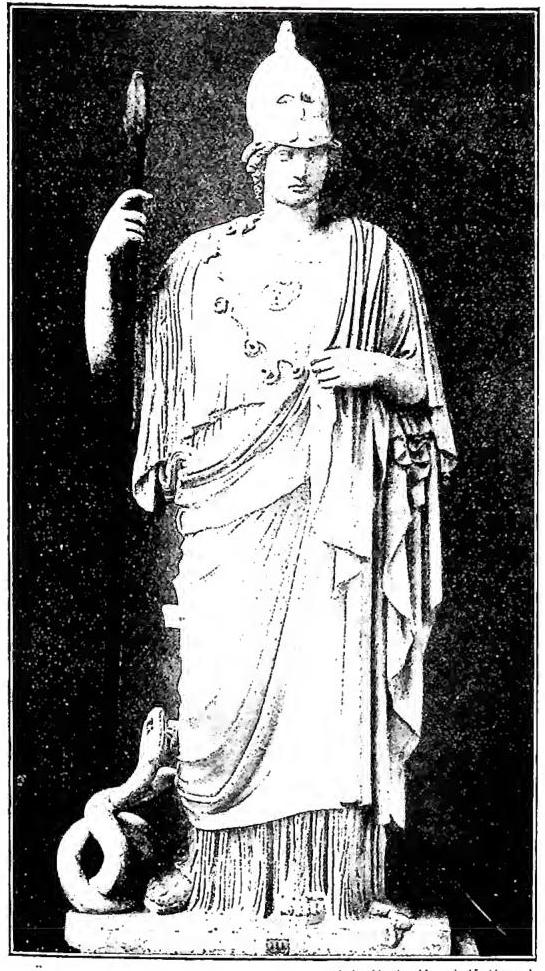
In Greek art, the archaic statues of A. can be traced back to two types: the palladia, that is, A. standing threateningly, with shield on her arm and spear, in the act of attacking; and A. seated with pólos and aegis. The latter type seems to be older than the former. Subsequently, the seated A. disappears: A. is represented standing, armed, always tranquil and dignified.