
CORINTH (Κόρινθος, Corinthus). - A city of the Peloponnese, capital of the Roman province of Achaia, famous not only for its wealth, splendor, and corruption but also for the apostolate carried out there by St. Paul and for the letters he addressed to the local Christian community.
Thanks to excavations conducted from 1895 onward, first by the Greeks and then by American archaeologists, our knowledge of pre-Hellenic Corinth, and especially of its Hellenic and Roman periods, has been greatly enriched.
Ancient Corinth stood about 7 km southwest of the present-day Neo-Kórinthus, to the north of the Acrocorinth. Excavations have revealed little of this citadel, which was similar to the Acropolis of Athens, but much of the rest of the city. The Roman city was almost entirely built over the Greek one, so that it is like a continuation of II.
Already civilly advanced in the 9th century B.C. with the rise of Macedonian influence, Corinth became the seat of the "League of Corinth." After the prosperous period of the "Achaean League" (Corinth joined it in 243 B.C.), and after the other allies had fallen, Corinth too came under Roman domination. At first the Romans limited themselves to occupying the Acrocorinth (196 B.C.); then, following an attempted rebellion, the city was besieged by the consul L. Mummius, who reduced to a heap of ruins the last symbol of Greek freedom (146 B.C.).
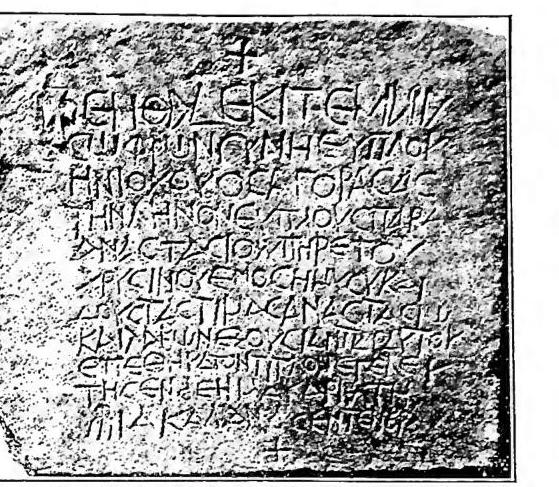
CORINTO - A Christian funerary inscription (6th century), discovered during excavations in 1931.
It was less than a century later that Paul began his apostolic work there, and by then Corinth had become a city of intense commerce. Its two ports, one on the Saronic or Aegina Gulf (the port of Cenchreae), the other on the Gulf of Patras or Corinthian Gulf (the port of Lechaeum) — hence the city’s epithet διθάλασσος or ἀμυθάλασσος (himaris: Horace, Odes, 1, 7, 2) — spared ships the long and perilous voyage around the Peloponnese, either by unloading cargo at one port and reloading at the other, or by dragging smaller vessels over the so-called δίωλος (Strabo, VII, 2, 1).
Corinth, a city of lavish pleasures (hence the proverb “not everyone can go to Corinth”: cf. Horace, Epistles, 1, 17, 36), attracted the wealthiest Romans and citizens of the Empire, especially during the biennial Isthmian Games (alluded to in 1 Cor 9, 24–27?). As in the past, and even more so, Aphrodite, served by more than a thousand prostitutes in her temple on the Acrocorinth (Strabo, VIII, 6, 20), was the reigning deity of this city, which had become not only a strange blend of races and civilizations but also an immense den of corruption. The phrase “Corinthian girl” carried an infamous connotation (Plato, Republic, III, 404), and the verb κορυνθάζομαι, “to live like a Corinthian,” was coined (Aristophanes, Fragments, 133).
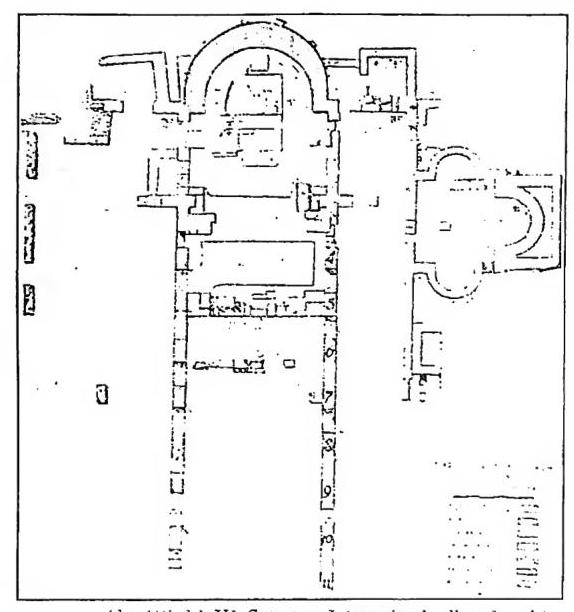
(from Acts of the 3rd International Congress of Christian Archaeology, Vatican City 1933, p. 39)
CORINTO - Pianta della basilica cristiana (fine sec. IV, inizio sec. V).
Dopo quasi due anni di lavoro, veglie e preoccupazioni d'ogni sorta (anche da parte di altre comunità fondate in antecedenza), Paolo giudicò la Chiesa di C. sufficientemente formata, sì da potersene allontanare temporaneamente. C'erano, però, gravi residui degli antichi vizi con abusi e turbolenze, come ci fanno sapere le due lettere canoniche ai Corinti (v. CORIBANTI, EPISTOLE ai) e la lettera da Clemente Romano indirizzata alla stessa comunità circa un quarantennio più tardi.
ARCHAEOLOGY. - Eusebius recalls (Hist. eccl., IV, 23) the bishop Dionysius, who exercised his zeal also toward other communities through the letters written to the Church of the Lacedaemonians, to the Athenians, to those of Nicomedia, of Gortyna and of the other churches of Crete, to the Church of Amastris and to those of Pontus, to the inhabitants of Cnossos; his is then the well-known letter to the bishop of Rome, Soter (166-75), in which he declares that on Sundays the Church of Corinth used to read the first letter written to the Corinthians by Pope Clement. The bishop Perigenes of Corinth was at the Third Council of Ephesus (431); the bishop Peter at the Fourth Council of Chalcedon.
The martyrs of Corinth, Leonidas and companions, appear not only in the Syriac and Hieronymian Martyrologies but also in the liturgical tradition of the Greeks; all present the date of 16 April (H. Delehaye, Synaxarium Ecclesiae Constantinopolitanae, Brussels 1902, p. 605).
A Christian basilica was discovered at Corinth in the years 1928-29 on the outskirts of the present city near the Cenchreae gate, a place inhabited in Justinian’s age.
To the right of the three-aisled basilica with diaconicon and non-apsed prothesis stands a trichora cell, which de Waele identifies as the Martyrium. All the tombs had been violated and stripped. Erected perhaps toward the end of the 4th or at the beginning of the 5th century. Coins of the 11th century and fragments of sculpture of the same period suggest that a second church then existed, with a floor of yellow bricks of Corinthian manufacture. The church fell into ruin in the 14th century with the Turkish occupation. Of the famous sanctuary of Asclepius nothing was found but a layer of burnt material with marble remains, lamps, and coins of the 4th century. It is believed to have been demolished and burned by the Christians, who did not occupy the temple area for burials but only the adjacent area.
For the Christian inscriptions of Corinth cf. B. D. Meritt, Greek Inscriptions 1896-1927 in Corinth’s Excavations, VIII, I, Cambridge 1931, nos. 136 ff. An ancient Christian cemetery of Corinth was found near the spring of Lerna; 315 Christian tombs have been uncovered; the earliest date to the mid-4th century; the latest are in groups and seem to belong to the period of the ruinous earthquakes that afflicted Corinth in the 6th century, i.e., before 542 and about 551 (F. J. de Waele, The fountain of Lerna and early christian cemetery of Corinth, in The American Journal of Archaeology, 39 [1935], pp. 352-59).
Corinth is now a titular archbishopric.