
CLEMENTE I, PAPA, saint. — Pope from 92 to 101, according to Eusebius; author of a letter to the Corinthians.
SUMMARY:
I. Life
II. The letter
III. Apocryphal works
IV. Title of S. C.I. LIFE
According to Irenaeus (Adv. Haer., III, 3, 3, in Eusebius, Hist. eccl., V, 6, 1-3), he was the third successor of St. Peter after Linus and Anacletus; other, less reliable testimonies (Tertullian, De praesv. haeret., 32; Jerome, De vir. ill., 15; Adv. Iovinianum, I, 12; Comm. in Isai., 52, 14) make him the immediate successor of St. Peter; still others, later in date (Eusebius, Hist. eccl., III, 4, 8-9; Constit. Apost., VII, 46; Catalogo liberiano; Optatus of Milevis, De schismate Donatist., II, 3; Augustine, Epist., 53, 2), give this order: Peter, Linus, C. The period of his pontificate is indicated by Eusebius both in the Hist. eccl., III, 15, 34, and in the Chron. ad a. Abr. 2110. From the letter he appears to have been educated in Hellenistic Judaism.He was personally acquainted with Peter and Paul (Irenaeus, loc. cit.), and according to the ancients he should be identified with the C. of Phil. 4, 3. The identification, proposed by some, with the consul Titus Flavius C., cousin of Domitian and martyred in 95, rests solely upon the testimony of the Clementine apocrypha, which make him a member of the imperial Flavian household, and conflicts with certain information. A tradition, attested only from the 4th century onward, makes him a martyr. Feast: 23 November.
II. L'EPISTOLA
Il cod. biblico Alessandro (sec. v) e il cod. greco 54 della biblioteca patriarcale di Gerusalemme (sec. XI) ci hanno trasmesso una lettera della Chiesa di Roma alla Chiesa di Corinto, pervenutaci pure in antiche versioni: siriaca e latina. Essa è anonima, ma l'attribuiscono a C.: Erma (Pastor, Vis. II, 4, 3); Egesippo (in Eusebio, Hist. eccl., IV, 22, 1); Dionigi di Corinto (ibid., IV, 23, 11); Clemente Alessandro (Stromata, I, 7, p. 339 ed. G. Potter; IV, 17, p. 609; 18, p. 613; VI, 8, p. 173); Origene (De principiis, II, 3, 6; In Ezech., 8, 3; 51, 1; In Iohann., VI, 54 [36]); Eusebio (Hist. eccl., III, 16, 38). L'allusione a una persecuzione cessata (1, 1), che dev'essere quella di Domiziano, pone l'epistola sotto il regno di Nerva (18 sett. 96-25 genn. 98). Ne fu occasione una sedizione suscitata da pochi faziosi contro i capi della Chiesa di Corinto (1, 1; 3; 21, 5; 47; ecc.). Nella prima parte (1-36), di carattere generale (cf. 62), C., descritto il miserando stato di quella Chiesa un giorno fiorente (1-3), ne indica la causa nell'invidia (5-6), e i rimedi nelle virtù della penitenza, dell'obbedienza, dell'ospitalità, della pietà, dell'umiltà (7-19); richisma i benefici di Dio a cui obbediscono le creature, le esortazioni della Scrittura, la risurrezione, l'onniscienza divina, la ricompensa promessa da Dio (20-36). Nella seconda parte (37-61), più aderente all'occasione della lettera, illustra l'ordinamento gerarchico della Chiesa stabilito da Gesù Cristo, che richiede l'ordine e la disciplina nella liturgia e nel governo (37-44); rimprovera i sediziosi, esortandoli alla penitenza, elogia e raccomanda la carità (45-58), prega per la Chiesa e per i pubblici poteri (59-61). Infine, riassunte le sue esortazioni, fa menzione dei legati inviati da lui a Corinto, che spera possano ritornare presto con buone notizie (62-65).L'epistola di C., come appare dagli autori sopra citati e da altre fonti, ebbe grandissima fortuna; fu letta pubblicamente in molte Chiese e accolta in alcuni codici biblici subito dopo il Nuovo Testamento. Storicamente sono importanti le attestazioni che ci dà della persecuzione di Nerone, in cui subirono il martirio Pietro e Paolo, delle sette prigioni e del viaggio in Spagna di quest'ultimo (cap. 5); della sedizione di Corinto; della preghiera liturgica, di cui quella riportata può considerarsi un modello; dei rapporti con il potere imperiale, per cui ivi si prega. Notevole è pure il contenuto dogmatico. Quanto alla dottrina trinitaria e cristologica, riproduce i dati del Nuovo Testamento; l'ecclesiologia è particolarmente sviluppata: la Chiesa è il corpo di Cristo (46, 7), in cui le varie membra hanno distinte funzioni (cap. 37); onde la gerarchia, di istituzione divina (cap. 42), composta di vescovi, chiamati anche presbiteri, e di diaconi (42; 44, 1-2). Il primato romano risulta luminosamente, sia che l'intervento di Roma sia stato sollecitato dai Corinzi, sia che, com'è più probabile, C. ne abbia preso l'iniziativa. Egli è consapevole di adempiere un dovere (1, 1), parla con autorità, esige l'obbedienza e minaccia i disobbedienti (59, 1-2; 63, 2-4; 65, 1); il risultato (Eusebio, Hist. eccl., IV, 23, 11) mostra che tale autorità fu pienamente riconosciuta.
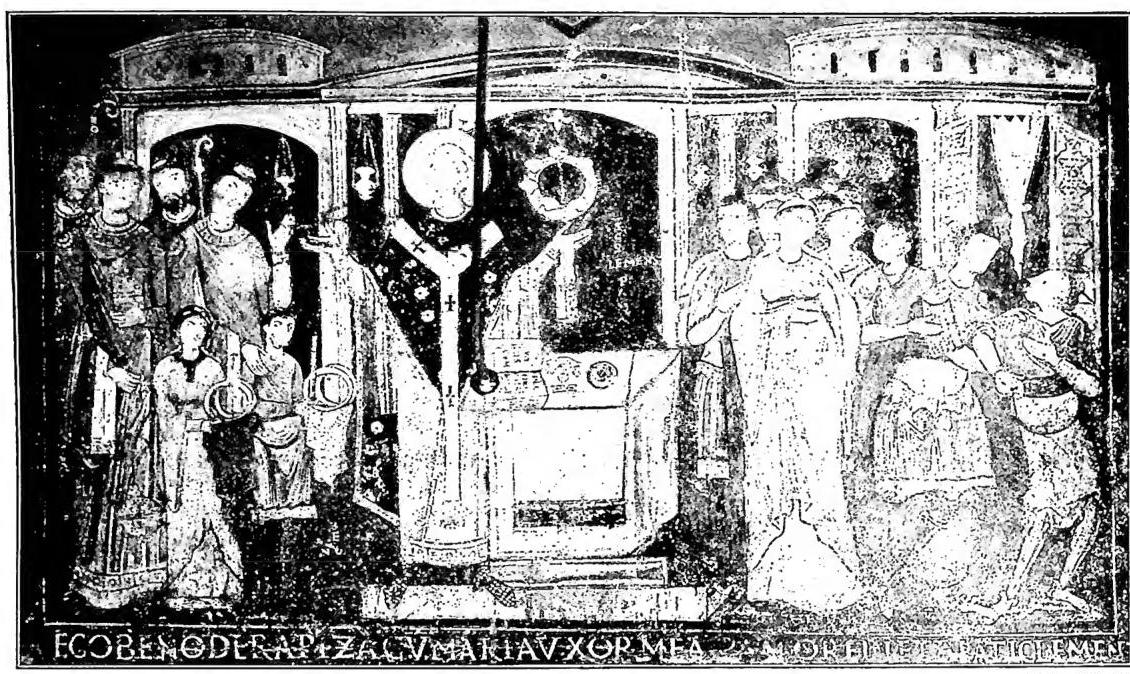
CLEMENTE I - The Mass of St C. Fresco in the lower church of S. Clemente, shortly before the destruction of the church by Roberto Guiscardo (1084) - Roma.
III. APOCRYPHAL WORKS
1. The Second Epistle to the Corinthians
In the manuscript tradition, a second letter follows C.’s first epistle; however, as is clear from the text itself, it is not an epistle but a discourse, read after attending the reading of a sacred text (chap. 19, 1; cf. also 15, 2; 17, 3). It does not emerge from the text that this discourse was intended for Sunday worship. The author himself recommends, as do Ignatius (Ephes., 13, 1) and Polycarp (4, 2), frequent religious assemblies (17, 3). It may be that his appeal, his ἐντεύξις (v. for the use of the word in this sense Clemente Aless., VII, 7, 49, 4; Eusebio, Hist. eccl., II, 15, 2), was intended for a more restricted circle (perhaps of ascetics of both sexes) or for worship on station days, when the presbyters (therefore not the bishop) spoke (17, 3, 5).The discourse is addressed to the “new people,” by now more numerous than the old (2, 3), but the formulation of the admonitions has a Judaeo-Christian flavor. Its religious ideal is “righteousness” (v. Mt. 7, 21 in 4, 2 [non-canonical formulation?]; 11, 7; 12, 1; 18, 2; 19, 3), perhaps, however, in the sense of an ascetic surpassing of ordinary “righteousness.” The author invites Christians to leave this world, this flesh (5, 1; 5, 5), because Christ’s great promise is rest in the future kingdom of eternal Life (5, 6).
The two worlds, the present one and the other, future one, are two enemies (6, 3). This world inclines toward adultery, corruption, love of money, and deceit. All this must be renounced (6, 4); one must preserve Baptism, the pure seal (6, 9; 7, 6), and repent while we are on earth (8, 1; 2). We must keep the flesh chaste if we wish to preserve the seal without blemish (8, 4 and 6); we must guard the flesh as a temple for its resurrection (9, 1 and 3). All ambiguity must be renounced and acts of righteousness performed in order to enter the Kingdom of God (11, 5; 7), awaiting its arrival from hour to hour (12, 1). By doing so we shall be members of the first church, which was built before the sun and the moon (14, 1); and if God created, according to Gen. 1, 24, the human being male and female, we must think of Christ and the primitive church (14, 2), who were spiritual. When the Spirit took up residence in Christ’s flesh, the Church also appeared (14, 3). In our flesh we must reproduce the relationship between Christ’s flesh and the Spirit; thus we shall be members of the primitive Church (14, 3, 4). The consequence is the “counsel” of abstinence (ἐγκράτεια). In addition, almsgiving, fasting, and prayer are recommended (16, 4). After suffering for a short time in the present world, we shall reap the immortal fruit of the resurrection. With “the fathers” we shall rise again and enjoy a happy world (19, 4).
The spirituality of the work is highly archaic. In its general features it has affinities with the Shepherd of Hermas, the pseudo-Clementine literature, and the Acts of Paul (on the last point cf. C. Schmidt, Acta Pauli, Lipsia 1905, pp. 190-92). It is an ascetic spirituality (apotaxis) based on the eschatological contrast between the two worlds. A virginal life seems to be recommended to Christians, both because such a requirement is already deduced from Baptism and because of Christ’s virginal birth. The Judaeo-Christian speculation on Adam was perhaps not unknown to the author when he refers to the Christological problem. The author knows apocryphal writings, almost certainly the so-called Gospel according to the Egyptians (chap. 12), which, however, he does not interpret in the sense of the Encratites, and probably another apocryphal gospel (5, 2; 3, 4 and perhaps 4, 2); moreover, he knows an apocryphal prophetic book (11, 2-4), which is also known to C.’s First Epistle.
(23, 3-4): perhaps Eldad and Modad. The country of origin of our writing is perhaps Syria; its date of composition probably the first half of the second century.
2. Letters to Virgins
A Syriac codex of the New Testament contains, after the Epistle of Jude, two epistles of “C. apostle of Peter.” Epiphanius (Panan., 30, 15, 2, ed. K. Holl [CB, XXV], Lipsia 1915, p. 352 sgs.) knows of “encyclical letters” of C. that were read in the churches and contrasts them with the Περσβοί of Peter attributed to C., that is, with the pseudo-Clementine literature.The fact that these epistles were read in worship in the East explains their presence in a New Testament codex; but Epiphanius’s notice also proves the existence of more than one letter, and public reading is understandable in view of C.’s almost apostolic authority. The same letters are also known to Jerome (Adv. Ioan., 1, 12), who believes that they were addressed to the “eunuchs who have made themselves eunuchs for the sake of the kingdom of heaven” (Mt. 19, 12). This destination, which does not emerge from the Syriac translation, appears instead in the Coptic translation of the text. The Coptic text, published in fragments by Th. Lefort (in Le Muséon, 40 [1927], p. 254 sgs. and ibid., 1929, p. 265 sgs.), nevertheless attributes the epistles not to C. but to S. Athanasius. Greek fragments (partly abridged) of the text were found in the Pandects of Holy Scripture by the Palestinian monk Antiochus (ca. 620). The public reading of the epistles in the churches favors their attribution to Pseudo-C.; while the attribution to Athanasius is explained by the fact that he too had written epistles to virgins. The asceticism of these letters is still primitive. The sacred virgins live in their parents’ home but have made a vow (profession, ἀμολογία [Coptic text]) of chastity. The practice of cohabitation between men and women consecrated to the Lord (virgines subintradtuctae) is opposed. Of interest is the survival of the cartami in these groups and the absence of stabilitas loci. The ancient hypothesis remains still more plausible, namely, that the epistles are the work of a Syrian or a Palestinian of the third century.
3. Liturgy of C
In book VIII of the Apostolic Constitutions, the liturgy mentioned is called that of S. Clement, because its compiler wrongly attributed his work to C.A different question is whether C.’s epistle, in its liturgical passages, has survived in later liturgical texts. Thus, for example, in Constit. Ap., VIII, 22, 3 (p. 526, 12 sgs. ed. F. Funk), phrases from C.’s First Epistle—60, 1 and 59, 1—recur almost verbatim; and coincidences with C.’s text are also found in the liturgical fragment of a third-century papyrus (cf. U. Wilcken, Mitteilungen aus der Würzburger Papyrussammlung [in Abhandlungen der Preussischen Akademie der Wissenschaften, 6], Berlino 1934, no. 3, p. 33 sgs.). The coincidences are probably explained by assuming that both C. and the liturgical texts depend on Jewish liturgical texts. The so-called liturgy of C. in book VIII of the Apostolic Constitutions must be distinguished from Syriac liturgies that go under C.’s name.
phorarum Syriacarum editionem (Anaphorae Syriacae, I, 1) Roma 1939, pp. XI-XXXIX. Erik Peterson
4. Clementine
Si dà questo nome (Κινημέτεια) ad un gruppo di scritti attribuiti un tempo a S. C. Romano, che costituiscono uno dei problemi più complessi dell'antica letteratura cristiana.a) Stato attuale. - Restano: 20 Homiliae, 10 libri di Recognitiones, una Epitome siriana compilata sulle due opere precedenti, due Epitomi greche, o estratti delle omelie e da altri scritti, due Epitomi arabe, ancora estratte dalle Omelie e dalle Ricognizioni. Alle Omelie in greco precedono due lettere, una attribuita a S. Pietro, una « Contestazione » (δινακρυσμία) di Giacomo e dei suoi presbiteri, e una lettera ove C. dichiara a Giacomo il contenuto dell'opera, che è nello stesso tempo la sua autobiografia e il riassunto delle prediche tenute da Pietro durante i viaggi in cui C. l'accompagnava. Pertanto, nelle Omelie, l'elemento narrativo, romanesco, s'intreccia con quello didascalico e gli serve di pretesto; il contrasto e le dispute con Simog Mago ne costituiscono in certo modo il centro. La dottrina è un insieme di elementi giudaici, cristiani e gnostici, non fusi in un corpus omogeneo: predominano ELCESAITI (v.): Cristo non è il Salvatore, ma uno dei profeti.
Anche le Recognitiones, pervenute solo nella traduzione latina di Rufino, si presentano come un'autobiografia di C. indirizzata a Giacomo, con alcune variazioni nel racconto e con una dottrina che, scostandosi dal giudaismo, si uniforma all'ortodossia cattolica; ciò è dovuto certamente al traduttore. Il titolo (ἀναγνωρίσιοι) viene dai « riconoscimenti », dopo molte peripezie, di C. e dei suoi congiunti, che hanno luogo nelle Omelie.
b) I rapporti e le fonti dei due scritti sono stati spiegati diversamente. Esclusa l'attribuzione a C., inconciliabile con l'elemento dottrinale, dapprima si sono fatte dipendere le Omelie dalle Ricognizioni (Hilgenfeld), poi s'invertì il rapporto (Uhlhorn); altri pensò ad un influsso mutuo, distinguendo nelle due opere parti di età diversa (Uhlhorn, Lehmann, de Lagarde). Si ammette oggi generalmente l'esistenza d'una o più fonti comuni, che si cerca di identificare con gli Atti e le Predicazioni di Pietro (Waitz, Harnack), o con le Περσβοί di Clemente menzionate da Origene (Schwartz). Incerta è pure la data, che alcuni fissano ai primi tempi dell'ebionismo, altri pongono non prima del 221 o 260, altri nel periodo postniceno, datando gli scritti a noi pervenuti dalla seconda metà del sec. IV.
IV. TITLE OF S. C. — It stands in the depression between the last spurs of the Esquiline and the Caelian (Caelian and Oppian), in an area close to the Flavian Amphitheatre. Excavations have established that the basilica was initially adapted from a large public building made of massive tufa blocks with a travertine course, dating approximately to the Augustan period, and later raised (late second–early third century) with a brick curtain wall. Beside it was a house of the Flavian period which, in the third century, underwent alterations, including the insertion of an important Mithraic cult centre.
The conversion of the public building into a Christian basilica could not have taken place before the peace of the Church. But as early as the first century a Christian group may have gathered in the aforementioned house. It is not unlikely that this was precisely the community directed by Pope C. and that the house belonged to Titus Flavius Clemens, since local tradition recalls the two figures. In the fourth century St. Jerome (De viris ill., 15) states: «nominis eius [Clementis papae] memoriam usque hodie Romae extructa ecclesia custodit». A fourth-century slave collar bears an inscription mentioning the dominicum Clementis. The word dominicum may suggest that the site possessed considerable dignity, perhaps even because of the memory of an original location of the Domus ecclesiae.
The basilica was cared for by many popes of the early Middle Ages, beginning with Siricius (384–99). In 417 a Council presided over by Pope Zosimus was held there. Extensive work was carried out under Hormisdas (514–32) and John II (533–35): the monogram of the latter is on the choir-screen slabs, later adapted for use in the upper basilica. Adrian II (867–72) placed there the relics of St. C., brought by SS. Cyril and Methodius. In 869 St. Cyril too, who had died in Rome, was buried in S. C. by the Pope.
After the destruction caused by the sack of Guiscard (1084), the basilica, which had received important pictorial decoration in the early Middle Ages (including a votive painting from the time of Leo IV, in which the Pope is portrayed), was again decorated with scenes alluding to St. C., St. Alexius, etc.; but shortly thereafter it had to be rebuilt at a higher level (in the time of Paschal II, 1099–1118). It was rededicated in 1128.
The mosaics of the apse, extremely beautiful (dominated by the Crucifix amid a profusion of flowering foliate scrolls), date from this period. The new basilica, narrower than the old one, had a new atrium; it was enriched with a schola cantorum and a Cosmatesque ciborium. Other works of art were added later, among them the notable fifteenth-century chapel of St. Catherine with paintings by Masolino da Panicale. - Vedi TAVV. CXIII-CXIV.