
ATHANASIUS, saint. — Bishop of Alexandria, Father and Doctor of the Church.
1. LIFE
Extremely agitated, it is almost wholly interwoven and confused with the history of the Arian controversy of the fourth century. It is easy to establish its periods: reliable information is scarce before the episcopate; its almost fifty years (328–73) are interrupted by five different exiles about which we have precise information, and these may therefore serve to divide our summary biography.A. is thought to have been born around 295 in Alexandria or its environs, and is said to have come from a Greek family on account of the name A. and that of his brother Peter (although A. also spoke and wrote in Coptic). He was certainly born of Christian parents and received a careful Greek, classical, and Christian education.
In his youth he seems to have frequented the patriarch of the solitaries, St. Antony, whose life he later wrote, clearly asserting that he had been his disciple. He consecrated himself early to the service of the Church; we know that he was a deacon when the Arian controversy arose in the autumn of 323 and that by that date he had already composed his first work, a treatise of apologetics, as well as the two books Contra Gentiles and De Incarnatione Verbi. As a deacon he accompanied his bishop, Alexander, to Nicaea (325).
When Alexander died on 17 April 328, A. was called to succeed him. We do not know how his election took place, and highly contradictory accounts circulate concerning II. The Church of Alexandria was then divided by a double schism: that of Arius and that of Meletius of Lycopolis (v.). According to various sources, the two schismatic groups each presented a candidate, but the great majority of the Egyptian bishops declared for A., who was elected on 8 June 328. It is easy to understand how difficult the task of a bishop was amid so many divisions; and as early as 331 the intrigues of the Arian court bishops, headed by Eusebius of Nicomedia, began against him. First they sought to cause him to lose the emperor’s esteem by ordering him to receive into his communion the bishops who were friends of Arius. But A. refused. The Meletians then accused him before Constantine of having imposed a tribute of linen cloths upon the Egyptians; and, in addition, of the fact that one of his priests had, on his orders, broken the chalice of the Meletian bishop Ischyras and sent a purse of gold to a certain Philumenus, suspected of high treason. Summoned before the emperor’s tribunal at Nicomedia, A. appeared and cleared himself of all the false accusations, returning to Alexandria in March 332 with a letter from Constantine full of praise for him but very harsh toward his enemies. Encouraged by this success, A. acted energetically against the Meletians, who retaliated by accusing him of having murdered Arsenius, a Meletian bishop of Hypsele. This, however, only brought shame upon his enemies, since Arsenius was found alive at Tyre; and the Eusebians, who had already convened a council at Caesarea to condemn A. (333), were forced to dissolve without having accomplished anything. The accused was once again rehabilitated by a letter from the emperor, who rebuked his enemies. The Arians, however, did not admit defeat and persuaded their leader Arius to subscribe to an ambiguous formula of faith. Constantine was satisfied with this and ordered the bishops to receive him into their communion. A. again refused, and then the Arians and Meletians asked the emperor to convene a great council to settle the Egyptian questions definitively. It met at Tyre in August 335, but only the bishops designated by the Eusebians, almost all of them enemies of A., were officially summoned.
A. arrived with fifty of his supporters, who were not admitted, however. Of all the accusations brought against him, only the affair of Ischyras was ultimately retained; it too was so confused that a commission of inquiry had to be sent to Mareotis. This commission was composed of the accused man’s worst enemies, and he did not await its return but left the assembly and went to Constantinople to defend himself before Constantine himself. Though at first favorable to A., Constantine eventually approved the sentence of deposition meanwhile pronounced at Tyre. An imperial decree of 7 November 335 relegated A. to Trier, in Gaul, without appointing a successor for him. This was the first exile, and it lasted until Constantine’s death (22 May 337). Constantine II, as early as 7 June 337, sent the exile back to Alexandria, where A. did not enter until 23 November, after meeting at Viminacium and then at Caesarea in Cappadocia the new emperor of the East, Constantius. His exile had lasted 28 months and 2 days.
Since the Eusebians could for the moment hope for nothing from the civil authorities, they brought A.’s case before Pope Julius, after first recognizing as bishop of Alexandria a certain Pistus, appointed by the Arians (338). Informed of this maneuver by the Pontiff himself, A. convened his bishops in synod, and they drafted a lengthy circular letter in his support. Julius then summoned both parties to Rome, to a plenary council. A. answered the summons faithfully, but the Eusebians did not appear; indeed, confident of the support of Constantius, emperor of the East, they had Pistus replaced by Gregory of Cappadocia in the see of Alexandria. The prefect of Egypt, Philagrius, forcibly occupied the city’s churches in order to hand them over to the intruder, and A., compelled to leave Egypt as early as 16 April 339, set out for Rome after protesting in an encyclical letter (PG 25, 221–40). Thus began his second exile, which lasted until 20 October 346.
Many events took place during these six years. In Rome, A. saw his innocence recognized by a council (autumn 340 or spring 341). He then attended the Council of Sardica (343), where he was again rehabilitated by the Catholic group. During his stay in the West, he introduced Westerners to monastic life as it was practiced in Egypt. He traveled extensively. At Easter 345 he was at Aquileia with Constans I, who obtained from his brother Constantius permission for him to return to Alexandria. This recall became official after the death of the intruder Gregory of Cappadocia (25 June 345); but the exile did not hasten to take advantage of Constantius’s favor, since there were too many reasons for distrust. Having obtained an audience with Constans, he went to Rome, where he received a letter from the Pope for the clergy and faithful of Alexandria. From Rome he traveled to Adrianople, then to Antioch, where Constantius received him and furnished him with a letter of recommendation for the Catholic clergy and the civil authorities in Egypt; and on 21 October 346 he made his triumphant entry into Alexandria.
A period of ten years of relative peace followed for A., and he took advantage of it to compose dogmatic works and works of personal apology. It was also during this period that he concerned himself with the conversion of Abyssinia (v. ETHIOPIA).
But as early as 351 the intrigues of the Arians began again, and they succeeded in setting even the episcopate of the West against him. At the Council of Arles (354) and that of Milan (355), all declared themselves against him, except for certain bishops such as Liberius, Eusebius of Vercelli, and Lucifer of Cagliari. Even Liberius, in 357, eventually abandoned him. These defections filled the holy bishop with bitterness, and he prepared himself for his third exile by writing an Apologia ad Constantium (PG 25, 595-642). On the night between 8 and 9 February 356, the church of Theonas, where A. was officiating, was invaded by the troops; but the bishop succeeded in fleeing into the desert, where the monks surrounded him with care and shielded him from all searches. With the monks A. spent the eight years of his third exile, until the beginning of 362; these years were extraordinarily fruitful both from the apostolic and from the literary point of view. From his solitude he continued to govern his Church, and it was then that he wrote the Orationes contra Arianos and the Letters to Serapion, which constitute his glory as a doctor of the doctrine of the Most Holy Trinity. He also wrote several works of personal apologetics, such as: Apologia de fuga sua (PG 25, 643-680) and Historia arianorum ad monachos (ibid., 691-796). In October 358, after the uprising that forced the Arian bishop George of Cappadocia to flee, he was able secretly to go to Alexandria for a few days; but his definitive return did not take place until 21 February 362, after Constantius had died (2 December 361), George had been massacred by the crowd, and Julian the Apostate had ascended the throne, whose first act was to recall the bishops exiled by his predecessor.
As soon as he returned to Alexandria, A. took care to restore Nicene orthodoxy and to combat official Arianism, which had triumphed at the Councils of Seleucia and Rimini (359). A council was convened, and decisions were taken marked by mercy toward all those who had embraced Arianism out of ignorance; even in the dogmatic sphere, a broad and tolerant approach was adopted with regard to anything that was merely terminology or a quibble over words. Christological doctrine was defined with great clarity against the opposing errors of Apollinarianism and Nestorianism, which were beginning to appear, and A. clearly summarized these important decisions in a brief writing entitled Tomus ad Antiochenos (PG 25, 795-810).
Such activity, directed toward securing Catholic unity, could not be viewed favorably by the apostate Julian, who was intent on restoring paganism. A decree of March 363 ordered A.’s expulsion. On 23 October he left his see for the fourth time, but only for a few months, because Julian died on 26 June 363 and was succeeded on the throne by the Catholic Jovian, who immediately recalled the persecuted bishop to Alexandria. Before going there, A. wished to pass through An-
tioch in order to confer with the emperor and once again attempt to restore religious concord; but his efforts again proved fruitless. It was only on 14 or 20 February 364 that he appeared among his faithful, and only briefly, because in the meantime Jovian died (17 February) and the empire was divided between his two brothers, Valentinian and Valens, the former receiving the West and the latter the East. Unfortunately, Valens favored Arianism, and on 4 or 5 May 365 he sent into exile all the bishops recalled by Julian. A. seemed likely to escape the proscription, having been recalled by Jovian; but despite the efforts of the Egyptians on his behalf, he had to disappear for a fifth time as early as 5 October 365, while remaining on the outskirts of the city. After four months, Valens, in order to win the sympathy of the Egyptians, recalled him, and on 1 February 366 A. returned to his see, never to leave it again until his death, which occurred on the night of 2 or 3 May 373.
His final years passed peacefully, devoted to the general good of the Church and in close communion with the entire West. He intervened in the West to warn the bishops against the supporters of the formula of Rimini, and it was at his instigation that Pope Damasus deposed Auxentius of Milan (369). In a Letter to the Africans A. urged them to remain faithful to the formula of Nicaea in order to avoid the snares of heresy, since the Christological errors that would be called Apollinarianism, Nestorianism, and Eutychianism were beginning to spread. A., who had already condemned them in his Tomus ad Antiochenos, sought to combat them, without naming their authors, in three dogmatic letters: Ad Epictetum, Ad Adelphium, Ad Maximum (PG 26, 1049-90).
History gave A. the title of great, which he richly deserved for the indomitable firmness of his character. He was a man of government, and as such was at times obliged to be severe; but he also knew how to show himself paternal and benevolent. A. was not quarrelsome, but a man of great common sense and broad outlook; in matters of doctrine he valued substance more than form.
II. WRITINGS AND DOCTRINE
The literary heritage of St A. is still far from having been fully established, as is shown by the recent research undertaken for H. G. Opitz’s critical edition of his works (Untersuchungen zur Überlieferung der Schriften des Athanasius, Berlin-Leipzig 1935). In addition to numerous apocryphal writings attributed to him, there are works of doubtful authenticity, whose number has at times been increased without sufficient reason. The translations into Armenian, Syriac, Coptic, etc., in particular, seem likely to reserve more than one surprise for us.St A. wrote few extensive works, but his numerous minor writings can be arranged into the following three
(Phot. Enc. Cett.)
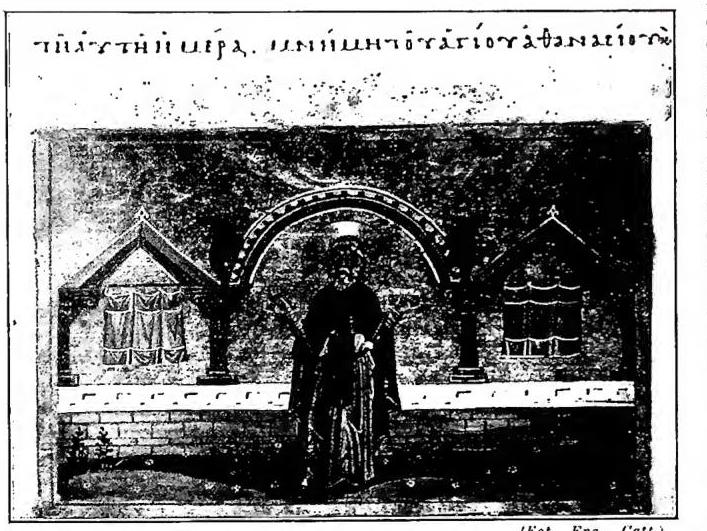
ATANASIO, santo — Miniature from the Menologion written for the emperor Basil II (976-1025). Vatican Library, cod. Vat. gr. 1613, fol. 320.
groups: a) apologetic and dogmatic works; b) historical works and works of personal apology; c) pastoral and ascetical works; the exegetical writings may be added to these, given their character. A brief account must also be given of the apocryphal writings and those of doubtful authenticity.
1. Apologetic and dogmatic works. — The first known writing of A., composed around 318-20, is an apology for the Christian religion divided into two parts: 1° The Treatise against the Greeks, in which he combats paganism and indicates the two paths by which one may attain knowledge of God, namely, the soul and the external world; 2° The Treatise on the Incarnation of the Word, which maintains the moral necessity of the Incarnation in order to
The properly dogmatic writings concern the two mysteries of the Trinity and the Incarnation. A. defends the divinity of the Word in the three Treatises or Discourses against the Arians (PG 24, 11-467); that of the Holy Spirit in the four Letters to Serapion, bishop of Thmuis (ibid. 529-676). These writings, which are the most important, probably date from his third exile, in the years 356-62. A fourth treatise against the Arians (PG 26, 467-526) is probably to be attributed to Apollinaris of Laodicea, since there are good reasons for not ascribing it to A. The following minor writings also concern the Trinitarian controversy: 1° Expositio Fidei (PG 25, 199-208); 2° Epistola on the Decrees of Nicaea (ibid. 415-76); 3° Fragment on the Text of St Matthew, 11:27: «Omnia mihi tradita sunt, etc.» (ibid. 207-20); 4° Letter on the Doctrine of Dionysius (ibid. 479-522), in which A. defends the orthodoxy of his predecessor, accused of Sabellianism (around 350-53); 5° Treatise on the Synods of Rimini and Seleucia (PG 24, 681-794), composed in 359, when these councils seemed to promise the triumph of Nicene orthodoxy before their capitulation before Constantius and the subscription of the Homoean formula, and completed shortly after those events; 6° De Incarnatione et contra arianos, later than 362 (ibid. 983-1028); 7° Letter to Jovian, an exposition of the Catholic faith (ibid. 813-24), from 363; 8° Letter to the Bishops of Africa of 368 (ibid. 1029-48), to warn them against the Arian heresy.
A.’s doctrine of the Trinity is above all positive and based on the texts of Sacred Scripture. A. is not enslaved to a formula, and although he remains faithful to the Nicene consubstantial (ὁμοούσιος), he also knows how to employ equivalent expressions. He was ready to extend his hand to Basil of Ancyra and his Homoiousians, and he held the logomachies in horror. The following expressions are found in him: ὅμοιος κατ' οὐσίαν, κατὰ πάντα; ὅμοιος, ὁμογενὴς τῇ φύσει (the Son like the Father according to essence, in all things, by nature). At the Council of Alexandria in 362, he even consented to give the word ὑπόστασις the meaning of person, instead of that of essence and substance, which were ordinarily used. This imprecision in terminology does not impair the clarity of his doctrine, and is explained by the fact that in his time Trinitarian and Christological formulas were still in the process of formation and had not yet assumed their definitive form.
After expounding in the Treatise on the Incarnation of the Word the mystery of Redemption, which he presents above all as a divinization of humanity through the contact of the incarnate Word with our nature, A. was led in his final years to concern himself with Christological dogma in the strict sense, which was beginning to become the object of dangerous speculation. As has already been said, as early as 362 he had clearly condemned the emerging Christological errors (Apollinarianism, Nestorianism, Docetism, Eutychianism). Particular attention must be paid to the condemnation of Apollinarianism, both in the Tomus ad Antiochenos and in the letter to Epictetus, because A. has been accused of having taught this error, given his habit of designating the humanity of the Savior by the words body and flesh. Moreover, the Apollinarians early falsified several of his works, such as the celebrated letter to Epictetus (cf. J. Lebon, Altération doctrinale de la lettre à Epictète, in Revue d'histoire ecclésiastique, 31 [1935], pp. 713-61), in which they attempted to pass off their own productions under his name. Far from being an Apollinarian, A. clearly affirms the substantial union of the Word with human nature and the unity of subject in Christ. He gives the Blessed Virgin the title θεοτόκος and anticipates the refutation of Diodore of Tarsus, Theodore of Mopsuestia, and Nestorius, although he uses terms that seem to favor the error, since in his time Christological terminology had not yet been firmly established. Likewise, Jesus’ human will and freedom remain in the shadows.
2. Historical works and works of personal apology. — Persecuted, calumniated, and attacked in every way, A. knew how to defend himself vigorously with his pen, convinced that his cause was intimately bound up with that of orthodoxy. The personal apologies are also historical documents in which one cannot demand absolute impartiality. For the most part, they were composed during the third exile (356-62).
Here they are in chronological order: 1° The Encyclical Letter, written in 339 as he was leaving for his second exile, in order to protest against his expulsion and against the intrusion of the Arian Gregory of Cappadocia (PG 25, 221-40); 2° The Apology against the Arians of 348, a collection of official documents concerning the persecutions he suffered from 330 to 348 and the Councils of Tyre and Sardica: an incomplete collection, since it includes only the documents favorable to him (ibid. 240-410); 3° The Letter to the Bishops of Egypt and Libya (ibid. 537-94), written in 356-57, as he was leaving for his third exile, in order to warn the bishops against an Arian formula and encourage them in the struggle; 4° The Apology for His Flight of 356 (ibid. 643-80), written in 357. A. justifies his flight and indignantly denounces the abominations committed by George of Cappadocia and his followers; 5° The Apology to the Emperor Constantius (ibid. 595-642),
perhaps begun even before 355 and completed in 357; a fine example of careful rhetoric, written in a calm tone, in which the official praises addressed to the emperor have something of the flavor of irony; 6° The History of the Arians to the Monks (ibid. 691-796), from 358, in which he recounts to the solitaries, in a lively and picturesque style, his adventures as a persecuted man and the infamies committed by his enemies, sparing no one, not even the emperor Constantius, whom he compares to the Antichrist and whose caesaropapism he condemns; 7° The Letter to Serapion on the Death of Arius (ibid. 685-90), written ca. 358 and recounting the final moments of the heresiarch.
3. Pastoral, ascetical, and exegetical works. — A. was not only a theologian of great worth and an indefatigable fighter, but also a pastor full of zeal. He took particular care of chosen souls, monks and virgins; and this office of spiritual director, hitherto little known, has been brought to light by recent discoveries. It was more for edification than in order to undertake scientific exegesis that A. commented on certain texts of Sacred Scripture.
Among his properly pastoral works, his Festal Letters should be noted; every year he addressed them to the faithful of his city to announce the date of Easter and exhort them to the practice of Christian virtues. Of these letters, only 15 (from 329 to 348) have come down to us in a Syriac translation (translated into Latin in PG 26, 1360-1433). There are also several fragments, among which one from the 39th letter is particularly important, having come down to us in the original text, because it gives us the biblical canon of the Church of Alexandria (ibid., 1176-80, 1436-40). This canon corresponds to the Catholic one for the New Testament, whereas, for the Old Testament, A. recognizes only the Hebrew canon, although he mentions and recommends the deuterocanonical books as books for reading, with the exception of the Book of Maccabees, and adds to them the Didaché of the Apostles and the Shepherd of Hermas.
Most of the discourses, or fragments of discourses, that have come down to us under his name are apocryphal; others are doubtful, and one must await the critical edition of his works to know what may be regarded as authentic (PG 28, 133-250, 501-1114). Several letters addressed to monks are ascetical and edifying in character. We have already mentioned the Letter to Dracontius (PG 25, 523-34); the Letter to Amun should also be noted (ibid. 26, 1169-78), as well as the Letters to Orsisius and the Monks (ibid. 26, 977-80, 1185-90). The celebrated Letter to Marcellinus on the Psalms (ibid. 27, 11-46) is regarded as the introduction to a Commentary on the Psalms, of which long fragments remain, considered authentic at least in their entirety (ibid. 27, 55-590). On the other hand, the De Titulis Psalmorum, which was placed under A.’s name, must be attributed to Hesychius of Jerusalem (ibid. 27, 649-1344). Photius also attributes to him a Commentary on Ecclesiastes and one on the Song of Songs. Whereas in his writings of dogmatic controversy A. adheres to the literal sense of Scripture, in the commentary on the Psalms he endeavors particularly to present its moral sense.
The Life of St. Anthony, written around 350 (PG 26, 838-976), is not merely a biography of the great Egyptian, but also an account of his spiritual doctrine, and exerted a great influence both in the West and in the East. Evagrius, a priest and later bishop of Antioch, published it—more an adaptation than a translation—in Latin before 388.
The authenticity of the brief treatise On Virginity (critical edition by Ed. von der Goltz in the Texte und Untersuchungen of 1905), certainly written after 362, was challenged without sufficient reason. It is a genuine manual of spiritual life for the use of the Christian virgin, full of common sense and discretion. The same qualities are found in three letters or treatises on the same subject, recently edited, two in a Syriac version (by J. Lebon, in Muséon, 40 [1927], pp. 205-48; 41 [1928], pp. 169-216) and another in Coptic (by C. Th. Lefort, ibid., 42 [1929], pp. 179-274, with a French version). This was cited by Ephrem of Antioch (Photius, Bibliotheca, cod. 229; PG 103, 993) and used by Sceune (v.) and especially by St. Ambrose in his De Virginibus, II (cf. Lefort, in Muséon, 48 [1935], pp. 55-73). It is incomplete, but contains a magnificent eulogy of virginity. We thus possess the four treatises on virginity mentioned by a Coptic fragment of the Chronicle of the Patriarchs of Alexandria at the beginning of the catalogue of the works of St. A.
The Letter of St. A. on Fraternal Charity and Temperance, edited in Coptic with a French translation by A. Van Lantschoot, in Muséon, 40 (1927), pp. 265-92, is also a fine treatise on spirituality. These discoveries reveal the importance of St. A. as an ascetical doctor and teacher of the spiritual life; and it is highly probable that his ascetical works were written in Greek and Coptic.
4. Doubtful or apocryphal works
From the earliest times, attempts were made to pass off writings by Apollinaris or his disciples under A.’s name, while authentic writings of his were falsified, especially by the moderate group of the Apollinarian sect. This happened with the letter to Epictetus.The following are by Apollinaris: 1° De Incarnatione Verbi Dei (PG 28, 25-30, 89-96); 2° Quod unus sit Christus (ibid. 121-32); 3° perhaps the fourth discourse against the Arians (PG 26, 467-526).
The following do not belong to A.: 1° the two books against Apollinaris (PG 26, 1093-1166); 2° the Quaestiones ad Antiochum (PG 28, 1-137, 597-700); 3° the symbol Quicumque, which is of Latin origin (v. SIMBOLO).
The most complete collection of the works is in PG 25-28 (edition by the Maurists J. Lepin and B. de Montfaucon, with some more recent additions). The critical edition by H. G. Opita (Berlin Corpus) is still in its first fascicles (those published in the years 1934-41 contain the personal apologies). — For particular editions of certain works and the special studies devoted to them, V. BARDENHEWER, OTTO, Geschichte der althöflichen Literatur, III, Freiburg im Br. 1923, pp. 44-79. — Among the numerous monographs on St. A., the following may be noted.
the following: H. Voigt, Die Lehre des hl. Athanasius von Alexandrien, Brema 1861; L. Atzberger, Die Logoslehre des hl. Athanasius, ihre Gegner und ihre unmittelbaren Vorläufer, Monaco 1880; G. A. Pell, Die Lehre des hl. Athanasius von der Sünde und Erlösung, Bessavia 1888; Fr. Lauchert, Die Lehre des hl. Athanasius des Grossen, Lipsia 1895; G. Voisin, La doctrine christologique de saint Athanase, in Revue d'histoire ecclésiastique, 1 (1900), pp. 226-48; E. Weigl, Untersuchungen zur Christologie des hl. Athanasius, Paderborn 1914; A. Gaudel, La théorie du Logos chez saint Athanase, in Revue des sciences religieuses, 19 (1929), pp. 524-39; 21 (1931), pp. 1-26; J. Berchem, L'incarnation dans la plan divin d'après saint Athanase, in Echos d'Orient, 33 (1934), pp. 316-30; id., Le Christ Santificateur d'après saint Athanase, in Angelicum, 15 (1938), pp. 201-32, 515-58; J. Lebon, Saint Athanase a-t-il employé l'expression ὁ νοημαὸς ἰνθρώπης?, in Revue d'histoire ecclésiastique, 31 (1935), pp. 307-29; Ch. Hauret, Comment le défenseur de Nicée a-t-il compris le dogme de Nicée, Bruges 1936.
Martino Jugie