
BERNINI, GIAN LORENZO. – Architect, sculptor, painter, and stage designer, born in Naples to the sculptor Pietro B., a Florentine, and Angelica Galante, a Neapolitan, on 7 December 1598; died in Rome on 28 November 1680. Schlosser defined him as a “much-debated genius.” His personality was certainly complex; but it is precisely through the power of his genius that B. demonstrated how the Baroque taste, decried by neoclassical criticism, could be transformed into art. Bal-
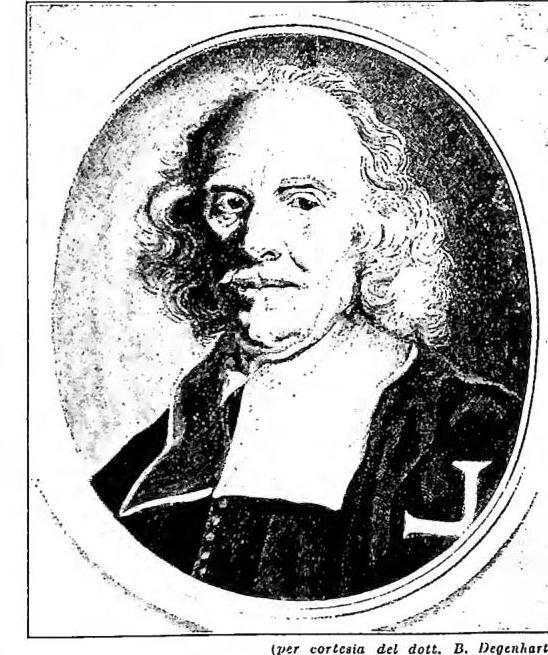
Already in the youthful group Jupiter as a Child (Rome, Galleria Borghese), he appears “Alexandrian” to our eyes; but at the same time there is an intention to return to the simple elements of the Renaissance, analogous to the figurative situation of the Carracci. The monument to Bishop Santoni in S. Prassede (1612) appears sixteenth-century and timid in execution. But then his pictorial vein was to triumph: contributing to this was the very figurative environment in which B. was formed, represented in Rome by that current of Venetian origin which, from Alessandro Vittoria through Pietro B., developed in Rome in Camillo Mariani and Mochi. Mochi, for his part, shows that he had overcome the taste of the late sixteenth century, which still prevailed to a considerable extent in Pietro B., and initiated the new Baroque language in the field of sculpture. The young Gian Lorenzo may have collaborated with his father on the group Aeneas and Anchises in the Galleria Borghese; in reality, however, no trace of his personality can be seen in II. His personality is instead manifested in youthful works such as the S. Lorenzo Strozzi (Florence), The Damned Soul and The Blessed Soul (Rome, Palazzo di Spagna), and, above all, the David (ca. 1619, Rome, Galleria Borghese). The latter derives iconographically from a figure in Guido Reni’s frescoes in S. Gregorio al Celio, and, at bottom, there is no trace of Michelangelo’s influence. B. immediately grasps the image in pictorial movement, with an anticlassical curve in the pose, with the virtuosity of the surfaces, polished or rough (to indicate the different material), and the expressive energy of the face, which is said to be a self-portrait. The Rape of Proserpina (Galleria Borghese), far less significant, is probably a case of collaboration between Gianlorenzo and Pietro B.; in reality, it is a group much less “Baroque” and more sixteenth-century and Giambolognesque than it might seem. The group Apollo and Daphne (1622; Galleria Borghese), on the other hand, is among the highest achievements of B., still young but by then fully confident in his own means. Apollo’s swirling garment is a recollection of Mochi, and the face recalls the Apollo Belvedere. In reality, Daphne’s figure is the better one;
but the work is then admirable for that tremulous and impassioned musicality, in a light rhythm, with movement at its most pictorial, rendered complex by the colouristic investigation inherent in II. Perhaps dating from the time of the brief pontificate of Gregorius XV (1622) are the bust of Cardinal Montoya (Church of S. Maria in Monserrato) and the monument to Cardinal Bellarmine (Church of the Gesù), iconographically linked to the type of late sixteenth-century sculptural portraiture, but so intense in their pictorial vitality and so vivid that the conventional meaning of the severe Counter-Reformation tradition now appears to have been surpassed. B. in fact rejects no tradition, provided that it can be brought back and reduced to the meaning of his own figurative vision. The pontificate of Urbanus VIII (1624) encompasses higher manifestations of Bernini’s genius, both in sculpture and in architecture and painting.
The marble portrait of Costanza Buonarelli, loved by B. (Florence, Bargello, ca. 1625), reveals a freedom in portraiture and a synthesis of psychological and pictorial vitality, surpassed—as regards the open “cut” of the portrait—by the busts of Cardinal Scipione Borghese (ca. 1632), in which the dynamic breadth of the pose reveals the influence of Rubens and gives concrete form to B.’s new canon of portraiture. He wanted the sitter “to move, and to speak” (Baldinucci). The painted self-portrait in the Uffizi also dates from this period. In any case, B.’s pictorial activity was intermittent, taking place predominantly between 1625 and 1635. As a painter, B. confirms—contrary to what was asserted—his belonging to the Neo-Venetian group, through his relations with Andrea Sacchi and Poussin; and the David in the Incisa della Rocchetta collection demonstrates that he also looked to Guercino. B. intended above all, however, to avail himself of certain painters who would execute, under his guidance, Berninian figurative ideas, such as Carlo Pellegrini, author of the painting of S. Maurizio once attributed to B. himself, and Guido Ubaldo Abbatini. Among the sculptures of this period, the statue of S. Bibiana (1626) should also be recalled.
But B. established himself above all as an architect through more than one work, and at least one masterpiece: the baldachin for S. Pietro (1624). The pictorial movement that animates the baldachin realizes, more fully than anywhere else, the synthesis of sculpture and architecture proper to B., and the rhythm of the twisted columns is truly that of an animated mass. The work lasted nine years and established B.’s fame as an architect. In the façade of S. Bibiana (1626) and that of the Collegio di Propaganda Fide (1627), although the accent of Berninian proportions is recognizable, he presents himself as an artist of sixteenth-century severity, not unmindful of Giacomo della Porta. In the Palazzo di Propaganda Fide, however, he achieves pictorial projections through the façade’s wedge-shaped inclination. B. also played a major part in the construction of Palazzo Barberini; but the question of what should be attributed to B. and what to Maderno and Borromini has not been definitively resolved. It should be remembered that, during the pontificate of Urbanus VIII, B. was also a stage designer for the Barberini theatre. Work on the mausoleum of Urbanus VIII in S. Pietro began in 1628 and was completed much later (1647). It responds to a new
B. initially fell out of favor with the new pontiff Innocenzo X (1644), who preferred Borromini. He then sculpted Truth Revealed by Time (Galleria Borghese), which remained unfinished in the figure of Time and was intended to symbolize the artist’s state of mind in the face of human injustice. It displays a complex painterly and coloristic investigation, through a broad movement in an undulation of Rubensian forms. But the masterpiece of this period is The Ecstasy of s. Teresa (1647) in S. Maria della Vittoria, which not only represents an architectural, sculptural, pictorial, and scenographic synthesis, but also reveals B.’s extreme sensitivity, in a sincere vision manifested through the virtuoso treatment of the marble masses. Having regained the Pope’s favor, he designed the Fountain of the Rivers in Piazza Navona (1651), for the execution of which he availed himself of the help of several disciples. He began (1650) the construction of Palazzo Montecitorio, important for the broken line of its façade and completed much later by Carlo Fontana.
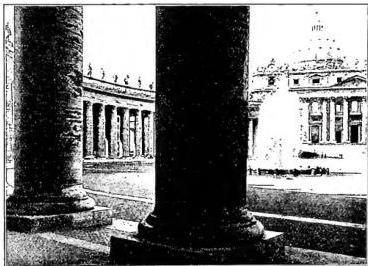
B.’s activity continued to develop during the pontificate of Alessandro VII Chigi. It is enough to consider the marvelous project for the colonnade of S. Pietro (1656); the church of S. Andrea al Quirinale (1658); the bronze Cathedra in S. Pietro (1661). In this last work, the principle of the moving coloristic mass that creates an anti-landscape representational space is important.
B.’s fame had by then become such that the king of France, Luigi XIV, asked him for the design of the façade of the Louvre and wanted him to come to Paris. He remained there for five months, from April 1665; but his design was not followed, partly because of jealousy on the part of French artists. Nor did the equestrian portrait of the king please them, and it was crudely retouched by Giraudon (a marvelous terracotta sketch is found in the Galleria Borghese). In any case, B.’s journey to France, faithfully described in a diary by Fréart de Chantelou, remains a fundamental document for the history of figurative taste in general, and of B. in particular.
Having returned to his homeland, he produced numerous further works, among which we may recall: the equestrian statue of Constantine (1670, portico of S. Pietro); the statues for the Ponte S. Angelo, two of which are in the church of S. Andrea delle Fratte; the monument to Pope Alessandro VII in S. Pietro (1672–1678); the recumbent statue of b. Ludovica Albertoni in S. Francesco a Ripa (1674); etc.
Numerous drawings by B. are also preserved, often arising from an intimate and immediate state of mind. These drawings cannot be understood without discovering in them, whole and concrete, the personality of B., sculptor,
architect, painter, scenographer. Even his caricatures recall the artist’s activity as playwright and actor, and seem to arise rather from a personal dramatic attitude, sharply biting and caustic, than from a benevolent experience of the «comic».
B. was a classic. Not only because in his works, especially the architectural ones, he employs the traditional classical vocabulary, but because the Baroque language (understood positively) that he exalts is often resolved into a lofty individual synthesis and is therefore, all the same, classical. - Vedi TAVV. XCII-XCIII.