
POUSSIN, NICOLAS. – French painter, born at Villers in Normandy in 1594, died in Rome on 19 November 1665.
Trained in his homeland under the guidance of Quentin Varin, around 1612 he went to Paris to work in the studios of S. Lallement and F. Elle, where he received his first commissions for works that have not come down to us. In 1620 P. made his first journey to Italy, to Florence, whence he soon returned to Paris, beginning his substantial series of compositions inspired by mythology that was to make him famous. In 1624 P. was once again in Italy, in Rome, the city he did not leave until his death, except for a relatively brief stay in Paris between 1640 and 1642. And it was in Rome that he created the finest of his production, especially in those canvases of historical and mythological inspiration mentioned above, in which
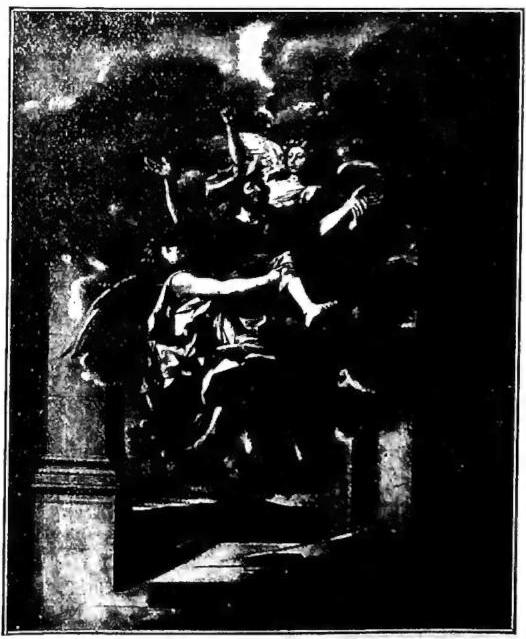
Initially educated in a moderately traditionalist environment, P. discovered his genius through the works of Raffaello and his direct followers. During his stay in Italy, it was above all these artists whom he kept in view as he advanced along his path, even while enriching himself through new experiences gained by deepening his knowledge of the painting of Tiziano, the Carracci, and Domenichino.
A serene temperament, an excellent draughtsman, and a calm, balanced composer, P. was above all a great colourist. Indeed, through the Carracci vein he was able to ascend to the pure source of Venetian colour, eventually capturing certain properly Giorgionesque accents of Sebastiano del Piombo and the young Tiziano. A characteristic representative of that group of foreigners enamoured of Italy who lived there for long periods, working industriously, P. retained in his art the frankness of French character and, despite living far from his homeland, exerted a decisive and lasting influence on the development of its pictorial culture. Even David, in his programmatic paintings executed in Rome and France toward the end of the eighteenth century, remembered P.; and even Corot, in his youthful Roman landscapes, was able to rediscover some of the secrets of the old master in the profound harmony of juxtaposed tones and in the lucid distribution of masses defined by clear light. – Vedi tav. CXXV.