
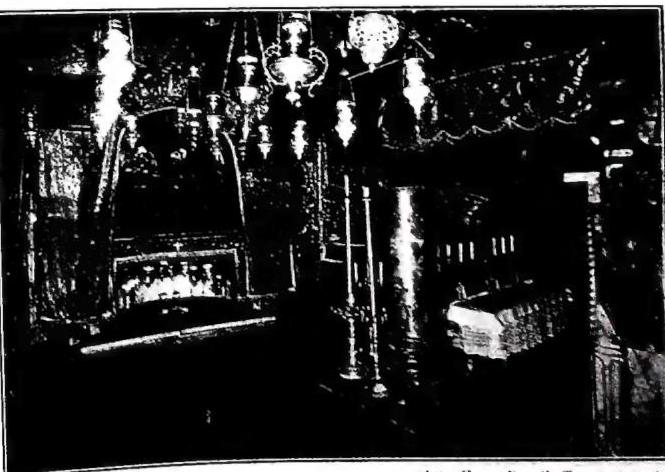
PRESEPE. — In 404, S. Girolamo writes to Eustochium that, on entering Bethlehem into the “Specum Salvatoris,” Paula saw the “stabulum” where He was born (Ep. 108, 10: PL 22, 384).
The idea that the manger consisted of a box made of beaten earth mixed with straw, such as are found in present-day Arab houses, cannot be accepted, first of all because such boxes are not used for this purpose, and then because it is impossible to understand how it could have survived the religious syncretism practiced in the Grotto (from 135 to 226), whereas it is attested by Origen and was seen in the Christian period. It is a manger hewn into the rock, substantially preserved to the present day, already covered with silver plaques (from 326 to 614) and later with metal plates pierced with holes that made it possible to touch the sacred rock. The interpretation of the soundings of 1934 (v. BETHLEHEM) led to the belief that there was an oculus above the Grotto, so that it could be seen from the Basilica; but this feature, besides being unknown in the literary tradition, is not supported by the monument, because, among other reasons, it would be larger than the Grotto itself. The platform was nothing other than the base of the ciborium. New soundings and excavations (1948–49) have clearly revealed the access to the Grotto at the end of the central nave, as well as arrangements different from those formerly believed to have existed in the atrium of the Constantinian Basilica, which does not seem to have had an octagon above the Grotto but only a polygonal apse.
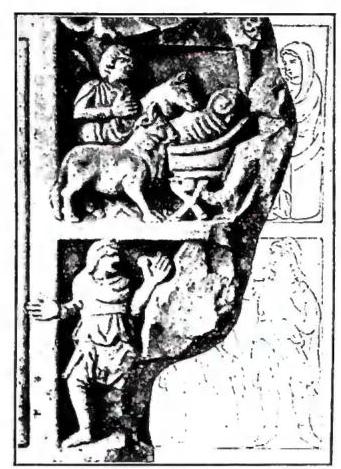
PRESEPE - Detail of a sarcophagus
from the 4th century - Arles, Museum.
I. ARCHEOLOGIA.
- In alcune scene
della natività del
Salvatore, nell'arte
cristiana antica, si
sono tenuti presenti
i passi di Is. 1, 3,
«cognovit bos pos-
sessorem suum et asi-
nus praesepe domini
sui»; di Hob. 3, 2
«in medio duorum
animalium» e lo
pseudo-evangelo di
Matteo (cap. 14). I
due animali sono
messi in evidenza
anche da s. Ambrogio
(In Lucam, 2, 7: PL
15, 2649) e da Pruden-
zio (Cathemerimon,
XI, 78: PL 59, 896).
In un affresco andato
distrutto nel cimitero
«in catacumbas», ri-
prodotto da G. B.
De Rossi (Bull. d'arch. crist., 1877, p. 141 e tav. 2), il
Bambino è tra i due animali. In un gruppo di sarcofagi
cristiani si vede il Bambino in una cesta di vimini sotto
una tettoia e dietro il bue e l'asino; talvolta ai lati da una
parte è la Madonna, dall'altra un pastore (Wilpert,
Sarcofagi, pp. 263, 283-85, tav. 198, 1; 201, 5; 226, 1;
249, 11). Il Marini vide e copio un raro frammento di
coperchio di sarcofago con la data consolare del 343 (G.
B. De Rossi, Inscriptiones christianae, I, Roma 1857,
p. 51) con la scena della Natività più antica che si conosca.
Nei sarcofagi di Mantova (Wilpert, op. cit., tav. 30) e
di S. Ambrogio a Milano (id., op. cit., tav. 189, 2) la
scena tra i due animali è rappresentata in uno degli acro-
teri. Un avorio conservato a Nevers rappresenta a si-
nistra il Bambino con i due animali, a destra l'Epifania
(F. X. Barbier de Montault, *Ivoire latin du Musée de
Nevers, in Bulletin monumental*, 50 [1884], p. 711). La
scena del Bambino sulla mangiatoia tra il bue e l'asino
con la Madonna e s. Giuseppe è rappresentata in una
stoffa di seta rinvenuta nel tesoro del Sancta Sanctorum
(H. Grisar, Il tesoro del Sancta Sanctorum, Roma 1907,
p. 181; riprodotto da Ph. Lauer, *Le trésor du Sancta
Sanctorum, in Monuments Piot*, 15 [1906], pp. 110-11,
tav. 18, 5).
La basilica di S. Maria Maggiore, che fino dal sec. VI
viene detta «S. Maria ad praesepe» o «ad praesepe»,
era un oratorio riproducente la grotta di Betlemme. In-
fatti nella biografia di Gregorio III (731-41) è denominato
«oratorium» (Lib. pont., I, p. 418) e fu abbellito da
Adriano I, da Leone III e da Sergio II. H. Grisar ri-
tenne che tale oratorio fu fatto costruire dal papa Sisto III
dietro l'altare maggiore. La cappella venne rifatta sotto
Nicolo IV da Arnolfo di Cambio, e forse già allora ri-
mossa; Sisto V la fece trasportare da D. Fontana sotto
la cappella del S.mo Sacramento. L'oratorio di Gio-
vanni VII (705-707) nella Basilica Vaticana («Oratorium
Sanctae Mariae» e anche «praesepe Sanctae Mariae»)
era splendente di marmi e di musaici (Lib. pont., I,
p. 385; G. B. De Rossi, Musaici, Roma 1890, fasc. 23). Anche
in appendice alla Notitia Ecclesiarum, nella descrizione del-
l'interno della Basilica Vaticana è ricordato l'oratorio «ad
praesepe Sanctae Mariae» (R. Valentini e G. Zucchetti,
Codice topografico della città di Roma, II, Roma 1942,
p. 98). Il p. eretto dal papa Gregorio IV (827-44) nella
basilica di S. Maria in Trastevere, decorato di lastre
d'oro e d'argento, era «ad similitudinem praesepii sanctae
Dei Genitricis quae appellatur maioris» (Lib. pont., II,
p. 78).
Quanto alla discussa autenticità delle reliquie della
culla, V. G. Cozza, Luzzi e P. Lais, *Le memorie Liberiane
dell'infanzia di N. S. Gesù Cristo* (Roma 1894) e H. Grisar,
La culla del divin Bambino e S. Maria Maggiore di Roma,
in Civ. Catt., 15ª serie, 1894, pp. 209-11.
II. ART
The presentation of the nativity scene, extremely frequent throughout the art of the Middle Ages (v. EPIFANIA) and also connected with that which s. Francesco established on Christmas night in 1223, when the image of the Child was placed in a grotto beside an ox and a donkey, was developed with ever greater intensity and naturalistic accents not only in the sculpture and painting of the fourteenth century (Duccio di Buoninsegna, Simone Martini, Giotto, Giovanni Pisano, Lorenzo Maitani, and the Lorenzetti) but also in those of the Renaissance. And in that flourishing season of Italian art, the profoundly human theme of the nativity scene was grasped and developed with varied and spontaneous accents, while the ancient laws of traditional iconography were adapted and at times renewed so that the most tender and intimate sentiments could be expressed. Lorenzo Monaco took it up, developing it in the supple elegance of Gothic fashion; Angelico, who in the convent of S. Marco viewed the profoundly human scene with eyes still dazzled by visions of Paradise; Masaccio, who in the small panel in the Museo Federico di Berlino placed the Virgin at the threshold of a little hut against a background of barren hills; Gentile da Fabriano, who in the Strozzi altarpiece (Uffizi) imagined the scene as a celebration of the power of the Medici. So too Donatello, with Jacopo della Quercia in the relief of the portal of S. Petronio in Bologna; Luca della Robbia in some admirable terracottas; and, later, Antonio Rossellino, who festively recounts the birth of Jesus in the high relief of the Piccolomini chapel in the church of Monteoliveto in Naples. Beside them, there was also Benozzo Gozzoli in the chapel of the Palazzo dei Medici in Florence, who used the scene as a pretext for depicting, in a most imposing procession, the splendour of the Medici court.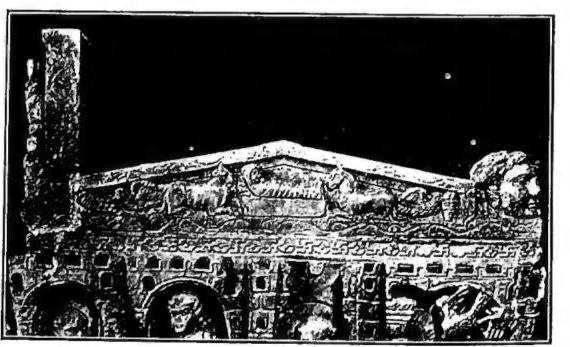
In the field of Renaissance sculpture, especially that of a more popular character, the theme of the nativity scene was developed chiefly in northern Italy; in Lom-
(from Wilpert, Sarcofagi, pl. 185, 1)
PRESEPE - The Child between the ox and the ass. Detail of the sarcophagus of S. Ambrogio (4th cent.) - Milan, basilica of S. Ambrogio.
In Lombardy and Emilia above all. In this connection, the works of Guido Mazzoni and Antonio Begarelli in the cathedral of Modena, and that of Federico Brandani in the cathedral of Urbino, deserve mention. These great terracotta cribs, like the procession of the Magi arriving at the hut of Bethlehem in a chapel of the S. Monte di Varallo, as well as the high relief left unfinished by Pier Paolo Olivieri in 1599 in S. Pudentiana in Rome, reveal a new tendency toward plastic verism. This tendency would have its importance when, through the experiences of seventeenth-century naturalism and realism, the taste for a certain kind of representation was refined on the one hand, giving rise to the admirable Natività painted by Tiepolo, Piazzetta, Pompeo Batoni, and de Mura, and, on the other, to those eighteenth-century plastic representations that found their highest expression in Naples. But in Naples itself the plastic representation of the crib had very ancient origins. It went back to the time when Queen Sancia had one prepared for the monastery of S. Chiara, which she had founded, certainly in memory of the one at Greccio where the Seraphic had prayed.
III. FOLKLORE
Among all the sacred representations of the Christian world, that of the Nativity, or nativity scene, enjoyed immense popularity in popular taste. This was due to the fact that, instinctively, the people have always regarded the scene of the nativity scene as an idealization and almost a projection onto the religious plane of the family itself, the essential center of human affections. But it is difficult to say when the nativity scene spread from the Church and religious confraternities into the private home.Three-dimensional nativity scenes developed with great success during the fourteenth century and, above all, in the following centuries, with a continually increasing number of figures; the moment when the nativity scene became properly “popular,” however, remains uncertain: it is perhaps more accurate to say that, from the fourteenth century onward, the nativity scene could equally appeal to high art and to folklore. By the middle of the fifteenth century, through the work of terracotta modelers (first and foremost the Della Robbia), there was already an example of a mixed composition of sculpture and painting, in which the landscape and minor figures were executed against the background of the niche housing the sculptures (Volterra Cathedral: a Robbian nativity scene with a background by B. Gozzoli). If Tuscany was a major and industrious center of nativity scenes during the Renaissance, northern Italy also took part in the naturalism of this representation, which in the north, and especially in Germany, found important interpretations at the hands of woodworkers.
The nativity scene enjoyed great success in wood and terracotta sculpture in Naples, where the nativity scene of S. Giovanni, in Carbonara (1484), marks the beginning of a highly successful local tradition. In this nativity scene, the intervention of the Prophets and the Sibyls indicates traces of the sacred plays in the Nativity.
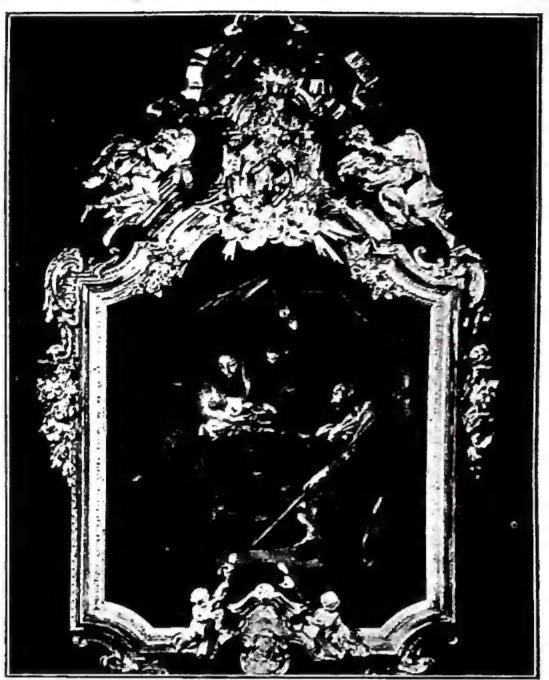
(Alinari photograph) PRESEPE - Pompeo Batoni’s eighteenth-century p. - Rome, Galleria Corsini.
In the Baroque taste, the sculpture of the p. was enriched with picturesque episodes even before attaining the characteristic complexity of the eighteenth-century Neapolitan p. In the pursuit of ever greater naturalism, the technique of the p. became varied and complicated. In the eighteenth century, alongside the crude figures modeled or stamped in terracotta or plaster and painted, there appeared the more refined forms of figurines dressed in fabric (sometimes plastered and colored), with the face and extremities modeled, and painted or carved in wood (especially the hands and feet), almost always with glass eyes; while the body, like that of mannequins, was made of soft iron wire covered with tow.
The exceptional development of the Neapolitan p. and the consequent creation of a specialized craft—from the stage scenery (made of wood, cork, papier-mâché, and painted canvas) to the clothing, the tiny jewelry, and the modeling not only of the figures but also of the animals and the infinitely varied objects housed in the many picturesque corners of the scene—was due in large part to Carlo III di Borbone, himself passionate about the art of the p. Among the people, encouraged by the sovereign’s example in his own static tendency toward the picturesque, the Dominican p. Rocco, himself the author of celebrated p., also helped spread the custom of making p.
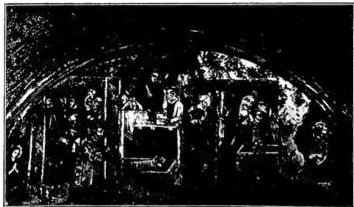
(phot. Altracco - Terni)
PRESEPE - The p. of Greccio, fresco in the Grotto of the p. (14th century) - Greccio.
all of them of great skill: indeed, it may be said that eighteenth-century Neapolitan sculpture found in this art its most felicitous expression. Some of them have been extensively studied by critics, such as Sammartino, Angelo and Giacomo Viva, Giuseppe Gori, Lorenzo Mosca, Giuseppe De Luca, Francesco and Camillo Celebrano: specialists in animal sculpture and still lifes were Lorenzo Mosca, Giuseppe De Luca, Saverio Vassallo and Giuseppe Sarno. With the 19th century, the art of the Neapolitan p. declined, just as it gradually died out in Sicily, where Giovanni Matera and Giacomo Bongiovanni had worked with great genius. Nevertheless, the popular custom of preparing the p. for Christmas remains extremely widespread. In Rome, during that period, the sale of “puppets” for the p. in the stalls of Piazza Navona was characteristic. - Vedi tavv. CXXXIV-CXXXV.