
NATALE. – Feast of the birth of the Lord, celebrated on 25 December.
I. THE DESIGNATION. – The typically Roman designation is Natale or Natalis Domini, from which the designations in the Romance languages derive. The current Latin Nativitas Domini is of Gallican origin.
II. THE DATE. — As regards the historical date of the birth of Jesus, there is no apostolic tradition whatsoever; the earliest liturgical celebrations are those of Easter and Pentecost; the notice in the Liber Pontificalis (I, p. 129), namely, that Pope Telesphorus introduced the midnight Mass of N., is entirely fictitious.
It is noteworthy that N. is a fixed-date feast, unlike Easter and Pentecost. Christian antiquity was uncertain about the day of Christ’s birth: cf. Clement of Alexandria, Stromata (ed. Sylburg, p. 340),
who indicates as the day either 25 Pachon (20 May), or 15 Tybri (10 Jan.), or 11 Tybri (6 Jan.; Epiphany); according to him, the last date was accepted by most. The writing De Pascha computus (among the works of St. Cyprian, ed. Hartel, II, p. 266) places Christ’s birth on 28 March; St. Hippolytus (ed. Bonwetsch, I, Leipzig 1897, p. 524), in his commentary on Daniel, indicates 2 April of the year 5500 of the world, or 752 of Rome, for the birth of Jesus; another reading, which gives the date of 25 March, is considered a later in-
It must nevertheless be borne in mind that the date of 25 December may also have originated in the Roman civil calendar. In 274, Aurelian introduced for this day the celebration of the Sol invictus, as the conclusion of the winter solstice (21 December); this was an influence of the Mithraic cult. Julian the Apostate, still in 362, wrote a discourse De Sole rege to be read in Rome on 25 December, in celebration of the sun (both real and intellectual); and St. Leo the Great, because N. coincided with the feast of the Sun, warned Christians not to confuse Christ with the natural sun (Sermo 22 De natio. Domini: PL 54, 198). At Petra, in Nabataean Arabia, the birth from a virgin of the god Doussares was celebrated on 25 December, and a Calendar of Canopus (from around 239) has under the date 25 December: Natale del Sole; cresce la luce. Considerations of an astronomical-prophetic-scriptural nature, possessing a certain symbolic character, and the existence of a civil pagan feast of the sun on 25 December, would therefore have contributed to assigning the birth of Christ, sun and light, precisely to this date.
III. ROMAN ORIGIN. - The specifically Roman origin of the liturgical celebration of N. is beyond doubt; but the precise moment at which it began remains rather uncertain.
John of Nicaea (ca. 900), in order to induce the dissident Armenian Church to accept the feast of 25 December, adduces among other reasons the fact that Pope Julius (337–52) is said to have introduced it in Rome following correspondence with Cyril, patriarch of Jerusalem (Combefis, Hist. haer. monoph., 304); but the correspondence is apocryphal and the information unfounded. Under Liberius, his successor (352–66), however, the feast seems to be attested for Rome; St Ambrose (De virginitate: PL 16, 219) reports the sermon delivered by him in 352 or 353 natalibus Salvatoris, when, in St Peter’s, he gave the veil to his sister Marcellina, and it seems that this in fact concerned N. In the Chronograph of 354, the feast of N. is recorded twice: at the head of the Depositio martyrum and in a consular list, «VIII kal. Ian. [that is, 25 December] natus Christus in Betleem Iudeae» (v. R. Valentini-G. Zucchetti, Codice topografico della città di Roma, II, Rome 1942, p. 17); and it is repeated in an inscription found at Setif: «natale domini Christi VIII Kalendas Januarias» (E. Diehl, Inscr. Latin. christ. veteres, Berlin 1925, no. 2114). Now, the list of the Depositio episcoporum originally ended with Sylvester (336), to whom Mark and Julius were added; the Depositio martyrum certainly indicated the days and places of the liturgical celebrations. It may therefore reasonably be supposed that the first entry, concerning N. (as well as that concerning the chair of St Peter), likewise refers to a liturgical celebration, and that the liturgical celebration of N. can and should be traced back to 336, while certainly being in existence by 354. St Zeno of Verona (380), in the third of his sermons De nativitate Dei (PL 11, 407–17), also draws a clear contrast between Christ and the material sun; but some critics do not consider it proven that his sermons were delivered at an actual liturgical feast, but only to commemorate the Nativity of the Lord. St Philastrius of Brescia, on the other hand, explicitly speaks of the feast of N. (Liber de haeresibus, chap. 140, composed ca. 383: PL 12, 1273). At the same time Pope Siricius (letter to Bishop Himerius of Tarragona, chap. 2: PL 13, 1134) recalls the feast as having already entered Christian practice.
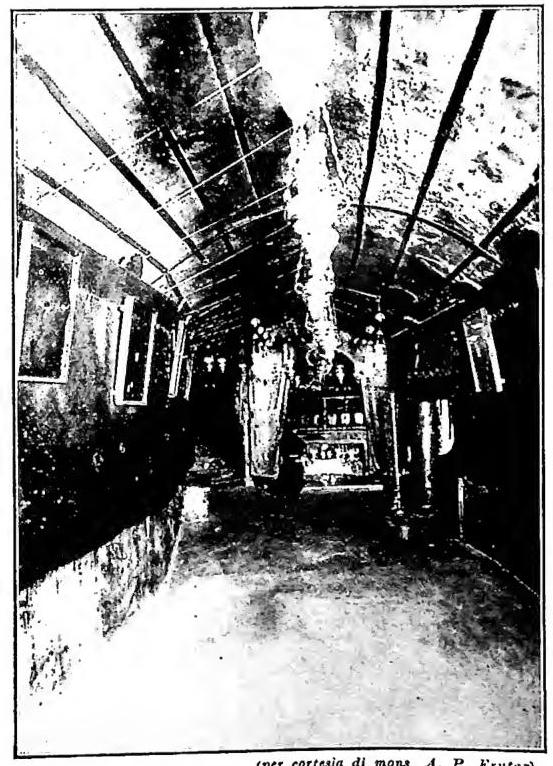
NATALE – Grotto of the Nativity – Betlemme.
IV. SPREAD OF THE FEAST
In Africa, the Donatists, who rejected the Epiphany as an Eastern innovation, nevertheless admitted the feast of N., as the aforementioned Filastrius indicates. Optatus of Milevis has a homily for N., dating from about 360, the oldest known for this feast (G. Morin, S. Aurelii Augustini tractatus sive sermones inediti, Monaco 1917, app. tr. 1, pp. 170–77; cf. also A. Wilmart, in Revue des sciences relig., 11 [1922], pp. 271–302). S. Agostino delivered several sermons on this solemn occasion, also comparing Christ with the sun (Sermo 190: PL 38, 1007; Sermo 203: ibid. 1035; De Trinitate: ibid. 42, 894).
For Mesopotamia, s. Efrem Siro (373) tells us that in his time only the feast of 6 January (thirteen days after the solstice) was regarded as the feast of the Lord’s birth. In northern Syria, on the other hand, s. Afraste delivered a homily for N. (25 December; cf. C. Erbes, Nachträgliches zum syr. Martyrologium u. dem Weihnachtsfestkrois, in Zeitschr. f.
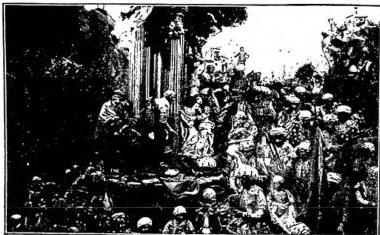
NATALE – Eighteenth-century Nativity scene – Naples, Museo di S. Martino.
At Constantinople, s. Gregorio Nazianzeno, probably in 380, delivered a homily for the first celebration, in that capital, of the feast of N. (Hom., 38: PG 36, 311–24). In Antioch, under Patriarch Flaviano (386), s. Giovanni Crisostomo, still a deacon, announced to the people, in his discourse on the feast of s. Filogonio (20 Dec.: PG 49, 752 ff.), that on the following 25th the birth of Christ would be celebrated for the first time as a distinct feast; on that day he then delivered the great Christmas sermon (PG 38, 353 ff.). Of interest is his assertion that the feast had already been known for about ten years, but had not been celebrated. Finally, in 425 Arcadio and Onorio included N. among the days on which the ludi circenses were prohibited (Cod. Theod., II, 8, 27), and Giustiniano declared it a civil holiday (Cod. Just., III, 12, 6).
V. LITURGIA DELLA FESTA DEL N
Il N., come tutte le feste principali, ha una vigilia (oggi privilegiata di I classe) e, ciò che è caratteristico, tre Messe festive: una per la notte, la seconda in aurora, la terza di giorno. Il grado liturgico è di I classe con ottava privilegiata di III ordine, disposta per inquadrare le feste dei comites Christi nella stessa ottava solenne.La vigilia dev'essere sorta molto presto; per s. Agostino è una cosa ordinaria. Il cosiddetto Sacramentario leoniano ha conservato tutto un libellus Missarum per il N., con 9 formulari diversi, non tutti completi, dei quali almeno due per la vigilia. Il Sacramentario gregoriano reca già il completo formulario del Messale romano attuale. Per la vigilia vi è notato come tempo l'ora nona, cioè le tre pomeridiane, e come luogo S. Maria Maggiore; segue, sempre come vigilia, la celebrazione notturna, ancora a S. Maria Maggiore; poi, senza determinazione di ora, la stazione a S. Anastasia; finalmente la Messa festiva, a S. Pietro. Da notare, che in S. Anastasia si festeggiava in primo luogo la detta santa, e solo in secondo luogo il N. Dopo s. Gregorio Magno, in tempo imprecisabile, si invierirono le parti; al suo titolo si fece la memoria, mentre il formulario diventò festivo natalizio.
La celebrazione della grande vigilia natalizia presso S. Maria Maggiore si spiega soprattutto con il fatto che ivi fu eretta una cappella particolare con una rappresentazione del presepe, forse già dai tempi di Sisto III (cf. R. Valentini-G. Zucchetti, Codice top. cit., II, 119-120). Giova ricordare che in Palestina, come attesta la nota Eteria, la celebrazione dell'Epifania (nella quale si ri-
ricordava anche la nascita di Cristo), si iniziava proprio a Betlemme, nella basilica del presepio (della nascita), di là si andava in processione alla basilica dell'Anastasia di Gerusalemme; si avrebbe dunque una delle varie imitazioni di usanze palestinesi a Roma. Forse già dai tempi di Sisto III, e certamente ancora all'epoca di Amalario (inizio sec. IX, Liber de Ordine antiphonarii, ed. I. M. Hanssens, in Amalarii Ep. Opera liturgica omnia, III, Citta del Vaticano [*Studi e testi, 140, 1950, p. 49 sgg.), e fino all'esilio di Avignone (come attestano i relativi Ordines Romani*), il Papa si portava a S. Maria Maggiore, per celebrarvi la Messa pomeridiana della vigilia, alla sera i Vespri solenni al presepe, poi, verso mezzanotte, un breve Mattutino, con la Messa di mezzanotte, considerata ancora di vigilia (si dirà meglio di « veglia »); da qui, verso le prime luci del giorno, si recava a S. Anastasia, per quella festività. Nella basilica di S. Pietro si cantava intanto, nella notte, il vero e completo Mattutino (la
II vigilia), che si chiudeva di giorno con la Messa papale. Dopo Avignone, la vigilia si trasformò, da vera « veglia », in « vigilia », cioè Ufficio e Messa al mattino, come in tutti gli altri giorni, mentre le altre Messe: di notte, di aurora, di giorno, rimasero come festive. La stazione, però, da S. Pietro fu trasportata anch'essa a S. Maria Maggiore. Quanto all'Ufficio natalizio, basta dire che è fra gli Uffici più lirici e profondi, con molti influssi orientali, diretti o indiretti (A. Baumstark, Byzantinisches in den Weihnachtstexten des römischen Antiphonarius Officii, in Oriens christ., 11 [1936], pp. 163-87; H. Frank, Das Alter der römischen Laudes und Vesperantiphonen der Weihnachtsoktav in ihre griechischen Originale, ibid., 14 [1939], pp. 14-18).
La notizia del Martirologio romano, da cantarsi in coro con melodia particolare, vi fu inserita dal Baronio, che la desunse dai Martirologi precedenti, come quelli del Moluoro o del Belino. Il Martirologio geronimiano ha la sola notizia della nascita di Cristo, e poi molti altri nomi di santi. Di essi solo Eugenia è martire romana, ma la sua memoria liturgica fu soppiantata da quella della martire Anastasia di Sirmio. La stessa brevissima notizia della nascita a Betlemme hanno i cosiddetti Martirologi storici (Beda, lionese, Adone; cf. H. Quentin, Les martyrologes historiques du moyen âge, 2ª ed., Parigi 1908). Fu Usuardo ad introdurre per primo, dalla Cronaca di Eusebio, nella versione latina di s. Girolamo (Cronicus lib. II, PG 19, 529-32) gli anni di Augusto e l'Olimpiade (Acta SS. Junii, VI, p. 654). Il canto di tale cronologia serve a dar risalto al solenne annunzio della nascita del Signore nel mondo, però meriterebbe di essere riveduta (cf. C. M. Perrella, De emendando Martyrologio romano votum, in Ephem. liturg., 55 [1941], pp. 150-54).
Alla festa del N. si raggrupparono intorno le date che ne dipendevano: il 25 marzo per la Concezione di Cristo (Annunciazione), il 24 giugno (VIII Kal. Jul.) per la nascita del Battista, e la Ipapante (Occursus Domini, Purificazione), al 40° giorno dopo N., cioè al 2 febbr. Per l'ottava del N., al 1° genn., V. CIRCONCISIONE, III.
comparée, 2ª ed., Chèvetogne 1939, pp. 162-74; M. Righetti, Storia liturgica, II, Milano 1946, pp. 48-62; H. Leclercq, Nativité de Jésus, in DACL, XII, coll. 905-58; Martyr. Hieronymianum, pp. 7-8; Martyr. Romanum, pp. 600-601; G. Rietschel, Weihnachten, in Realencyklopädie für protestant. Teologie und Kirche, XXI, pp. 47-54; R. Günther, Weihnachten, in Die Religion in Gesch. u. Gegenwart, V, pp. 1787-91. Giuseppe Löw