
DANIELE. – Prophet who gave his name to a sacred book of the Old Testament.
SUMMARY:
I. The prophet
II. The book
III. Critical problems
IV. The origin of the book
V. The deuterocanonical parts
VI. Prophecy and apocalypse
VII. Iconography
VIII. Apocryphon of D.I. THE PROPHET
D. belonged to the tribe of Judah (Dan. 1:6) and, in the deportation of 605 B.C., was taken to Babylon (1:1), where, after suitable preparation, he was chosen with other young men to serve the Neo-Babylonian king, under the name of Baltassar. The episode of Susanna (ch. 13 Vulg.) belongs to the period of his youth. It is not known when he left the court, with which he appears to have maintained occasional relations because of his reputation as a prophet. Episodes from his life and prophecies dated between the years of Nabuchodonosor II (605–562) and the third year of Cyrus (539–529) are known. Unverifiable traditions identify his tomb as being in Susa.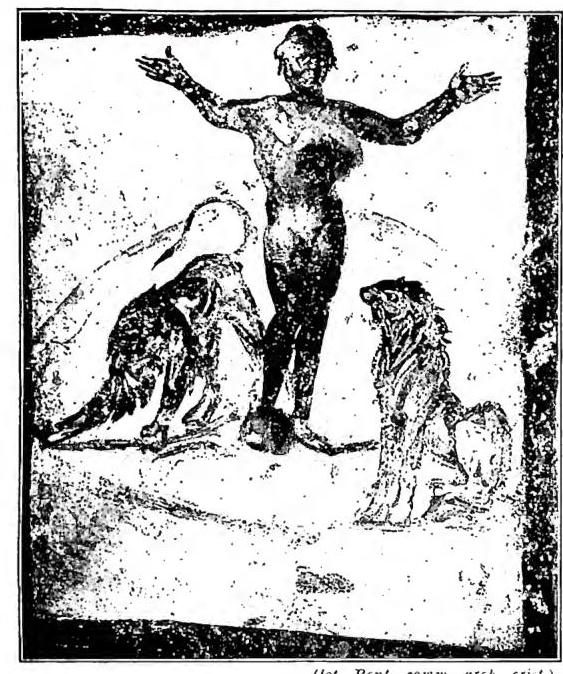
DANIELE – D. among the lions. Fresco in the cemetery of the Giordani
(2nd half of the 3rd century).
II. IL LIBRO
Contiene la narrazione di seifatti (capp. 1-6), più o meno miracolosi, e quattro
visioni profetiche (capp. 7-12). Narrazioni stilisti-
camente simili a quelle dei capp. 1-6 contengono i
racconti di Susanna e di Bel e il dragone, numerati
nella Volgata come capp. 13 e 14.
I capp. 1-12 sono scritti parte in ebraico (1,
1-2, 4a; 8, 1-12, 13) e parte in aramaico (2, 4b-7, 28)
e costituiscono il libro « protocanonico »; i capp. 13 e
14 e un complesso di elementi narrativi e lirico-re-
ligiosi, connessi con il racconto del cap. 3 (ivi inse-
riti come vv. 24-90), sono tramandati solo in greco
e sono chiamati parti « deuterocanoniche ».
minare le questioni che intorno a questo materiale
narrativo e profetico si addensano.
I racconti (capp. 1-6) rispondono al fine di mostrare
come la potenza e superiorità del Dio d'Israele di fronte
alle divinità pagane si fosse manifestata al tempo del-
l'esilio. La speciale sapienza goduta da D. e messa in
azione nei racconti successivi fu conferita al profeta e ai
compagni per la fedele osservanza della legge di Jahweh
(cap. 1). I cinque episodi seguenti (capp. 2-6) terminano
con il solenne riconoscimento del Dio d'Israele da parte
dei re babilonesi: D. spiega il sogno di Nabuchodonosor
sulla statua di materiali diversi, infranta da un masso che
cade dal monte, come simbolo di quattro imperi mondiali,
che cedono all'avvento del regno messianico (cap. 2);
egli ed i compagni escono illesi dal fuoco, in cui sono
stati gettati per non aver voluto adorare un idolo (cap. 3);
Nabuchodonosor guarisce da una malattia mentale che
l'ha colpito, conformemente alla predizione di D., ri-
cavata dalla spiegazione di un sogno dello stesso re
(cap. 4); D. BALDASSARRE (v.) le parole che una
mano misteriosa ha scritto su una parete durante un
banchetto, come preannunzio dell'imminente fine del
regno e morte del re (cap. 5); D. esce indenne dalla « fossa »
dei leoni, in cui è stato gettato per aver pregato il suo Dio,
nonostante la proibizione (cap. 6).
La 2ª parte (capp. 7-12) contiene quattro grandi
visioni, il cui oggetto comune è l'annunzio di un mo-
mento avvenire, in cui deve avverarsi un trapasso da male
a bene, dopo la vittoria su un complesso di forze avverse,
che determineranno una lotta estrema. Il momento ne-
gativo, già figurato nella statua del cap. 2, è sviluppato
accanto all'aspetto positivo di vittoria nella visione dei
quattro mostri marini, che significano quattro regni
mondiali, e della figura umana (« come un Figlio d'Uomo»:
7,13), che fonda un nuovo regno universale ed eterno
(cap. 7); particolari aspetti del momento negativo sono
poi ripresi nelle visioni del caprone e del montone
(cap. 8), in quella dell'angelo Gabriele che reca al profeta
il vaticinio delle 70 settimane (cap. 9) e in quella degli
avvenimenti che trascorreranno dalla fine dell'impero per-
siano fino al termine della persecuzione del « popolo
dei santi » e alla morte del persecutore (capp. 10-12),
con un cenno finale al momento positivo (cap. 12).
III. CRITICAL PROBLEMS
This account already shows the firm unity linking the various parts of the book, by virtue of the thought that pervades and sustains the whole: the establishment of God’s universal kingdom, which in a certain sense has a historical precedent in the recognition of Jahweh by the pagans of the ancient Near East (chaps. 1–6), but which in the visions (chaps. 7–12) is prophesied in detail and placed in close relationship with history that has recently unfolded or is still developing. More precise observations of stylistic and ideological details confirm this impression of the book’s strongly unified character, which is also the first indication of unity of authorship.Yet the ten episodes of which the book consists present themselves individually as self-contained units, on account of their consistently complete general form (note the formulas of introduction and conclusion), their slight mutual internal inconsistencies, and the minute peculiarities of each one, both in the narratives and in the prophecies (e.g., the visionary scheme of the universal kingdoms). A further complication is introduced by the fact, mentioned above, of the alternation between the Hebrew and Aramaic languages.
It is now universally admitted that the individual episodes were originally written as independent units, later brought together in smaller collections, from which in
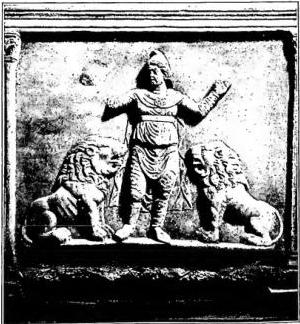
(photo Alinari)
DANIELE — D. among the lions. Side of a sarcophagus from the 5th century.
Ravenna, Museum.
was subsequently assembled into the book. The manner in which this occurred is connected with the problems surrounding the book’s origin and its subsequent history, which also explain the alternation of languages.
IV. ORIGIN OF THE BOOK
This problem has elicited different solutions from critics of various tendencies.Formerly, not only was the Danielic authenticity of the prophecies unconditionally admitted (cf. already Mt. 24:15), but the entire book was readily attributed to D. himself, who was thought to have written it in his old age (at the end of the sixth century B.C.); confirmation was found in the accuracy of the information concerning persons (for the problems relating to the kings Baltassar and Dario the Mede [v.] and Babylonian matters).
Today such a rigid conception of the book’s authenticity is no longer current: attention is drawn to the marked difference between its Hebrew diction and that of Ezechiele (the Babylonian exile), as well as to the use of Greek words in the Aramaic of chap. 3, a usage that cannot be envisaged in Semitic territory before the invasion of Alessandro il Macedone.
Rationalism, in general, dates the book considerably later, down to the years of the oppression exercised by Antioco Epifane (175–164 B.C.) against the civil and religious independence of the Jews. During that period, a pious Israelite, making use of traditions already in circulation concerning events in the life and visions of a “prophet” D., is said to have composed the (protocanonical) book in order to encourage his persecuted compatriots and console them, showing that the fulfillment of ancient prophecies was imminent—prophecies that had foretold the persecution itself, its increasing intensity, and its rapid resolution with the persecutor’s end. It is observed that in all the visions, after a sometimes precise description of a state of anguish (= persecution), there appears at a certain point an announcement—likewise more or less veiled—of the end of evil and the beginning of good, at a time fixed by numerical indications (7:25; 8:14; 9:24–27; 12:7, 11, 12). Consistently with this, radical criticism profoundly modifies the explicit or implicit data of tradition concerning the person of the prophet (whose historicity it does not consider entirely demonstrable), the history of the book, and the religious meaning of the prophecies.
Conservative critical-exegetical scholarship, through a much more thorough analysis of the book and of the external testimonies, rejects these conclusions as superficial. Studies by various Protestant authors (Holscher, Haller, Noth) and Catholic authors (Junker) have meanwhile demonstrated the certain existence, in the narratives and visions, of archaic elements of varying extent, which the “author” used by reworking them and incorporating them into an organic work, namely, the present book. If these elements derived from accounts of visions and prophecies, perhaps also from first-person memoirs in Hebrew dating back to the exile, there is nothing to prevent their being acknowledged as the work of D. The later “author” would have done no more than disseminate the old narratives and visions in a new form.
Criticism was led to assign this work to the second century B.C. especially by the consolatory purpose that it believed it could discern in the book. But if this purpose is admissible to a certain extent for chaps. 7–12, it is not at all so for chaps. 1–6, from which the others cannot be separated: the kings Nabuchodonosor (chaps. 1–4) and Baltassar
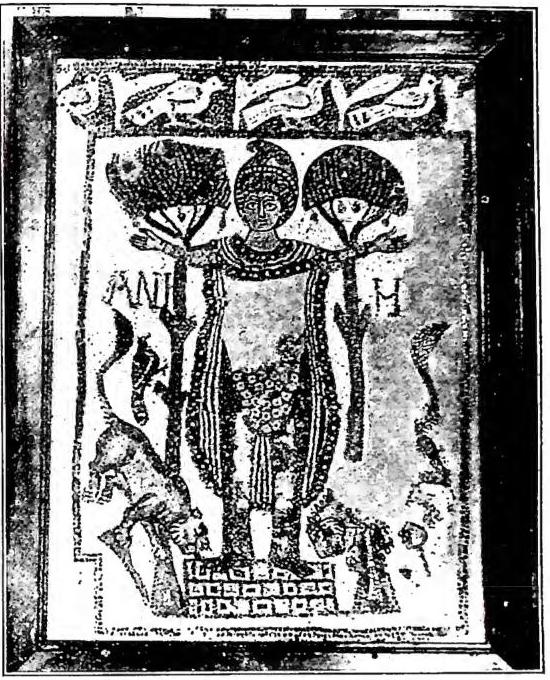
(courtesy of Prof. E. Jovi)
DANIELE – D. among the lions. Mosaic from the 5th century – Sfax, museum.
(cap. 5) are not “anti-Semites”; they end by acknowledging Yahweh, honoring D. and his companions; Darius the Mede (cap. 6) displays an explicit attitude of sympathy toward D., who “prayed to his God.”
Some Catholic scholars, whether concerning the work as a whole (Junker) or individual sections (e.g., chapter 9: Szydelski), admitted a definitive composition from older materials around the time of Antiochus IV; but it is commonly thought that, by assigning the date to approximately 300 B.C., when the Book of Chronicles was being composed (whose Hebrew is quite comparable to that of D.) and Judaism was gathering together its literary, historical, and prophetic heritage, one would provide the most satisfactory explanation for all the problems concerning this book.
The precision of certain prophecies, especially that of chapter 11, is certainly remarkable; but it cannot be ruled out that the text assumed its present form as a result of revisions (v. DARIO il MEDO), so that the prophecies, too, were revised and expanded in accordance with their fulfillment.
V. LE PARTI DEUTEROCANONICHE
They are for the most part regarded as later embellishments of writings associated with the name of the great prophet, produced when the protocanonical book had already been completed. Their Semitic origin is certain, as is their belonging from antiquity to the Judaeo-Alexandrian canon and to the Catholic canon of the inspired Scriptures.VI. PROPHECY AND APOCALYPSE
Notable features of literary and ideological conception distinguish Dan. from all the other prophetic books and instead bring it close to a group of other writings, outside the canon, of the “apocalyptic” genre; among these features are a taste for complicated visions, an interest in eschatological subjects, a wide use of expressions tending to veil thought and create a mysterious atmosphere, symbols, numbers, etc. The application of this classification to Dan. is now admitted by many; but significant reservations are imposed by the fact that the “style” of this book does not display those exaggerations proper to the literary genre of the “Apocalypses.”The incomparable superiority of D. over the apocalyptics appears especially in the elevation of his thought. D. foretells a future affirmation of forces united in the good, as the fruit of struggles victorious over the forces of evil, which he nevertheless describes in their historical aspect as organized entities (“kingdoms”). The disparate elements constituting the two aspects foretold for the future, evil and good, have led exegesis to recognize three struggles and victories prophesied by him: the Maccabean liberation with the end of the oppressor Antico IV, the foundation of the eternal and universal messianic kingdom, and the victorious final affirmation of the kingdom of God against the Antichrist, with the resurrection of the dead and the triumphant allotment of eternal punishment and reward.
VII. ICONOGRAPHY
The prophet D. appears from the earliest representations of cemetery art, naked among two lions, according to the interpretation of Dan. 14:30–31. At times he is depicted in the pit and, more rarely, striking down the idol, with a clear reference to the prophetic significance of the gesture. In Danielic iconography, indeed, the hidden symbolic meaning of the juxtaposition of the prophet’s martyrdom with that of the Redeemer is particularly evident.The theme of D. among the lions entered the iconographic repertoire of the earliest Christian painters: it is found in many frescoes of the catacombs, from the cemetery of Domitilla to the crypt of Lucina and the Vigna Cassia in Syracuse; in sarcophagus sculptures, historiated glass, small terracotta lamps, and many other funerary objects, which became especially abundant after the third century. The same scene is repeated in a powerful Byzantine relief, assigned to the sixth century, on the façade of the church of SS. Giovanni e Paolo in Venice, and in a fragment of a marble ambo, from the ninth century, in the cloister of the cathedral of Novara.
The large ivory casket of the Museo Cristiano in Brescia, from the fourth century, which takes up motifs from the Roman sarcophagi, presents instead the scene of D. in the pit, with Habacuc bringing him food; the same connection between the two episodes, with an allusion to the Eucharist, is found in a sculpture from the first half of the twelfth century on the rear door of the church of S. Fedele in Como.
With the decline of the use of biblical representations, the stories of D. were only rarely of interest to Renaissance and modern artists. But among the prophets, often depicted from the sixteenth century onward in the spandrels of domes, in the spaces between windows, and so forth, for the purpose of decorating architectural elements, D. was never omitted, even though the treatment was limited to the single figure of the prophet reading and writing the sacred texts. See Michelangelo’s splendid example on the vault of the Sistine Chapel.
Giovanni Carandente
VIII. APOCRYPHAL BOOK OF D
A book attributed to D. under various titles (prophecies, visions, interpretations of D.), attested from the 8th century A.D. onward. Essentially, in its various forms, it recounts the dynastic succession of the kings of Constantinople, imitating the sacred book of D.Of the originals, in Greek, an “apocalypse of D.,” the work of Methodius of Patara, was published in Monumenta SS.PP., I, Basel 1569, pp. 93–99. Various Boheiric manuscripts
of the canonical D. preserve a Coptic version (G. Baldelli, Daniel coptomemphiticus, Pisa 1849, pp. 103–12); the manuscripts of the Armenian version append it to the canonical text under the title “seventh vision of D.” (G. Kalemkar, Die siebente Vision Daniels, in Wiener Zeitschr. f. die Kunde d. Morgenl., 6 [1892], pp. 109–36).
Another “apocalypse of D.,” in a different form, was published by E. Klostermann, Die Apokalypse des Propheten Daniel, in Analecta zur Septuaginta, Leipzig 1895, pp. 113–20.