
ABACUC (Hebr. Hâbaqqûq; Septuagint: Ἀμβακούμ, confusing him with the personage of Dan. 14, 32). — Eighth among the “minor” prophets of the Old Testament. The name is connected either with the Assyrian hambaququ (cassia tora plant), or with the Hebrew root hâbaq, meaning “embrace.”
1. LIFE
Of the person of A. we know only that he lived in Judea (Hab. 3, 17) at the end of the seventh century B.C., and wrote a prophecy of three chapters in an elegant style rich in bold images drawn largely from nature. The deduction (from 3, 19) that he was a Temple singer is unfounded, since the choral indications in chap. 3 are probably later additions; legendary is his identification with the homonymous figure of Dan. 14, 32-38, which must be assigned to a different period.2. THE PROPHECY
a) Content. — To the prophet, who laments the unjust oppression of the good by the wicked (1, 2-4), the Lord responds by announcing their future punishment through the Chaldeans (1, 5-10). The prophet, even more troubled by these insatiable invaders, complains that God likens all men to the “fish of the sea and the reptiles that have no Lord for their defense” (1, 11-17). But God assures him that the righteous will be protected and saved by him, while the invaders too will finally be overthrown (2, 1-5). There follow five imprecations intended to raise the spirits of the oppressed good (2, 6-20): the enemies sucked human blood, but the victims will awaken to torment them (2, 6-8); the edifice of their power, built through crimes, will cry out for vengeance (9-11); over the magnificence of their bloodstained cities the glory of God will rise (12-14), and he will offer the invaders the cup of infamy (15-17), causing their foolish idolatry to disappear (18-20). A poetic description of the coming of God the Judge (the Canticle of A.) concludes the book (3, 1-19).b) Date. — Following O. Happel, B. Duhm favors the period of the conquests of Alexander the Great (336-24 B.C.). To support this, in 1, 6 the invading Chaldeans (Kaidim) are emended to Kittim (Macedonians), and γογν (wine: 2, 5) is changed to ievani (Ionians). K. Budde, however, who wishes to see the destruction of the Assyrians, not of the Chaldeans, foretold in the book, places it before 612 B.C., the year of the fall of Nineveh. From the “erratic block” of 1, 5-11 (the Chaldean invasion), which is out of place and serves only to indicate in the Chaldeans the future punishers of the Assyrian people, he even draws an argument by which he would go back to 625 B.C., the year in which Chaldean power began. Junker, on the other hand, favors 612. More probably A. pronounced and wrote his oracles shortly after the battle of Carchemish (605), when, having defeated Egypt near the Euphrates (Jer. 46), the Chaldeans, now omnipotent, were about to undertake with Nebuchadnezzar the campaign against Judea in 602/1. The prophecy, which according to P. Humbert would be a sacred service to be pronounced in the temple of Jerusalem, stigmatizing the sovereign Joakim (the “tyrant” of 2, 6), seeks to console his compatriots by asserting the future ruin of the fierce Chaldean power. In subject matter and age, the book of A. Nahum (v.).
3. THE DOCTRINE
A. teaches the unity of God (2, 18-20), his holiness and justice (1, 12 ff.); he raises the problem of evil — why does God permit the oppression of his people by the wicked man “who devours one more righteous than he”? (1, 13) — and insists upon the Providence of the universal Lord, ruler of nature and peoples, defender of Israel, in whom he will establish his kingdom. The messianic restoration is not described expressly (“your anointed one” in 3, 12 is not the Messiah); but it is alluded to in 2, 14: “the earth shall be filled with the knowledge of the glory of Jahweh,” and still more in 2, 4, “the righteous shall live by his faith,” the nucleus of the entire book, cited three times by St. Paul (according to the Septuagint) as “Scripture” (Rom. 1, 17; Gal. 3, 11; Hebr. 10, 37-38). The Apostle also cites (Act. 13, 41) the passage 1, 5 among the group of “prophetic” books.Faustino Salvoni
(Alinari photograph)
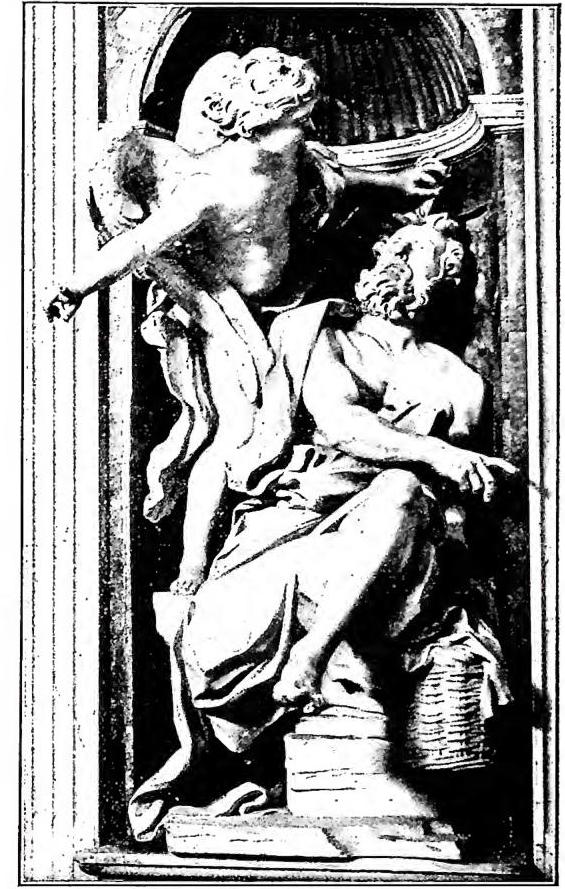
ABACUC – Sculpture by Gianlorenzo Bernini – Rome, S. Maria del Popolo, Chigi Chapel.
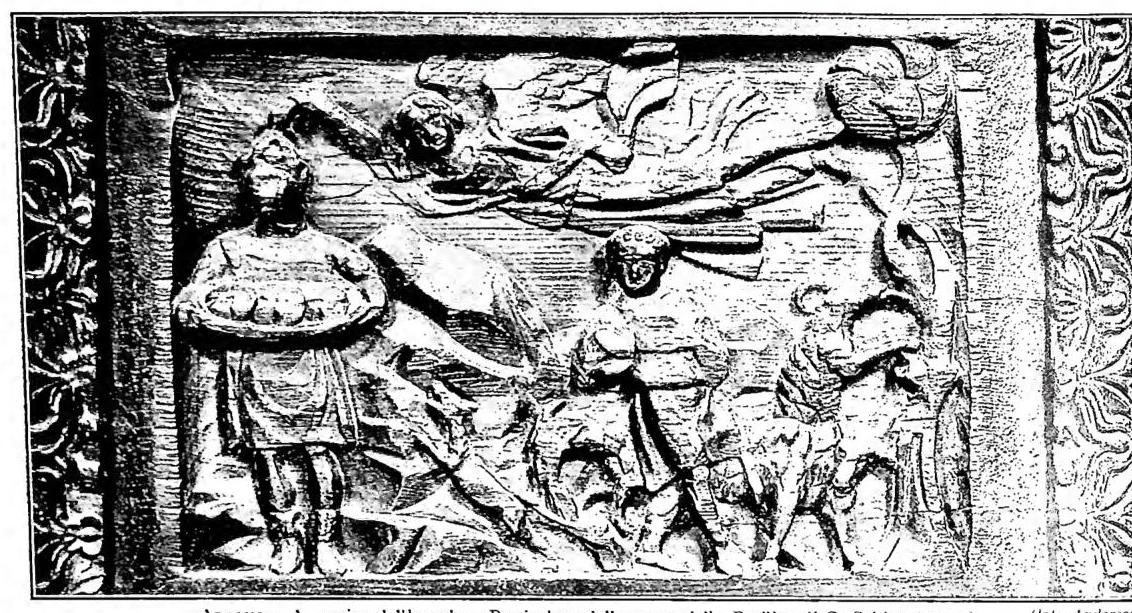
of the biblical text, are found in the 5th century, almost simultaneously in the East and in the West. A., appearing elderly, bearded, and pensive, is depicted in the apse mosaic of Hosios David in Thessalonica, in a theophany that would become a common type in the Byzantine cultural sphere, and, at the same time and with the same features, but accompanied by the angel, in one of the panels of the wooden door of S. Sabina in Rome. In the fantastic repertoire of Romanesque sculpture, A. again found favor, first in a portal of S. Fedele in Como, then in a capital of the rood screen of the cathedral of Modena, and finally, through the work of followers of Antelami, in a capital of the baptistery of Parma and in a relief in the cathedral of Fidenza. Among contemporary examples outside Italy, the one in a capital of the cloister at Arles deserves mention. He is often found together with the other prophets, as in a dome of S. Marco in Venice and perhaps in the cathedral of Milan and in the panels of S. Petronio in Bologna, although in these latter examples the lack of inscriptions does not permit a secure identification of A. among figures possessing more or less the same characteristics. Without altering the data of tradition, Donatello gave the statue carved for one of the niches of Giotto’s campanile an unusual intensity of thought and dramatic vitality. Later, representations of A. became quite rare. Among the few, one presents a certain
(Anderson)
Of some interest is the fine group by Bernini in the Chigi Chapel at S. Maria del Popolo in Rome, among the few examples. V. tav. I.
For A. in Christian archaeology, V. DANIELE.