Machine translation of the 1948–1954 Italian original. The original text is authoritative.
2. IN ARCHAEOLOGY
Unknown in cemetery painting, the offering of A. and Cain is represented by 14 funerary sculptures. Usually the two brothers appear with their gifts before God, represented with a beard,
seated upon a rock in the act of speaking. A.’s gift is always a lamb or a kid; Cain’s, which is a bunch of grapes in the oldest example, soon becomes a sheaf of ears of grain (cf. Gen., 4:2). Exceptionally, the divinity is represented by Jesus, or by two or three persons. The scene probably figured among the mosaics of the dome of S. Costanza in Rome. If, originally, funerary art seems to have seen in it the just man of the Old Testament, shortly after Constantine it interpreted it as the prototype of the sacrifice on the cross. It does not seem that the other allegorical interpretations of the patristic period, according to which Judaism would represent Christianity, and A. the shepherd the Bonus Pastor, were reflected in ancient art. A. and Cain figure among the titles of Prudence’s Dittochaeum. The fratricide depicted in the miniatures of the Cotton Bible inaugurates the subsequent development of this historical cycle.
BIBL.: Wilpert, Sarcofagi, I-II, Roma 1929-32, pp. 10, 83, 213, 225, 228-29, 275; K. Kaufmann, Handbuch der christlichen Archäologie, Friburgo in Br. 1922, pp. 300 e 419.
Luciano De Bruyne
3. IN RABBINIC LITERATURE
Rabbinic literature sees in A. and Cain the symbol of the rivalry between agriculture and pastoralism. A.’s corpse is guarded by a dog that drives away birds of prey (Pirqé R. Eliezer, 21). A raven covers the body of its dead mate with sand, and Adam decides to do the same with A.’s corpse. Birds and pure animals buried A. Therefore a blessing is pronounced when they are slaughtered. According to a tradition (Midraš Cant., ed. Schechter) recorded by s. Girolamo (In Ez. 27:18), the killing took place at the site where Damasco later arose (dam “blood,” šaqah “to drink”).
BIBL.: I. Aptowitzer, Kain und Abel in der Legende, Vienna 1922; I. Chanoch, in Enc. Judaica, I (1928), col. 211; M. J. bin Gorion, Sagen der Juden, Berlino 1935, p. 95 seg.; A. Rosmarin, Kain, in Enc. Judaica, IX (1933), col. 776 sg. Eugenio Zolli
4. IN ART
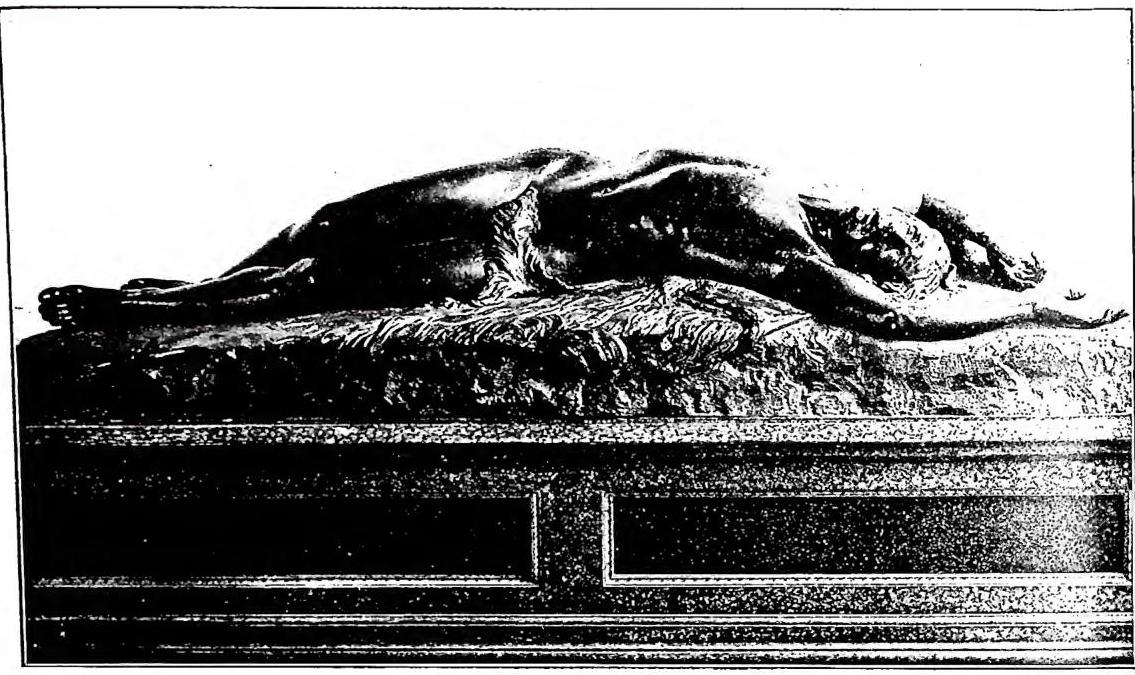
The story of A., which in cod. vati- ABELE. – A. Killed, bronze by G. Dupré – Florence, Galleria d'Arte antica e moderna. (photo Alinari)in the Vatican codex of Cosmas Indicopleustes (7th–8th century) appears as a Virgilian shepherd; it offered artistic imagination, with the scenes of Cain and A. in the act of the sacrifice and the subsequent fratricide, a subject that inspired countless works of art, from the miniatures of the Ashburnham Pentateuch (7th century, Paris) to the paintings of Titian (Venice, S. Maria della Salute) and Tintoretto (there, Galleria dell'Accademia). Both scenes are depicted at Hildesheim (bronze door, 1007–15), Modena (facade of the Duomo, 1106), and Schöngrabern (13th century). A more explicit illustration of the biblical account is provided by the mosaics of S. Marco in Venice, of the Palatine Chapel in Palermo, and of the cathedral of Monreale (13th century), by Ghiberti’s reliefs on the eastern door of the Florentine Baptistery, and by Bellano’s reliefs in the basilica of the Santo in Padua (1484–88). With symbolic significance, that is, as a prefiguration of the Eucharistic sacrifice, the sacrifice of A. is already found on three early Christian sarcophagi. In a mosaic of S. Vitale in Ravenna it is represented, with the same meaning, beside the sacrifice of Melchizedek. But at S. Apollinare in Classe (there, 7th century), in the sacramentary of Drogone (Paris, 9th century), and in the enamels of Eilbert’s portable altar (Monaco-Gladbach, 12th century), it is also accompanied by that of Abraham. – Vedi Tav. IV.
BIBL.: Th. Ehrenstein, s. V. in D. Alte Test. im Bilde, Vienna 1923; K. Künste, Ikonographie der christlichen Kunst, I, Freiburg im Br. 1928, 280–81; I. Errera, Répertoire abrégé d'iconographie, Wetteren 1929, pp. 5–7; L. Rogers, s. V. in Reallexikon 2. deutschen Kunstg., I, pp. 18–27. Kurt Rathe
Cite this article
“ABELE (EBR. HÉBEL; GRECO DEI SETTANTA ἈΒΕΛ).” Enciclopedia Cattolica, vol. I (1948), p. 67. Azione Romana digital edition, https://azioneromana.com/article/abele-ebr-hebel-greco-dei-settanta-abel.