
MELCHISEDEC. – King of Salem, probably Jerusalem (cf. Ps. 76 [75], 5), and priest of God (called ‘El-‘eljôn; cf. Num. 24, 16; Deut. 32, 8).
The Hebrew Malki-šedheq, transcribed by s. Girolamo as Melchisedec (A. Vaccari [V. BIBLICA.], p. 208), is explained by W. Gesenius and E. Kautzsch as “king of righteousness” (cf. Hebr. 7, 2); by many modern scholars: “my king is Šedheq,” the name of a Canaanite divinity, otherwise unknown (cf. ‘ădhônî-šedeq, Ios. 10, 3; P. Heinisch, Das Buch Genesis, Bonn 1930, p. 221).
M. went out to meet Abraham, returning from his victorious counter-raid against the kings of Mesopotamia, bringing bread and wine for refreshment to him and his 300 combatants (cf. Chrysostom: PG 53, 336); he blessed Abraham in the name of ‘El-‘eljôn, and Abraham in turn gave him a tenth of all the booty (Gen. 14, 17-20). The terms employed (the verb jāsā) and the very construction (ibid. 14, 18 s.) do not permit the conclusion that M. also offered the bread and wine in sacrifice; this may nevertheless be considered certain, in agreement with Jewish and Christian tradition, bearing in mind the ancient practice of consecrating the victory obtained by means of a sacrifice (A. Vaccari, P. Heinisch).
M. is a type of the Messiah (Ps. 110 [109], 4), to whom the same name, and that of the city, apply perfectly in the interpretation given by s. Paolo (Hebr. 7, 2). Like M., the Messiah is king and priest; no genealogy is given for M. (ἀγενεαλήγητος, Hebr. 7, 3),
which was instead necessary for the Levitical priesthood; thus the priesthood of Christ, because of its eternal origin, is not bound to any earthly kinship; the Messiah possesses it by native right and by investiture from God himself (cf. Hebr. 5, 4 ff.); therefore, forever. M. blesses Abraham and receives the tithe from him; he is consequently superior to the patriarch and to the Levitical priesthood descended from his loins; he is the type of the absolute superiority of Christ’s supreme priesthood over that of the ancient law (Hebr. 7, 1-28).
Catholic tradition furthermore sees in the sacrifice of M. a foreshadowing of the sacrifice of the Last Supper, renewed in the sacrifice of the Mass.
I melchisedeciani (ca. 200 d. C.) lo consideravano come «una grande potenza»; altri ne facevano un angelo dalle apparenze umane. La maggior parte dei Padri rigetta questi elementi fantastici.
Francesco Spadafora
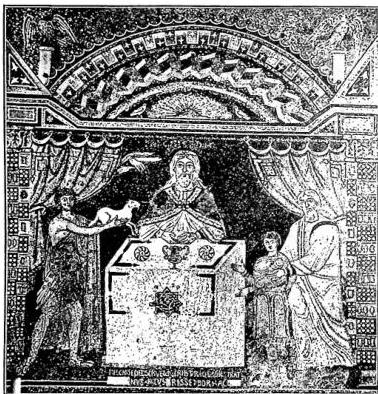
ICONOGRAPHY. - In primitive Christian art M., as priest and king, prefigures Jesus Christ (Ps. 109, 4; Hebr. 7, 1-17). In one of the mosaics of S. Maria Maggiore in Rome, M., in priestly vestments, offers bread and wine to Abraham returning victorious (Gen. 14, 14-20; Wilpert, Mosaihen, pl. 8). The same scene was represented in the Genesis of Vienna (f. 4, 8) and in that of Cotton (f. 21, almost entirely charred). In Ravenna, in the mosaics of S. Vitale and S. Apollinare in Classe, Abel and M. offer their gifts to the Lord.
Clement of Alexandria sees in the bread and wine offered by M. to Abraham the sanctified nourishment, as a figure of the Eucharist (Stromata, IV, 161, 3). S. Cyprian observes: « but who was truly more a priest of the Most High than Our Lord Jesus Christ? He offered to God his Father the same sacrifice that M. had offered, namely bread and wine, that is, his body and his blood » (Ep., 63, 4). In the miniature of the codex of Cosmas Indicopleustes, M. is represented haloed, praying, in royal vestments and crown (cod. Vat. gr. 699, f. 50). Later M. is depicted in the Palatine Chapel of Palermo and in S. Angelo « in Formis ». In the Sacramentary of Drogo of Metz, Abel, Abraham, and M. are depicted in the letter T of the Te igitur. In Jerusalem, in the chapel called that of Adam on Golgotha, there was an altar dedicated to M.