
ANGELO. — Spiritual creature, messenger (ἀγγέλος from ἀγγέλλο = announcement) of God and his minister in relations with human beings.
SUMMARY: 1. The a. in the Old Testament. — 2. The a. of Jahweh. — 3. The a. in the New Testament and in dogma. —
4. Devotion to the a
5. The feasts of the a
6. The a. in archaeology. — 7. The a. in art.1. THE A. IN THE OLD TESTAMENT. — In the Old
Testament, the Hebrew mal'akh (messenger) often means an intermediary being who serves as a link between man and God; the Septuagint translates it as ἀγγέλος. Only the Sadducees denied the existence of the a. (Act. 23, 8).
Many appearances of a. are described in the Bible, not only in visions or dreams, but within the context of external historical episodes. They appear, among others, to Hagar (Gen. 16, 7), Abraham (Gen. 18, 1-2; 22, 1-18), Lot (Gen. 19, 1), and Jacob (Gen. 28, 12). The Old Testament does not explicitly speak of the creation of the a., but it is implicit in the fact that the one God is described as the creator of all beings (Ex. 20, 11; Ps. 148, 2-5). They existed before man sinned in the earthly paradise: the presence of the cunning tempter in the form of a serpent (Gen. 3, 1-15) suggests the fall of the a. (transformed into demons), described in the New Testament. The cherubim placed to guard the garden of Eden appear as a., ministers of God (Gen. 3, 24).
It follows from the Bible that the a. are innumerable (Gen. 32, 2-3), constitute the “armies” of Jahweh (cf. the expression Jahweh sebhā'ath), are powerful, messengers and executors of the divine commands (Ps. 102, 20 ff.), intelligent (II Sam. 14, 20), and holy (Ps. 88, 6-8): for this reason they are called “sons of God” (Job 1, 6) and also “gods” in a broad sense (Gen. 33, 10), but they are infinitely distant from the one God, their creator, who finds imperfections in them (Job 4, 17 ff.).
They appear to human beings in human form (cf. Dan. 9, 21). Only the cherubim (v.) and the seraphim (v.) appear winged. They care for human beings: they save Lot (Gen. 19), Isaac (Gen. 22, 11), and the three young men in the furnace (Dan. 3, 49). They carry the prayers of human beings to God and bring back his graces (the vision of Jacob’s ladder, Gen. 28, 12). One of them, Raphael, acts as a visible guardian to the young Tobias (Tob. 5, 17). From the book of Daniel one may infer that individual nations (Israelites, Persians, Greeks) also have an a. (called šar, “prince”) as protector (Dan. 10,13, 20).
At times the a., by divine command, punish human beings (e.g.: Gen. 19, 11; II Sam. 24, 16-17). In Prov. 17, 11 mention is made of a cruel a. who will be sent by God against the sinner.
It does not clearly follow from the Old Testament that the a. are pure spirits. Ps. 103, 4 “Qui facis angelos tuos spiritus” concerns the winds, poetically presented as messengers of God. In certain Septuagint manuscripts, the sons of God who committed carnal sins with the daughters of men (Gen. 6, 2) are called ἀγγέλοι. This fact is both an indication and a cause of doubts, widespread in Judaism and among the ancient Christian writers, concerning the perfect spirituality of the a. (cf. G. E. Closen, Die Sünde der Söhne Gottes, Rome 1937). In the New Testament, on the other hand, the a. are presented more clearly as spirits (Hebr. 1, 14), invisible (Col. 1, 16), who have no carnal relations (Mt. 22, 30), and their fall is explicitly mentioned (Iud. 6; II Pt. 2, 4).
In the more ancient texts there are few traces of a hierarchy of a. In Daniel there is mention of angelic “princes,” among whom Michael and Gabriel are named (8, 10; 9, 21; 10, 13). In Tob. 12, 15 a third, Raphael, is mentioned as “one of the seven who stand before the Lord” (cf. Apoc. 1, 4; 4, 5). In the Greek version of Dan. 12, 1, Michael is called ἀρχάγγελος; the “archangel” (v.) occurs in I Thess. 4, 14 and in Iud. 9. Besides the cherubim and seraphim known from the Old Testament, the New Testament alludes to classes called thrones, dominions, virtues, principalities, and powers (Col. 1, 16; Eph. 1, 21; 3, 10); but the hierarchical distinction is not clear. In the apocrypha, classification and nomenclature reach fantastic proportions: Enoch lists no fewer than 150 names of a.
The origin of angelology has been the subject of many studies. Almost all known religions believe in intermediary beings between man and the Divinity. Some scholars of the history of religions maintain that originally the Hebrews believed in the existence of certain minor divinities, which were subsequently downgraded to the rank of a. when Israel passed from polytheism or polydaemonism to monotheism. This thesis, which is based on the purely natural evolution of the religion of Israel, is refuted by the most recent investigations. If there were polytheistic traces in the doctrine concerning the a., the prophets, fierce opponents of polytheism, would not have favored it so strongly. Others assert that the angelology of the Hebrews is a syncretistic synthesis of Assyro-Babylonian and Persian elements, augmented by Greco-Roman demonological conceptions in the New Testament and in ancient Christian literature (cf. U. Fracassini, A., in Enc. Ital., III, pp. 297-302). But this is refuted by the fact that belief in the existence of the a. is already presupposed in the oldest books of the Bible. It is true, moreover, that Jewish angelology developed especially from the fifth century B.C., with the growth of knowledge of God’s absolute transcendence and through the contribution of certain Persian and Hellenistic Eastern conceptions. These developments are already noticeable in the Septuagint version and especially in apocryphal literature, as well as in Philo and among the Essenes.
2. THE A. OF JAHWEH (Hebr. Mal'āhī J.) — In various passages of the Old Testament there occurs an a. who presents himself
as a divine messenger (of Jahweh or Elohim) and at the same time speaks and acts as God. He makes promises as Jahweh himself (Gen. 16, 10-13; 21, 17-19; 22, 11-17), identifies himself with God (Gen. 31, 11-13; 48, 15-16; Ex. 3, 2-4, 10 [*Act. 7, 31-35]; Iud. 2, 1-4; 6, 11-24; 13, 6-23; Zach. 3, 1-6). At the end of the “covenant code,” Jahweh promises “his a.” who will lead Israel (Ex. 23, 20-23), the “a. of the covenant” (Mal. 3, 1). At times the a. of Jahweh is clearly distinguished from Jahweh (Ex. 33, 2-6; Num. 22, 31; II Sam. 24, 16). After s. Irenaeus (Adv. Haer., 4, 20; Demonstr., 45), many Greek and Latin Fathers saw in the a. of Jahweh a manifestation of the Word; Origen is very explicit on this point: Hom. in Gen., 8, 8; Tom. I in Io., 34; Tract. de ll. ss. Scripturarum, ed. P. Batiffol, Paris 1900, p. 33. S. Jerome, s. Augustine, and s. Gregory the Great, followed by the scholastics (s. Thomas, De Potentia, q. 6, a. 8 ad 3, and In Ep. ad Hebr., cap. 2, lect. 1) and by many modern theologians (Suárez, De Angelis, VI, 20; A. Lapide, In Exodum*, III), see in him instead a created
a. D. Petavius collected the opinions of the Fathers in Theologic. Dogmatum, vol. 3: De Angelis.
P. Heinisch observes that the ancient Israelites identified the angel of Jahweh with Jahweh without raising the question, and refrains from offering explanations. M.-J. Lagrange holds that the term angel of Jahweh was interpolated later into the texts in which the appearance of Jahweh was spoken of, in order to explain II. According to certain recent Protestants (F. Hitzig, W. H. Kosters, K. Marti, R. Smend, etc.), until the Exile the angel of Jahweh was simply the appearance of Jahweh, and only later came to signify one of his messengers. Today the discussion is very lively. Besides various Protestants (R. Kraetzschmar, W. Novack, E. König), the majority of Catholics (J. Knabenbauer, in Is. 63, 9; J. Rybinski; more decisively F. Stier) maintain the distinction between Jahweh and the created angel who represents him (the theory of substitution). But, following A. van Hoonacker and J. Touzard (according to whom the ancient Hebrews did not distinguish between the angel of Jahweh and Jahweh, but later attributed the theophanies to an angel in order to safeguard the transcendence of God), B. Stein, limiting his investigation to the angel of the Exodus (Ex. 3, 2; 14, 19; 23, 20-3; 32, 34; Num. 20, 16; Ios. 5, 14; Iud. 2, 1-4; Is. 63, 9; Mal. 2, 17; 3, 1), advocates identity: the angel of Jahweh is the same omnipresent God who emerges from his transcendence in order to appear and act in a place, and the expression was the most appropriate for distinguishing between God, immutable and invisible by nature, and God who manifests himself personally in time and space.
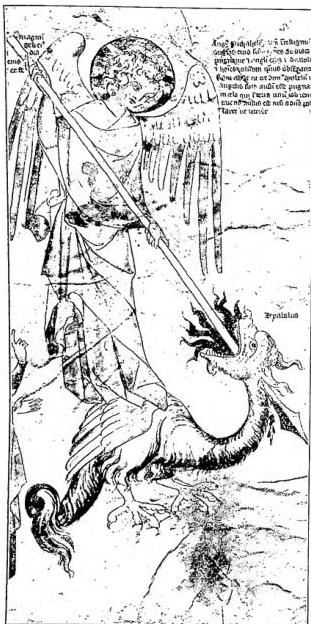
(phot. Museo Nazion, Germanico)
ANGELO - A. slaying the dragon. Drawing on parchment from the 14th century - Nuremberg, Germanic National Museum.
110: A. Lemonnier, Angéologie chrétienne (for the N. T.), in DBs, I, cols. 255-62; H. Lange, Engel, in LThK, III, cols. 672-76; J. Bonsirven, Le Judaïsme palestinien au temps de J.-C., I, Paris 1934, pp. 222-39; L. Lanzoni, Gli a. nella Divina Scrittura, Domodossola 1935; E. Langton, The Ministries of the Angelic Powers according to the Old Test. and later Jewish Literature, London 1936; id., The Angel Teaching of the New Test., there 1937; P. Heinisch, Theologie des Alten Testamentes, Bonn 1940, pp. 100-107; G. Philips, De angelis in Antiqua Testamento, in Evangelio, sec. 1. Paulum, in Revue ecclésiastique de Liège, 31 (1940), pp. 44-52, 172-79, 226-34.
For the a. of Yahweh: M.-J. Lagrange, L'ange de Jahvé, in Revue Biblique, 13 (1903), pp. 212-25; J. Touzard, Ange de Jahvé, in DBs, I (1928), cols. 242-55; id., in Revue Biblique, 36 (1927), pp. 764-65, 181-83, 186-88; J. Rybinski, Der Mal'ah Jahvé, Paderborn 1930; F. Stier, Gott und sein Engel im Alten Testament, Munich 1934; B. Stein, Der Engel des Auszugs, in Biblica, 19 (1938), pp. 286-307; P. Heinisch, Theologie des Alten Testamentes, Bonn 1940, pp. 75-77. - On the relations between the a. of Yahweh and the divine Word: F. Cavallera, *Une prétendue con-
troverse sur le Christ-Ange, in Recherches de Science religieuse, 2 (1911), pp. 36-50; D. Finestone, Is the Angel of Jehovah in the Old Test. the Lord J. C.?, in Bibliotheca Sacra, 91 (1938), pp. 372-77; J. Barbel, Christus-Angelos: die Anschauung von Christus als Bote und Engel in der gelehrten und vollbeständlichen Literatur des christlichen Altertums (Theophaneia), 31, Bonn 1941.
Antonino Romeo
3. THE A. IN THE NEW TESTAMENT. - In the New Testament, essentially the same ideas as in the Old Testament are found. But the ministry of the a. appears within a new framework, of which the following are some of the more notable points: 1) The a. always form God’s court. If they are present throughout the whole life of Jesus, it is precisely because he is God and with him the kingdom of God has descended upon earth. This presence of the a. is especially conspicuous at the nativity of Jesus (the annunciation to Mary, appearances to Joseph, the appearance to the shepherds, the flight into Egypt and the return to Galilee), at the beginning of his public ministry (Mt. 4, 11), in the Passion (Mt. 26, 53; Lc. 22, 43), in his triumph at the resurrection and ascension (Mc. 16, 5; Lc. 24, 23; Io. 20, 12; Act. 1, 10), at the future judgment (Mt. 13, 39, 41, 49; 16, 27; 24, 31; 25, 31; Mc. 8, 38), and in the definitive triumph of heavenly glory (Apoc. 1, 11; 8, 2 sgg.). - 2) The a. are subject to the Son. In the Epistles, especially those of Paul, against the danger of certain Gnostic-Jewish tendencies that exaggerated the importance and worship of the a., emphasis is placed on their subordination to Christ (Col. 2, 14 sgg.; Gal. 3, 19; Hebr. 1, 14 sgg.). In St. Paul, angelology is closely connected with soteriology and Christology. - 3) The subordinate mediating work of the a. between God and earth nevertheless remains of the greatest importance, both socially and individually. They are the particular protectors of the apostles and of the Christian community. Special mention is made of «the a. of the Lord», particular protector of the new Israel, as he had been of the ancient one (Act. 5, 19; 8, 26; 10, 3 sgg.; 12, 7 sgg.; 27, 23). They are protectors of individuals, or guardian a. (Mt. 18, 10; Act. 12, 15); they take the greatest interest in the salvation of every human being (Lc. 15, 10); they are sent by God for the «service» of men (Hebr. 1, 14). - 4) Regarding the nature and condition of the good a., the following may be noted. They appear in white and shining garments (Io. 20, 12; Act. 1, 10; 12, 7), signifying their celestial nature. In Jesus’ statement that the a. protecting children «always see the face of the Father» (Mt. 18, 10, with reference to Ex. 33, 18 sgg. and to the discussions to which this question had given rise among the rabbis; cf. H. Strack-P. Billerbeck, Das Evangelium nach Matthäus erläutert aus Talmud und Midrasch, Munich 1922, p. 783 sgg.), some see an affirmation that the a. enjoy the beatific vision. Others point to their elevation to the supernatural order from the fact that the future happiness of the elect is likened to that of the a. and will be enjoyed in their company, a company already begun here below, whereby we are their fellow citizens (Hebr. 22, 12). The knowledge of the a. is limited and admits of progress (Mt. 24, 36; Mc. 13, 32; Eph. 3, 10; I Tim. 3, 16). Their number is immense (Hebr. 12, 22; Apoc. 5, 11). There is also a certain diversity among them; the following are named: a., archangels, thrones, dominions, virtues, principalities, powers that dwell in the supraterrestrial regions (Eph. 1, 21; 3, 10; 6, 12; Col. 1, 16-20).
The patristic tradition. - Jewish and Hellenistic ideas sometimes exerted a considerable influence on certain conceptions of various ecclesiastical authors in the field of angelology. Hellenistic influence was greater in demonology than in angelology properly so called. The principal points are as follows: 1) The perfect spirituality of the a. began to be correctly conceived above all from the 6th century onward with pseudo-Dionysius. Before that, and sometimes even afterward, it was more glimpsed than clearly affirmed. The a. were attributed an extremely subtle ethereal body. - 2) In the question of the knowledge possessed by the a., the Neoplatonic theory of illumination exerted a notable influence, especially in Augustine. Opinions remained divided as to whether the a. had foreknowledge of the Christian mysteries, especially the Incarnation. Before Augustine, the negative view was generally held. - 3) Likewise, before Augustine some held that the a., after the first trial, had not been definitively determined toward the good, and that they could therefore still fall, be punished, or merit reward. - 4) Under the influence of the Jewish exegesis of Gen. 6, 2 (pseudo-Enoch), several held that the sin of the fallen a. had been carnal sin. - 5) Opinions also differed regarding the celestial hierarchy: Origen derived it from diversity of functions and merits; Methodius, and many others after him, from a metaphysical diversity of natural constitution. Pseudo-Dionysius divided it into a hierarchy of three choirs each. - 6) It is generally held that all a. may be sent on missions among men, but pseudo-Dionysius, and certain others after him, admit this only for a. of the lower category. Often, under the influence of pseudo-Enoch, and perhaps also of the Hellenistic milieu (Stoic panpsychism and popular beliefs), a protecting a. was assigned not only to every individual, nation, and community, but also to every material element of this world—an idea that others, however, rejected. Others, finally, such as Augustine, under the influence of certain Hellenistic theories (the Peripatetics, Philo, Plotinus), asked whether the stars might not be animated by moving a. - 7) As long as the pagan danger lasted, the Fathers were generally very cautious about permitting the worship of the a.
Scholastic theology. - The great development that angelology underwent in the twelfth and thirteenth centuries was caused chiefly by the application to traditional and scriptural data of Aristotelian metaphysics and psychology, and of certain theories of Arab philosophers concerning separate substances. S. Tommaso has a notable treatise on the a. (Sum. Theol., 1ᵃ, qq. 50-64. 106-14; De substantiis separatis, ed. P. Mandonnet, Opuscula omnia, I, Paris 1927, pp. 70-144). The diversity of currents within scholasticism influenced angelology. Thus Scoto represents the tendency opposed to S. Tommaso, while Suárez later adopted an intermediate position, often eclectic in nature. The questions most widely debated among the scholastics were: 1) the composite or simple nature of the a. and their relation to space; 2) the analysis of their act of knowledge and will; 3) the state in which they were created and the moment of their elevation to the supernatural order; 4) the nature of their trial; 5) the cause of the differing degree of beatitude granted to them; 6) their hierarchy; 7) mutual illumination and speech; 8) their action upon nature and man. Angelology thus assumed a highly metaphysical character and provided an occasion for clarifying the philosophical concepts of spirit, matter and form, intellectual knowledge, and will.
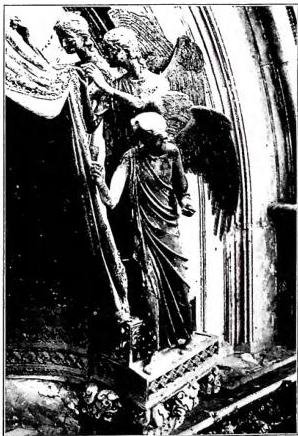
(properly D. Degenhart)
ANGELO – Group of angels in bronze, on the façade of the cathedral of Orvieto – L. Maitani (early fourteenth century).
in a place, what the measure of their duration is, depends on philosophical presuppositions which, from the standpoint of dogma, are secondary. It is certain that the angels naturally possess limited knowledge; they do not naturally know the strictly divine mysteries, and they have complete free will. — 7) The angels have been elevated to the supernatural order, whose end is the beatific vision of God. This follows from the ordinary teaching authority interpreting Scripture and tradition. This elevation is gratuitous (condemnation of the doctrine of Baio; cf. Denz-U., 1001 ff.), but there is debate concerning when it took place: St. Thomas maintains that it occurred at their very creation; other scholastics assert that it occurred after a certain period. It is also a matter of faith that the angels had to undergo a trial; but precisely what the trial was, and how and how many angels fell, is not known. After the trial, the time for meriting came to an end for them; the good angels enjoyed and continue forever to enjoy the beatific vision, while the evil angels were condemned to eternal punishment. This too is a matter of faith. — 8) The ministries of the angels are, toward God, to adore, praise, and serve him; this is a matter of faith. It is equally a matter of faith that they are ministers of God to human beings. — 9) The existence of guardian angels, who have the special ministry of protecting human beings, is certain. Tradition and the ordinary teaching authority have always admitted that at least every Christian (therefore from Baptism onward) has his guardian angel. It is also the common opinion today that every human being (from birth onward) has his own, which never abandons him. Many Fathers also attributed one to every nation and community. — 10) The worship of the angels is legitimate. This is a matter of faith according to the ordinary teaching authority interpreting tradition, especially from the fifth century onward (condemnation of the Iconoclasts at the Second Council of Nicaea, cf. Denz-U., 320, and of the Protestant doctrine concerning the worship of the saints at the Council of Trent, ibid., 984 f.).
For the doctrine from the fifth century to St. Thomas: F. Suárez, De Angelis, Louvain 1620; F. Frassen, Scotus academicus, IV, Rome 1900; Cl. Bacumker, Witelo, Münster 1908, p. 523 ff. (important for the scholastic milieu of the thirteenth century); A. Vacant, Angélologie dans l'Église latine depuis le temps des Pères jusqu'à s. Thomas, in DThC, I, II, col. 1222 ff.; id., Angélologie de s. Thomas d'Aquin et des scolastiques postérieurs, ibid., cols. 1228-48.
For the more recent doctrine: Joannes a s. Thomas, Cursus theologicus, ed. Vivès, IV, Paris 1884, p. 559 ff.; J. K. Oswald, Angélologie, 2e ed., Paderborn 1889; W. Lucken, Michael, Göttingen 1898 (concerning the guardian angels of peoples); L. Janssens, Tractatus de Deo creatore et de Angelis, Freiburg im Breisgau 1905; E. Caretti, Gli angeli, Bologna 1925; Chr. Pesch, Die Hl. Schutzengel, 2e ed., Freiburg im Breisgau 1925; P. A. Arrighini, Gli angeli buoni e cattivi, Turin 1937; J. Duhr, Anges, in DSp, I, col. 586 ff.; J. Bernhart, Der Engel des deutschen Volkes, Munich 1939; H. Leclercq, Anges, in DACL, I, 2e partie, cols. 2080-2161 (especially concerning worship: col. 2144 ff.). — For the other exegetical details, v.: G. Kurze, Der Engels- und Teufelglaube des Apostels Paulus, Freiburg im Breisgau 1915; F. Prat, La théologie de s. Paul, II, pp. 493-502; A. Lemonnier, Angélologie, in DBs, I, cols. 255-62. Cipriano Vagaggini
6. DEVOTION TO THE A
The earliest Fathers of the Church denied the angels the worship due to God, but not every form of worship; in this regard, one must bear in mind their concern to protect newly converted Gentiles against a return to the false worship of the Genii. Origen, in arguing with Celsus, maintains that Christians do not adore the angels, but render them worship (θεραπεύειν), provided that this word is properly understood (C. Cels., VIII, 13: PG 11, 1533 c). In St. Justin (I Apol., 6: PG 6, 336 c) and Athenagoras (10: PG 6, 909 b) are found the earliest testimonies to the worship of the angels. Ambrose exhorts the faithful: « Obsecendi sunt angeli pro nobis, qui nobis ad praesidium dati sunt » (De Viduis, cap. IX, 55: PL 16, 264 c). Augustine states succinctly: « Honoramus eos (ingelos) charitate, non servitute » (De vera relig., 55, 110: PL 34, 170), understanding by « servitus », Greek « λατρεία », the worship due to God alone. Canon 35 of the Council of Laodicea (fourth century), if properly understood, is not opposed to right devotion toward the angels (Hefele-Leclercq, I, p. 1017). Didymus of Alexandria (d. 395) attests that, from the earliest Christian times, churches and oratories arose consecrated to God under the name of the archangels (De Trinit., II, 8: PG 39, 591 A. B). In Constantinople, after Constantine, about fifteen churches were dedicated to St. Michael. In the time of Gregory the Great, worship of the angels and of St. Michael had a center on Monte Gargano; another center arose in France (eighth century) on Mont Saint-Michel. In Rome (ninth century), seven oratories were dedicated to the same archangel. St. Benedict contributed to spreading faith in the assistance of the angels: in his Rule he reminds the monks that the divine office is recited in the presence of God and the angels (cap. 19).Particular impetus to this devotion was given by s. Bernardo, whose words the Church makes her own in the Breviary (feast of the guardian a., 2 Oct., lect. 4–6). His comprehensive formula reflects the uninterrupted tradition of the Church: to the a. we owe « reverentiam pro praesentia, devotionem pro benevolentia, fiduciam pro custodia » (In ps. « Qui inhabitat », serm. XII, 6: PL 183, 233 c). From the 12th to the 17th century, scholastic theologians, rather than dwelling on worship, investigated the angelic nature. But by then devotion had entered the common practice of the faithful. From as early as the 13th century, prayers for the guardian a. were widespread; they were published by A. Wilmart. Particularly widespread were Gersone’s little work Sermo de Angelis (Op., III) and the seven Sermones of Dionigi il Certosino on s. Michele and the a. (Op., XXXII, Tournai 1906). The latter echoes the thought of s. Bernardo, establishing our relations with the a.: « diligendo (eos) cordialiter, quotidie honorando, assidue invocando, imitando, eis collaborando » (Sermo de Sanctis, ibid., pp. 351 and 421–45). Lutero and Calvino, after the worship of the saints, rejected that of the a. But this devotion received fresh impetus through the work of the Society of Jesus. S. Ignazio recommends that his religious imitate the purity of the a. (Reg. Summ., 28). Through the work of the Jesuits, especially in the 17th century, treatises and manuals of piety concerning the a. multiplied. We mention only: Trattato e pratica della Devozione agli a. by s. Francesco Borgia and the widely circulated Trattato dell'A. Custode by p. Francesco Albertini. Card. De Bérulle and ven. Olier also contributed greatly to spreading this devotion. Worthy of note is the recent theological appeal by E. Peterson concerning devotion to the a., executors of the heavenly liturgy and mediators of the union of the faithful with God.
7. THE FEASTS OF THE A
At Constantinople the « synaxis » of all the a. ἀσωμάτιον is celebrated on 18 Nov. and 11 Jan.In ancient times the guardian a. were honored together with s. Michele: 29 Sept. in the West and 8 May in the East. Their particular feast, instituted by Paolo V (1608) for the States of the Austrian Empire, was extended to the whole Church by Clemente X (1670). Leone XIII raised its rite (1883 and 1893). From the 9th century onward, the Sacramentaries established the votive Mass of the a. for the first free day after the one dedicated to the Most Holy Trinity or to one of the three Persons. When Sunday was reserved for the Most Holy Trinity, Monday was consecrated to the a. (15th century); it is now Tuesday. Devotion to the a., particularly to the guardian a., after the 17th century became one of the devotions most familiar to the Christian people. The Angelo Dei, a concise expression of medieval prayers from the 11th–13th centuries, published by A. Wilmart, is its most evocative expression.
6. THE A. IN ARCHAEOLOGY. — The first representation of the a. in Christian iconography, corresponding to the meaning of the name (ἄγγελος), is in the form of a messenger Annunciation (v.), preserved in the cemetery of Priscilla and dating from the end of the 2nd or the beginning of the 3rd century. In it we also find, already definitively, the type that would dominate in art: a human figure of youthful appearance, almost always beardless, in sacred clothing, namely a white tunic and pallium, in accordance with the Gospel texts (Mt. 28, 3; Io. 20, 2; Apoc. 15, 6; Act. 10, 30). In a fragmentary painting in a hypogeum between S. Callisto and S. Sebastiano, two young men in tunic and pallium flanked the inscription of the deceased; beside the surviving figure one reads angelus (Wilpert, Sarcofagi, p. 353). In funerary sculpture the a. represents divine assistance; thus it appears: in the sacrifice of Isaac (Wilpert, op. cit., pl. 217, 240); in the scene of the three youths saved from the flames, according to Dan. 3, 49 (Wilpert, op. cit., 262 ff., pl. 129, 2); in that of Daniel in the lions’ den; of Balaam’s ass (here the a. is bearded and wears the garb of the apparitores); of David and Goliath (Wilpert, op. cit., 264, pl. 194, 1–2), in which it also appears winged (Garrucci, Storia, V, pl. 341, 4); and in that of S. Pietro in prison (Wilpert, op. cit., p. 118, pl. 116, 3). Two a. also appear on a sarcophagus lid now in the Lateran Museum (Wilpert, op. cit., 251, 3). Later they replace the winged victories, as on two sarcophagi in the crypt of S. Vittore at Marseille; on the first, two winged a. in flight support a disk in which Jesus Christ the teacher is seated (Wilpert, op. cit., pl. 43, 4); on the other, two winged a. standing support the triumphal crown enclosing Christ the teacher (Wilpert, op. cit., p. 57, fig. 24). This motif would be taken up again in S. Vitale at Ravenna and on a rare Christian sarcophagus from Constantinople.
In non-funerary sculpture the a. appears to the pious women at the Tomb, according to Mt. 28, 2–8 (Ravenna, S. Apollinare nuovo, Trivulzio ivory in Milan, etc.).
Two 6th-century slabs, probably belonging to the decoration of the church of the Theotokos at Carthage (v.), present the winged a. announcing to the shepherds the birth of the Savior (Wilpert, op. cit., fig. 276 and pl. 298, 1) and the winged a. present at the offering of the Magi (Wilpert, op. cit., pl. 298, 2).
Just as in various imperial representations the sovereign appears surrounded by his retinue (the scene of the congiarium on the Arch of Constantine), so in certain majestic scenes the Lord or the Madonna enthroned are attended by the a. (the triumphal arch of S. Maria Maggiore and S. Maria Antiqua).
The type of the adoring a. is found on the triumphal arch of the basilica of S. Paolo on the Via Ostiense (442–60); with the six-winged cherubim in the miniatures of the Vatican codex of Cosma Indicopleuste (the vision of Isaiah); the angelic host also appears in the Last Judgment. In S. Vitale at Ravenna, two haloed a. support a medallion with a jeweled cross; in the Murano diptych, the cross is in the triumphal crown. In the mosaics of S. Maria Maggiore the a. has a face, hands, and feet of fiery red (Hebr. 1, 7; Sedulio, Carm. Pasch., V, 328; PL 19, 740). In S. Apollinare nuovo at Ravenna, in the mosaic depicting the separation of the flock (Mt. 25, 32), the Lord is attended by two winged and haloed a.; the a. on the right, with the sheep, is entirely red, while the one on the left, with the goats, is entirely dark bluish-violet. Kirschbaum recognized in the red a. the a. of light, who dwells in the starry region, in the ether; the blue a., on the other hand, is in the air, whose substance has no light; it is the a. of darkness (Riv. Arch. Crist., 17 [1940], pp. 209–48). The opposition of red a. and blue a. would later recur in European art between the 14th and 15th centuries and in Eastern icons up to the 17th. Distinction of colors according to the categories
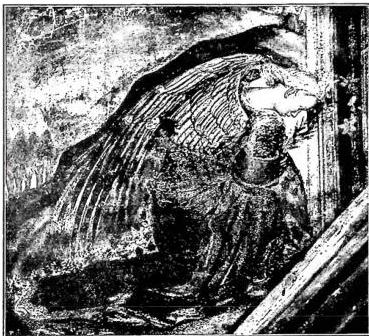
ANGELO - Announcing angel. Fresco by Pisanello (15th century). Verona, church of S. Fermo.
In ancient Christian inscriptions, the deceased is wished pax cum angelis; a deacon is wished to be angelorum hospes; of those who died at a tender age it is said that they were accessitus or raptus ab angelis; of a woman it is stated that she was angelicae legis docta; in metrical inscriptions the angelici chori are recalled. The early Christians sometimes adopted the Jewish practice of using the names of the angels to ward off evil spirits. They used the abbreviation XMI (Χριστός, Μιχαήλ, Γαβριήλ); they often placed in their tombs sheets of gold, silver, or other metal filled with the names of angels and with incantations. Famous is the gold sheet found in the sarcophagus of the empress Maria, wife of Honorius, bearing the graffito Michael, Gabriel, Raphael, Uriel.
On the island of Tera (Cyclades), a group of 48 Christian epitaphs contains dedications to the angels who protect or guard the Sepulchre.
8. THE ANGEL IN ART
The oldest representation of the tetramorphs dates from the 6th century, on the columns reused in the ciborium of S. Marco in Venice; they were variously repeated in illuminated manuscripts, mosaics, and frescoes, down to the 13th-century example in the crypt of the cathedral of Anagni, without substantial iconographic variations. The angel in tunic and pallium likewise retained unchanged characteristics from the 5th to the 9th century (SS. Cosma e Damiano; S. Maria Antiqua; S. Prassede; S. Maria in Domnica).Around the 12th century, art began to instill life and movement into the figures. If the angels of the door of the cathedral of Pisa, the work of Bonanno, still appear awkward, those of the 13th-century mosaics in the dome of the Baptistery of Florence, or of the contemporary sculptures of the French cathedrals, are more lively and graceful. From that century onward, and even more in the 14th century, iconographic schemes were stretched, and the artists’ imagination gave the angels varied feelings and freedom of posture. Thus, from Cimabue to Cavallini and Giotto; from Orcagna in the Strozzi Chapel at S. Maria Novella, to the Maestà of Duccio and Simone Martini at Siena and the representations in the Camposanto of Pisa, the angels emerge from their schematism and transcendent impassibility in order to participate in the spirit of the composition.
In the 15th century, the angels of Beato Angelico reconciled the medieval type of angel with the increasingly humanized type of the Renaissance painters, from Masaccio to Filippo Lippi and onward to Luca Signorelli, Melozzo, and Perugino. Having by then abandoned the traditional garments of classical origin, they are often represented playing various instruments (musician angels), that is, as the authors of that celestial music in which, perhaps as a reflection of Renaissance Neoplatonism, the order and blessedness emanating from the Divinity were embodied. The best-known types are those of Melozzo da Forlì, Angelico, and Giambellino. The example of the angels who, with the sound of trumpets (trumpeting angels), summon souls to the Last Judgment provided the basis for the development of the theme in accordance with the ideas and tastes of the period.
In the 16th century, alongside the angels who served as a pretext for expressing an ideal of flourishing youth, a new type began to appear: at first the angel became a winged putto accompanying Christ and the Virgin in their ascent into heaven; then, becoming still more dematerialized in the theophanies of the Counter-Reformation, it was finally reduced to a simple winged head, merging with the iconography of the cherub. Giovanni da S. Giovanni, in the apse of SS. Quattro Coronati in Rome, left a characteristic example of an angel in feminine form (the choir known as that of the angiolette).
The traditional type, however, remained in favor: from Reni’s musician angels (Rome, S. Gregorio) to those of Bernini and the Berninesque angels on Ponte S. Angelo, each supporting a symbol of Christ’s Passion. Bernini, especially in the group of S. Teresa and in the Cattedra di S. Pietro, defined the type of angel with ephebe-like features derived from Correggio. More recent production has since introduced no iconographic modifications worthy of particular note. - Vedi Tavv. CXVII-CXVII.