
PRISCILLA, CEMETERY of. — On the Via Salaria nuova (today, entrance at Via Salaria 430). It is mentioned in the Depositio martyrum and in the Leonine Sacramentary
—
and Filippo (10 July), and in the Depositio episcoporum for the popes Marcellino (16 January, the date of the deposition of Marcello, buried in the same cemetery, as indicated in the Lib. Pont., ed. Duchesne, I, p. 164) and Silvestro (31 December). The Lib. Pont. also indicates as buried
(photo Pont. comm. arch. 1879)
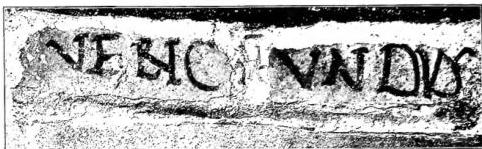
PRISCILLA, CEMETERY of — Inscription of Vericundus (2nd century), painted in red on roof tiles. The monogrammatic M may signify Memmius; others have thought of Martyr — Rome.
also in P. the popes Liberio (352–66), whose funerary poem G. B. De Rossi claimed (Bull. arch. crist., 1883, pp. 5–60; Inscr. christ., II, I, Rome 1888, pp. 83–84); Siricio (384–99), indicated as having been laid to rest “ad pedes” of Silvestro (Notitia ecclesiarum in R. Valentini and G. Zucchetti, Codice topografico della città di Roma, II, Rome 1942, p. 77), whose metrical eulogy is also known (G. B. De Rossi, Inscr. chr., II, pp. 102, 138); Celestino (422–32), buried in a mausoleum to the right of the Basilica (Notitia eccles. cit., p. 77), in which, at the time of Adriano I (772–95), the decorative frescoes could still be seen and the funerary poem was transcribed (G. B. De Rossi, Inscr. chr., II, pp. 62, 101); Vigilio (537–55), laid to rest near S. Marcello (for the various popes cited, cf. Lib. Pont., I, pp. 208, 216, 230, 299).
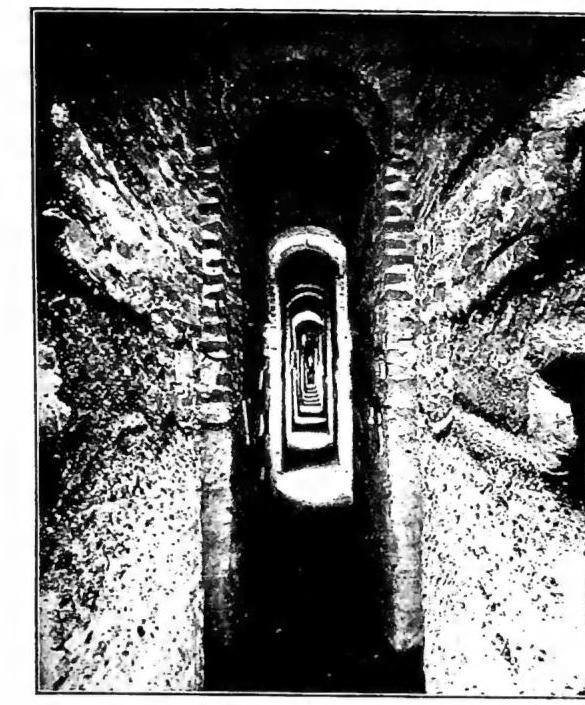
In the biography of Pope Marcellino, the Lib. Pont. attests that he was laid to rest in the cemetery beside the body of the martyr Crescenzione, in a cubiculum illuminated by a skylight, still accessible in the 6th century. G. B. De Rossi identified its location through a graffito invoking the martyr; this was later confirmed by an inscription of two spouses, Felicissimo and Leoparda, who purchased a two-person tomb at (ad) Crescentionis introitum. The pilgrims of the 7th century also point out other martyrs’ tombs: the Notitia ecclesiarum marks out Prisca, Potenziana, Prassede, and Fimite in a cubiculum near the exit; the itinerary de locis and the Notitia portarum add a s. Paolo and a s. Simetrio (R. Valentini and G. Zucchetti, op. cit., pp. 77, 116–17, 144). The cemetery appears to consist of a large Christian burial area in the open air, in which, in 1890 and 1905, the remains of two Christian basilicas and a series of mausoleums or oratories were identified; these suffered damage during the barbarian invasions. The underground section consists, on the first level, of a series of hypogea, originally independent and later interconnected, and of a later second level excavated with great regularity beneath the area of the first, with a large independent staircase.
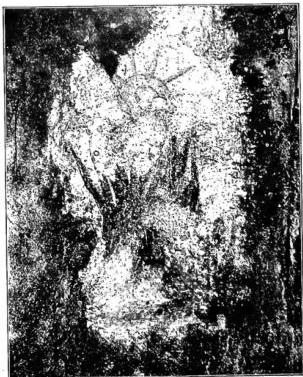
One of the oldest regions is that known as the cryptoporticus (2nd century), with an entrance at ground level from the Via Salaria, within the heart of the hill. Here a series of cubicula were constructed, some covered with stucco, and especially the so-called Greek Chapel (named after two Greek inscriptions painted in red), which contains the oldest cycle of frescoes, partly classical in type, such as the personifications of the seasons and the phoenix with a radiate nimbus, discovered in January 1952 by the Benedictine Sisters of P.; partly with scenes from the Old Testament (Noah, the Sacrifice of Abraham, the miracle of the spring, the three youths in the furnace, Susanna in two large frescoes, Daniel among the lions) and from the New Testament (Epiphany with the three Magi, the healed paralytic, the resurrection of Lazarus). On the back wall is the fractio panis discovered by G. Wilpert: seven figures are seated around a table, on which are placed a double-handled chalice and a dish with fish; the first person on the left is breaking bread; on the two sides of the table are arranged the seven baskets symbolizing the multiplication of the loaves. For G. Wilpert, the scene is the act of the Eucharistic meal; for P. Styger and F. X. Dölger, a funerary banquet. The room adjoining the chapel was judged by A. Profumo to be a baptistery, and by P. Styger to be a kitchen.
A second region was identified by G. B. De Rossi as the hypogeum of the Acilii Glabriones; it has niches for sarcophagi with decorations from the period of the early Antonines, together with later additions and modifications. Here, in the pavement, is the Greek inscription noteworthy for its doxology: “O father of all that you have created, you have taken Irene, Zoe, and Marcello to yourself; glory to you in Christ”; another epigraph, also in Greek, ends with the wish “for the eternal resurrection.” The inscriptions concerning the gens Acilia mention in Latin a Manius Acilius Verus C(larissimus) v(ir), that is, of senatorial rank, as was his sister P. c(larissima foemina o puella), and an Acilius Glabrio; in Greek, a young Claudius Acilius Valerius and an Acilius Rufinus, for whom the wish is expressed that he “may live in God.” All are descendants of Manius Acilius Glabrio, consul in 91, mentioned by Suetonius (Domit., 10) and Cassius Dio (Hist., 67, 13), accused of atheism and put to death by Domitian together with many others. The eponymous woman of the cemetery was therefore identified by G. B. De Rossi as belonging to the gens Acilia, as attested by the P. who was the sister of
Acilio Vero mentioned above, whereas P. Styger supposes, without evidence, that she was a freedwoman.
A third region is that known as the arenarium, consisting of its own staircase which led on the left to a broad gallery with large burial niches, later cut through by the skylight opened during the excavation of the second level; at the end of the gallery is the room with the celebrated painting of the Madonna. In the vault, two images of the Good Shepherd with sheep among olive trees were depicted in raised stucco. In the right-hand corner the Madonna with the Child is represented; to her right, a man (Balaam [v.] or Isaia [v.]) in tunic and pallium holds a scroll in his left hand and with his right points to a star placed above the Virgin’s head. Opposite, on the left, in the upper part of the first tomb, the deceased are represented: a man, a woman, and a child. It belongs to the second half of the 2nd century because it is located at the point farthest from the staircase giving access to the arenarium itself. Other parallel galleries were subsequently opened; at a later period the galleries had to be reinforced by means of pillars, and later still formae were constructed in the floor and tombs in the walls built as reinforcements along the sides. These consequently blocked the primitive graves and marble sarcophagi, which were later broken up. G. B. De Rossi removed some of these walls and found a series of loculi still intact, one of which contained the inscription painted in red on roof tiles: VERI CVNDVE, with the monogrammatic letter M painted in the lime (perhaps Memmius). The cubiculum Annunciation (v.) also belongs to the region of the arenarium. The well-known inscription of Agape, now in the reconstructed aula of the Basilica of S. Silvestro, perhaps came from one of the formae. There the deceased woman addresses the fratres of the community, asking them, when they descend into the cemetery, to remember dear Agape in their common prayers (precibus totis), so that the almighty Lord may preserve Agape forever.
For dating the so-called arenarium, it must be borne in mind that not a few stamps borne by the bricks used to seal the loculi in this region belong to
alla fine del sec. II e all'inizio del sec. III (CIL, XV, 1, 164; 371 a; 337 b; 408 c, ecc.). La regione più tarda del primo piano contiene un cubicolo detto della velata per la vestizione d'una vergine sacra, dipinta nella parete di fondo (da A. Mitius ritenuta per scena matrimoniale), nella volta il Buon Pastore; a destra, i tre fanciulli nella fornace, a sinistra il sacrificio di Abramo; sulla parete d'ingresso Giona rigettato dal mostro marino (fine sec. III). Un altro cubicolo è detto delle botticelle per la scena realistica di un gruppo di trasportatori di botti di vino dipinta nella parete di fondo (sec. IV).
Al romanzo « Quo vadis? » del polacco Senckiewicz si deve anche l'idea che Pietro avesse predicato e battezzato in P., sorta a O. Marucchi quando fu incaricato di scrivere una prefazione archeologica al romanzo stesso tradotto in italiano. Ivi era descritto Pietro intento a predicare e battezzare nel cimitero Ostriano, identificato allora con il « Maius » della Nomentana, presso S. Agnese. O. Marucchi invece propose di riconoscere l'Ostriano e quindi la memoria di Pietro in P. Ma in nessuno dei documenti antichi sia biografici (Lib. Pont.) sia liturgici (calendari o martirologi) che topografici (itinerari) si trova mai qualsiasi accenno a una memoria di s. Pietro in uno dei cimiteri della Nomentana o della Salaria. I due documenti che offrono un riferimento sono due testi apocrifi: le Gesta Liberii e la Passio Marcelli delle quali il Profumo e il Duchesne hanno fissato il valore e la data rispettiva non anteriore alla fine del sec. V. Per molti anni il Marucchi cercò tutti gli indizi favorevoli alla sua tesi; prese le conserve d'acqua in P. per battisteri, tentò di collocare in P. carmi relativi a battisteri, e di datare al sec. I alcune gallerie del cimitero, ma fu validamente contraddetto da G. Bonavenia, da L. Duchesne e da A. Profumo. Nel cimitero sotterraneo di P. nessuno dei suoi nuclei più antichi può risalire oltre la metà del sec. II. Storicamente non si hanno testimonianze di luoghi Pietro (v.) abbia svolto il suo apostolato, molto meno si possono indicare cimiteri cristiani sotterranei nei quali, come si legge nel romanzo « Quo vadis? », Pietro avrebbe battezzato. Non risulta che all'età apostolica i cristiani avessero già costituito aree sepolcrali in Roma esclusive per loro, e molto meno che queste fossero sotterranee; si sa infatti che i due fondatori della Chiesa romana furono tutti e due depositi in aree sepolcrali pubbliche all'aperto cielo, Pietro (v.) sul colle Vaticano e Paolo (v.) sull'Ostiense. Tertulliano accenna fugacemente che Pietro in Tiberi tinxit (De baptismo, 4: PL 1, 1312); ma neppure quando i cristiani possedettero cimiteri per loro, cioè non prima della metà del sec. II, consta che essi li abbiano adibiti per battisteri; questi invece, come risulta dai fortunati DUBA EUROPOS (v.), facevano parte integrale delle case di preghiera, costituite nell'interno della città e non fuori come i cimiteri. - Vedi tav. I.