Machine translation of the 1948–1954 Italian original. The original text is authoritative.
PUDENTE and PUDENZIANA (Pudens, Πούδης or also Σπούδης). — A member of the Roman community, mentioned by St. Paul in II Tim. 4:21, during his second Roman imprisonment; Pudente, Eubulo (v.), Lino (v.), Claudia, and all the brethren, sends greetings to Timothy.
Pudente was a cognomen in use at the time when the Pudente of II Tim. lived, as inscriptions attest (CIL. VI, 15066; VII, 17), as well as authors such as Tacitus (Hist., I, 24), Flavius Josephus (Bell. Ind., VI, 2, 10), and Martial (IV, 13; XI, 53). Pudens was also the name of freedmen: Vibius Pudens was a workshop manager in 100; in 123 Q. Servilius Pudens was the owner of the Nevian brickworks, and in 124 of those at Narni.
(Alinari photograph)
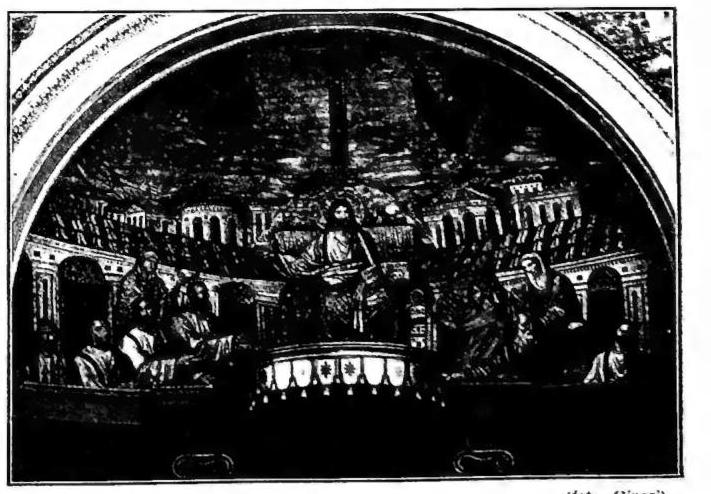
PUDENTE E PUDENZIANA – Christ teaching among the Apostles. Mosaic (late 4th century) – Rome, church of S. Pudentiana.
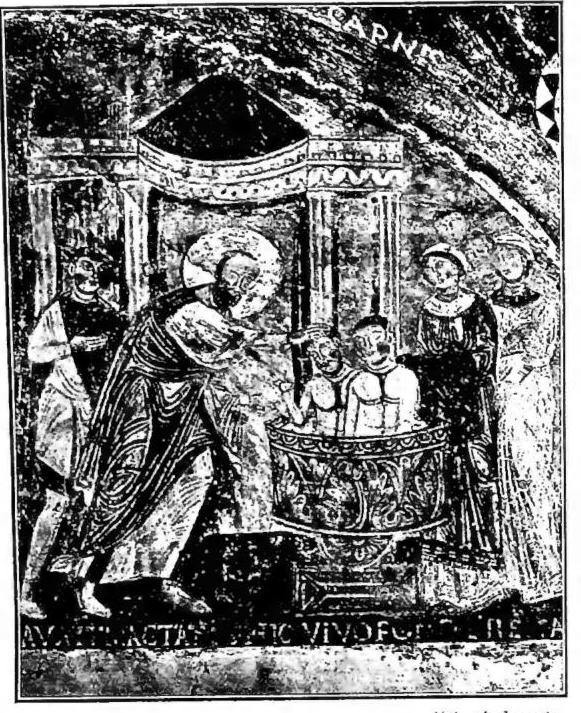
(Anderson photograph) PUDENTE E PUDENZIANA - St Paul baptizes the children of Pudens. Fresco in the oratory annexed to S. Pudentiana (early 12th century) - Rome.and the villa called delle Vignacce near the Aqua Marcia seems to have belonged to him (Th. Ashby and G. Lugli, La villa dei Flavi cristiani « ad duas lauros », in Mem. Pont. accad. rom. di arch., 3rd series, 2 [1928], pp. 183–92). Arria Fadilla, mother of Antoninus Pius, had among her brick-stampers L. Gellius Pudens (H. Bloch, I bolli laterizi e la storia dell'edilizia rom., in Bull. comm. arch. com. di Roma, 65 [1937], p. 163). L. Arrius Pudens was consul in 165; Q. Servilius Pudens, son of Quintus, in 166; C. Valerius Pudens was consul suffectus at the beginning of the 3rd century. A martyr Pudens is listed on the third day before the Kalends of May (29 April) in the calendar of the Church of Carthage; another, recorded on 28 July by the Martyrologium Hieronymianum, seems to belong to the group of Laodicea, commemorated on that day. Of the senator Pudens, buried in Priscilla beside his two daughters Pudentiana and Prassede (passio s. Pudentianae in BHL, 6988–91), there is no trace either in the Martyrologium Hieronymianum or in the Sacramentaries: he appears only in the Martyrology of Ado, who made use of the passio Pudentianae; from there he passed into the Roman Martyrology on 19 May, the day on which s. Pudentiana is recorded in the Tamlacht, Munich, and Richenau codices of the Martyrologium Hieronymianum, as also in the capitulare evangeliorum of Würzburg. It may be asked whether this day might not be that of the « dedicatio » of the « ecclesia Pudentianae » or « titulus Pudentis ». A « lector de Pudentiana » is attested by an inscription of the year 384 (G. B. De Rossi, Inscr. christ., I, Rome 1857–61, no. 347). The basilica of the Vicus Patricius was built over a bath complex between 387–90 and 398, as could be read on the open pages of the book held by St Paul in the apse mosaic, which still bears the inscription « Dominus conservator ecclesiae Pudentianae » (Wilpert, Mosaiken, pls. 42–44). Two epitaphs recall a presbyter « tituli Pudentianae » of the year 489 and a reader of « tituli Pudentis » of the year 528; in the records of the Synod of 499, two presbyters « tituli Pudentis » sign their names, while in 595 there is a « presbyter tituli Sancti Pudentis »; in the Lib. Pont. the title is called « Pudentis id est ecclesia sanctae Pudentianae » in the biography of Hadrian I (772–95)
and « titulus sanctae o beatae Pudentianae » and also « Pudentis » in the life of Leo III (I, p. 508; II, pp. 11, 34, 24). Pudentiana is also called Potenciana or Potentiana in the itineraries of the 7th century (R. Valentini and G. Zucchetti, Codice topografico della città di Roma, II, Rome 1942, pp. 78, 116, 144). In a chapel of S. Pudentiana, scenes from the legends of St Paul, Pudens, Pudentiana, and Prassede are painted (Wilpert, op. cit., pl. 262). The two female figures in the mosaic of the basilica of S. Pudentiana do not represent Pudentiana and Prassede, as G. B. De Rossi (Musaici cristiani, Rome 1872, sheet 9; J. P. Kirsch, Die römischen Titelkirchen im Altertum, Paderborn 1918, pp. 65–66, and Wilpert, op. cit., pp. 1066–68) believed, but the two churches, ex gentibus and ex circumcisione (v. CHIESA, III, col. 1468).
H. Delehaye published a Vita Sancti Pastoris in which Pastor, instructed together with Timothy by St Paul, is said to have been ordained a priest by the Apostle, to have lived until the time of Antoninus, and, at the request of Pudens, father of Pudentiana and Prassede, to have built a church in vico Latericio, still called titulus Pastoris in the time of the author of the life and remembered until the 13th century near S. Clemente (Etude sur le légendae romain, Brussels 1936, pp. 139, 264–66). H. Delehaye proposed identifying this Pastor with the martyr Pimenio or Pymenius or Παυξίν (op. cit., pp. 137–40), mentioned in the Martyrologium Hieronymianum and in the Neapolitan marble calendar on 18 February, 18 March, and, more appropriately, 2 December. His Passio identifies him as a presbyter tituli Pastoris who lived during the reign of the emperor Julian (id., op. cit., pp. 259–63). The martyr Pimenio was buried in the cemetery of Pontianus, as indicated by the notitia ecclesiarum and the de locis (R. Valentini and G. Zucchetti, Codice topografico della città di Roma, II, Rome 1942, pp. 92–107), and was depicted there together with the martyrs Milix and Pollion (Wilpert, Pitture, pp. 453–520 and pl. 255, 1).
Enrico Josi
Cite this article
“PUDENTE E PUDENZIANA (PUDENS, ΠΟΎΔΗΣ O ANCHE ΣΠΟΎΔΗΣ).” Enciclopedia Cattolica, vol. X (1953), p. 179. Azione Romana digital edition, https://azioneromana.com/article/pudente-e-pudenziana-pudens-poudes-o-anche-spoudes.