PRASSEDE, Saint
PRASSEDE, saint - S. P. always with the sponge with which she collected the blood of the martyrs. Painting by B. Luini (early 16th century). Naples, Museo Filangieri.
II. PRASSEDE, Saint of Bourges
Constitution promulgated by Charles VII, King of France, to regulate the relations of the French Church at the height of the conflicts of the Council of Basel with Eugenius IV. The King convened an assembly of the clergy at Bourges in June 1438, which also included laymen; he refused to take sides between the two opposing parties, though disposed to promote union. He promulgated the *Pragmatic Sanction* on 7 July, imposing the observance within the kingdom of the disciplinary canons decreed up to that time at Basel and revised by the Assembly. The Council approved the *Pragmatic Sanction* on 17 October 1439. In it, the superiority of the Council over the Pope was proclaimed and its periodicity sanctioned; the intervention of the Pontiff in ecclesiastical appointments, the conferral of benefices, judgments, and appeals was limited; annates were regulated; and useful prescriptions were also given regarding divine office, the morality of the clergy, and the observance of censures. It gave to Gallicanism (v.) its most perfect expression and constituted the substance of Gallican liberties in the pretension to temper, within the limits of the canons, papal authority. It was therefore not accepted by the popes, who attempted to obtain its abrogation; it ceased to have force with the Concordat of 1516, but in the following centuries the Parliament of Paris claimed to revive it, refusing to accept its decline.
III. PRAGMATIC SANCTION OF CHARLES VI
Solemn act issued by this Emperor of Germany in Vienna on 19 April 1713, with the aim of regulating the succession in the other Habsburg states in the absence of male descendants, admitting females as well, to maintain indivisibility and unity. It gave rise to the wars of succession until the Peace of Aix-la-Chapelle in 1748.
---
**PRASSEDE, Saint** – Commemorated in the *Martyrologium Germanicum* on 21 July; the 7th-century itineraries recall her buried in the cemetery of Priscilla on the Via Salaria Nova.
(1st. Sansaini)
**PRASSEDE, Saint** – Reliquary of the head of St. P. (11th century) – Vatican Library, Museo Sacro.
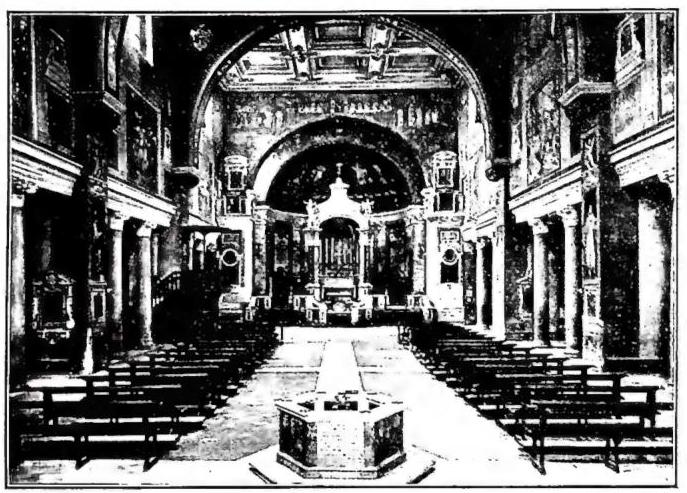
**PRASSEDE, Saint** – Interior of the church of St. P. (9th century with reconstructions of the 15th and 17th centuries) – Rome.
According to the legendary *Passio* of the 5th century, P. was the daughter of Pudens (v.) and sister of Pudentiana (v.). After her death, the priest Pastor, author of the account, arranged for her burial in the cemetery of Priscilla next to her father and sister. The author’s evident aim was to illustrate the origins of the two Roman titles of P. and Pudens or Pudentiana, blending persons and places.
As for the origin of the *titulus Praxedis*, no certain information exists; it already existed in the 5th century, as attested by the Roman Synod of 499 and an inscription of 489 in the cemetery of St. Hippolytus on the Via Tiburtina. In the 6th century, the foundress, according to custom, is called St. P. The association of P., Pudens, and Pudentiana undoubtedly arose from the fact that the cemetery of St. Hippolytus was dependent on the two titles and perhaps also from their proximity. The church of St. P., already restored by Hadrian I (772–95), was completed while being rebuilt by Paschal I (817–24) but “not far from its original site.” The new construction, despite various later works, still preserves the structure of the 9th century; it was enriched with many martyrs’ relics, including that of Zeno taken from the cemetery of Praetextatus. In her honor, a separate oratory was built, adorned with rich mosaics representing the most distinguished and characteristic work of Rome in that period. Other mosaics were executed in the apse and on the triumphal arch, depicting respectively the Redeemer with saints and the Heavenly Jerusalem.