
MARTIRIO e MARTIRE. — From the Greek μάρτυρ, witness; in Christian usage, the person who has borne witness to Christ with his blood.
SUMMARY:
I. Concept
II. The cult of the martyrs and ancient iconography
III. Martyrdom in the causes of beatification and canonization.I. CONCEPT
In his great discourse on the mission of the Apostles (Mt. 10), Jesus says: “I am sending you like sheep among wolves” (v. 16), and foretells (v. 17): “Beware of men, for they will have you brought before tribunals and scourge you in their synagogues” (v. 18), “and you will be led before governors and kings for my sake, to bear witness before them and before the gentiles.” At the time of the trial they must worry neither about how to speak nor about what to say, because the Spirit of the Father will speak in them (v. 20). The time when all this will take place is the eschatological time, in which “brother will put brother to death, and father his son, and children will rise up against their parents and have them put to death. And you will be hated by all on account of my name; but whoever perseveres to the end will be saved” (vv. 21, 22). The dissolution of all family ties is a characteristic sign of the time before the end (cf. Mc. 13, 8 and 12; Henoch aeth., 100, 2; IV Esd. 6, 24; Sanhedhrin, 97a); it is characteristic of Jesus’ preaching, which places the persecution of the disciples and the possibility of martyrdom within the traditional framework of eschatology. This eschatological background to the disciples’ passion distinguishes Christian martyrdom from the sufferings either of the “righteous” in the Jewish religion (persecuted prophets and Maccabees) or of the Greek sages who defend moral truth against “tyrants.”The account of Christian martyrdom may be enriched with elements drawn from Jewish or Greek tradition, but this does not alter the fundamental fact that martyrdom in the eschatological age is intimately bound up with Jesus himself. “For my sake you will be led before governors and kings”; “on account of my name you will be hated by all.” “All” means, according to Jesus’ clear words, Jews and gentiles, who from the beginning oppose Christian preaching. This hostility, which culminates in acts of violence against those who assert the truth of the Gospel, is in itself a revelation of what man is in relation to Jesus: it uncovers the innermost feelings of Jews and Hellenes concerning the revelation of God himself. On the other hand, the testimony publicly borne by Jesus’ disciples also reveals the presence of the Holy Spirit in them. Thus, in the last times, “men” will be revealed in Jews and gentiles, and the Holy Spirit in the martyrs. Testimony belongs to the concept of martyrdom, and it must be public. Whoever has acknowledged Jesus before men will be acknowledged by the Son of Man before the angels of God (Lc. 12, 8). Martyrdom is not exhausted by the fact that the martyr suffers for the cause of Christ. What distinguishes the death of the martyr from the death of the soldier is that the latter suffers for a man (or a human cause), whereas the martyr suffers for the “Son of Man,” who by his own death has initiated the creation of a future world transcending human causes. The martyr’s testimony presupposes the testimony of him who was “born and came into the world to bear witness to the truth” (Jo. 18, 37). The disciple suffers like the Master, or better still, with the Master, because he finds himself in the same eschatological situation, in which the word “truth” signifies the revelation of God himself. “Baptized into the death of Jesus,” “united with the likeness of him” (Rom. 6, 3, 5), who compares his own death to a Baptism (Lc. 12, 30, whence the term: Baptism of blood), and drinking the cup of the Lord’s death, we have no other course than to remember (I Cor. 11, 26) the death of the Lord. One cannot belong to the Church without also sharing in the Passion of Jesus. Not everyone can become a martyr, because martyrdom is only one of the charisms in the Church,
In the martyr the Holy Spirit is manifested in the last times, especially in the word of his testimony, which reaches its climax in the profession of the phrase christianus sum. This is why the account of the martyrs has its centre in the words uttered by the martyr during the judicial interrogation. But, on the other hand, the indwelling of the Holy Spirit in the martyr also elevates his body to a dignity that will make it a sacred relic. Just as Jesus after his death did not remain in the earth but was raised to heaven, so too the martyr enjoys the privilege that distinguishes him from the other faithful, of ascending directly to Paradise. It is understandable that the martyr should thus become an intercessor for the faithful.
There has been much discussion concerning the terminology: martyrdom and martyr. The terminology has undergone a historical evolution. It is highly significant that the Jews do not know the category of martyrs; those among them who suffered for the observances of the law are designated as «just». The specific meaning connected with the word «to bear witness» cannot be explained by the general presuppositions of the Jewish religion, but by the eschatological situation, which makes testimony not only an act of accusation against the persecutors (testimony against them), but also the revelation of a new reality. It is true that the words of the witness to the truth have extraordinary importance, but to limit the meaning of martyrdom to confessio alone means closing one's eyes to the reality that the new world is not brought about by words, even if they are words of the Holy Spirit, but
by the death of Jesus and of those who followed him in the shedding of blood. It is not arbitrary that in the ancient Church the name of martyr increasingly became the privileged title of those who died for Jesus, but this does not mean that the confessor was left without privileges. Confessor and martyr are the expression of the fact that the Church always finds herself in the eschatological situation begun by Jesus and brought to an end with the arrival of the «Son of Man», accompanied by the martyrs, at the Judgment. The Church is therefore, not only in the succession of its bishops, but also in the ever-new vocation of confessors and martyrs, the apostolic Church.
II. THE CULT OF THE MARTYRS AND ANCIENT ICONOGRAPHY
The esteem and veneration enjoyed during their lifetime by the “witnesses of Christ” among their contemporaries, by virtue of the exalted conception they held of martyrdom, will be discussed in the entry PERSECUTION; here we are concerned only with the devotion directed toward them after their heroic and glorious death.1. Origins
For more than a full century after the establishment of the Church, a period truly rich in illustrious martyrs (suffice it to recall the protomartyr Stephen [v.], the Apostles, the Roman protomartyrs, the “ingens multitudo” sacrificed by Nero, Antipas, martyr of Pergamum [v.], St Ignatius of Antioch [v.], St Justin the Philosopher [v.]), it seems that nothing was done beyond ensuring honorable burial and paying the confessors of the Faith those honors customarily paid to the dead, whose cult was so vigorous in antiquity, both classical and Christian. Yet, whereas the pagans, in order to escape the remembrance of death, celebrated the birthday γενέθιλον or dies natalis of the deceased, Christians, for whom death had a quite different meaning, solemnized the anniversary of the passing, in remembrance of the deceased’s birth into heaven, which marks the end of trial and suffering and the beginning of true life in God (cf. the observations made on this subject by the Arianizing Anonymus in Job, lib. III: PG 17, 517). The first document to record the dies natalis of a martyr in the sense just described is the Martyrium Polycarpi, written by the community of Smyrna probably in 177 (cf. H. Grégoire-P. Orgels, La véritable date du martyre de 12 Polycarpe [23 février 177] et le «corpus Polycarpianum», in Anal. Bolland., 69 [1951], pp. 1-38). This document takes care to establish unequivocally the honors to be paid to Christ and to the martyrs: to the former, worship “as the Son of God”; to his “witnesses,” love, and consequently veneration, “because they are disciples and imitators of the Lord” (ch. 17; ed. R. Knopf, Ausgewählte Märtyrerakten, 3rd ed., Tübingen 1929, p. 6). This clear distinction removes any possibility of tracing this cult back to that of the gods and heroes, as Protestant or rationalist authors claimed, on the basis of analogies between pagan myths and customs and later hagiographical compositions and manifestations of popular cult in honor of certain thaumaturgical martyrs. Indeed, St Jerome (Contra Vigil.: PL 23, 357-58) and St Augustine had already been obliged to stigmatize this error (De Civitate Dei, XXII, 10). The cult of the martyrs is nothing other than a sublimation of that of the dead; at the tombs of both (for the ancients, these constituted the most direct means of entering into communion with the deceased), the faithful went to commemorate them. But whereas they prayed for the dead, and the rites performed at the tomb retained their mournful character, they appealed to the intercession of the martyrs, and the rites in their honor assumed a pronounced character of joy. Moreover, the memory of the martyrs served “as encouragement and preparation for those who were preparing for the struggle” (Martyrium Polycarpi, 18; cited ed., p. 6). The external manifestations of the cult of the martyrs and of the dead were still so similar at the end of the fourth and the beginning of the fifth century that St Augustine felt the need to warn his faithful not to confuse ordinary dead persons with martyrs (cf. Serm. 159, 1, 284, 5: PL 38, 868, 1291; In Ioan. Tractatus, 84, 1: ibid. 35, 1847; De Civitate Dei, XXII, 10).The veneration paid to the martyrs consisted: a) in gathering their sacred remains with religious devotion, when the tyrant had not deliberately scattered them, in order to bury them honorably. The Smyrnaeans gathered the bones of St Polycarp from the pyre, “more precious than splendid gems and more exalted than gold, and placed them in a fitting place” (Martyrium, cited, 18; cited ed., p. 6); at Caesarea, the Roman senator Astyrius, who had witnessed the martyrdom of the soldier Marinus, “placed the corpse upon his shoulders, wrapped it in a shining and precious garment, and with magnificent pomp placed it in a suitable tomb” (Eusebio, Hist. eccl., VII, 16); at Carthage, the body of St Cyprian was “removed by the Christians from the curiosity of the pagans and, during the night, accompanied amid candles and torches with prayers in solemn procession to the cemetery of Macrobius Candidianus” (Acta Cypriani, 6; ed. Knopf, cited, p. 64). The honorable burial took place either in private cemeteries or in cemeteries shared with the other faithful, above ground or in underground passageways; often burial was carried out without any distinction. Even on the slabs closing the loculi of the martyr-popes Pontian, Fabian, and Cornelius, in the cemetery of Callistus, only their names were inscribed; only later was the designation “martyr” added.
b) On the dies natalis of the martyrs, the faithful gathered near their tomb or, when this was impossible, elsewhere (cf. the case of the martyr Pionius, arrested at home while celebrating the feast of St Polycarp: Martyrium Pionii, 2-3, ed. Knopf, pp. 45-46), to commemorate them through the celebration of the Eucharist or also through the rite of the “refrigerium,” as was in fact customary for the faithful departed. In the so-called “tricia Apostolorum” in the catacumbus on the Appian Way, graffiti such as these may be read: “Petro et Paulo Tomius Coelius refrigerium feci/ At Paulum et Petrum refrigeravi / XIII Kal. apriles refrigeravi Parthenius in Deo et nos in Deo omnes / Dalmatius botum is promisit refrigerium,” which recall the funerary rite of the “refrigerium,” or liturgical agape (cf. F. Grossi Gondi, Il rito funebre del « refrigerium » al sepolcro apostolico dell’Appia, in Dissertazioni Pont. accad. rom. archeol., 2nd series, 14 [1920], pp. 261-77). The celebration of the Eucharist and the sacred chants constituted the essential part of the gathering. An allusion to a liturgical synaxis that the Romans might have celebrated after the death of Ignatius has been seen in the letter of St Ignatius to the Romans (II, 2), but the passage is unclear (cf. G. Jouassard, Aux origines du culte des martyrs dans le christianisme. St Ignace d'Antioche, Rom. II, 2, in Recherches de science religieuse, 39 [1951], pp. 362-67). Two fourth-century texts enable us to imagine how a liturgical synaxis in honor of the martyrs was conducted: the Oratio ad Sanctorum coetum, attributed to Constantine (ch. 12: ed. I. A. Heikel, in CB, VII, Berlin 1903, p. 171), and the Constitutiones Apostolorum, VI, 30 (ed. F. X. Funk, I, Paderborn 1905, p. 381; a text of the abbot Schenute, cited by Fr. H. Delehaye, in Anal. Bolland., 40 [1922], p. 37, should also be taken into consideration). It was probably in order to make these gatherings of the faithful on the anniversaries of the martyrs or the dead more convenient that Pope Fabian “ordered many buildings to be erected throughout the cemeteries” (Catalogo Liberiano: ed. L. Duchesne, Lib. Pont., I, p. 4). The prohibition issued by Valerian to the Christians “that gatherings should not be held in any places, nor should they enter the cemeteries” (Acta Cypriani, 1: ed. Knopf, cited, p. 62; cf. also Eusebio, Hist. eccl., VII, XI, 10; IX, II, 1) must likewise refer to cultic gatherings.
St Cyprian wanted the day of death of the glorious confessors of the faith to be taken into account, “so that we may be able to celebrate among the commemorations of the martyrs” (Epist. 12: ed. G. Hartel, in CSEL, III, II, p. 503; cf. also Epist. 39: ibid., p. 583). Unfortunately, many communities, including that of Rome, during the first and second centuries failed to take care to record the dates of the dies natalis of their martyrs, so that for most of them only the name is known, and often not even this has been preserved, as in the case of the Roman protomartyrs. This should cause no surprise, since the first Christian communities were above all occupied with the thought of rendering liturgical worship to Christ, the Son of God.
(from Wilpert, Mosellen, inv. 22)
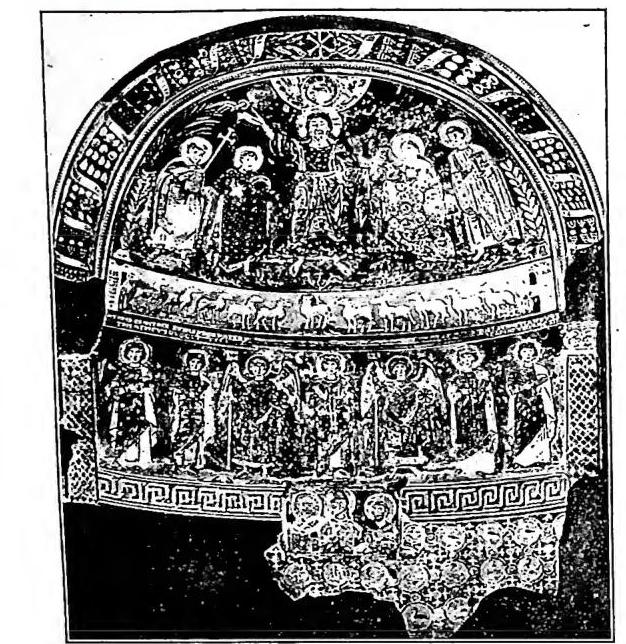
MARTIRIO E MARTIRE - Christ among the martyrs Lorenzo, Sebastiano, Zotico, and Stefano. Fresco in the apse basin of S. Maria in Pallara (10th century); the lower part dates from the 11th–12th centuries. - Rome.
of the reality or otherwise of the martyrdom (v. VINDICATIO), as happened especially in Africa at the time of Donatism, which boasted of having genuine martyrs. Meanwhile, the faithful asked, as the supreme favor, to be buried near the tombs of the martyrs, as is attested by many inscriptions (cf. F. Grossi Gondi, Trattato di epigrafia cristiana latina e greca, Rome 1920, pp. 256–57) and by St. Augustine, who explains what value should be attributed to burial near a martyr (De cura pro mortuis gerenda: PL 40, 609–10). The martyrs were invoked as advocates of the dead; here is a characteristic inscription found in the cemetery of Panfilo: « Martures Sancti Boni Benedicti boni atiuate Quiracu » (E. Josi, Il cimit. di Panfilo, in Riv. di arch. crist., 1 [1924], p. 63).
This general enthusiasm for the heroes of the faith led communities to exchange the anniversaries of the most celebrated martyrs. Rome, for example, received the anniversaries of the holy Perpetua and Felicitas and of St. Cyprian, the latter celebrated in the cemetery of Callistus, at the tomb of St. Cornelius (cf. Depositio Martyrum: ed. R. Valentini-G. Zucchetti, Il codice topografico della Città di Roma, II, Rome 1942, p. 26); Carthage and the African Churches, in turn, celebrated the anniversaries of the best-known Roman martyrs, as can be seen from the sermons of St. Augustine (cf. C. Lambot, Les sermons de st Augustin pour les fêtes des Martyrs, in Anal. Bolland., 67 [1949], pp. 244–66) and from the Calendar of Carthage. The Egyptian Churches did the same for various Eastern martyrs (cf. H. Delehaye, Les Martyrs d'Égypte, ibid., 40 [1922], pp. 1–154, 207–364; Egypt also manifested its love for the martyrs in its chronology: the era of the martyrs, a transformation of the Diocletian era, remained in use there until the 8th century). Yet the factor that contributed more than any other to spreading the cult of particular martyrs was the translation and dissemination of their relics. This practice began in the East, and the first known translation was that of St. Babylas of Antioch, carried out by Caesar Gallus (351–54), followed by the more celebrated translations of 356 and 357, which enriched the new capital of the Empire, Constantinople, with the relics of Sts. Timothy, Andrew, and Luke. Thereafter, translations and divisions of the holy bodies became innumerable. Some communities distributed the relics of their martyrs with great generosity, for the pleasure of seeing them known and honored in other lands. St. John Chrysostom attests, for example, that the Egyptians distributed relics with the same generosity with which they gave away the grain that was surplus to their needs (cf. Laudatio Martyrum Aegyptiorum: PG 50, 693–94). This practice also spread to the West, but it was not accepted in Rome before the advanced 7th century and the 8th century, when Rome was compelled, for reasons of security, to transfer within the walls the sacred remains preserved in the suburban cemeteries. The relics of the martyrs, removed from their tombs, were placed beneath altars and were often enclosed in precious reliquaries (v.).
In addition to the translation of relics, the panegyrics of the great orators of the 4th and 5th centuries, the Passiones, the booklets of miracles, the poetic works of Prudentius and Paulinus of Nola, and the wonder-working fame of some of the martyrs helped to spread the cult of particular martyrs: for example, that of St. Lawrence in Rome, St. Menas in Lower Egypt, St. Stephen and St. John the Baptist after the discovery of their relics, St. Euphemia at Chalcedon, St. Theodore at Euchaita, St. Sergius at Rusafa on the Syrian limes, St. Demetrius at Salonica, St. Maurice at Agaunum, and so forth. The tombs of these martyrs soon became pilgrimage destinations, and crowds of pious devotees thronged the grand basilicas erected ad corpus through the munificence of emperors, popes, bishops, or generous faithful; pilgrims brought rich gifts and ex-votos there as signs of gratitude and returned to their native lands with relics, brandea, and various eulogies, which naturally helped to spread their cult. Yet popular manifestations in honor of the martyrs were not always edifying, as can be seen, for example, from the reproaches of the abbot Schenute (d. 466) against the incubatio and the manner in which the feasts of the martyrs were celebrated (Delehaye, art. cit., pp. 37–39), or from those of Bishop Pisentius of Qeft, at the end of the 6th century (cf. W. E. Crum, Discours de Pisentius sur st Omophrus, in Rev. de l'Orient chrétien, 2nd series, 10 [1915–17], pp. 38–67; Anal. Bolland., 38 [1920], p. 415).
In brief, during the course of the 4th and 5th centuries the cult of the martyrs increasingly lost its local character and assumed a universal one, which would be definitively secured through the acceptance by the various Churches of particular types of liturgical books. In the West, for example, the triumph of liturgical books of the Roman type, promoted by the activity of Charlemagne and his liturgists, secured a universal cult for all the martyrs listed in them.
3. Ancient iconography
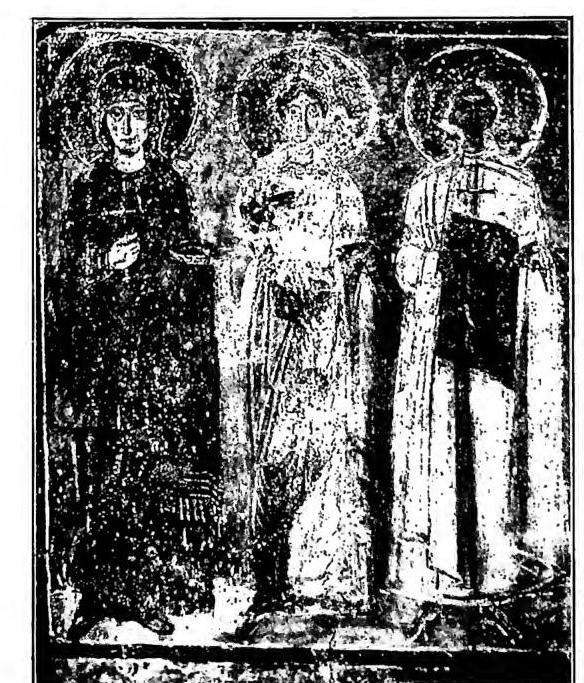
Before the Constantinian peace, no certain representations of martyrs could be identified except those of the Princes of the Apostles; they became frequent, however, with the proliferation of new sacred buildings adorned with paintings, mosaics, and sculptures and with the embellishment of their tombs. The martyrs were then represented in the dress of a personage of high rank: that is, with tunic, pallium, and sandals, generally white, if male; with tunic and chlamys (in some cases replaced by the pallium), if a soldier; with stola, dalmatic, and palla, if female.In the 4th and 5th centuries it is sometimes difficult to distinguish a martyr from a sacred or high-ranking personage because of the absence of iconographic characteristics; for example, one would not know that the figures were the martyrs Sixtus and Hippolytus (sarcophagus of Apt, V. illustration at the entry IPPOLITO, saint) or the martyrs Nabor and Felix (chapel of S. Vittore in S. Ambrogio, Milan), since their only distinguishing feature is the scroll or book, also held in the hands of ordinary deceased persons, if the artist had not inscribed their respective names beside them. Soon, however, the martyr acquired his own iconographic characteristics, distinguishing him from ordinary figures: the crown and the palm, symbols of victory; the crown is preferred in ancient art,
the palm and the instrument of martyrdom, on the other hand, came to be used normally in medieval and modern art. The crown initially consisted of foliage and flowers (v. baptistery of Naples, 4th century); then, around the middle of the 5th century, it was transformed into a true diadem studded with gems (in the cemetery of Pontianus, Christ places a jewelled crown on the heads of ss. Abdon and Sennen, 6th century). The crown only rarely encircles the head of the m. (s. Agnes [V. related illustration] in the apse of her Basilica); ordinarily it rests on hands covered by the edge of the pallium, the chlamys, or the palla; at other times it is supported by a single covered hand, while the other, uncovered, approaches it delicately. The circular nimbus is found around the head of the m. toward the end of the 5th century, and the earliest examples are found in the frescoes of the cemetery of Pontianus (Wilpert, Pitture, pl. 255). As for the posture of the m., it should be noted that it may be: 1) hieratic: the m. stands upright, holding the crown in his hand (v. , for example, the procession of m. in S. Apollinare Nuovo, 6th century, or that in the chapel of S. Venantius beside the Lateran Baptistery, end of the 7th century); 2) one of reverent and solicitous homage, in apsidal compositions, to Christ or to Maria S.ma, who occupy the place of honor: the m., somewhat bent forward, approaches the central figure with a brisk step, holding the crown in his hand (for example, in the church of SS. Cosmas and Damian in Rome, 526–30, and in the Euphrasian Basilica at Parenzo, ca. 530–60); 3) that of prayer: s. Menas (v. related illustration) is represented in this manner between two camels, s. Cecilia (v. related illustration) in the corresponding crypt at S. Callistus, s. Januarius (v. related illustration) in an arcosolium of his cemetery at Naples, and s. Apollinaris (v. related illustration) in the church of the same name at Classe in Ravenna. The m. belonging to the clergy—deacons, bishops, etc.—dressed in sacred vestments, hold in their hands the open book of the Gospels, or the Cross and the book of the Gospels (s. Stephen, s. Lawrence in the mosaic of S. Lorenzo fuori le mura: V. Lorenzo, santo, related illustration), or else a richly bound closed volume, the lex Christi (ss. Sixtus II, Cornelius, Cyprian, and Ottatus in S. Callistus, 6th century: Wilpert, Pitture, pl. 256). Extremely rare is the scene of a m. in glory beside Christ, such as is frescoed in the cemetery Inter duas Lauros (v. related illustration) on the Via Labicana.
At times the m. is represented in his function as an « advocatus » before Christ: « S. Martyres apud Deum et Christum erunt advocati » is read in an inscription from the Agro Verano (cf. E. Josi, art. cit., p. 63). The m. Petronilla, for example, stands beside the deceased Veneranda in Domitilla (after 356: Wilpert, pl. 231); the m. Adauctus, in the cemetery of Commodilla, rests his hand on the shoulder of the deceased Tortora, who is approaching the throne of Maria (v. COMMODILLA, related illustration).
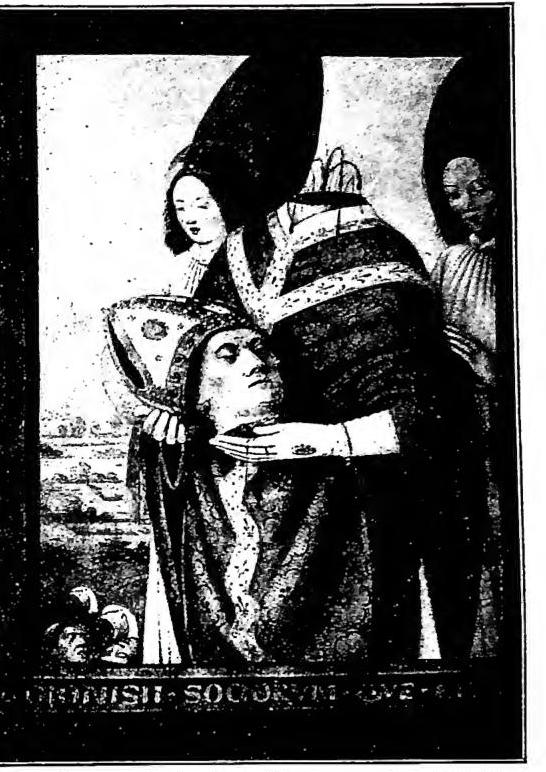
Special mention should be made of representations of the cephalophore m., that is, those m. who are said to have gathered up and carried in their hands the head severed from the body. The episode, recounted in the case of more than a hundred m., is wholly legendary, and the oldest hagiographic text containing it is the Passio anonyma of s. Dionysius of Paris (Acta SS. Octobris, IV, Brussels 1780, p. 794), which dates from the first decades of the 9th century. Its author altered a phrase from his source, the Passio s. Dionysii of Pseudo-Fortunatus (ibid., p. 927), which says something entirely different. Given the great diffusion of the Passio anonyma, also translated
(from V. JALABERT, LOUIS, Les livres d’Heures mm. de la bibliothèque nationale, Mécun 1802, 1st. VI)
MARTIRIO E MARTIRE — The cephalophoric martyrdom of St. Dionysius. Miniature from the Book of Hours probably belonging to Carlo VIII (late fifteenth century) — Paris, National Library, ms. lat. 1370, f. 212.
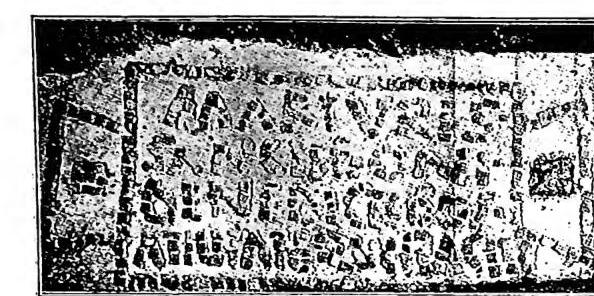
MARTIRIO E MARTIRE — Funerary inscription with an invocation to the martyrs (4th century) — Rome, cemetery of Panfilo.
Mélanges offerts au R. P. F. Cavallera, Tolosa 1948, pp. 215–30; R. Loenertz, Un prétendu sanctuaire romain de st Denys de Paris, in Anal. Bolland, 66 (1948), pp. 118–23; id., Le panégyrique de st Denys l'Aréopagite par st Michel le Syncelle, ibid., 68 (1950), pp. 94–107; id., La légende parisienne de st Denys l'Aréopagite. Sa genèse et son premier témoin, ibid., 69 (1951), pp. 217–37. A. Pietro Frutaz
III. MARTYRDOM IN THE CAUSES OF BEATIFICATION AND CANONIZATION
Despite the more extensive meaning that the term martyr had in antiquity and the analogous meanings subsequently assumed in the ascetical sphere, the Church, as the process of beatification became more refined, increasingly sought to define the figure of the m. and narrowed the concept to its present definition, in which four historical-juridical elements are clearly distinguished.The first element today is the duly proven fact of the violent death suffered by the hero. It is not enough for it merely to have been threatened or decreed by the persecutor and intentionally accepted by the persecuted person, if in fact it did not occur for any reason whatsoever; likewise, even the most cruel sufferings endured for the faith are considered insufficient if they did not lead to death. In addition to this material element of martyrdom, there is the personal element, no less important and no less juridically necessary, which requires that the death should have resulted from an extrinsic causality, distinct from the victim and for which another is responsible. The victim cannot seek death under the impulse of merely subjective and environmental suggestions, but must heroically undergo it insofar as it is imposed by a persecutor. The third element to be established is the causal or final one, which is the most formal and discriminating, since it substantially specifies and distinguishes the Christian holocaust from every other sacrifice, making evident its supernatural meaning and meritorious value. It is therefore required that the true martyr be put to death for a reason of faith or of moral virtue referable and referred to God. The reason for the death may thus be fidelity to revealed dogma or to the Church as teacher of divine truth; or fidelity to a moral precept, natural or positive, insofar as it is sanctioned by God’s authority. Although other ends and other motives may coexist, whether in the victim or in the persecutor, they cannot obscure the essential religious and moral meaning of the sacrifice, since the Augustinian dictum always holds: «martyres non facit poena sed causa». Finally, there is a moral or psychological element that completes the figure of the martyr and reveals him as a perfect imitator of Christ. Death must be consciously accepted for the aforementioned purpose and endured with particular spiritual dispositions: constant fortitude and serene meekness, inspired by principles of the supernatural order.
The causes of martyrs are regarded by the Church with particular favor, both because the supplementary proof of miracles may more readily be dispensed with when the case is utterly evident (can. 2116 § 2), and because they do not require a judgment concerning the heroic virtues that the victim may have exercised during life. Nevertheless, the evidence must extend to each and every one of the elements mentioned above and must consist of direct testimony or, in the so-called historical causes, of authentic and exhaustive contemporary documents (can. 2020). It is collected and discussed under the critical supervision of faith (v.), examined in a threefold session, and finally submitted to the supreme judgment of the pontiff. The causes of martyrs may not be joined except when they concern a single persecution that affected several persons in the same place (can. 2001 § 1); even in that case, however, the evidence remains distinct for the respective subjects. For canonization, no special requirements exist; beatification must always precede it, and the required miracles must first be approved (v. MIRACOLO).