
COMMODILLA, CIMITERO of. — Near the Via Ostiense: entrance on the present Via delle Sette Chiese. The name is found in the index of cemeteries (v.). The martyrs venerated there were Felice, Adautto, Merita, and Nemeseo, mentioned in the itineraries. Pope Damasus composed an epigram in honor of the first two, and Boldetti discovered a fragment of it in 1720, when he happened by chance to enter the cemetery. It was explored by the Pontifical Commission for Sacred Archaeology from 1903 to 1906.
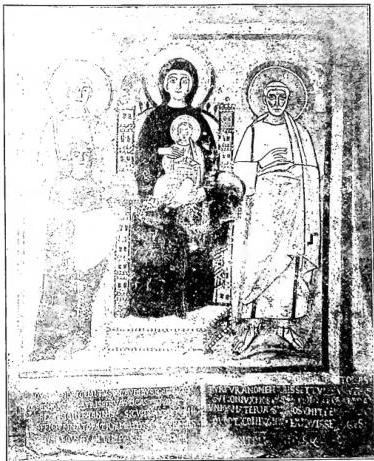
The cemetery consists of two levels of burial galleries. Part of the first level reused an earlier pozzolana quarry, whose entrance was at ground level at the bottom of the valley. In one of these galleries the martyrs Felice and Adautto were buried; later, when the right-hand section of the gallery was demolished, a small basilica was built to honor their tombs. An inscription was placed in their honor during the time of Pope Siricius and was found mutilated during the excavations. The first embellishment of their tombs belongs to the same period. Among the paintings decorating the walls, the scene of the traditio clavium is noteworthy: the Lord, seated upon the globe, hands the keys to s. Pietro; behind him were s. Adautto and then s. Merita; on the other side, s. Paolo, s. Felice, and s. Stefano. Also noteworthy, almost life-size, is the painting of the Madonna enthroned with the Child between the ss. Felice and Adautto, the latter presenting, as advocatus, the deceased woman named Tortora, a widow, as recalled by the affectionate metrical inscription placed beneath the fresco by her son.
The third noteworthy painting is that of the evangelist Luca, who bears the instruments of a physician; the painting was executed (668–85).
(photograph: Pontifical Commission for Archaeology and Sacred Art)
COMMODILLA, cimitero di — Madonna between the ss. Felice and Adautto and the deceased Tortora. Fresco of the 6th–7th century.
The frescoes are covered with graffiti by visitors from the end of the 7th and the 8th century, mostly presbyters; one of them wrote «non dicere illa secritta abboce» (G. Celi, Di un graffito di senso liturgico nel cimitero di C., in Nuovo bull. di arch. crist., 12 [1906], pp. 239–52). To the right of the historical crypt, entirely occupied by tombs in the floor, two galleries with the inscriptions in place from the end of the 4th century remained intact. A particular feature of this cemetery is a series of rectangular pits in which the corpses were placed one on top of another, also making use of the two long lateral walls.