
CHRISTIAN ARCHAEOLOGY. - Etymologically it is the science of ancient things (λόγος τῶν ἀρχαίων).
I. CONCEPT
The word was used often from Thucydides onward. Dionysius of Halicarnassus published in 7 B.C. the 'Ρωμαϊκή Ἀρχαιολογία, that is, the ancient history of Rome, and in the same sense Josephus titled his work on the ancient history of the Jews Ἰουδαϊκή Ἀρχαιολογία. The Latins used instead antiquitates, and thus Varro's work Antiquitates rerum humanarum et divinarum was a history of sacred and profane antiquity. Antiquarius, on the other hand, was for the Latins a synonym of librarius (a lover and copyist of old books). Throughout the entire era of the Renaissance and the Baroque we find in use only the Latin terms antiquitates and antiquarius to designate the study of antiquity, but with a very broad sense and increasingly including also the science of institutions and monuments. It seems, however, that Giacomo Spon as early as 1685 (preface to the Miscellanea eruditae antiquitatis) had the precise idea of a special science which he calls archaeographia and defines as « declaratio sive notitia antiquorum monumentorum, quibus veteres sui temporis religionem, historiam, politicam aliasque tum artes tum scientias propagare posterisque tradere studuerunt ». And he gives his own division of it into various branches, which however had no following.
With the 17th century the use of the Greek term archaeologia was also reborn in England (Archaeologiae Atticae by Rous in 1637) and in 1770 the Society of Antiquaries of London began the publication of the periodical Archaeologia, while in 1799 the first Manual of Archaeology (Handbuch der Archaeologie) by J. F. Siebenkees came out in Nuremberg. But up to this point the term archaeology also retains the universal sense of the study of all antiquity, both literary and monumental.
With the reconstitution of the Pontifical Roman Academy of Archaeology through the work of Pius VII in 1816 (it had previously been called the Roman Academy of Antiquity and History) the term archaeology designated in fact the study of monuments as opposed to that of written documents. This concept was then affirmed theoretically by Gerhardt in his Grundzüge der Archaeologie (Principles of Archaeology) in 1833.
He defined archaeology as « that half of the universal science of classical antiquity which is founded on monuments » as opposed to the other half, founded on documents of a literary nature. According to this definition, Christian archaeology will be the « science of Christian antiquity according to non-literary monuments ».
It suffices merely to note that today archaeology is sometimes confused with the « history of ancient art », whereas the object of the history of art is the works of man insofar as they present artistic qualities. In Germany the term « archaeology of the history of art » has been in use since the 18th century, meaning by it the study of material objects (realia) of which one must speak in the history of art.
II. SUBJECT, METHOD, DIVISIONS
The material object consists of all those ancient artifacts that can reveal something to us about Christian antiquity. They may even be pagan (that is, the work of non-Christians), such as the inscription of Aricanda (v.) and the arch of Constantine; with all the more reason Jewish, syncretistic, or simply heretical. They are often written monuments; of this sort, archaeology excludes from its field only written monuments on paper, parchment, and papyrus, and those that have a markedly literary character as such (such as the res gestae of Augustus written on the temple of Ancyra and the epistle of St. Athanasius ad monachos preserved painted in a hermitage in Egypt), leaving them as the proper object of philology. The formal object of archaeology is the study of these monuments insofar as they can reveal something to us of the life and culture of the ancient Christians as such. On the other hand, the study of monuments, even Christian ones, that have nothing specifically Christian about them (such as the basilica and the baths of Constantine), or insofar as they illustrate the life of the ancients in general and not precisely as Christians, belongs to pagan archaeology in general.
Literary documents often enter indirectly into the study of archaeology insofar as they provide information about monuments or aid in their correct understanding. In this sense they may be considered auxiliary sources of archaeology.
The direct or principal sources are above all buildings of worship, funerary monuments, many objects of domestic use, and those of liturgical use. Of these one studies especially the topography, the architecture, the iconography, the epigraphy, and the use.
The method for the study of Christian archaeology is that proper to the historical and philological sciences. The search for monuments is preceded by topographical studies and the practice of excavation; the study properly so called deals with the authenticity of the monument, that is, with its ancient origin, its original destination, its purpose, meaning, and age, and finally with its preservation or possible restoration. This applies both to individual monuments and to entire classes or complexes of monuments. Its proper aids are bibliographies and archaeological inventories.
The divisions are various. Spon, already cited, recognizing the great freedom in this field, said: « Mihai praecipue octo statuendae scientiae videntur, iuxta totidem subiecta, nummos (numismatographia), lapides (epigrammatographia), aedificia (architectonographia), statuas (iconographia statuas picturas musivaque opera describit), toremmata (toremmatographia), manuscripta (bibliographia) instrumentaque omnis generis (angeographia) ».
Today the most usual divisions are the geographical ones (Eastern and Western; of India, of Africa, of Gaul, etc.) and the intrinsic ones according to the various branches into which this science is subdivided for convenience of study (architecture, sculpture, painting, epigraphy, topography, glyptics, numismatics, etc.).
Much debated is the question of the chronological limits of our science. Its first masters and founders (De Rossi, Garrucci, Kraus), followed by many others, judged that it should end with the 6th century. Le Blant went a century further in his collection of the Christian inscriptions of Gaul; others propose the year 726, in which the iconoclastic struggle broke out. In our opinion, although the problem deserves a somewhat different solution according to the different branches of Christian archaeology, the limitation proposed by De Rossi must nevertheless be considered more exact. With the death of Gregory the Great (604), the ancient age truly comes to an end in the West in its cultural and artistic manifestations, and in the East the last impulses of the powerful Justinianic renaissance die out, while the invasion of the Arabs soon comes to mark a decisive turning point.
III. IMPORTANCE AND USEFULNESS
The importance of Christian archaeology within the framework of studies, especially sacred studies, follows from what has been said about it. The role of monuments for the knowledge of antiquity is often decisive, especially with regard to private life and the evolution of a people's artistic qualities. Institutions and great public events, too, often receive from them an impressive illustration or at least clarifications, above all topographical, of the greatest moment. For these general reasons Christian archaeology was always held in the highest esteem by ecclesiastical authorities and, especially from the end of the 18th century, was repeatedly praised, encouraged and effectively promoted. One need only think of the establishment of a museum of Christian archaeology (1757), of the Pontifical Roman Academy of Archaeology already mentioned, of the Pontifical Commission of Sacred Archaeology (1852), the official body for the excavation and preservation of ancient monuments, and particularly of the work of grandiose patronage carried out by Pius IX in favor of De Rossi for his work of excavating and illustrating the great Roman cemeteries. These great traditions were taken up again by Pius XI, who, with a lavish employment of means and with the motu proprio of 11 December 1925, founded the Pontifical Institute of Christian Archaeology (v.) and renewed the life of the two old pontifical institutions, the Academy and the Commission.
This warm interest in Christian archaeology is explained in particular by the fact that it was regarded as a science of great apologetic value. The monuments of Christian antiquity, says Pius XI in the aforementioned motu proprio, "are witnesses as venerable as they are authentic of the faith and religious life of antiquity and at the same time sources of the very first order for the study of Christian institutions and culture from the times closest to the apostles." One must not, however, harbor the illusion that such monuments can furnish a complete apology for all the dogmas of the Church. Although from the second half of the 18th century Christian archaeology was often studied especially with a view to a theology based on monuments, and various works were even attempted in that sense, it is nonetheless certain that the ancient Christians neither intended nor were able to express in inscriptions, for example, and in paintings and sculptures the greater part of the dogmas, nor is it possible to find them in the monuments that have come down to us. They bear witness only to those truths that it was natural to manifest in monuments that were for the most part funerary: to seek others in them is for the most part very risky or at least devoid of sure result.
One must never forget that the true sources of Christian doctrine are quite other: the living ecclesiastical magisterium, Scripture and the books of the Fathers. Monuments are, more than a locus theologicus, generally an illustration of the articles of faith. Nevertheless it cannot be denied that Christian archaeology can provide properly so-called proofs for certain Catholic theses, such as judgment and recompense immediately after death, the communion of saints, the validity of the prayers of the living for the dead and vice versa, the existence of a purgatory, the cult of the holy martyrs, the coming of St. Peter to Rome and his preeminent position in the Church, the most ancient use of certain Sacraments such as Baptism and the Eucharist. But in this matter it is necessary to weigh expressions carefully, since in the general religious syncretism of the pre-Nicene age one often risks taking as specifically Christian dogmatic terminology what is also proper to Stoic, Neoplatonic or mystery religious currents. In every name, in every epithet, in every inscription that reveals a noble religious feeling one often wants to see the Christian monument; in every tomb furnished with some singular sign one wants to discern the sepulcher of a martyr. Christian symbolism, like the exegesis of certain theologians and preachers, becomes the art of extracting from any monument whatever one wishes. Since one often pays more attention to external resonances than to the true meaning of a monument, one is content to read probabilities, and it seems one seeks more to amass than to discern, more to multiply so-called proofs than to weigh them. This defect, very visible in the old archaeological apologies, is not lacking even in the most modern treatments of that kind.
IV. SOURCES, AIDS, CRITICISM
The sources of archaeological studies would be, first of all, the monuments themselves; but these are considered rather as the object, and "sources" are those ancient literary documents that help us in their study. Such are the Acts of the martyrs, especially the Roman ones, which give us much information, generally reliable, about their tombs and sanctuaries; the same may be said of the calendars and various related documents that flowed into the vast compilation of the Hieronymian Martyrology, often provided with useful topographical indications; something is also gleaned from liturgical books such as the sacramentaries and lectionaries. Very important sources are the writings of the Fathers, who often describe certain churches and their decoration (e.g. Eusebius for the Constantinian buildings, Prudentius for many Spanish and Roman monuments, Paulinus for Nola, etc.). Especially the official biography of the Popes (Liber Pontificalis) is an inexhaustible source of information on the churches and cemeteries of Rome.
Those who, from the 4th century onward, went on pilgrimage to the famous sanctuaries of Christendom, especially in the Holy Land and in Rome, left us a curious record of what they had observed in them. From the 6th century, alongside those so-called itineraries, there also formed in the same way collections of monumental and hagiographic inscriptions, which, at least in part, copied and variously confused among themselves, have come down to us together with those.
In the 11th century the famous dispute over precedence in dignity between the Vatican and Lateran basilicas gave occasion for various valuable descriptions of them, such as the Liber de sanctis sanctorum, the Liber de ecclesia Lateranensi, and the description of St. Peter's by Pietro di Manlio, in which we have the first index of the catacombs of Rome in nineteen numbers. To the same century belong the various editions of the Mirabilia urbis Romae, a very elementary guide to Rome that also includes a chapter de cimiteriis. In parallel, descriptions of the monuments of Syria and Palestine arose in the East, together with the guides or itineraries of the monk Epiphanius (9th century), of John Phocas (11th century), Perdicas of Ephesus (14th century), Daniel of Smyrna and another anonymous writer of the 15th century. The city of Constantinople, moreover, had special illustrators of its monuments already in the 6th century: Procopius (De aedificiis) and Hesychius of Miletus (Patria Constantinopolis), then in the 9th century the very extensive topographical-descriptive compilation of the pseudo-Codinus (Patria Constantinopolis) and in the 10th the very useful De officiis of Constantine Porphyrogenitus. This is represented to a certain extent at Rome by the Ordo of Benedict, canon of St. Peter, from the beginning of the 12th century.
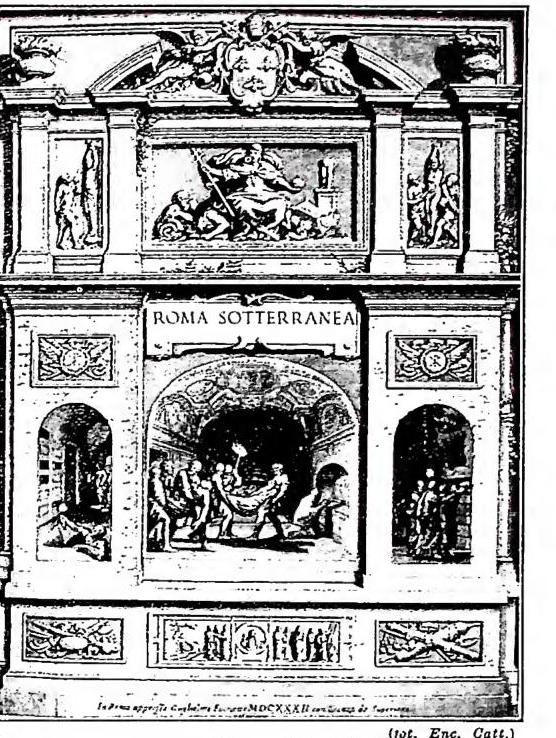
(pt. Enc. Cutt.)
Among the aids for the study of Christian archaeology, the most valuable is still always the practice of excavation itself; there is nothing more instructive, nor anything that can replace it. Excavation is for the most part occasional, rarely conducted intentionally with a pre-established plan; in that case it can be very dangerous to follow a preconceived thesis.
The monuments found should if possible be suitably arranged where they were discovered; carried elsewhere, they generally lose part of their eloquence. When this is not possible, especially for lack of security, they are customarily transported to museums; but then a diligent excavation journal and an exact catalogue of the individual objects with their provenances become all the more necessary. Many monuments in our museums have lost a great part of their importance precisely for lack of an identity card. For those who are too far from museums, or when the monuments cannot be transported, photography, surveying, casting, and reconstruction on a reduced scale now serve as good substitutes for personal study. The plaster cast is especially recommended for sculptures, that in blotting paper or in a polished cast for inscriptions. In any case they must always be accompanied by an accurate description made on the spot. Unfortunately it is often forgotten today that the direct study of the originals cannot be replaced except with many disadvantages for science. In any case, similar collections of casts, photographs, etc. (such as, for example, those attached to the University of Berlin and to the École des Hautes Études in Paris) offer great advantages for teaching. Other powerful aids are specialized libraries such as that of the Pontifical Institute of Christian Archaeology, the congresses (the IV held in Rome in 1938) and the combined teaching courses for the training of specialists (as in Rome at the aforementioned Pontifical Institute). Two very useful initiatives also exist in Rome: the Pontifical Academy of Archaeology, which in fact deals predominantly with Christian matters, and the Society for Conferences on Christian Archaeology, intended to promote the exchange of views among specialists.
Archaeological criticism must often begin with authenticity, that is, with the examination of the antiquity of the object itself. Many coins and small objects, especially precious ones, were falsified in times past in Italy, and it is not always easy to judge the authenticity, for example, of gems and cameos; today it is above all Oriental objects, for which there is great demand, that are falsified. The most refined forgers often content themselves with reworking pieces that are actually ancient. It is always very important to know the place of origin of a monument, especially for objects that tend to travel a great deal, such as fabrics, silverware, miniatures and the like. Lacking historical data, one readily resorts to stylistic arguments, and the same is customarily done when investigating the age of a monument. But often one falls into a vicious circle, attributing a monument to a certain age and a certain country because of its resemblance to others that were in turn dated or topographically situated only on the basis of stylistic considerations. It must always be kept in mind that in very different places and very different ages there are often very similar artistic phenomena, and that the place where a monument is found (when it is not a museum or a collection) always counts as its place of origin, until there is probative reason to the contrary.
Another capital part of criticism is the exegesis or interpretation of the monument, whether it is Christian or not and what its meaning is. The question becomes complicated and often insoluble when the monument is partly lost and it is therefore a matter of divining what is missing. One generally proceeds by the comparative method, and for this too the Christian archaeologist can never be sufficiently urged to acquire a knowledge of philology and of the pagan world.
V. TOPOGRAPHY
Rome is by far the most important center, and in terms of churches, catacombs, epigraphs, institutions and various collections it alone equals almost all the rest of the West. In the rest of Italy, besides many minor catacombs, the following are to be remembered: Naples for its great catacombs, its museum and some ancient churches; Nola for the complex of monuments in honor of St. Felix; Syracuse for its museum and its great catacombs (minor ones at Palazzolo, Modica and elsewhere); Spoleto with the basilica of the Savior and the nearby temple of Clitumnus; Bolsena and Chiusi for their catacombs; Ravenna for the great buildings of the 5th and 6th centuries (sarcophagi and mosaics); Albenga with its baptistery; Milan for the basilica of St. Ambrose and the complex of St. Lawrence; Aquileia for its museum and Basilica; Parenzo for its Basilica; Salona for its churches and necropolis.
In France, beyond the cemeteries of Arles, only wretched remains of ancient buildings or scattered groups of sarcophagi survive; in Spain the necropolis of Tarragona and the nearby rotunda of Centcelles, similar to the Roman one of St. Constance, have proved extremely important; in Germany the most notable monument is the cathedral of Trier; at Xanten, Mainz and Cologne numerous remains of very ancient churches and necropolises have been found; the museums of Berlin, Paris and London preserve rich collections of Early Christian objects and monuments. In the Danubian countries we have a small catacomb at Pecs and remains of small churches (as more or less everywhere in the Balkans). Worth noting are the basilicas of Thebes, Nicopolis and Athens, the baptistery of Butrinto and the largely preserved monuments of Corfu, Salonica and Constantinople with their famous mosaics, which have begun to be studied. Asia Minor is rich in inscriptions, especially in Phrygia; ruins of churches are found everywhere there, and among them, magnificent, the three basilicas of Ephesus and the sanctuary of St. Thecla at Meriamlik (Cilicia). Mesopotamia has become famous for the synagogue and the church with baptistery of Dura Europos. In northern Syria and the Hauran there survive ruins of a very great number of churches, some with their upper structures; most curious is the sanctuary of St. Simeon Stylites near Antioch. Palestine is extremely rich in remains of the sanctuaries that covered almost the whole of it from the 4th and 6th centuries onward; but they are only wretched ruins or have been totally transformed. Better preserved are the countless figured floor mosaics, among them the famous topographic map of Madeba and many rather late inscriptions; let us also recall the complexes of the Holy Sepulchre and the sanctuaries of the Mount of Olives, of Emmaus, of Bethlehem, of Mamre near Hebron, of the multiplication of the loaves on the Sea of Galilee, and the eleven churches of Gerasa. Egypt, besides ruins of monasteries that may be very ancient, preserves small catacombs near Alexandria and great necropolises at Bault (near Antinoe, with paintings) and El-Kargeh (Great Oasis) and the grandiose complex of the sanctuary of St. Menas; a rich collection of Coptic antiquities is in Cairo. Cyrenaica keeps some painted hypogea and important remains of churches at Apollonia and Ptolemais; likewise in Tripolitania we have important necropolises at 'Ain Zara and Ngila and ruins of churches at Leptis and Sabratha. Tunisia has revealed an infinity of ancient little churches and tombs, often with mosaics and inscriptions. Important are the catacombs of Hadrumetum and the basilicas of Thelepte and Ammaedara. Carthage preserves ruins of six great Basilicas and a museum rich in Christian antiquities; in Algeria, among many others, the centers of Tebessa, Tipasa and Cuicul are to be noted.
VI. PARTICULAR QUESTIONS AND DIRECTIONS
With great fervor there was discussion in past centuries about the "signs of the tombs of the martyrs." Today it is settled that only those historically attested or furnished with evident signs of veneration (graffiti with invocations of the faithful, ornamental works) are to be held as such. Many questions also arose about the "origin and purpose of the catacombs": today it is certain that they were almost all excavated by the Christians themselves, for funerary purposes, in terrain of a light calcareous nature; only rarely were pre-existing sandstone quarries later adapted as cemeteries; quite exceptionally, individual pagan hypogea were combined into catacomb complexes. The catacombs served properly as cemeteries and (at least underground) never as dwellings or hiding places of the Christians during the persecutions; for acts of public worship only on the feasts of the martyrs who were buried in them.
1. On what legal title the Church possessed from the beginning at least of the 3rd century its own goods, such as churches, houses, cemeteries, is still vigorously debated; it appears that this came about through a kind of practical tolerance. What is the origin of the basilical type, which at least for us represents the first form of churches after Constantine? It was probably a matter of an adaptation of the architecture of the civil basilica (including sumptuous private palaces) to the practical needs of Christian worship, with few and non-essential modifications. The derivation from the development of funerary mausoleums is not persuasive; too uncertain in its monumental bases is the attempt to make of it the progressive evolution sive evolution of halls of private buildings adapted to worship before Constantine.
2. The controversy over the first dwelling of the apostles in Rome, the first "sedes ubi sedit Petrus", the mysterious Ostrianum, the houses of Prisca and Pudens and the sojourn of St. Paul have wasted much energy in discussions whose usefulness it is legitimate to doubt and which do not deserve to be revived.
3. Did St. Peter and St. Paul really come to Rome and die there? Few Protestants and rationalists still ask themselves this question, especially after the wonderful results of the excavations of St. Sebastian's and St. Peter's. But the problem remains always open regarding the nature of the memoria in catacumbas (tradition of a dwelling of the apostles? primitive burial? later temporary translation? or none of these things?) and regarding the history of the relics of the apostles (heads included), nor perhaps will it ever be possible to resolve it.
A very delicate point, and one on which the soundness of an archaeologist can often be tested, is that of distinguishing what is Christian from what is pagan. No fixed and unitary criterion exists, nor can one hope to find one. According to the various materials and the various countries, special criteria must be formed; unfortunately the works that exist on the subject are scanty and for the most part amateurish. And one must also keep in mind the possibility of syncretistic or heretical productions. Unfortunately this convenient formula or alibi of heresies has often been abused in order to dispose of singular monuments of uncertain origin and interpretation.
4. No less difficult often proves to be the problem of dating. Where positive historical or epigraphic data were lacking, in the past one generally proceeded with great arbitrariness, not to say by fantasy. It was De Rossi's merit to have established solid criteria as the basis for the investigation of the catacombs and of the inscriptions; for buildings, on the other hand, we are still far from any real progress, and the consequences are felt especially in research outside and far from Rome. The same may be said for the small objects of the instrumentum, in which for the most part one abandons oneself to vague stylistic inferences, whereas it would be appropriate to do something similar to what has been achieved for the terra sigillata of the 1st and 2nd centuries; for paintings and sculptures, after Wilpert's fundamental works, only now is one beginning to seek some more precise and positive canon.
5. The grave problem of symbolism is also always open. There is by now agreement in rejecting the method of those who in times past, as in Scripture, saw symbols everywhere even in artistic productions, and as it were a cryptotheology (even Wilpert still exaggerates a little in this sense), and likewise a pretentiously universal historicism (Styger). But it is very difficult to mark the limits and the correct interpretation in individual cases, and often even merely the nature of the symbolism at play, whether the traditional pagan one or a new Christian one. For one must indeed remember that there existed a rich syncretistic pagan symbolism, and likewise bear in mind that the Fathers of the Church in their symbolic expositions proceed in a wholly personal manner or else draw inspiration from strictly literary sources, instead of drawing on the treasury of conceptions common among the Christian people. In that case their very testimonies are of scant value even when accumulated.
6. Another very obscure problem is the origin of the individual iconographic themes. The iconological questions are still almost all in their infancy. It ought once and for all to become clear how much Christians took from pagan iconography and how much they innovated on their own account in the individual countries and in the individual ages; not even on themes as celebrated as the orant and the good shepherd has light yet been shed. It ought likewise to become clear whether and to what extent Christian artists were animated by a portraitistic concern, not so much in the representations of private individuals as in those of the saints, of the apostles, and even of Jesus and Mary. Perhaps this problem has been given excessive importance by historians of Christian art in search of novelty.
7. The dilemma East or Rome, posed at the beginning of this century with audacity and almost with high-handedness by Strzygowski (deserving nonetheless for having widely introduced into our studies the knowledge of Oriental monuments), has already preoccupied, and perhaps excessively, several scholars (for example Kaufmann and Wulff, authors of well-known manuals). But it is at bottom as unreasonable as the error it seeks to correct. By now the sound criterion is gaining ground of not denying a priori to anyone the right to sit at the banquet of Christian art, which is instead to be conceived as one of those potluck banquets so dear to the ancient Greeks. Rather, in these investigations of artistic ontogenesis one should always preserve a scrupulous care for chronology and a certain respect for geography, so as not to fall into the error of supposing, for example, monuments of the 4th or 5th century to be inspired by artistic schools of which we barely have productions from a century or two later, or of making regions artistically dependent on one another that were at the antipodes of the then-known world.
The international Congresses of Christian Archaeology always proved very useful: the 1st at Split in 1894, presided over by F. Bulić; general interests and particular themes were treated there, as in the 2nd at Rome in 1900, directed by L. Duchesne; the 3rd at Ravenna in 1932, presided over by G. P. Kirsch and C. Ricci, with reports on the most recent discoveries relating to Christian archaeology; the 4th at Rome in 1938, presided over by P. Paschini, dealt with buildings of worship.