
TIPASA. — A town of Mauretania Caesariensis (present-day Algeria) on the shores of the Mediterranean, 70 km west of Algiers.
Probably founded by the Carthaginians, its original Phoenician name means place of passage; but it became important after Claudius, in 39 B.C., established there a colony possessing Latin rights, which subsequently received the full right of civitas. A fragment of an inscription discovered during excavations in 1951 shows that under Antoninus Pius (138–61) the eastern gate in the circuit of the walls was constructed. It reached its greatest prosperity in the time of the Antonines, engaging in agricultural and commercial activity; through its port it maintained relations not only with Italy but also with Spain and Greece. It resisted in 37 and the siege of the Moorish king Primum, who ravaged Caesarea (Cherchel) and Icosium. It suffered under Julian the Apostate (Optatus, De schismate donatistarum, II, 18, 19), and under the Vandals, in the time of Genseric and Huneric; in 484 a group of Christians from T. emigrated to Spain, where they spread the cult of S. Salsa. Christianity in T. is documented from as early as the first half of the 3rd century by several funerary inscriptions. A Christian cemetery was identified by S. Gsell southeast of T.; from it come the inscriptions of Rasinia Secunda, dated to the year 238 (199 of the Mauretanian era; E. Diehl, Inscr. lat. christ., no. 3319), of Magna Crescentina, with the dove bearing an olive branch and the anchor (S. Gsell, T., in Mél. d’arch. et d’hist., 14 [1894], p. 407, fig. 54), of I. Saturninus, of Samaita et Immi, and of Modia Saturnina (id., loc. cit.).
The wealth of the monuments discovered in T.—amphitheater, temples, forum, Capitolium, curia, judicial basilica, theater, and baths—is surpassed by the importance of the Christian monuments, situated to the west and east of the city. Near the circuit wall, at the expense of pre-existing buildings, a large basilica was erected, 32 m. long and 40.50 m. wide, divided into seven naves; two rows of columns were subsequently added, all of them now vanished; the apse too is badly ruined. It was preceded by a portico; the floor was paved with mosaic; a baptistery was attached to II. North of the Basilica a chapel was found with a mosaic floor depicting sheep grazing; to the south lay a series of interconnected buildings. The square hall of the baptistery has a mosaic floor with lotus flowers and an inscription of which only the end remains: «sancta lava(cra)»; the round basin was reached by three steps; there was an opening for the discharge of the water. In the vestibule of the baptistery, the mosaic floor contained the inscription: «si quis ut vivat quaerit addiscere semper, hic lavetur aqua et videat caelestia (dona)» (CIL, VIII, 20911). In one of the adjoining rooms, the mosaic floor likewise contained a long inscription referring to the «aula Dei» (CIL, VIII, 20912). In the civic basilica, a «signum Christi» with the apocalyptic letters A and Ω was carved in the 5th or 6th century; and between the first two columns, near the apse, irregular holes are visible in the floor. These have led scholars to suppose that, as elsewhere in Africa, this basilica too was adapted to Christian worship in the 5th or 6th century. In the same way that an apsidal chapel was constructed in a house near the Capitolium of T., an apse was added to the pre-existing hall, and the following metrical inscription was set in the mosaic floor: «He who knew how to overcome all the difficulties of the work and to decorate a spacious dwelling with varied mosaics, in order to add to the ample building the immensity of Christ’s kingdom, will soon receive with joy the crown and glory due to him, so as to retain possession of his name (Coronatus or Stephanos) and receive its reward» (J. Heurgon, Nouvelles recherches à T. ville de la Maurétanie Césarienne, in Mél. d’arch. et d’hist., 47 [1930], pp. 182–201). Its bishops too are revealed more by funerary epigraphy than by literary sources.
In 1892, in the western part of T., the remains of a trapezoidal funerary church were identified, with a mosaic floor containing two large-
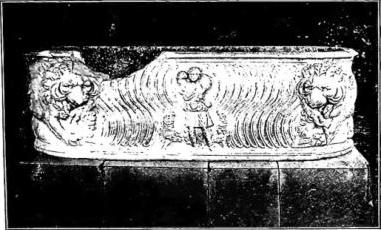
TIPASA - Sarcophagus with the Good Shepherd (4th century).
Some of the mosaic inscriptions that covered the floor of the Basilica were transferred to the Museum of Algiers. In 1914, on the lid of the sixth sarcophagus, the mosaic inscription « Memo X ria Re/nati episcopi/ musivo lacu/ (nari nitescit) » was identified (J. Carcopino, Sopra un frammento di
iscrizione musiva proveniente da una chiesa di T. nella Maurétania, in Bull. com. arch. com., 55 [1927], p. 253 ff.). Excavations resumed in 1939 brought to light four more mosaic inscriptions; one in the left aisle commemorates a Donata, mother of a deacon of Bishop Alessandro; the other three are metrical, and one reads: « resurrectionem carnis/ futuram esse qui credit/ angelis in coelis/ resurgens similis erit ». In the north-east corner of the chapel, access was found to a crypt measuring 6.50 × 3 m., excavated in the rock below the level of the chapel itself, with a window in the vault. Its floor is occupied by two rows of five tombs, while the eleventh is situated in the apse. These are undoubtedly the tombs of the iusti priores, the predecessors of Bishop Alessandro.
To the north of the chapel, a staircase leads to a vaulted room and to a rectangular area enclosed by 80 sarcophagi. Here too there was a space measuring 30 × 14 m., enclosed by walls and, on the right side, a kind of portico with pillars; six tombs with mensae were found there, one of them bearing the fragmentary mosaic inscription: « Me(moria) marturom Rogati, Vitalis... ». Another tomb had plastered walls with painted decoration in red, foliage in a large vase, and the inscription: « Massima in pace ». A Maxima is commemorated in Mauretania Caesariensis on the fourth day before the Nones of December (12 December). Opposite were six other tombs; in one of them, in mosaic, one reads « Me(moria) Amanti() presbyteri v(e)rus Dei cultor qui etiam cum marturibus in sinu Abr(aham) requiescu(nt) cum Ilar(a) consoci(ata) ». Above it is written « Memori(a) Amanti presbi(teri) Ilara et Aurelia ». Nearby, on a marble block, one reads: « Memoria Victorini in pace marture professum octav(o) idus Mai(as) die Solis ora octava(anno) pr(ovinciae) CC... ». It may date from 239, that is, from the year 200 of the era of the province of Mauretania Caesariensis, or from a date no later than the beginning of the 4th century (J. Carcopino, Note sur une épitaphe de Martyr récemment découverte à T. de Maurétanie, in Recueil des Notices et Mémoires de la Société archéologique de Constantine, 66 [1948], pp. 87-101). In addition, leaning against the wall was an inscription of an ancient character, between two anchors: « Sabina hic dormit ». Near this area, and perhaps partly over it, Bishop Alessandro erected his funerary chapel. At T. a bronze serpent with a gilded head was worshipped; Salsa, a fourteen-year-old Christian girl, broke the idol and suffered martyrdom. She is mentioned in the Hieronymian Martyrology on 20 May and 10 October; the Passio, preserved in two manuscripts (BHL, 7467, edited by L. Duchesne, in Bull. critique, 1890, p. 125 ff., and translated by P. Monceaux, in La vraie légende dorée, Paris 1928, pp. 299-326), assigns her martyrdom either to 2 May or to 26 August; in the Mozarabic calendars, besides 2 May, 29 April is also given (M. Ferotin, Le « liber ordinum » en usage dans l'Eglise visigothique et mozarabe de l'Espagne du Ve au XIe siècle, Paris 1904, pp. 462-463, 497). The year of her martyrdom is uncertain, though some place it toward the end of the reign of Costantino. The Passio states that the martyr’s remains were placed « brevi admodum tabernaculo ». Later a large three-aisled basilica was erected, with a mosaic floor composed of squares alternating with lozenges and crosses inscribed in disks. In front of the apse, in the pavement, was a mosaic inscription affirming that where the sacred altar shines « hic est Salsa »
ever sweeter than honey; she merited dwelling forever in heaven in perfect beatitude; the work was carried out under the direction of a certain Potentius (CIL, VIII, 20914), whom G. B. De Rossi thought might be identified with the man of the same name sent in 446 to Mauretania Caesariensis by Pope Leone I (Bull. arch. crist., 5th series, 2 [1891], pp. 24-26, with a facsimile of the inscription). Another fragmentary inscription also commemorates the martyr Salsa (P. Monceaux, Enquête sur l'épigraphie chrétienne d'Afrique, Paris 1907, no. 323). At the eastern entrance of the Basilica an inscription in three lines was found: De Dei promissa (hi) c q uies) - cit in nomine Crisi- (n), Salsa (CIL, VIII, 20915). Toward the center of the nave is a stone sarcophagus bearing the epitaph of a relative of the martyr: « Fabiae Salsa matri sanctissimae et rarissimae » (CIL, VIII, 20913). The epitaph may not be Christian, but H. Grégoire went too far in writing « Ste Salsa roman épigraphique, in Byzantium, 12 [1937], pp. 213-224 (vedi in proposito Riv. arch. crist., 14 [1937], pp. 405-406).
The tombs around the Basilica of S. Salsa consist of stone sarcophagi, masonry coffins, and funerary tables or mensae. Some are decorated with mosaics bearing the epitaph of the deceased or with representations such as Noah in the ark, Daniel among the lions, and the three youths in the furnace. The inscriptions commemorate an Aviarius and a Bavaria, a merchant named Venustus from Mesarfelta (near present-day Biskra), and the Greek epitaph of a Maxima originally from Tripoli in Syria, engraved on the side of a sarcophagus. On the outside of a masonry coffin there was a vosso, into which libations were poured. The numerous funerary mensae were built of bricks in a semicircle, to hold the food, with an inclined space for the participants. One of them is in a small room with seven windows, and on the door is written: « Ixove. »
Presso la basilica di S. Salsa è una sala rettangolare con un corridoio in cui si apre un'abside; era stata in origine occupata da 19 sarcofagi e da una tavola per agapi. Nell'abside furono trovati frammenti di un pannello in pietra con l'iscrizione: « in Christo semper »; l'edificio anteriore alla Basilica presenta un carattere funerario; esso fu poi utilizzato come annesso alla Basilica, conservando il suo carattere funerario. I sarcofagi rinvenuti, erano tutti violati meno uno; uno solo aveva inciso X, gli altri tutti anepigrafi; contennero ciascuno più acheletri, da due a sette, forse a causa di qualche epidemia. Nel cimitero tra le epigrafi si ricordano quella di un Berus di Icosium (Algeri); di un'italiana indicata soltanto « una Italorum » (E. Albertini, L'archéologie chrétienne en Algérie, in Atti del III Congr. inter. di Arch. crist., Roma 1934, pp. 418-24). Ad occidente della città si rinvenne contro la collina un grande mausoleo circolare (di m. 18,75 di diametro) con 16 semicolonne all'interno in pietra calcare e, contro la parete, 14 grandi arcosoli per sarcofagi. Contro il muro esterno si rinvennero sarcofagi e semplici tombe a regole o anche in anfore. Contro la roccia si aprivano piccoli cubicoli con arcosoli e formae. Circa una trentina di celle funerarie furono identificate da S. Gsell (T., in Mél., cit., p. 401); in una, situata nel cimitero occidentale, fu tro-
vato un sarcofago marmoreo mutilo col Redentore e le personificazioni delle stagioni (Wilpert, Sarcofagi, III, tav. 290, 2, pp. 41-42); molti i sarcofagi in pietra locale e in terracotta. A poca distanza dalla porta da cui partiva la via per Cesarea (Cherchell) fu trovato un piccolo mausoleo col sarcofago del Buon Pastore (ibid., I, tav. 67, 5, p. 83-92g.; III, p. 40) e un altro sarcofago con una scena matrimoniale (S. Gsell, T., in Mél., cit., pp. 341-434). Pietre miliari hanno il « signum Christi » una del tempo di Costanzo e l'altra del tempo di Valentiniano e Valente con l'indicazione del secondo miglio sulla via litoranea da T. ad Icosium (Algeri; S. Gsell, T., in Mél., cit., p. 411). In T. fu trovato un piatto in terra cotta di m. 0,39 di diametro con al centro due personaggi portanti una lunga croce (S. Gsell, T., in Mél., cit., pp. 448-49, fig. 61). Nel 1952 sulla via litoranea per Icosium si è rinvenuta un'area cimiteriale cristiana con molti sarcofagi in pietra locale disposti a sud di una basilica a tre navate con abside sopraelevata mediante tre gradini; i frammenti di un'iscrizione ivi rinvenuta provano che vi erano venerate reliquie (brandea) dei « beati
martiri Pietro e Paolo ». Attualmente T. è sede titolare; da non confondersi con l'altra sede titolare di Tipasa di Numidia, l'attuale Tifech pure in Algeria. - Vedi tav. XIV.