
BAVARIA. - A historical region of southern Germany that, from the foot of the Outer Prealps (Swiss, Bavarian, and Salzburg), extends northward beyond the Danube as far as the Rhön and the Thuringian Forest; it is bounded on the west by the Iller, the Franconian Heights, and the Spessart, and on the east by the Salzach, the Inn, the Bohemian Forest, and the Fichtelgebirge. To this core of Bavaria is added, on the left bank of the Rhine, the so-called Bavarian Palatinate (Pfalz), territorially detached from Bavaria by Baden and Hesse. In turn, this historical unit is composed of several distinct natural regions, which correspond, at least in broad outline, to smaller historical regions.
The climate accentuates its continental character and relative scarcity of precipitation toward the east (middle Danube), becoming naturally harsher in the mountainous zones and on the Swabian-Bavarian plateau, which in general lies above 500 m. Munich (525 m. in elevation) has an average annual temperature of 7.9°, ranging from -2.1° in January to 17.7° in July.
In 1939, Bavaria’s area amounted to 76,089 sq. km., of which 5,492 belonged to the Rhenish Palatinate, 27,420 to Bavaria proper, 23,554 to Franconia, and 9,966 to Swabia.
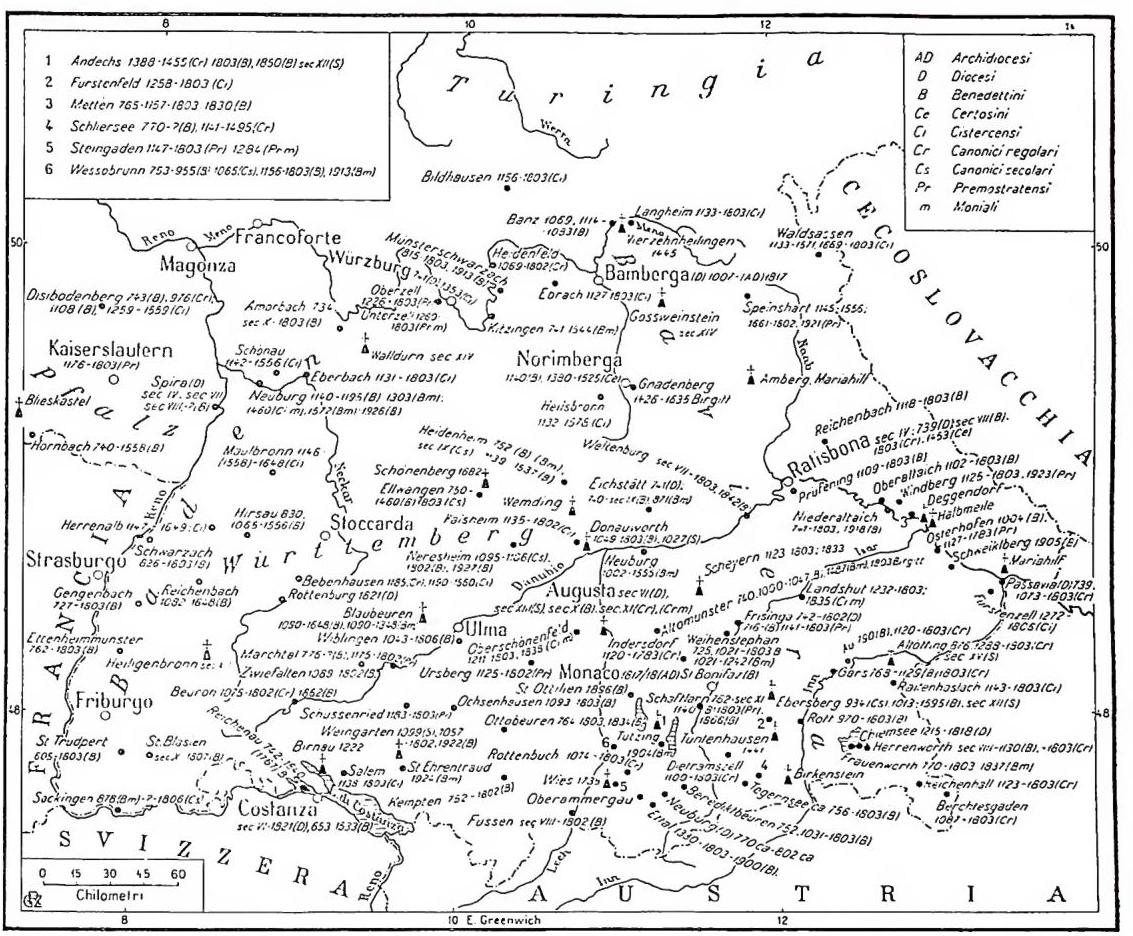
BAVARIA - Historical ecclesiastical map.
Catholics number more than half (58% in 1939; 71% in 1946), with fewer than half (29% at the same date) being Evangelical Christians.
Bavaria is essentially an agricultural and forestry country. 40% of its population is engaged in farming (49% of its area) and forestry (22%). Agricultural production (cereals, potatoes, hops; wine in the Rhenish Palatinate and along the lower Main) exceeds domestic demand.
Pastures and meadows, which occupy 24% of the territory, are especially widespread in the Alpine zone, where livestock farming (cattle) flourishes. Industry (33% of the population), though comparatively less developed than in the rest of Germany, before the last great conflict boasted a varied and substantial range of activities (breweries, textiles, mechanical engineering, chemicals, toys), concentrated in numerous urban centers. The three largest of these correspond to the historic-administrative hubs of the main regions: Munich (760,000 inhabitants) in Upper Bavaria, at the intersection of major international trade routes (Berlin-Rome and Paris-Vienna-Constantinople); Nuremberg (322,000 inhabitants in 1947; 430,000 in 1939) in Franconia, already an important industrial and commercial center in the Middle Ages; and Augsburg (Augusta Vindelicorum, 168,000 inhabitants in 1947; 186,000 in 1939) in Swabia, one of the most important industrial centers in southern Germany. Other notable cities include Würzburg in Lower Franconia (107,000 inhabitants), Ludwigsburg (144,000 inhabitants) on the Rhine, capital of the German chemical industry, Regensburg (Ratisbona, 118,000 inhabitants) in Upper Palatinate, and Fürth (80,000 inhabitants) near Nuremberg.
Giuseppe Caraci
I. ECCLESIASTICAL HISTORY
In the Roman provinces of Raetia and Noricum, inhabited by Celtic tribes, Christianity penetrated together with Latin culture, and by the end of the 3rd century and the beginning of the following one, martyrs appeared such as St Afra in Augsburg, St Florian (Lorch on the Enns), St Maximilian (Cilli). Bishops from this region attended the Synod of Serdica (343). In the 5th century, when Roman rule was about to vanish, St Severinus (d. 482) preached the Christian faith for 30 years. From his biography written by Eugippius, it can be seen that there was already an organised Church, and to this period date the episcopal sees of Lauriacum (Lorch), Tiburnia (Sankt Peter im Holz), Petavium (Pettau), Augusta Vindelicorum (Augsburg), and Sabiona (Säben). Most of the territory was subject to the metropolitan see of Aquileia, a small part to that of Milan.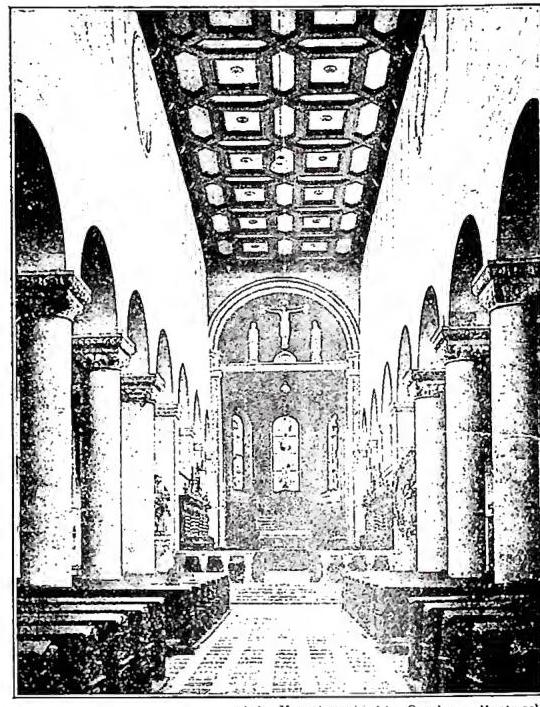
The eminent place which the Church thus came to occupy is also evident in Bavarian law (codified in the Lex Baiwariorum between 730 and 740), which recognises many rights for II. Ecclesiastical discipline was regulated by the Synods of Ascheim (756) and Dingolfing (774). Among the numerous collegiate churches and monasteries founded at that time, those which were so celebrated throughout the Middle Ages and beyond should be recalled: St Emmeram’s at Regensburg (early 8th century), on the Domberg at Freising (744), Niederaltaich (741), Mondsee (748), Altomünster (749), Benediktbeuren (752), Wessobrunn (753), Tegernsee (756–61), Schäflarn (762), Ottobeuren (764), Kremsmünster (777), Herrenchiemsee (782), Metten (790), St Florian (9th century), Altötting (876).
In 788 Tassilo III, the last of the Agilolfings, was deposed by Charlemagne, and Bavaria entered under Frankish rule and became part of the kingdom of Germany. On 20 April 798 Pope Leo III erected Salzburg into an archdiocese with Passau, Regensburg, Freising and Säben as suffragan sees. In 791 the first provincial synod of Bavaria was held. The country flourished both under Charlemagne and under Louis the German (817–76). Duke Arnulf the Bad (905–937) confiscated ecclesiastical goods (908–914) to distribute them to his vassals, and thus the first secularization of Bavaria took place. The country suffered greatly from the numerous invasions of the Hungarians, who were later defeated by Otto I (955).
Saintly bishops, such as Ulrich of Augsburg (890–973) and Wolfgang of Regensburg (924–94), reformed the Church. Emperor Henry II the Saint founded the diocese of Bamberg (1007). Under Henry III three Bavarians ascended the papal throne: Clement II (whose tomb in Bamberg cathedral is the only papal sepulchre still extant in Germany), Damasus II and Victor II.
In the Investiture Controversy Bavaria was divided, but the Bavarian William, abbot of Hirsau (1069–91), was a great promoter of the papal reform together with the archbishops of Salzburg.
After the constitution of Carinthia (1002), Austria (1156) and Styria (1180) as independent duchies, Otto of Wittelsbach received Bavaria as a fief and his descendants ruled it until 1918, generous to the Church, as indeed was the whole people. In 1216 Chiemsee was erected into a diocese.
In the 13th century the Bavarian Church was on the one hand disturbed by the disorders caused by Frederick II and the Waldensians, on the other hand it received a new impulse from the mendicant orders: the Friars Minor (1221 at Mo-
BAVARIA - Interior of the church of St James (12th–13th c.), Regensburg.
The religious Orders flourished in Bavaria: the Benedictines (from the 8th c.), the Augustinians (1223 at Diessen), the Dominicans (1229 at Regensburg), the Dominican nuns (1235 at Altenhohenau on the Inn), the Poor Clares (1284 at Munich). Great representatives of them were the Franciscans David of Augsburg (1200–72), Berthold of Regensburg (d. 1272) and the Dominican St Albert the Great (1193–1280).
Church life was much hindered during the struggle of Louis the Bavarian (1314–47) against John XXII. During the Great Western Schism (1378–1417) the dukes followed the Roman Pope and then the Pisan Pope, as did most of Germany. The land suffered greatly during the Hussite wars (1419–43).
In the 15th century the Church reforms promoted by Albert III the Pious (1438–60) and by the papal legate Nicholas of Cusa aimed to suppress abuses among clergy and people. William IV (1508–50) fought the Reformation ECKART (v.) (1486–1543), Luther’s greatest opponent. The duke summoned the Jesuits Salmerón (v. 1515–85) and St Peter Canisius to the University of Ingolstadt, founded by Louis VI the Rich (1450–79). They opened various colleges for the education of the young (Munich 1560). Albert V the Magnanimous (1550–79) altered the statute of 1506 so that only Catholic princes could govern the duchy (1578). His son William V the Pious (1579–97) regulated Church–State relations in a concordat concluded with the archbishop of Salzburg and his suffragans.
Maximilian I the Great (1597–1651), a skilful politician and absolute prince, promoted Catholicism with all his might, so that Bavaria became the first Catholic state in Germany. He founded numerous Jesuit colleges (Mindelheim 1618, Landshut 1629, etc.)
and convents for the Capuchins (Augsburg 1601, Landshut 1610, etc.) and for other Orders. He formed the league of the German Catholic states (1609). In the Thirty Years War Bavaria suffered greatly, and after the Peace of Westphalia (1648) Ferdinand Maria (1651–79) rebuilt many churches and convents that had been destroyed.
The absolutism of the princes grew ever stronger, tending to place the State above the Church. In 1717 the erection of new convents was forbidden by law. Scholars such as John von Ickstatt (1702–76) and Peter von Osterwald (1718–76) propagated the idea of a national Church. It was the century of Febronianism and Josephinism. To remove jurisdictional difficulties, in 1785 Pius VI established a nunciature at Munich despite the protest of the metropolitans of Salzburg, Mainz and Trier.
As a consequence of the French Revolution and the absolutism of the State, all convents and religious foundations were suppressed in the early 19th century (about 97 abbeys, 200 convents of the mendicant Orders, 400 other convents besides the chapters), and their temporal properties passed to the State. Prince-bishops deprived of their traditional principality, canons, and secularized religious were pensioned off. About 50 monastic libraries passed to the State Library of Munich. Protestants (1800) and Jews (1813) obtained freedom of worship. The dioceses and the numerous parishes without a pastor, the altered frontiers of Bavaria, which had become a kingdom (1806), made the need for a new ecclesiastical organization felt: in 1817 a concordat was concluded with the Holy See, and with the bull Dei ac Domini of 1 Apr. 1818 Pius VII fixed the boundaries of the dioceses. The publication of the concordat by the government took place in 1818 together with the edict concerning religion, which in many parts contrasted with the spirit of the concordat.
During the reign of Louis I (1825–48) the Church was able to regain strength, since the king appointed eminent bishops and permitted the restoration of abbeys and religious Orders (except the Jesuits). The bishops assembled at Freising protested against State interference and demanded full observance of the concordat (1850 and 1852). Ecclesiastical life flourished again (literature, press, and Catholic organizations) despite the nefarious activities of the liberal minister Lutz (from 1869), who favored the Old Catholics but failed to introduce the Kulturkampf into Bavaria, although the Catholic party of the “Patriots,” founded in 1869, with the exception of the years 1893–99, always had a majority in the parliament. In 1883 the Catholic public school was recognized by the State. During the regency of Prince Regent Luitpold (1886–1912) ecclesiastical life continued to develop peacefully. The First World War, inflation, and the post-war social-communist conflicts caused considerable damage to the Church; yet the new constitution of the Bavarian Republic of 1919 was not unfavorable to II. A new concordat between the State and the Holy See was concluded on 29 Mar. 1924 and approved by the parliament in 1925 (the Pope’s representative was Msgr. Pacelli, who had been nuncio in Munich since 1917 and in Berlin from 1925, the present Pius XII). This concordat (AAS, 17 [1925], pp. 41–45) guaranteed many freedoms to the Church. With the advent of National Socialism (1933) the persecution of the Catholic Church began. Catholic associations were suppressed, religious manifestations (processions, etc.) were forbidden as symptoms of a “political” Church. Despite the repeated protests of Cardinal Michael Faulhaber, archbishop of Munich, Catholic schools were closed (1935). At present in Bavaria, as in all Germany, Church and Catholics are energetically recovering.
II. STATISTICS
Bavaria is divided into two ecclesiastical provinces; the archdiocese of Munich-Freising with the suffragan dioceses of Augsburg, Passau and Regensburg, and the archdiocese of Bamberg with the suffragan dioceses of Eichstätt, Speyer and Würzburg. In 1945, out of a total population of 9,354,293, of whom 6,598,631 were Catholics, there were counted 8,432 churches, 3,904 parishes, 7,273 secular priests, 1,700 regular clergy, 202 male religious houses with 2,924 professed members, 1,071 female religious houses with 27,136 professed members, and 1,759 welfare institutions with approximately 70,000 residents.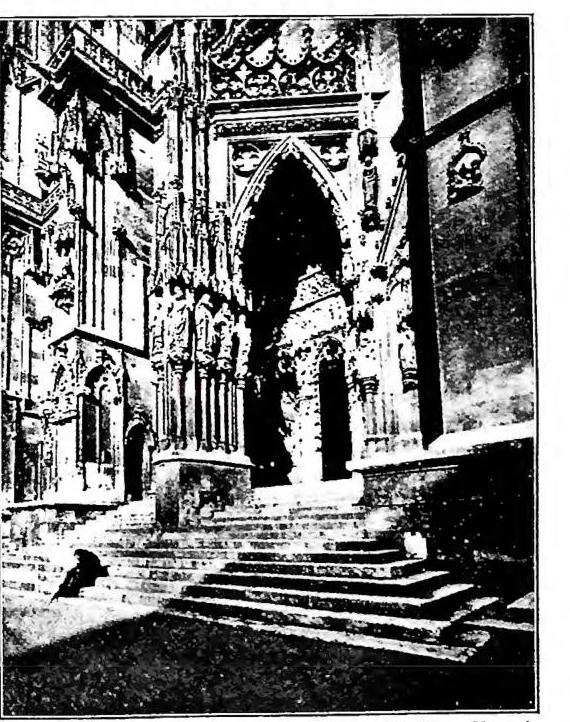
III. SACRED ART
Traces of pre-Romanesque churches are found, partly later transformed, in the ancient Bavarian cities of Roman foundation: Regensburg (v.), Augsburg (v.), Passau, Altötting. Donations by Emperor Arnulf of illuminated codices and precious goldsmith works imported into the treasure of the cathedral of Regensburg, now in the Library and in the "Reiche Kapelle" of the Residenz-Museum in Munich, gave a strong impetus to the flourishing of these arts, especially in Regensburg, from the 11th century onwards; monasteries, such as those of Wessobrunn, also became artistic centres. Ecclesiastical architecture also developed fully from the 11th century, especially in Augsburg, Tegernsee, Freising and again in Regensburg. The bronze doors of the cathedral of Augsburg (mid-11th century) are the most important example of Romanesque sculpture.In the 12th and 13th centuries, the foundations and expansions of churches and monasteries multiplied: Prüfening (near Regensburg), Regensburg (St James, All Saints, Niedermünster, St Emmeram), Freising, Seeon, Altenstadt, Steingaden, etc. Remains of ancient wall painting are scarce (Prüfening, Regensburg,
phot. H. Wutz, Munich)
Bavaria – Main portal of the Cathedral (14th–15th c.) – Regensburg.
The most important sculptures are in Regensburg. The figured stained-glass windows in Augsburg Cathedral are also well known, and Regensburg boasts an important school of miniature painting.
Gothic style begins to infiltrate in the 13th century; in 14th-century architecture the local character becomes ever more pronounced, lasting until the relatively late appearance of Renaissance elements. Regensburg (present-day cathedral), Augsburg (cathedral reconstruction) and Kaisheim provide examples of mature Gothic; Amberg, Nördlingen, Straubing, Wasserburg, Ingolstadt, Passau, Landshut and other churches in Munich document the late Gothic style, which flourished exceedingly and increasingly freed itself from Western ties through the work of famous architects (e.g., the Stettheimer). At the same time, secular buildings multiply (town halls, etc.).
Sculpture, anonymous, in the cathedrals of Augsburg (14th c.), Regensburg (early 15th c.) and others, includes in the 15th century many distinct personalities who were also among the most important in German sculpture: working in Bavaria were the Kaschauer, H. Multscher (q.v.), Erasmus Grasser, H. Leinberger, Gregor Erhart, Adolf and Hans Daucher, Jörg Lederer, L. Hering, who were largely still “Gothic” but in a dynamic, sometimes impassioned style that already heralded the new Renaissance wave. The same holds for painting: anonymous are the masters of the Paehl altarpiece (Munich), the Augustinian altarpiece in Munich (National Museum), the master of the “Pollinger Tafel,” and the other of the “Marientafel”; active until the 16th century were F. Herlin (Nördlingen), H. Holbein the Elder (q.v.), Burgkmair (q.v.), J. Breu (q.v.) and Chr. Amberger (Augsburg); Altdorfer (q.v.), W. Huber, Ostendorfer (Regensburg); H. Strigel (Memmingen), M. Schaffner and B. Zeitblom (Ulm); G. Mälskircher and J. Pollack (Munich).
Only in the late 16th century is Gothic style definitively surpassed by the arrival of Renaissance, or rather Mannerist, southern forms that later evolved into Baroque. These forms reached Bavaria already transformed, through Flemish masters (F. Sustris [q.v.], Hubert Gerhard, Peter Candid de Witte, Adrian de Vries). The most important monuments (now destroyed by war) included parts of the royal castle and the church of St Michael in Munich and the town hall in Augsburg (Elias Holl). Secular architecture assumed pre-eminent importance, as evidenced by the Fugger palace in Augsburg and the “Antiquarium” of the Munich Residenz (one of the first buildings designed specifically to house a collection of antiquities), all decorated with paintings and sculptures of the period.
In painting, the same stylistic development is outlined, with a prevalence of profane themes (portrait) through the work of H. Muelich, Christoph Schwarz (Munich), up to J. Rottenhammer, the two Loths (Munich) and Joh. Matth. Kager (Augsburg). The principal sculptors of this same period are: A. Daucher, Hubert Gerhard (fountain of the "Augustusbrunnen," Augsburg), H. Krumpper (statue of the "Patrona Bavariae," Munich).
Churches and castles contain rich stuccoes and paintings. Among the great decorators are known the Guenther, the Feuchtmayer, Joh. Zimmermann; among the painters J. Knoller, George de Marées, J. Zick, Chr. Wink; among the engravers Riedinger; and among the sculptors, finally, Faistenberger, J. B. Straub and Bustelli, who was one of the greatest creators in porcelain, active in the factory of Nymphenburg.
The architecture of Neoclassicism and the full 20th century is manifested especially in Munich (v.). But painting also concentrates increasingly in the capital, so much so that one can speak of a true Munich school. The Kobell, P. V. Hess, the portraitists Stieler and Edlinger and, even more, the landscape painters Dillis, Dorner, Wagenbauer initiate the naturalism of the 20th century, in part under French influence. Schwanthaler is the most important Neoclassical sculptor; Klenze, Gärtner and others become architects to the kings of Bavaria. Under court patronage flourishes monumental painting (P. V. Cornelius, W. Kaulbach, Schnorr V. Carolsfeld), as well as classical landscape (Rottmann). Spitzweg, Schleich, Piloty, Lenbach, Lier,
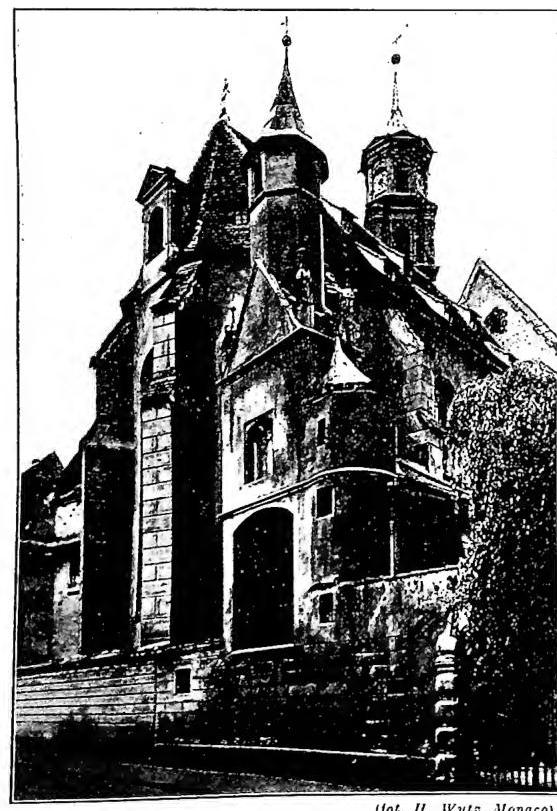
BAVARIA - Church of St Anne (15th–16th centuries) - Augsburg
Loeffz and W. Dietz represent various currents of German painting, culminating in the group Leibl, Schuch, Trübner; Hölzel, L. Dill, Langhammer, Uhde; typical representatives of Munich painting, such as H. V. Habermann, L. Samberger, L. Herterich, influenced painters of the importance of H. V. Marées, Uhde, Corinth. Among modern artists born or active in Munich are listed the painters A. Weisgerber, K. Caspar, the sculptors Ad. Hildebrand, B. Bleeker, C. Caspar, K. Fiedler and H. Wimmer.
For the art of northern Bavaria (Franconia) V. FRANCIA.
IV. SCHOOL SYSTEM
At the time of the collapse of Nazism, efforts were made to reorganize the school system and to transform the Bavarian school into an institution for re-education, while still maintaining its unified German national character. An attempt was made to introduce secular moral education in the schools, with the aim of fostering humanitarian and social solidarity among all peoples. This moral education was to be independent of religious education, which remained a compulsory school subject, though not to the same extent as before the Nazi era. Religious instruction was to be provided by religious and confessional communities, while secular moral education, where envisaged, was to be entrusted to laypersons (philosophy teachers?). Supervision, inspection, and administration were once again to be the responsibility of the central authority, which, for the time being, was under the control of the occupying powers.(courtesy of Dr. B. Degenhart)
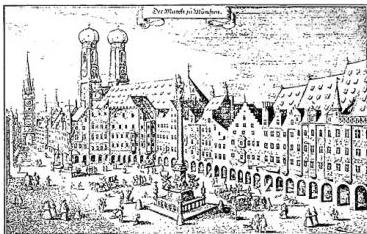
BAVARIA - The ancient Piazza S. Maria in a 17th-century engraving - Munich.
Instruction is divided into preschool and school education. Preschool takes place in kindergartens. School education is compulsory, free, and lasts 10 years. Throughout Bavaria there are 7,600 elementary schools ("Volkshauptschulen"), of which 5,347 follow the Catholic curriculum, 1,958 the Protestant curriculum, 89 the mixed curriculum, and 27 the Jewish curriculum. Elementary education lasts 7 years and is followed by the compulsory three-year post-elementary "Volksfortbildungsschule." Secondary education includes classical, scientific, teaching, and vocational courses. Higher education is provided at the Universities of Munich (founded in 1472 in Ingolstadt, moved in 1846 to Landshut and in 1880 to Munich), Würzburg (founded in 1402 and renewed in 1582), and Erlangen (founded in 1743); at the Munich Polytechnic ("Technische Hochschule," founded in 1836 and reorganized in 1868); at the Agricultural University ("Hochschule für Landwirtschaft") in Weihenstephan (founded in 1852); at the School of Commerce ("Handelshochschule") in Nuremberg; at the Academy of Fine Arts in Munich (founded in 1770); at the State Academy of Music ("Staatsakademie der Tonkunst") in Munich; and at a Conservatory in Würzburg.
The education of the Catholic clergy is provided in the diocesan seminaries of Regensburg, Speyer, Würzburg, and Miltenberg, and in the "Philosophisch-Theologischen Hochschulen" (Philosophy and Theology Universities) in Amberg, Bamberg, Aschaffenburg, Augsburg, Burghausen, Landshut, Regensburg, and Würzburg, where academic degrees can be obtained. For members of the Franciscan Order, there is a "Philosophisch-theologische Hochschule" in Munich, founded in