
GIOVANNI NEPOMUCENO, saint. - Son of a certain Wölfin, born in Pomuk (de Pomuk) in Bohemia between 1340-50 and died in Prague on March 19 (or 20?) 1393. Having become a priest in 1380, he devoted himself to the study of canon law first in Prague, then in Padua, where in 1387 he was promoted to "doctor decretorum". But much earlier he had already begun his
When the struggle broke out in 1393 between Archbishop Jenštein and King Wenceslaus IV—who, in order to limit the archiepiscopal powers, wanted to elevate the abbey of Kladruby (=Kladrau) to a diocese and place his favorite Venceslaus Králík there—the king's wrath fell upon the vicar general G. N. for having vigorously defended, fortified by his knowledge of canon law, the liberty of the Church and of its archbishop, by having the newly elected abbot of Kladrau, Odilo, confirmed. Arrested in the presence of Jenštein along with two other ecclesiastics, G. N.—unlike them, who were released—after mysterious interrogations and torture, was thrown by night from the Charles Bridge of Prague into the Vltava and drowned there (March 19 or 20, 1393).
According to this version, based on documents and chronicles of the time (principally the bill of indictment against Wenceslaus IV presented to Boniface IX by Archbishop Jenštein on April 23, 1393, but discovered only in 1752 after the canonization of G. N. and ed. by F. M. Pelzel, Geschichte des König Wenzeslaus I, Urkundenbuch, Prague 1788, pp. 143-63), G. is to be considered a martyr for ecclesiastical liberty. Instead, he is known as a martyr to fidelity to the sacramental seal, having been killed, so it is said, for refusing to reveal the confession of Queen Sophia to the king. This opinion, the origin of which is obscure (since G. had not been appointed the queen's confessor), is attested for the first time by Thomas Ebendorfer in the Chronica regum Romanorum (finished in 1459) and by Paul Zidek in the Správovna (finished in
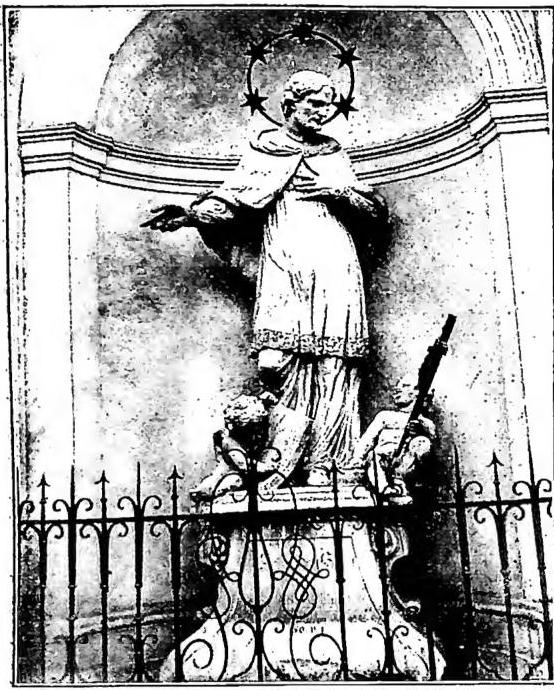
1477) and spread into the devotion toward G. N. during the Counter-Reformation. An epigraphical error made during the restoration of the tomb of G. N. (1534) led the chronicler Venceslaus Hájek z Libočan (Kronika česká, Prague 1541) to distinguish two G. N.'s: one a martyr of confession drowned on May 16, 1383, and the vicar general likewise drowned in 1393. Only the former would be a martyr and saint. This hypothesis, which had supporters until recent times (cf. La critica moderna e il martirio di s. G. N., in Civ. Catt., 12th series, 2 (1883, II), pp. 306-19 and 672-87), is today commonly considered unfounded, and only the G. N. killed in 1393 is admitted (cf. Martyr. Romanum, p. 192). In 1721 the Church recognized the cult ab immemorabili of G. N., and on March 19, 1729, Benedict XIII declared him a saint, consecrating the tradition of his martyrdom for the sacramental seal. The bull of canonization, which contained various historical errors revealed by the subsequent discovery of documents (above all the aforementioned complaint of Jenštein, which seemed to overturn all current traditions concerning G. N.), gave rise to a long and bitter controversy not yet fully clarified today. However, the conclusion that the nonexistent G. N. who died in 1383 is the only one canonized, and that the other, real one of 1393 was not declared a saint, is false, since the Church intended to decree the honor of the altars to the victim of Wenceslaus known to history. In an inspection of his body made in 1719, besides the skeleton, the Saint's tongue was found to be desiccated, but incorrupt. In 1693 a statue was erected in his honor on the bridge from which he had been thrown (in northern countries the statue of the saint is frequently found on bridges; in Rome it can be seen on the Milvian Bridge). He is generally invoked in dangers involving water and also as the protector of the good reputation of accused innocents. Feast day, May 16.