
PADOVA, DIOCESI di. – City and diocese of the Veneto, suffragan of the patriarchate of Venice. It has an area of 2,929 sq km and a population of 839,024 inhabitants, of whom 837,015 are Catholics; it has 406 parishes served by 916 diocesan priests and 190 religious priests; 30 male and 328 female religious communities (Ann. Pont., 1952, p. 302).
A city watered by the Brenta and the Bacchiglione and by intersecting canals, which give fertility to the soil and, especially in the past, facilitated communications and defense. According to legend, it was founded by the Illyrian Veneti under the leadership of Antenor after the destruction of Troy; in any case, its great antiquity cannot be denied. The Illyrians subdued the Euganeans, who were forced to take refuge in the mountains, and brought the city to prosperity through commerce on the Adriatic, to such an extent that Mela could count P. among the urbes opulentissimae; it aided Rome in the struggle against the Celts and in 49 B.C. became a municipium, enrolled in the Fabia tribe. Its territory, which extended eastward to the sea, reached the hills of Este (the Euganean Mountains), Monte Venda (the territory of Lonigo and Teolo), and the territory of Vicenza (as far as ten miles); its boundaries toward Altino are uncertain. In A.D. 69 it still appears in its splendor, but thereafter for two centuries it is scarcely mentioned. Of its classical monuments, apart from numerous inscriptions, only the ruins of the Arena remain (Pauly-Wissowa, XVIII, IV, col. 2114 ff.). P. has the glory of having given Rome its greatest historian, Titus Livius.
The history of Christianity in P. opens with the martyr s. Giustina, venerated on 7 October and buried in the immediate suburb of the city; she was honored from antiquity, but the Passio concerning her is not reliable; nor can anything be gained from the legend of s. PROSDOCIMO, SANTO (v.), who is said to have been the first bishop of P. The first bishop of whom there is certain evidence is a Crispinus, mentioned by s. Atanasio in 356 as having been active even before 345. Venanzio Fortunato (MGH, Script. antiquiss., IV, 1, p. 369) recalls in P. his friend Giovanni, who delighted in poetry with his sons; but among the bishops, a Bergullo is mentioned at the Synod of Grado in 579, and then an Ursinianus in 680 in connection with the Monothelites. A Tricidius is mentioned in an epitaph of uncertain date, perhaps from the eighth century; a Domenico at the Synod of Mantua in 827. As can be seen, reliable information concerning the Church of P. is extremely scarce during these centuries. This was certainly due to the profound decline into which P., like the other neighboring cities, fell as a result of the Lombard invasion. It was burned and razed to the ground by Agilulf in 601 after stubborn resistance (Paolo Diacono, Hist. Langob., IV, 23), and the inhabitants perhaps sought temporary refuge at Malamocco; nevertheless, it slowly recovered, especially beginning with the favors granted by the Carolingian rulers. A deed of donation by Lodovico II in 835 to Bishop Rorigo recalls earlier concessions by Carlomagno and Lotario. Growth was greater under the Italian rulers: Berengario I donated to the see of Padua the court of Sacco “de camera palatii nostri” in the county of Treviso on 5 May 897; after the Hungarian invasions, on 25 March 912, he confirmed to Bishop Silicone the privileges lost in the fires and granted him the right to erect castles; the grant of Solana on the Brenta dates from 915; on 20 April 918 there was another confirmation and regulations concerning the canons. A new confirmation was issued by Rodolfo II in 924; another by King Ugo in 926–31; and on 25 May 942, one by Kings Ugo and Lotario. The Saxon rulers, following their policy, were no less generous: Ottone I with Bishop Gauslino in 964 and Ottone III with Bishop Orso in 998; then Corrado II in 1027. Privileges were granted by Enrico III (1049) and repeatedly by Enrico IV until 1079. It is therefore unsurprising that Bishop Milo supported the latter to the point of signing at Bressanone in 1080 the deposition of Gregorio VII. His successor Pietro likewise sided with the antipope Clemente III; he was therefore deposed by Pasquale II at Guastalla in October 1106 and replaced by the Catholic Sinibaldo. The Gregorian reform thus triumphed; yet not all difficulties had been overcome, since Bishop Bellino was killed in the Polesine on 26 November 1147 while defending the rights of his Church, and was subsequently venerated as a saint. Giovanni de Cacio, who succeeded him, was present at Pavia in 1160 with Barbarossa, from whom he also received a diploma, and recognized the antipope Vittore IV; but only briefly, because P. entered the Veneto-Veronese League as early as 1163 and then the League of 1167 against Barbarossa. From him Bishop Gerardo obtained a diploma in 1177, and the city received broad favor at the Diet of Constance in 1183. This did not prevent it from participating once more in the Lombard League in 1195, and again in 1226, when it was placed under the ban of the Empire by Federico II. The Commune had by then established itself over the ephemeral episcopal government; in 1138 it already had its consuls and was able to influence the neighboring cities of Vicenza, Bassano, and Feltre, to enter into conflict with Venice (1214), and to play an important role in disputes with Treviso, the Principality of Aquileia, Verona, and the Este family.
As Federico II’s policy prevailed in the Veneto, the power of Ezzelino III da Romano was also established. After seizing P. on 25 February 1237, he kept the city under an extremely harsh regime, targeting the secular and regular clergy in particular, until June 1256, when he was expelled. The lords of Carrara soon acquired an important role in the government of the Commune, especially in confronting the ambitions of the Scaligeri, who from Verona sought to subject P.; indeed, Can Grande succeeded in becoming its lord in September 1328,
and only in August 1337 did P. free itself from the Scaligeri lordship. The power of the Carraresi thus revived, as they resumed their attempts to exploit the divisions of the Veneto and Friuli in order to expand their dominion; these efforts were soon opposed by the shrewd policy of Gian Galeazzo Visconti and of Venice itself. After Visconti’s death (1402), Francesco II di Carrara succeeded in becoming lord of Verona as well (1404–1405), but he could not withstand Venice, which, having taken him prisoner together with his sons Francesco and Giacomo, put all three to death (January 1406). P. thus came under Venetian rule and, apart from a brief period during the war of 1509–11, remained so until the fall of the Republic. As for the bishopric, during this period it was conferred almost exclusively on members of the most illustrious Venetian families. Among them one may recall Pietro Barocci (1481–1507), for his virtues and for opposing the Averroism dominant at the University; Nicolò Ormaneto of Verona (1570–1577), a true reformer who opened the Seminary in 1571 and died as nuncio in Spain; BARBARI (v.); Cardinal Carlo Rezzonico (1743–67), who almost entirely rebuilt the Seminary and subsequently became pope under the name Clemente XIII; Francesco Scipione Dondi dell’Orologio (1807–6 October 1819), a critical scholar and interpreter of the records of the Paduan bishopric; Callegari (v.).
(fot. Biblioteca Capitolare)
PADOVA, DIOCESI di – Statutes of the rural Commune of Pernumia (codex from the late fourteenth century: Dr. P. Sambin has the edition ready) – Padua, Biblioteca Capitolare.
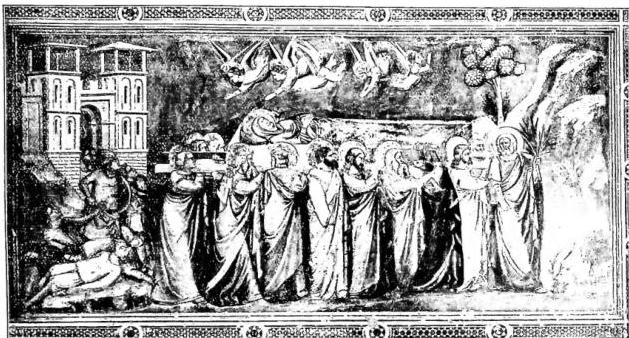
PADOVA, diocesi di – Funerals of the Virgin. Fresco by Giotto and collaborators – Padua, Scrovegni Chapel.
The Cathedral, dedicated to St. Mary and St. Justina within the city, destroyed by the earthquake of 1117, was served by a Chapter endowed with extensive properties and episcopal, papal, or sovereign privileges; there it observed the common life until about the end of the thirteenth century. Cardinal Francesco Pisani undertook its reconstruction in 1524, so that nothing ancient remained there except the baptistery. Of the oldest churches of P., only the Romanesque church of S. Sofia remains; it was even mistakenly regarded as the original Cathedral and was the seat of a collegiate church. Under papal protection lived the collegiate churches of the two most illustrious diocesan centers, S. Giustina of Monselice and S. Tecla of Este.
Monastic life underwent considerable development in the diocese. The most illustrious monastery was the Benedictine one near the church of S. Giustina, in the immediate suburbs. Its earliest origins are unknown; in 874 Bishop Rorigo made a donation to II. Destroyed by the Hungarians during the invasion of 899, it was reestablished by Bishop Gausalino, who granted it a very extensive privilege in 970, and it was protected by his successors; papal privileges were also not lacking. It had passed into commendam when, in 1409, BARBA (v.) laid there the beginnings of the Congregation of S. Giustina, later called Cassinese. In 1498 the reconstruction of the ancient church was decided upon, and it was carried forward throughout the sixteenth century by various architects, until it was consecrated on 14 March 1606 (cf. R. Pepi, in La Badia di S. Giustina, cenni, Padova 1943, p. 96 ff.). The reconstruction of the grandiose monastery proceeded alongside that of the church; the monks were expelled from it for the first time in 1797 and then on 31 May 1810. The great church subsequently became a parish church and the monastery was converted to military use. Monastic life was restored in 1943 by monks who came from the abbey of Praglia.
The second great Benedictine monastery was that of S. Maria di Praglia, in the Euganean Hills, founded around 1080 by Count Maltraverso di Montebello and his family on their own property and placed under the Apostolic See subject to an annual tribute of two gold pieces. In 1124 Bishop Sinibaldo subjected it to the abbot of S. Benedetto in Polirone, while maintaining the census owed to the Holy See. Reduced to commendam in 1389, the abbey was united with the Congregation of S. Giustina in 1448. Suppressed by the Italian laws in 1806, it was revived in 1904 through the work of the Sublacensian Congregation.
The monastery of S. Croce di Campese, founded by the Cluniac abbot Ponzio in 1124, likewise passed in 1127 under the government of the abbey of Polirone and paid the annual census to the Apostolic See.
Dependent upon the abbey of S. Zeno of Verona was the monastery of SS. Maria e Tommaso of Sacco, mentioned as early as the ninth century. That of S. Michele of Candiana, founded in 1097 by Cono di Calzone, depended upon S. Pietro of Modena and passed from the Benedictines to the Canons of S. Salvatore of Bologna in 1450.
Under episcopal jurisdiction were the Benedictine monasteries of S. Daniele in Monte near Abano (charter of 8 March 1134) and of S. Maria of Saccolongo (charter of 15 November 1147), that of S. Stefano of Carrara, perhaps founded in 1027 by Litolfo of Carrara under the patronage of that family, and the two convents of women, S. Pietro in the city, destroyed by the Hungarians and reestablished by Bishop Orso, and S. Stefano outside P., united in 1459 with that of S. Maria di Festumbia, which lasted until 1810.
The Canons Regular of Porto had the monastery of S. Maria delle Carceri near Este, mentioned in 1107 and generously favored by the marquises of Este; the church was consecrated by Godofredo, patriarch of Aquileia, on 27 March 1189. It passed to the Camaldolese in 1408, was granted in commendam in 1494, and suppressed in 1690. S. Maria of Ispida (Lispida) was likewise a house of Canons Regular, but it underwent various vicissitudes.
The first origins of the University of Padova are traced to 1222, following the disturbances that agitated Bologna and led to an exodus of masters and students. They were welcomed by Bishop Giordano, although schools already existed at Padova. A Collegium iuristarum of doctors and a Universitas iuristarum of students from both sides of the Alps were formed; they elected their own rectors and also their masters. The Universitas iuristarum, with its masters of arts and medicine, was subsequently added. It stood under the supervision of the bishop, who, as chancellor, conferred the doctorate. On 2 January 1264 Urban IV confirmed its statutes and privileges. On 15 April 1363 Urban V also established there the Faculty of Theology, with its Universitas, its dean, and a college of doctors. Special colleges were founded for poor students. In 1493 the University acquired its own premises in the Hospitium Bovis and became famous in those years as a stronghold of Aristotelianism and Averroism, from Pietro Pomponazzi to Cesare Cremonino; Galilei taught there from 1592 to 1608. Meanwhile, after the disturbances of 1516, Venice supervised the institution through the “reformers of the Studio,” who were also entrusted with granting approval for the printing of books. It enjoyed great prestige during the sixteenth century, when men of government, cardinals, ecclesiastics, jurists, and philosophers of distinction, both Italian and foreign, were drawn to it; P. also possessed a botanical garden from that time. More than for the flourishing of sixteenth-century dialect comedy, whose principal representative was Giovan Francesco Beolco, known as Ruzzante, P. held particular importance in the cultural life of the eighteenth century because of the development of historical-philological studies, whose center was the Seminary established by Barbarigo. Its most FACOLTÀ (v.), E. FORCELLINI, EGIDIO (v.), G. Costa, translator of Pindar, Prosdocimo Zabeo, and Giuseppe Furlanetto, an erudite scholar (d. 1848), and Sebastiano Melan (d. 1847).
The Civic Museum, in addition to monuments, also houses an important library and an archive into which those of the suppressed institutions have been incorporated. Also of great importance are the Libraries of the Seminary, the Basilica of S. Antonio, and the University, as well as the Archives of the Curia, the Episcopal Mensa, and the Cathedral Chapter.
Painting experienced in P. a period of powerful originality and splendor in the fifteenth century with Francesco Mantegna (v.); but in the following centuries it was tributary to the Venetian school in painting and sculpture.
A particularly imposing thirteenth-century monument is the Palazzo pubblico, called della Ragione, built in the thirteenth century. — Vedi tavv. XXXV-XXXVI.