
PALLAVICINI (PALLAVICINO), FAMILY. — The first certain information concerns OBERTO, a follower of Henry V, who in 1143 divided among his sons the possessions extending from the Po to Liguria: from this division there also derive the two branches of the P. of Genoa and those of Lombardy.
The latter enjoyed greater fortune because of its attachment to the Ghibelline party in Upper Italy: Oberto II was imperial vicar of Frederick II and several times podestà of the city. He adhered to Conrad IV and Manfred, entered into conflict with Ezzelino da Romano, and contributed to his downfall in June 1259. He himself in turn fell with the arrival of Charles of Anjou, who drove him from Milan, where he was captain general (d. 18 May 1269). The “Pallavicino State,” however, did not fall; it was an imperial fief comprising territories in Parma, Piacenza, and Cremona, with its principal nucleus at Busseto, and it disappeared only through its division among the various branches and the growing power of the Visconti-Sforza, when the State became a chamber fief within the Milanese State.
The P. of Genoa made their fortune both in the service of the Church and in that of their Republic; in particular, during the seventeenth and eighteenth centuries they held various diplomatic posts in Spain, France, and Austria, as well as in Rome and The Hague, also participating in the Congress for the Peace of Aachen.
The following belonged to the Genoese branch: ANTONIOTTO GENTILE, cardinal, b. in 1441, d. in Rome on 10 Sept. 1507, who spent his youth in the East, settled in Genoa after the fall of the Byzantine Empire, and formed a friendship with Cardinal Cibo. Sixtus IV appointed him bishop of Ventimiglia on 15 June 1484. Cibo, elected pope under the name of Innocent VIII, appointed him his datary and bishop of Orense on 27 Jan. 1486, then of Lamego in Portugal from 26 March 1492 to 1493; he held the bishopric of Tournay in commendam (1491–May 1494), then that of Pamplona on 31 Aug. 1492, when Cesare Borgia relinquished it in order to obtain that of Valencia, and retained it until his death, together with other benefices in Spain. Meanwhile Innocent VIII had created him cardinal on 9 March 1489. Alexander VI charged him at the end of 1494 with negotiating with Charles VIII, who was advancing against Rome; on 11 May 1494 he sent him as legate, together with Bernardino Quiñones, to Naples to the same King; and on 27 May, leaving him as legate in Rome, he escorted that King to the
in 1507, sent him as legate to Savona, when Louis XII
of France and Ferdinand the Catholic were negotiating an
alliance against Venice.
Silvio Furlani
CIPRIANO, archbishop of Genoa, b. there in 1510,
d. there in 1586, after resigning in Nov. 1585.
A protonotary and apostolic secretary, he participated in the Council
of Trent, and was collector and nuncio in Naples from 15 May
to 23 Nov. 1566; he received the archbishopric on 14 Nov. 1567.
In implementing the decrees of the Council, he had
jurisdictional disputes with the government of the Republic and
with the Society of Jesus; to settle them, Gregory XIII
sent there as apostolic visitor the bishop of Novara,
Francesco Bosio, who carried out his charge severely, taking
measures also against the P. The P. was a patron of artists,
and various churches in Genoa owe their restoration to him.
GIOVANNI BATTISTA, cardinal, nephew of Antoniotto,
was a writer of Apostolic Letters, an abbreviator of the first
vision in 1503, and attended the Fifth Lateran Council in
Dec. 1516 as bishop of Cavaillon, a see which he held from
22 Nov. 1507 until his death. He was included in the great
creation of cardinals carried out by Leo X on 1 July 1517;
d. in Rome on 13 Aug. 1524.
LAZZARO, b. in Genoa in 1603; a cleric of the Apostolic Camera,
he was created cardinal by Clement IX on 29 Nov. 1669.
He was legate to Bologna; he died in Rome in 1680.
OBIZZO, b. in Genoa on 13 Oct. 1632; he was nuncio in
Tuscany and Cologne; then in Poland from 1680 to 1686,
when the intrigues for the anti-Turkish league so strongly advocated
by Innocent XI were in full swing; the P. worked there
with fervor. He was created cardinal on 2 Sept. 1686.
Bishop of Spoleto on 28 Nov. 1689, then of Osimo (8 Aug. 1691),
he died in Rome on 11 Feb. 1700.
LAZARO-OPIZIO, cardinal, b. in Genoa on 30 Oct.
1719, d. in Rome on 23 Feb. 1785. He was nuncio in Spain
(1760–67), but did not give much satisfaction, because of his excessive
devotion to that sovereign. He was created cardinal by Clement XIII
on 26 Sept. 1766. Clement XIV appointed him cardinal
Secretary of State on the very day of his election, but subsequently
did not take his collaboration into account. Through the
influence of Cardinal de Bernis, he retained the office under Pius VI,
although he was considered a man of little ability. From Spain
he had brought that aversion to the Society of Jesus which accompanied
his actions. In the Conclave of 1775 he was supported by Spain,
but without result.
RANUZIO, cardinal, b. in Piacenza on 17 Oct. 1632.
He was governor of several cities of the Papal States, inquisitor
in Malta in 1672, secretary of the Congregation of the Council,
then governor of Rome; he was created cardinal by Clement XI
on 17 May 1706. D. in Rome
on 30 June 1712.
The member who most certainly brought distinction to the
P. family in the ecclesiastical sphere was PIETRO P. SPORZA, a Jesuit,
cardinal, of the Parma branch, b. in Rome on 28 Nov.
1607, d. there on 5 June 1667. Having brilliantly
completed his philosophical, juridical, and theological studies at
the Collegio Romano and been ordained a priest, he entered
the administrative career of the Roman Curia, became
referendary of the two Signatures and a member of the Congregation
of Good Government and of Ecclesiastical Immunity;
but, having fallen from favor with Urban VIII,
in 1632, together with his friend Giovanni Ciam-
poli, secretary of Briefs, he had to go as governor
(phot. Frits)
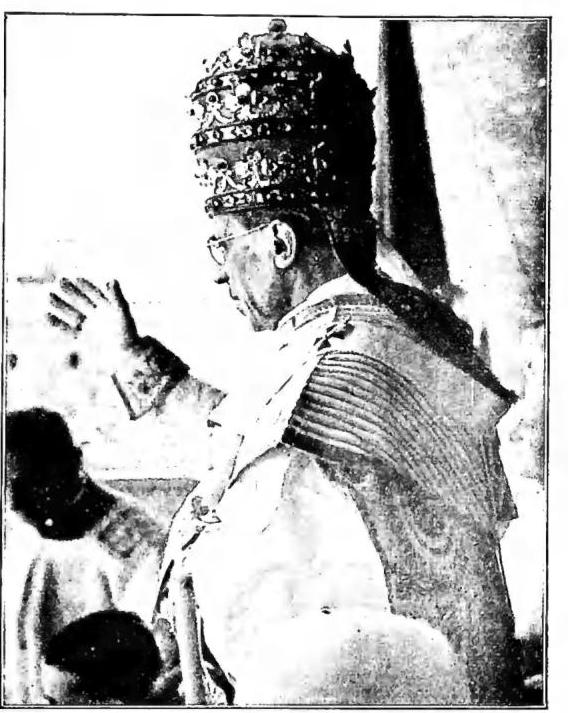
PALLIO — Pius XII with the fanon and pallium. The three pins (aciculae or spinulae), ornamented with precious stones and placed at the front, back, and on the left shoulder, now have a purely ornamental function.
at Jesi, then at Orvieto and Camerino. Having overcome his father’s opposition, on 21 June 1637 he entered the Society of Jesus; by 1639 he was already professor of philosophy, and in 1643 of theology (succeeding his teacher De Lugo) at the Collegio Romano, where Paolo Segneri was among his pupils. As a theologian he was commissioned to examine the theory of M. de Barcos, condemned on 24 January 1647 (Denz-U, no. 1091), and from the autumn of 1652 he took part, together with L. Wadding and eleven other consultors, in the sessions concerning the five propositions of Jansen. P. sided with the more moderate current, which judged the propositions merely erroneous and proximate to heresy (v. Pa-stor, XIV, 1, pp. 204 ff).
After the election of his youthful friend Fabio Chigi to the papacy (7 April 1655), P. was created cardinal in pectore on 9 April 1657 and published on 10 November 1659. How close his personal relations with Alexander VII remained throughout the pontificate is demonstrated by the lively correspondence exchanged with him (the originals are in Cod. Chig. C III 63 of the Vatican Library; a judgment by P. on the benefices of the Pope’s nephews in Pastor, XIV, II, pp. 518–19). The fruit of P.’s philosophical learning consists of the four books Del Bene (Rome 1644; in Latin under the title: Philosophia moralis, Cologne 1646); of his theological learning, the Observationes Theologicae (8 vols., Rome 1649–52) and the Disputationes in Primum Secundae s. Thomae (ibid. 1653). At the same time P. composed a tragedy, Ermenegildo (ibid. 1644), and a work on stylistics, Considerazioni sopra l’arte dello stile e del dialogo (ibid. 1646). In response to the accusations of the former Jesuit Clemente Scotti, he defended his Order with great skill in the Vindiciae Societatis Jesu (ibid. 1649). These many accomplishments as a writer, rather than historical works, led the General, at the beginning of 1652, to entrust him with refuting the history of the Council of Trent by the Servite Paolo Sarpi, published in 1619. Material for such a refutation had already been collected as early as 1625 by the Jesuit Terenzio Alciati, but he died on 12 November 1651 without completing the composition. P. took Alciati’s collection, enlarged it with material drawn from the manuscripts of the Barberini, Borghese, Spada, and Medici Libraries and from others placed at his disposal, and obtained from Innocent X permission to inspect the Acts of the Council, kept at Castel S. Angelo. After three years of work, the framework of the work was already complete; P. devoted another year to polishing it to perfection, and finally in 1656 the Istoria del Concilio di Trento appeared in two in-folio volumes, dedicated to the new pope, Alexander VII. The work enjoyed extraordinary success; in 1663–64 a second edition became necessary (3 vols., in 4°), and in 1666 a Latin abridgment appeared under the name of his secretary, p. Giampietro Cataloni, in which the polemical sections were omitted, thereby making it easier to read. A version of the complete work in Latin appeared at Antwerp (1670) under the name of p. G. B. Giattino; versions in French, Spanish, and German appeared for the first time in the nineteenth century. The best edition of the Italian text is the one edited by F. A. Zaccaria (6 vols., Faenza 1792–99). P. himself, in a letter to the marquis Durazzo dated 2 June 1657, defined his work as an «istoria mista di apologia; anzi più veramente un'apologia mescolata d'istoria». He intended, in fact, to defend the papacy against Sarpi’s calumny that it had used the Council of Trent solely to restore and expand its power. As means of demonstration, P. makes simple use of the historical facts drawn from the sources; he sees himself as an advocate who must present a defense, but refrains from any deliberate distortion, and speaks so openly even of unpleasant facts that his frankness was reproached. The very numerous and superior sources on which he drew enabled him to demonstrate many of Sarpi’s errors; nevertheless, he did not succeed in clearing the field of Sarpi’s work, because Gallicans and Protestants and, later, liberals as well had adopted its fundamental conceptions. P.’s artistically polished and aphoristic style did not attain Sarpi’s incisive concision.
From 1656 to 1659 P. also wrote a life of Alexander VII, which he left unfinished and which remained unpublished for a long time; a complete edition was produced in two volumes at Prato in 1839, reprinted at Milan in 1843 and, more accurately but only partially, by O. Gigli (Rome 1849 [cf. Pastor, XIV, II, pp. 523–27]).
In P., multiple talents were united with great diligence, but also with profound humility and a sincere pursuit of perfection. Two years before his death he published an ascetical work: Arte della perfezione cristiana (Rome 1665). But the work that may properly be called the work of his life, and that secured his fame for centuries, remains the Istoria del Concilio di Trento, which he himself declared to be «un vivo ritratto mio». He died in the novitiate of S. Andrea al Quirinale, where a floor plaque commemorates him.