
PRATO, DIOCESE of. — City and diocese in Tuscany, Pistoia (v.). The diocese, established in 1653 through the detachment of part of the territory of the diocese of Pistoia, encompasses the Bisenzio valley and extends over the entire municipality of the city, as well as the municipality of Vaiano. It borders the dioceses of Pistoia and Florence. In 1916, 12 parishes detached from the diocese of Florence and 28 detached from the diocese of Pistoia were incorporated into the diocese of P. It has 83,000 inhabitants and 49 parishes; 5 rural vicariates; 4 houses of male religious orders and 30 houses of female religious orders. The number of secular priests amounts to 62; there are 31 regular priests. It has a seminary founded by Bishop Gherardi in 1682; its first location was the abbey of Grignano, and it now occupies the former abbey of S. Fabiano. The patron saint of the diocese is s. Stefano.
1847; Storia e fantasia, 1851; Canti politici, 1852). The second is marked by attempts at more extensive poems (Dio e l'umanità, of which only the episode Jelone di Siracusa was written, 1852; Satana e le Grazie, 1855; Rodolfo, 1853; Ariberto, 1860; Armando, 1868: the last three engage in the description of souls diseased by scepticism). In the third
I. CIVIL HISTORY
Pratum lies on the banks of the Bisenzio. Originally it was a small village, Borgo al Cornio; like other localities in that valley, it broke free from the rule of the Alberti counts. Later it was organized as a commune and had its own consuls. It formed part of the Guelph league in Tuscany and shared its fortunes. But from the middle of the 14th century it became a possession of Florence and with it shared and merged its history; and when Florence was besieged by the imperial forces, P. suffered a cruel sack at the hands of the Spaniards (1512). Today it is a populous city, rich in industries and manufacturing plants, from which it derives the impetus for continued expansion.II. RELIGIOUS HISTORY
The population inhabiting the locality that later came to be called P. had a church dedicated to SS. Stefano and Lorenzo at least as early as the 6th century, since in 530 Pope Felice granted a plenary indulgence for the solemn feasts of the titular saints. In 1133 Pope Innocenzo II placed this church under apostolic protection; nevertheless, the clergy and people of P. repeatedly showed signs of insubordination toward the bishop of Pistoia, their legitimate pastor. At the beginning of the 15th century, a serious dispute arose between the provost of P. and the bishop of Pistoia, the former challenging the latter, in a notarial deed, over the right to display to the people a relic then, and still today, venerated in P. under the name of S. Cintola. To remedy this situation, in 1409 the lordship of Florence requested from Alessandro V that the church of Prato be raised to cathedral status. When the request was not granted, Pio II, in 1460, removed the church of P. from the jurisdiction of the bishop of Pistoia, constituting it a prepositure nullius dioeceseos. Since the territory had subsequently increased considerably, Innocenzo X, by a bull dated 22 September 1653, raised the Prato provostry to a cathedral and elevated the borough to the status of a city, separating it from the diocese of Pistoia and joining it to that diocese, as a new diocese, aeque principaliter. From then on, the religious history of P. became identified with that of Pistoia.III. ILLUSTRIOUS FIGURES
In addition to Caterina de' Ricci, a Florentine who brought renown through her sanctity to the Dominican convent of P., mention should be made of Cardinal Niccolò da P., the peacemaker in Florence between the Neri and the Bianchi; Mons. A. Martini, the well-known translator of the Bible and archbishop of Florence; and Mons. Giovacchino Limberti, who, as a canon of his cathedral, became archbishop of Florence, consecrated by Pius IX himself. Among the laity, Cesare Guasti left a reputation for outstanding piety in the past century, a name well known in our literature.IV. ART
Within the polygonal circuit of its walls, opened by five gates, P. no longer presents the appearance of a turreted city that it still retained in the eighteenth century; but among the remodeled buildings and the modern ones, erected to meet the needs of its life as an active wool-manufacturing center, there are many monuments that bear witness to its past, in forms that for the most part reflect those of powerful and prosperous neighboring cities.1. Architecture
The buildings dating from before 1200 have disappeared or been reduced to a few remnants (the remains of the first circuit of walls, dating from the beginning of the twelfth century; the church of the Badia di S. Fabiano, built around the year 1000, whose façade bears one of the earliest examples of Tuscan polychrome decoration; the ruins of the church of S. Barnaba incorporated into the Hospital). The oldest monuments of Prato may be considered to be the Duomo and the Castello dell’Imperatore, both dating from the thirteenth century. The Castello dell’Imperatore, which legend says was erected by Frederick II with the bequest of the Pratese Panfollia Dagomari, who died in 1233, is in reality a radical reconstruction, on the ruins of an older castle, commissioned around 1248 by Frederick of Antioch, natural son of Frederick II and vicar of Tuscany with the royal title. Quadrangular in plan, strengthened by massive towers at the corners and midway along the sides, it recalls the Castello Ursino of Catania in its ground plan and Castel del Monte near Andria in its portal, so that it seems likely that Frederickian craftsmen worked on II. PRATO, DIOCESI di – Ancient vessel in which the Holy Girdle was kept. Panel with the Death of the Virgin (fourteenth century).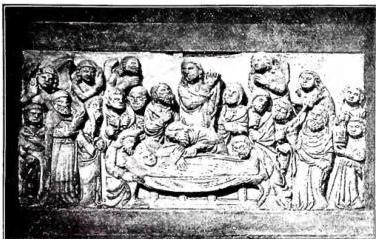
Among the civil buildings, mention should be made of the Palazzo Pretorio, which has housed the municipal gallery since 1910; the massive building of the Pia Casa dei Ceppi, formerly the residence of the Pratese merchant Francesco di Marco Datini, whose walls preserve remnants of frescoes by Niccolò di Pietro Gerini, a rare example of the exterior decoration of a fourteenth-century house. Among the religious buildings of the Gothic period, the church of S. Francesco, dating from the second half of the thirteenth century but with a later Renaissance façade of two-colored bands and a triangular gable, and that of S. Domenico, begun in 1281, slender and imposing, enriched along the left side by a series of tombs surmounted by Gothic arches of Pisan and Florentine type, should be recalled. The Renaissance did not renew the appearance of the city, already marked by Gothic art, limiting itself to some alterations or the construction of a few palaces (Palazzo Pugliesi); but it created in P. one of its purest architectural masterpieces, S. Maria delle Carceri, by Giuliano Giamberti da Sangallo. Built in 1485–1492, Sangallo’s building, in the form of a Greek cross with two superimposed orders and faced with white and green marble, reveals its descent from Brunelleschi. The interior, however, although it repeats the forms and decoration of the Cappella dei Pazzi, already has a sixteenth-century breadth in the spaciousness of its proportions. The eighteenth century left its mark on the fine building of the Convitto nazionale Cicognini, erected on the site of the Badia di Gragnano.
2. Sculpture
Since Romanesque and Gothic sculptures have for the most part been lost (although the Duomo still contains the beautiful Madonna della Cintola [1317], the last work of Giovanni Pisano), the city reflects in its sculptural decoration the style of the Florentine school of the fifteenth century.Projecting from the corner of the Duomo façade, the Pergamo della S. Cintola, built in 1433–38 for the display of the relic in place of Niccolò di Cecco del Mercia’s Gothic pulpit, which had previously stood along the southern side, is the work of Donatello, with the collaboration of Michelozzo in the balustrade adorned with dancing putti; Michelozzo, meanwhile, was responsible for the harmonious canopy and for casting in bronze the marvelous capital modeled by his great companion. Other works of the Florentine school decorate the Duomo: the exquisite grille of the chapel of the S. Cintola, the work of Bruno di Ser Lapo Mazzei of Florence and Pasquino di Matteo of Montepulciano; the pulpit by Mino da Fiesole and Antonio Rossellino (1473), conceived by the artist from Fiesole as a great holy-water font; the beautiful Madonna del Tabernacolo dell’Uivo by Benedetto da Maiano (the brothers were responsible for constructing the Tabernacolo and the Pietà on its base); the glazed terracotta lunette by Andrea della Robbia above the portal (other works by the same artist are scattered throughout various churches of the city). Of the sculptural decoration of the succeeding centuries, it will suffice to mention the Fontana del Bacchino, now in the municipal gallery, which Ferdinando Tacca executed (1657–1665) for the Piazza del Comune, where it has been replaced by a copy.
3. Painting
Pictorial decoration fared better than sculpture during the Gothic period. The disappearance of the frescoes by Bettino da P., a disciple of Giotto, both in the Duomo and in the Palazzo Pretorio, and of those by Guido senese in the Podestà’s apartment, is offset by the survival of several important mural cycles from the end of the fifteenth century: such as the Stories of the Virgin and the episodes from the Legend of the S. Cintola, painted by Agnolo Gaddi shortly after 1367 on the walls of the chapel where the relic is kept; the Stories of S. Margherita and S. Giacomo Maggiore, also in the Duomo, attributed to Lorenzo di Bicci; and the Episodes from the Life of S. Matteo and S. Antonio Abate, frescoed by Niccolò di Pietro Gerini in S. Francesco. Far more imposing are the testimonies of Renaissance painting, which also include local elements, such as the Pratese Pietro di Miniato, to whom the frescoes in the refectory of S. Niccolò are due, and interesting anonymous works, such as those by the two masters who decorated the chapel of the S. Cuore in the Duomo with the Stories of the Virgin and S. Stefano. Among the paintings of the fifteenth century, the grandiose fresco cycles executed by Filippo Lippi in the Cappella maggiore of the Duomo with the collaboration of fra’ Diamante stand out (Stories of S. Stefano and the Baptist, 1452–64). Two other works also belong to Lippi: the panel with the Funerals of S. Bernardo, likewise in the Duomo, and the beautiful painting in the municipal gallery, which the Florentine artist painted in 1453 for Francesco di Marco Datini (Virgin Enthroned and Two Saints). Filippino Lippi, son of Filippo, was born in P.; of his works there remain the frescoed triptych of the tabernacle of S. Margherita, which despite its damage is among his most delightful works, and the Virgin with the Child and Two Saints, in the municipal gallery. Paintings from the sixteenth century are scarce. It will suffice to mention Ridolfo del Ghirlandaio’s Virgin of the Girdle in the Duomo (1514). – Vedi tav. CXXIX.golo nel duomo di P. e gli affreschi di Agnolo Gaddi, in Riv. d'arte, 14 (1932), p. 355 sq.; id., Studi e mem. pratesi, Prato 1933; A. De Witt, P. Restauri nella cattedr., in Emporium, 81 (1935), p. 183 sq.; R. Piattoli, s.V. ENOCH. Ital., XXVIII (1935), p. 165 sq.; G. Marchini, La chiesa di S. Agostino in P. e l'architettura fiorentina tardo-gotica, Firenze 1938; numerosi articoli sui monumenti e sugli oggetti d'arte di P. in Arch. star. pratesi, dal 1917 in poi. Amalia Mezzetti