
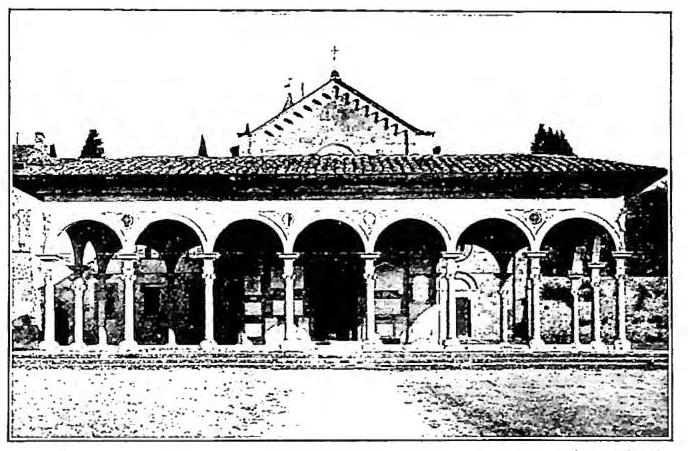
BENEDETTO da MAIANO. — Architect, sculptor, and woodcarver, b. at Maiano in 1442, d. at Florence on 24 May 1497. As an architect he belonged to the Brunelleschian school, as is well demonstrated by the portico of S. Maria delle Grazie at Arezzo (1492–94); in this work, in fact, B. repeated, with exaggeration, from the models of S. Lorenzo and S. Spirito in Florence, the very tall impost blocks at the tops of the columns, upon which spring arches so broad that the entire portico seems almost to be realized through the absolute predominance of voids over solids. The strong projections of the architectural members, capitals, impost blocks (which are composed of fragments of entablature), and cornice lend great pictorial quality and movement to the airy structure, fully integrated into the surrounding nature.
The Strozzi palace is also attributed to B.; some, not without foundation, assign it to Giuliano da Sangallo (who certainly executed a model), without excluding the direct intervention of the patron himself.
As a sculptor, B. was inspired by Donatello. His most famous sculpture is the pulpit adorned with scenes from the life of s. Francesco in S. Croce in Florence (1481).
In 1489 B. executed in Florence the altar with the Annunciation for the church of Monte Oliveto in Naples. To depict the central scene, he employed pictorial perspective by opening a deep portico behind the figures of the Virgin and the Angel, taking up a theme developed by Desiderio da Settignano in the tabernacle of the Sacrament in the Florentine church of S. Lorenzo.
We should also recall the naturalistic bust of Pietro Mellini (Florence, National Museum); the ark of s. Savino in the cathedral of Faenza; the tomb of b. Marcolino in the Municipal Gallery of Forlì; the ciborium of S. Domenico in Siena; the urn with the altar of S. Fina in S. Gemignano; the door of the Audience Hall in Palazzo Vecchio; the Madonna and s. Sebastiano in the oratory of the Misericordia
B. was also a highly renowned woodcarver (Palazzo Vecchio, ceiling of the Hall of the Eight and of the audience chamber of the Priors). – Vedi Tav. LXXIX.