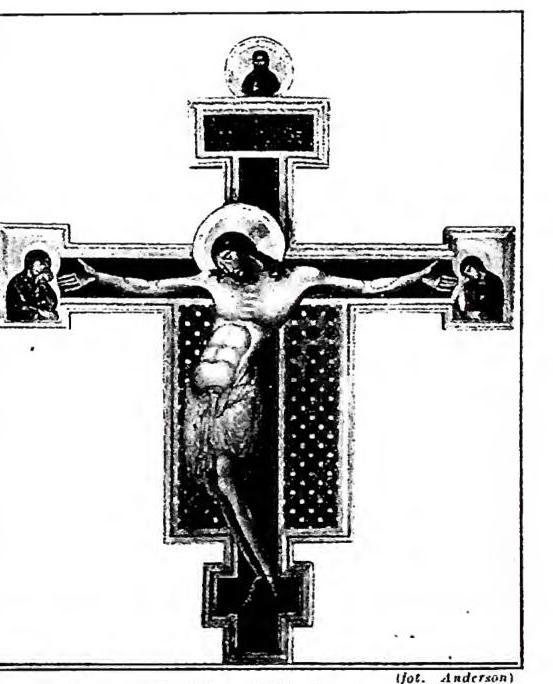
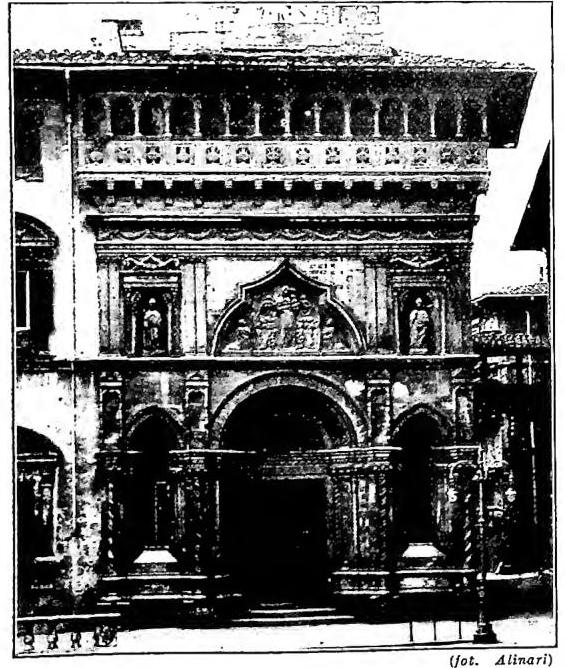
AREZZO, DIOCESE OF. — It remains today the largest in Tuscany, extending over 3,250 sq. km. of territory, which includes the upper Arno valley (Casentino), the upper Valdarno as far as San Giovanni Valdarno, and the Val di Chiana, and borders the dioceses of Fiesole, Sarsina, Borgo San Sepolcro, Città di Castello, Cortona, Montepulciano, Chiusi and Pienza, Montalcino, and Siena. The diocese of Arezzo has 215,000 Catholics out of a total population of 220,000; 750 churches, 336 parishes, 355 diocesan priests, and 95 regular clergy. It is a see immediately subject to the Supreme Pontiff. The bishop enjoys archiepiscopal insignia (pallium and double cross), by concession of Clement XII, granted in perpetuity to Bishop Giovanni Antonio Guadagni (1724–32), later a cardinal and his nephew. He also holds the title of Count of Cesa.
Its patron is St. Donatus (q.v.), bishop, whose feast is celebrated on 7 August.
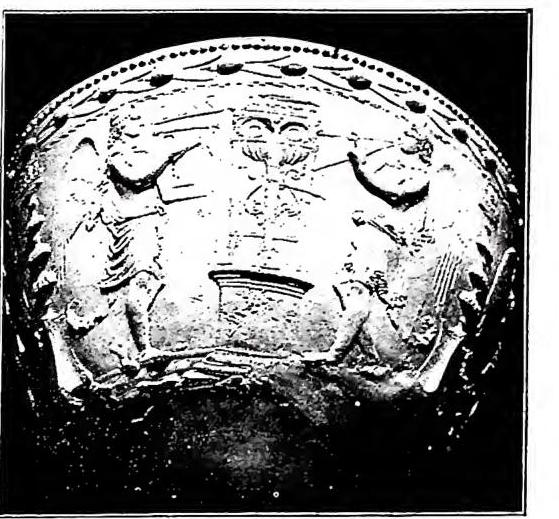
AREZZO - Cast of an Aretine vase (2nd century A.D.) - Boston, Museum.
1305) and Guido Tarlati (1306-27), who restored the city’s fortunes and brought it to its greatest splendor. Soon, however, Arezzo had to submit to Florence (1336); it attempted to rebel, but without success, and from the second half of the 14th century onward it definitively entered the orbit of the powerful Florentine republic, following its political fortunes.
Christianity must have penetrated Arezzo at a relatively early date, given its location along one of the great consular roads; its systematic conversion, however, is to be attributed to the 4th century. The series of bishops, preserved in a 11th-century parchment (U. Pasqui, Documenti per la storia della città di Arezzo, IV, p. 259), begins with St. Satyrus, from the first half of the 4th century. The territory of the diocese was considerably reduced in the 14th-16th centuries to the benefit of new dioceses, namely Cortona under John XXII (1325), Pienza and Montalcino under Pius II (1462), Borgo San Sepolcro under Leo X (1520), and Montepulciano under Pius IV (1561). Regarding territory, a long dispute arose in the early Middle Ages and lasted for centuries between Arezzo and Siena over jurisdiction over 18 rural churches in the Sienese countryside (cf. E. Besta, Il diritto romano nella contesa tra i vescovi di Siena e di Arezzo, in Archivio storico italiano, 5ª serie, 37 [1906], pp. 61 ff.).
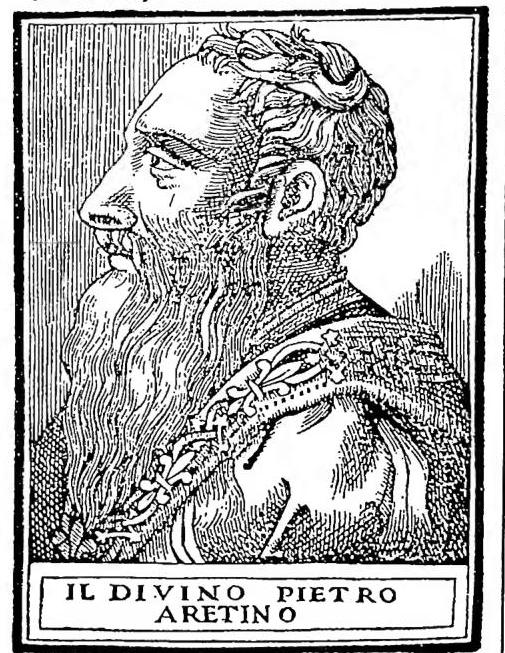
PERSONAGGI ILLUSTRÌ. — A. has given birth to many illustrious figures, some of the highest order. We recall the principal ones: Maecenas (d. 8 BC), friend of Augustus and patron of Virgil and Horace; Fra Guittone d’Arezzo (d. 1294), poet; Margaritone (13th c.), painter; Francesco Petrarca (d. 1274); Spinello Aretino (d. 1410), painter, the most distinguished master, together with Angelo Gaddi, of the Florentine school at the end of the 14th century; Leonardo Bruni (d. 1444), humanist, man of letters and historian; Angelo Gambiglioni (d. 1451), jurist; Francesco Accolti (d. 1483), philosopher, jurist, poet and musician; Andrea Contucci (d. 1529), called il Sansovino from his birthplace Monte S. Savino near A., sculptor; Pietro Aretino (d. 1556), noted satirical poet; Giorgio Vasari (d. 1574), painter, architect and writer; Andrea Cesalpino (d. 1603), philosopher, physician and physiologist, to whom is attributed the discovery of the circulation of the blood; Alessandro del Borro (d. 1656), celebrated captain; Francesco Redi (d. 1698), physician and poet; Pietro Benvenuti (d. 1844), painter; Vittorio Fossombroni (d. 1844), mathematician, economist and statesman; Antonio Guadagnoli (d. 1858), poet.
CON LA VISIONE DI NOE NE
LA QUALE VEDE I MISTERII DEL
TESTAMENTO VECCHIO E DEL
NVOVO, DIVISO IN TRE LIBRI.
(propr. B. Ingenhart)
ARETINO, PIETRO - Title page of the work Il Genesi, Venice 1539.
jesting; Gianfrancesco Gamurrini (d. 1923), historian and archaeologist, to whom we owe, among other things, the discovery of the Peregrinatio Aetheriae; Giulio Salvadori, of Monte S. Savino near Arezzo, critic and poet, d. 1928 in a reputation for holiness, and for whom the process for beatification is being prepared.
Among the most distinguished ecclesiastical figures are to be recalled: Guido Monaco, reformer of ecclesiastical chant; Grazia Aretino (d. after 1243), archdeacon and canonist; Fra Benedetto Sinigardi (d. 1292), companion and friend of St Francis, missionary in Greece; the Blessed Rainerio de Marianis, Franciscan friar (d. 1304), to whom Pius VII granted the office and Mass for the Franciscans; Dovizi (v.) da Bibbiena, known as Cardinal Bibbiena (d. 1520), great friend of Leo X and patron of Raphael; Pietro Accolti (d. 1532), cardinal and canonist; Pope Julius III (v.), born in Rome of a family originally from Monte S. Savino near Arezzo; Burali (v.), bishop of Piacenza and later cardinal (d. 1570), beatified by Clement XIV in 1772; Francesco Pitigiani (d. 1616), Scotist theologian; ACCIA, BARTOLOMEO (v.) da Salutio, orator, mystic and poet (d. 1617); St Margaret Redi (d. 1770), grand-niece of the poet Francesco Redi, canonized in 1934; the priest Giuseppe Borghi of Bibbiena (d. 1847), a man of letters best known for his sacred hymns.
In the annals of the Church of Arezzo, mention must also be made of the death of the Blessed Gregory X (v.), pope, who died in Arezzo and was buried in the cathedral. In Arezzo, too, the successor was elected, the Blessed Innocent V (v.), a Dominican.
ABBEYS AND MONASTERIES. — The diocese of Arezzo has had and still has many religious houses and most celebrated shrines. It suffices to recall the sacred hermitage and monastery of Camaldoli (q.v.), cradle of the Camaldolese hermit monks, founded by St Romuald (q.v.) around the year 1012; the monastery and shrine of La Verna (q.v.), where St Francis received the stigmata (1224); the abbey of Monte Oliveto Maggiore (q.v.), cradle of the Olivetan Benedictine monks, founded by the Blessed Bernardo Tolomei (q.v.) with the approval of the bishop of Arezzo, Guido Tarlati (1319), at that time belonging to the diocese of Arezzo, later passing to the diocese of Pienza (1462); the shrine of Santa Maria del Sasso near Bibbiena (Dominican), whose church is recorded as early as 1204; the shrine of Santa Maria delle Vertighe (Franciscan), with a church rebuilt in the early 16th century. Among the abbeys and monasteries once famous in the diocese but now extinct, mention may be made of the Arezzo monastery, first called San Benedetto, then of the SS. Flora e Lucilla, founded around the year 770, whose buildings still exist (the cloister attributed to Sangallo, the refectory and church with paintings by Vasari); the Arezzo monastery of Santa Maria in Gradibus, of the Camaldolese, existing before 1050; the monastery of San Gennaro at Capolona, of the Benedictines, founded in the 10th century; the monastery of San Salvatore di Selvamonda in Casentino, near the Zenna stream, founded around the year 1000, originally for nuns and later for Benedictine monks: from this abbey, which later passed to the Camaldolese, depended the priory known as Badia a Tega, near Ortignano in Casentino; the monastery or abbey of the Most Holy Trinity of the Alps, also called Fonte Benedetta, founded at the end of the 10th century above Faltona in Casentino; the monastery of San Fedele di Strumi, near Poppi in Casentino, founded at the end of the 10th century, later passing to the Vallumbrosans and of which Callistus III, the antipope during the time of Alexander III (1159–1181), was abbot; the monastery of Santa Maria di Prataglia, today Badia Prataglia, founded by the bishop of Arezzo, Elemperto (986–1010); the monastery of San Bartolomeo di Anghiari, founded by the Camaldolese in the early years of the 12th century; the monastery of Santa Maria d’Agnano in Val d’Ambra, which already existed at the end of the 11th century, first as a
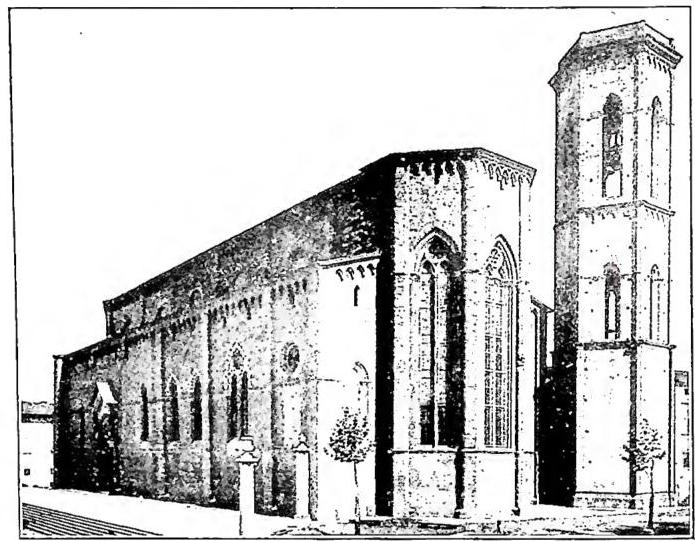
AREZZO — Abbey of the Cathedral (14th century).
INSTITUTES OF CULTURE, LIBRARIES, ARCHIVES. — Apart from the general study discussed elsewhere, among the cultural institutes currently in existence, the Accademia Petrarca of letters, arts, and sciences, founded in 1810, should be mentioned; it publishes a semiannual volume of Proceedings and Memoirs. The libraries and archives of Arezzo are: the library of the Fraternità dei Laici, with 79,000 volumes, 160 incunabula, and 534 manuscripts; the library of the Accademia Petrarca, with 11,000 volumes and 6 incunabula; the Biblioteca Vasariana with the attached Vasari Archive; the library of the episcopal seminary and the Collegio Piano, with 16,000 volumes, 50 incunabula, and 800 manuscripts, and with the attached archive of the Chierici di Murello. Of great importance is the episcopal archive, to which is joined the chapter archive of the Cathedral, one of the earliest ecclesiastical archives in Italy, both for its antiquity and for the richness of its documents.
A. also possesses a Museum founded in 1822, with a good collection of Etruscan material and many matrices and fragments of Arezzo pottery; and a municipal picture gallery, established following the suppression of religious corporations in 1810, containing many paintings from suppressed monasteries and rich especially in works by Arezzo painters.
MONUMENTS. — The principal monuments of Arezzo consist of its churches, among which we may mention: the grand cathedral, in Romanesque-Gothic style, with three naves and many fine works of art, erected on the highest point of the city in the 13th–14th centuries to replace the old cathedral of the 11th century, which stood outside the walls; attached to it is the grand chapel of the Madonna del Conforto, a most venerable sanctuary; S. Maria della Pieve, with artistic portals, a celebrated crypt, and a characteristic bell tower, the most prominent Romanesque monument in the city (13th century); the church of S. Francesco (14th century), with the famous frescoes by Piero della Francesca; the church of S. Domenico (13th century), designed by Niccolò Pisano, according to Vasari; the church of the Santissima Annunziata, begun by Bartolomeo della Gatta (1491) and completed by Antonio da Sangallo; the Badia church, touched up by Vasari in the mid-16th century, with an adjoining 15th-century cloister by Giuliano da Maiano; the church of S. Maria in Gradi, begun in 1592 by Bartolomeo Ammannati; the church of S. Maria delle Grazie, on the outskirts of the city, begun in 1449 by Domenico di Giovanni called il Fattore, to which was added, toward the end of the same century, an airy Renaissance-style portico of remarkable lightness and grace, attributed to Benedetto da Maiano.
BIBL. For the Etruscan-Roman period V. the article by Ch. Hülsen, Arretium, in Pauly-Wissowa, Realencycl. der class. Altertumswiss., II, cols. 1227 ff. For the history of the city and diocese, of fundamental importance is the publication of sources by the aforementioned Aretine U. Pasqui, Documenti per la storia di A. nel medio evo, published under the auspices of the R. Deputazione di Storia Patria della Toscana, 4 vols., Arezzo 1899–1929. — Historical monographs: P. Farulli, Annali ovvero notizie dell'antica, nobile e valoroso città di A. in Toscana, dal suo principio sino al presente anno 1717, Florence 1717; G. Rondinelli, Relazione sopra lo stato antico e moderno della città di A. al Granduca Francesco I, Arezzo 1755; U. Leoni, Storia di A., 2 vols., Arezzo 1898; C. Lazzeri, Guglielmino Ubertini vescovo di A. (1248–1289) e i suoi tempi, Florence [1920]; L. Falciani, Storia di A. dalle origini alla fine del Granducato Lorenese, Arezzo 1928. — For the history in particular of the diocese and its churches and monasteries v.: Lanzoni, pp. 567–73, 593 ff.; also: F. Kehr, Italia Pontificia, III: Etruria, Berlin 1898, pp. 145–96; Rationes decimarum Italiae nei secoli XIII e XIV, Tuscia, I: La Decima degli anni 1274–80, ed. P. Guidi (Studi e Testi, 58), Vatican City 1932, pp. 65–101; II: La Decima degli anni 1295–1304, ed. M. Giusti and P. Guidi (Studi e Testi, 98), Vatican City 1942, pp. 89–137; L.-H. Cottineau, Répertoire topo-bibliographique des abbayes et prieurés, 2 vols., Mâcon 1936–37. — For the geographical and historical account of churches and monasteries, including those no longer extant, the Dizionario geografico fisico storico della Toscana by E. Repetti, 6 vols., Florence 1833–1845, remains of great assistance. Ferdinando Antonelli
THE UNIVERSITY. — At Arezzo a law school flourished from the early 13th century, though its exact origins remain obscure. It appears to have been due to an emigration of masters and students from Bologna in 1215, as may be inferred from a passage by Roffredo of Benevento, who states that he passed from Bologna to Arezzo and there taught law (Proem. in Quaest. Sabbat.). Denifle demonstrates that Roffredo remained in Arezzo for three years.
The Studium at once acquired renown and, alongside legal instruction, added courses in the arts and medicine.
The statutes, drawn up in 1255 by the college of professors under the direction of Martino da Fano, reveal the presence of a medical faculty. These statutes are among the briefest and oldest known; they are important, among other things, for their mention of “repetitors” (an intermediate figure between professors and pupils), who seem to have been a characteristic institution of the Arezzo Studium. Published by Lorenzo Guazzesi (Opere, II), they were reproduced by Savigny in his History of Roman Law (III, Turin 1857, pp. 263–64). In 1338, following Benedict XII’s interdict against Bologna, other Bolognese professors of canon and civil law moved to Arezzo and received salaries of 200 gold florins (cf. Annali di A., in Muratori, Rerum Italicarum Scriptores, XXIV, Milan 1738, p. 878).
Plagued by civil wars, the Arezzo schools declined, but they were revived by Emperor Charles IV, who, by diploma of 5 May 1355, raised them to the status of a General Studium “in accordance with imperial privileges said to have been lost through civil wars.” This Studium was later confirmed by the Pope, though the text of the bull has unfortunately been lost; its existence is attested, however, by a graduation diploma of 1373, which shows that the university chancellor was the bishop, exercising his right on the basis of papal documents: “by apostolic authority granted to the Church and to the Bishop of Arezzo.”
Subsequently the Studium again fell into decline, but in 1456 Frederick III revived it, confirming its old privileges and granting new ones, such as the power to confer academic degrees not through the bishop but through the city’s gonfaloniere. Yet these measures failed to revive the moribund university. When Arezzo passed under Florentine rule, the Florentines, eager to foster the glories of their revived University of Pisa, took no further interest in the Arezzo Studium, which accordingly expired in 1470. — V. Tav. CXXXIII.