
VERNA, SANTUARIO della. — A detached mountain of the central Apennines (highest point, La Penna, 1,284 m), in the province and diocese of Arezzo, presented as a gift to s. Francesco d'Assisi in 1213 by Count Orlando Catani of Chiusi in Casentino, on the occasion of a chance meeting between them at the castle of S. Leo in Montefeltro during a festival of knights.
After sending two companions to explore it and finding it most suitable for contemplation, s. Francesco accepted it, and six times he withdrew there between 1214 and 1224 to spend periods of recollection in penance and prayer; on the last occasion he received the Sacred Stigmata there. The mountain therefore became famous and venerated as a Franciscan Calvary, not only among the Friars Minor but also among the people, who immediately began making uninterrupted devotional pilgrimages there, continuing to the present day. The first religious inhabitants lived in poor cells made of wood and earth. In 1216 the first little church was built, which s. Francesco wished to dedicate to S. Maria degli Angeli, with dimensions given to him by the Mother of God herself in a memorable vision. The second, chronologically, was the church of the Stigmata, built on the very site of the prodigy (1263); third was the Great Church (1348), raised by Benedetto XV to the rank of minor basilica (23 Aug. 1921: cf. AAS, 13 [1921], pp. 472–73). Around the three sacred buildings and the convent, which gradually developed, as well as throughout the marvelous beech and fir forest, oratories and chapels flourished, commemorating particular moments in the life of s. Francesco, or in memory of saints and beati of the Order, and of others connected in some way with the holy mountain. In the 15th century the Municipality of Florence began to exercise there, through the Consuls of the Wool Guild, a right of protection and guardianship entrusted to it by Eugenio IV (1431). Luca and Andrea della Robbia and their school worked there, leaving twelve marvelous panels, among which the Annunciation and the Nativity are especially noteworthy.
(photo Allerecca, Terni)
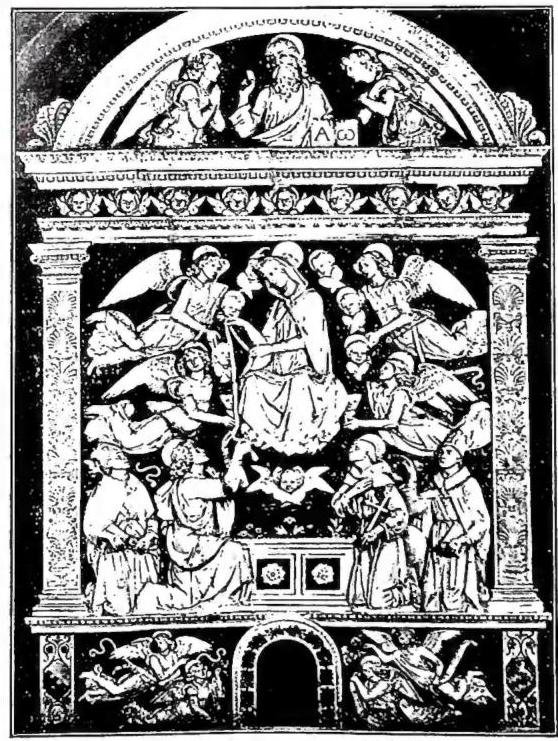
VERNA, SANTUARIO della — The Madonna giving the girdle to s. Tommaso d'Aquino, placed between ss. Gregorio, Francesco and Bonaventura. Glazed terracotta altarpiece by Andrea della Robbia (2nd half of the 15th century) — Verna, little church of S. Maria degli Angeli.
the Ascension (Great Church), Madonna della Cintola (S. Maria degli Angeli), and the Crucifixion (church of the Stigmata). In the preceding period Giotto and Taddeo Gaddi painted there; in the following period, Gerino Gerini da Pistoia, perhaps Bartolomeo della Gatta, and fra' Emmanuele da Como. From the 15th century onward, the following succeeded one another at La Verna: the Observants (1431–1625) and the Reformed (1625–1897), until in the latter year they were united under the ancient name. The juridical form of the Municipality of Florence’s action concerning the Sanctuary and its appurtenances was also subject to various vicissitudes, until the Concordat between the Holy See and Italy (1929) prepared a revision of positions and a return to the state preceding 1866, the year of the suppression of religious corporations. On 18 Oct. 1934 an Act was concluded whereby the Municipality of Florence, continuing its centuries-old merits toward the Sanctuary, once again restored the Friars Minor to full possession of their ancient rights. — Vedi tav. CXXXI.