
BENEDETTO XV, PAPA. – Giacomo Della Chiesa, born in Genoa on 21 November 1854 to Giuseppe and Giovanna Migliorati. Of a marquessial family, descended from the dukes of Spoleto and belonging to the same stock as Callistus II and Berengar II, he traced his lineage to Anselmo Della Chiesa, co-lord of Priocca in 1207, while on his mother’s side he descended from Innocent VII. He pursued his classical studies first at the Danovaro Giusso College, then at the seminary lycée, and graduated in law in 1875 with a dissertation on the “Interpretation of Laws.” That same year he entered the Capranica College in Rome and, having obtained his doctorate in theology, received Holy Orders there in 1878. After completing his courses at the Academy of Noble Ecclesiastics in 1882, he entered the Secretariat of State, from which he followed to Spain, as private secretary, the nuncio Msgr.
Mariano Rampolla del Tindaro, who, having been created cardinal and appointed secretary of state in 1887, immediately called him to the office of minutante for Ordinary Affairs, subsequently sending him on special assignments to Vienna in 1889 and 1890. Substitute of the Secretariat of State in 1901 and professor of Diplomatics at the Academy, where he had been a student, he continued to discharge this high office under the pontificate of Pius X, until, elected archbishop of Bologna in 1907, he received episcopal consecration from the same Pontiff on 22 December. Raised to the sacred purple in the Consistory of 25 May 1914, he received the cardinalitial hat on the 28th and the title of the SS. Quattro Coronati. After three months, on 3 September, he was elevated to the papal throne, taking the name B. XV, in homage—as he said—to the illustrious predecessor in the See of S. Petronius and of S. Peter, Prospero Lambertini.
He was endowed by nature with lively intelligence, rapid and sure intuition, an iron memory, a mind open to broad visions, and a magnanimous heart. Slender in person, with slightly deformed shoulders, an irregular and changeable face, he revealed through his vivid and penetrating eye so robust and noble a spirit that it very often became transfigured into features of suggestive grace and a bearing of venerable majesty. Inclined to wit and satire, of an impetuous and even choleric temperament, he was ready for gentle cordiality, obliging courtesy, and exquisite refinement. Deeply devout, innocently devoted to prayer, tenacious in his affections, incapable of resentment, forgetful of every offense, and of royal generosity, he irresistibly overcame aversions and criticisms, confounding them, unperturbed, with open cheerfulness, and showing solicitous preference for those who did not know themselves to be his friends, almost as though grateful for the opportunity to exercise the virtue of compassion and forgiveness. By such distinctive qualities, at once subjugating and attractive, he impressed upon people’s souls the image of a most vigorous personality, leaving a moving and indelible memory.
His unexpected election to the pontificate did not dismay him, although the condition of the Church, the Holy See, and the world was more grave than ever. Pius X’s pontificate, “restorative in Christ,” had been obliged to combat with the utmost exertion the extremes of social and political laicism, which had manifested themselves in France and, strengthened by this example, had spread everywhere, even to Spain. While the Church emerged strengthened—in the harmony of the episcopate, in the discipline of the clergy, in its defense against modernism, and above all in Eucharistic fervor—the Holy See, in its relations with the States, suffered from a breach that suggested a deliberate and hostile isolation. Fourteen nations were diplomatically represented in the Vatican, some more as a tribute to tradition and to the opportunity for observation and control than out of cordiality and devoted feeling. And this was happening as a world conflict was beginning, one in the face of which the Church and Rome found themselves, for the first time in the centuries, and at a time when the Holy See, having lost all civil sovereignty, was deprived of every effective protection. This might in one respect have been advantageous, in view of the papacy’s nonetheless neutral position, had the political conscience of the world not been disinclined to recognize the Pontiff’s lofty spiritual function outside and above the disputes. The lack of a state did not in fact preserve him from interested pressures contrary to his mission of peace and civilization, which, on the contrary, required him to be impartial, while it hindered his communications with the Church. These would not have enjoyed the consideration and protection proper to a non-belligerent sovereign, whereas the necessary communion of thought and action between the episcopate and the Head of Catholicism ought to have been more urgent and uninterrupted, if only because religious life, moral conduct, and Christian civilization, during the scourge that was descending upon the peoples, demanded it of the pastoral mission and pontifical teaching. This state of affairs, in addition to its incomparable difficulties, offered for the most part no example or advice from precedents on which to draw; it called for much more than courage—heroism—and for genius rather than intelligence. This reality, superior in every respect to all expectations, found in the thought and labor of B. XV the appropriate understanding and apostolate.
B. XV, in his first encyclical Ad Beattissimi (1 November 1914), outlining the program of his pontificate, revealed that fundamental unitary conception to which the historian must return in order to treat it properly. Supreme moderator of the life and world of souls, he presented everything—morality, culture, labor, wealth, progress, politics and economics, justice and law—as ordered toward God according to the doctrine of the Church, regarded, in relation to humanity, as mother and guide; in her charity, she completed the cycle of life here below in all its ordered manifestations: from the individual to the family, to the class, to the nation, and to international relations. From this universal motherhood and teaching authority, earthly reflection of divine fatherhood and providence, there derived and acquired real religious and social substance the brotherhood of mankind, the indissoluble necessity of its discipline among the faithful, as well as the Church’s constant love for those who had separated themselves from her or ignored her, yet were destined to return to her and learn to love and follow her. Thus the whole complex of existence, the entire multifarious movement of humanity, was once more simplified through this intimate and vital relationship with the Church and in its supreme end—the glory of God and the salvation of souls—pursued by every means and in every sphere, the sole guarantee of a reconstructive order passing from the moral to the material world, and from that of individual conscience to that of the collective life of peoples. Such was the essence of his pontifical government, as he liked to say and emphasize: exclusively religious, no less in necessarily and contingently political and social activities than in ecclesiastical and moral ones. This essence was summarized in the words he wrote at the very beginning, on 23 September 1914, to Cardinal Dubillard: «hoc unum velle et unice contendere ut Christi Ecclesiae per tot adversa gradienti, utile praebeamus ministerium», words that echoed a few hours before his death: “If the Lord still wishes me to work for his Church, I am always ready.”
Such premises reveal to us above all the sentiment and spirit with which he confronted the world crisis, its bereavements and its ruins. For him, the Church of Christ was all that suffering; all that calamity from which the war dripped blood and tears; all those immortal spirits afflicted; all those oppressed over whom force rose and violence bore down. The bloody conflict was not merely an immense social danger, but also a moral and religious one. He did not deceive himself: the war had neither sprung from nor remained within the limits of a political and economic phenomenon. He saw in it “the conflagration of mortal elements fermented in materialism”; the crisis of thought and conscience of an era. To save society from it meant not only halting its suicide, but raising it to Christian rebirth. This is why, from his very first encyclical, he pronounced before a world almost absorbed in the worship of violence the condemnation of war as “the most odious manifestation above all others of the prevailing moral disorder,” and indicated as remedies prayer, penance, the restoration of God’s rights, and submission to the precepts of the Gospel and of the Church. What it meant, in that autumn of 1914, before a Europe partly in arms and partly awaiting war, amid the unchallenged triumph of material force, to stand alone against everyone, against the idea and against the fact; alone against armed force, himself armed in turn solely with love.
And for this purpose the plan of B. XV was threefold: to invoke the end of the conflict by preparing a lasting peace; to humanize the war; to alleviate all its sufferings. What he dared to do in order to reconcile the world, restoring in it the triumph of a justice inspired by charity and by a practical vision of the aspirations and needs of peoples and of present political possibilities, belongs to a history that, twenty years later, wrote another chapter, fully illuminating the providential wisdom of his warnings and appeals had they been heeded. In this field his work could only be diplomatic and magisterial. The former is more difficult to know; but it is not difficult to infer it from what he himself hinted at in speeches and letters. It was a continuous work of exhortation and persuasion that rose to the level of an unassailable vocation, in accordance with his famous words repeated to Achille Ratti, who recalled them on the eve of succeeding him on the papal throne: “They want to condemn me to silence. The Vicar of Christ ought not to invoke peace. They will not succeed in sealing my lips. Woe if the Vicar of the Prince of Peace were mute in the hour of the storm! The spiritual and universal fatherhood with which I am invested imposes upon me the precise duty of inviting to peace those children who, from opposite barricades, are slaughtering one another. I am and feel myself to be the spiritual father of the combatants in both camps. No one can prevent the Father from crying out to his own children: peace, peace, peace!”
A work of counsel carried out on every occasion, by every possible means, and illustrated by the paternal appeal to peoples and governments on the first anniversary of the war, by his most solemn allocutions during the conflict, and by that note to the Heads of State of 1 August 1917, in which a thought until then suspended in the sphere of principles was made concrete, lest, amid such tumult of passions, the balance of his impartial mission toward everyone, directed solely toward pacification, be exposed to any criticism. The “note” called for a stable and honourable peace for all, to be achieved through the mutual reduction of armaments and compulsory arbitration; freedom of the seas; the mutual remission of war expenses and credits and of reparations, except in cases of justice and equity, such as that of Belgium, whose independence was to be guaranteed; the evacuation of occupied territories; and the settlement of territorial claims according to the aspirations of peoples. This appeal was crowned by the celebrated phrase he uttered when the international dispute concerning Wilson’s Fourteen Points was already intensifying—a broader but no more effective paraphrase of the “note”: “Nations do not die!” This constituted the fruitful seed of that Christian international law which the Second World War would call to a more luminous development. Yet his charitable intention and zealous contribution toward averting further wars, and shortening this one, which threatened to engulf Europe, did not escape suspicion and sectarian opposition. Content only with divine consolations and with the incomparable satisfaction of which love is the source, even when ineffectual and unrecognized, he remained firm, constant, and unperturbed amid adversity, human ingratitude, and rebellion; resigned to every rejection, yet always eager to begin again from the start. Intent only upon the good he was accomplishing, he continually directed his tireless activity toward supreme ends, never toward particular interests, making impartiality its essential and unmistakable attribute.
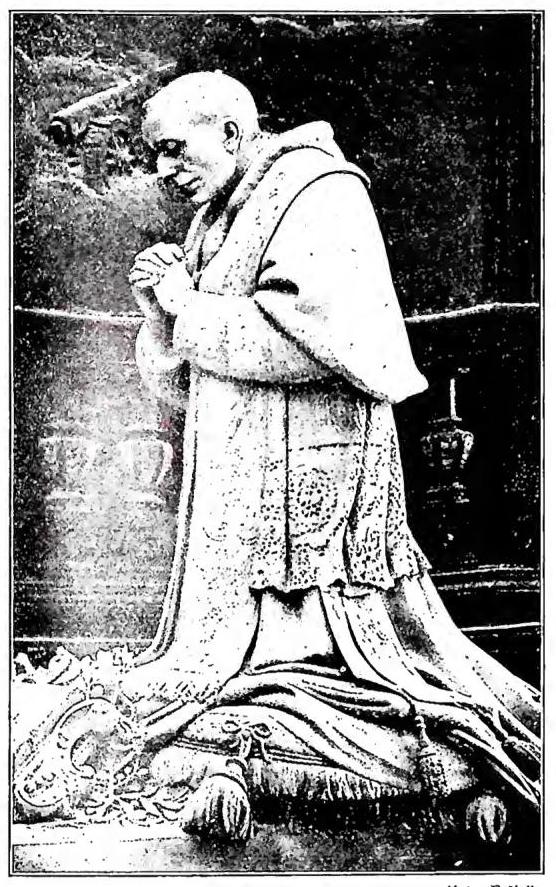
(phot. Felici)
BENEDETTO XV – Detail of the tomb in St Peter’s.
Work by P. Canonica.
a man. Thousands of prisoners unfit for war service (1914), prisoners who were fathers of numerous children, or who had exceeded eighteen months of captivity (1916), were returned to their homeland; civilian detainees were liberated (1915); entire deported populations returned to their domestic hearths (1917); more than 30,000 French, English, Belgian, and Austrian prisoners were hospitalized in Switzerland (1915); Italian tuberculosis sufferers returned to recover in the mild climate of their homeland (1916); Sunday rest was guaranteed to prisoners (1915); a consecrated tomb was granted to the Christians who died at the Dardanelles (1916); populations overtaken by the enemy invasion were given the consolation of news of their loved ones (1915). The “Prisoners’ Work” in the Vatican Palace assumed imposing proportions: seven hundred thousand requests for information, forty thousand for repatriation, and five hundred thousand communications to families. Ecclesiastics, nuncios, and bishops visited and inspected the concentration camps, interceded, consoled, and provided aid. The Pope’s prayer and mediation reached everywhere to mitigate disciplinary measures, commute sentences, and save the innocent. And although he asked for, but did not obtain, a truce at the first Christmas of the war (1914), burial for those fallen on the battlefield (1915), and a prohibition against aerial attacks beyond the war zone (1916), Poland (1915–17) and Belgium (1917) found in him their greatest benefactor. The devastated Balkans, Armenia, with a million of her children massacred, the Maronites of
Lebanon (1916–20), the Christians of Syria, and the peoples of the East afflicted by disease, famine, and abuse hailed him as their most effective protector. And after the war, over shattered altars, destroyed workshops, and devastated fields; over misery, famine, epidemics, languishing youth, and metropolises and nations rendered powerless to live, his beneficent hand reached out once more. The Russian refugees received his aid through the hands of the “Orthodox” metropolitan Anastasios; their exhausted children found refuge in Crimea, in a sanatorium bearing his name; the persecuted schismatic clergy appealed for and obtained protection (1919), just as the appeal of the Jews of America (1916) had already been welcomed on behalf of the massacres of Israelites in Europe. Later Russia was dying of hunger amid horrifying scenes of barbarity and death. Politics debated and prevaricated; B. XV proclaimed: “it is the duty of every man to hasten to where another man is dying” (1921). And his charity arrived first, once again, as it had already done in Austria, where not only creatures were wasting away, but a State itself was languishing. Germany and Ireland (1920), and distant China (1921), likewise became objects of his solicitude, while the entire world, seeing him again among martyred and desolate children, as one day the Divine Master had stood among the little ones, responded to his appeal launched in an encyclical (1920) for the children of Belgium, Central Europe, and Russia (1921). More than a hero of charity, he appeared as the champion of human civilization and fraternity. The statue erected to him in Constantinople (1920), because it was to stand among the infidels and be situated between two continents, fully expresses this historical truth. And all this took place amid innumerable secret and direct acts of aid to individuals, families, and institutions, so that of the many requests—even the humblest, most distant, and most obscure—not one remained unheard, and many were often anticipated. Cardinal Gasparri specified that in this work of personal charity B. XV had distributed eighty-two million lire.
Such an immense field of solicitude and labor did not divert him from the more immediate field of religious life and of the life of the Church itself. If the defense of doctrine was not challenged by new errors, and if after Pius X’s struggle against Modernism the proscribed books diminished in number and importance, the encyclical on s. Girolamo (1919), concerning the method of biblical exegesis, remains memorable, as beneficial as was the continuation of the disciplinary norms regarding the anti-Modernist oath and the Councils of Vigilance. To the Czech-Slovak schism, influenced by the proximity of heterodoxy and its ecclesiastical customs, the Pope indicated the most effective remedy in diligent improvement of the seminaries and of the formation of the clergy. He devoted particular care to this work in establishing a Congregation of its own, that “of Seminaries and Universities of Studies” (1915), whose regulations, defined as “pedagogically perfect and doctrinally admirable,” issued for the seminaries of Italy, clearly and preponderantly bear the personal imprint of the Pope. He promulgated the Code of Canon Law (1917), while saying that he was reaping what his predecessor had sown, after, from the very beginning of his pontificate, he had collected the opinions of the bishops on the first drafts of the grand undertaking, from which the definitive work was subsequently developed. From his first encyclical onward, he established the fundamental points of Christian discipline in concord and obedience to the authority of the bishops and the ecclesiastical hierarchy, and in mutual charity and piety—what he always repeated for every conflict within Christian peoples, and in every one of his writings and speeches, and in every counsel to priests and preachers. He himself composed moving prayers for the cessation of the war, for the reunion of the Churches of the East, to invoke God’s help upon the congress for peace, for the end of civil strife, and for the propagation of the faith. He extended to the whole Church the use of three Masses on the day of the dead (1915) and the feast of the Holy Family; through the Code he restored the precept concerning s. Giuseppe and Corpus Domini; and he approved the office of the Eucharistic Heart of Jesus. He directed many provisions toward increasing the fervor of religious life. This is attested by the encyclicals on the centenaries of s. Domenico, s. Francesco, and Dante; by the briefs, letters, and acts promoting Eucharistic worship, the domestic reading of the Gospels, enthronement of the Sacred Heart, and devotion to the Most Precious Blood; concerning the Rosary, Our Lady of Sorrows, the Queen of Peace, and Our Lady of Loreto; concerning s. Giuseppe and the fiftieth anniversary of his universal patriarchate; concerning the feasts of the archangels; concerning the canonizations of s. Giovanna d’Arco, s. Gabriele dell’Addolorata, and s. Margherita Alacoque (1920); the beatifications of Giuseppe Cottolengo and Anna di S. Bartolomeo (1917), and of Anna Maria Taigi, Luisa di Marillac, Oliviero Plunket, the twenty-two Martyrs of Uganda, and the Ursulines of Valenciennes (1920); the proclamation of s. Efrem as a doctor; and that entire treasure of pious wisdom to which he paid tribute at every jubilee celebration, as for s. Girolamo, s. Alfonso, s. Giovanni Berchmans, and the blessed Canisio, and at every introduction of causes and proclamation of the heroic virtues of other luminaries of religion. He manifested tireless zeal for the Catholic missions in the encyclical Maximum illud and through the establishment of colleges in Rome, Italy, Switzerland, and Germany; through the protection of the Pious Union of the Clergy for the Missions; through preparations for the third centenary of Propaganda Fide; and through the subsidies lavishly granted to all missionaries. His ardent desire to call the separated brethren back to the Mother Church, and his predilection for the united Churches of the East, are demonstrated by the autonomy granted to the appropriate Congregation and by the establishment of a Pontifical Institute over which he wished “to keep personal watch.”
In harmony with pontifical traditions was his zeal for cultural and social progress, in which he recognized fertile ground for civil renewal. To the extent permitted by the universal crisis and the brevity of his pontificate, he was a munificent protector of science and art. This is demonstrated by the foundation of the Catholic University of the Sacred Heart in Milan (1920), the munificent contribution to the reconstruction of the library at Louvain (1918), the expansion of the School of Sacred Music in Rome (1915), the establishment of the Petrian Museum (1917), the enlargement of the Egyptian Museum (1915), the foundation of the Astrophotographic Cabinet at the Vatican Observatory and, in the Apostolic Palace, the restoration of the Tapestry Factory (1915), the extensive protection granted to the Mosaic Factory, the restoration and decoration of the Ducal Hall (1917), the new administrative headquarters (1917), the new quarters of the Noble Guard (1922), the statue of Our Lady of Peace in S. Maria Maggiore (1918), the grant for the Franciscan church in Ravenna (1921), and the favor and assistance bestowed upon artists, especially the young, upon works of art, and upon schools in every country. In the complex and agitated social sphere, he may be said to have continued the thought of Leo XIII, whose doctrines he confirmed whenever the great problems of economic justice touched upon the Church’s teaching authority. In the acute crisis following the war, his diagnosis of the threatening disease was as sound as his remedy was radical. For peace, equilibrium, and social order, justice and equity are not enough “unless in minds and hearts there takes place the rebirth of those principles that made the pagan world Christian,” that is, through victory over the passions. These are unleashed “by an unbounded love of wealth and an insatiable thirst for pleasures, so that, while on the one hand accumulated treasures are never enough, on the other there is not a spirit of resignation, but rather envy, which is at once impotent hatred and expectation of revenge.” It is therefore necessary to begin with an “individual reform,” which is an “instrument for bringing a breath of Christian life into the bosom of society.” It blossoms from a spirit made simple anew, from that “spiritual childhood whereby love is joyfulness, like the need for joy in little children”; it opens the paths of Truth and makes it desirable for oneself and for others. Hence arises social love of one’s neighbor. Indeed, “the people are won back through an action that brings truth and charity, capable of neutralizing the contrary activity informed by hatred and falsehood.” To depart from this norm, to make love degenerate into conflicts and violence even in the name of legitimate claims, is a betrayal of the very civil order, which is harmony, concord, and class collaboration; it is the fruit of that relationship between duties and rights whereby only the observance of the former legitimizes the assertion of the latter. And when bloody conflicts broke out, giving rise to new fratricidal struggles, the Pope summarized all the wisdom of this doctrine of Christian love in a celebrated prayer in which he implored God on behalf of humanity that people might know how to repeat the Pater Noster, remembering that they constituted one family and preparing themselves to have their debts forgiven as each of them forgave his own debtors.
This biographical sketch cannot be brought to a close, lest it remain incomplete, without turning our gaze to what particularly concerns Italy, where the work of the Holy See, though always producing singular repercussions, did so in especially notable ways under B. XV, both because of its importance and because of the distinctive circumstances of the time. The “Roman question” remained ever open, to which the Pontiff, like his predecessors, had referred by explicitly renewing the traditional protests; nevertheless, he found its primary political difficulties overcome through the measures of Pius X, who, having in practice abolished the non expedit and having demanded the freedom and independence of the Holy See without temporalistic preconditions, had brought into concord the divergent currents among Catholics on this matter, and had led all political sectors to a more serene judgment. Yet the Great War, like that of 1911 for the Italian conquest of Libya, had demonstrated the need for a solution. The episode of the occupation of Palazzo Venezia (1916) by the Italian State, which regarded the seat of an embassy to the Vatican as a pledge of war, and, earlier, the departure to Lugano of the diplomatic representatives accredited to the Pope by the Powers at war with Italy (1915), were merely the two most significant symptoms of the complications that the situation, already untenable in peacetime, was creating in so many respects during a war of such proportions. It is enough to consider the relations of the central government of the Church, seated in the capital of a belligerent state, with nations hostile to that state, as well as the Pope’s own teaching concerning the moralization of war and his work for peace, which was accused in turn—according to the opposing criticisms of the parties in conflict—of partiality or hostility toward Italy and her allies. B. XV, while never ceasing to seize from events the opportunity to draw Italy’s and the world’s attention to the Holy See’s incontrovertible claims, nevertheless did so by reaffirming the possibility of and confidence in agreements capable of resolving the matter, and even by mitigating, in favor of the more rapid advent of international peace, any new intensification of the disagreement between the papacy and Italy. Cardinal Gasparri, Secretary of State, in an interview granted to the Corriere d’Italia on 28 June 1915, declaring himself an interpreter of the Pontiff’s thought, stated that the Holy See expected “the settlement appropriate to its situation not from foreign arms but from the triumph of those sentiments of justice which it hopes will spread ever more widely among the Italian people in accordance with their true interests.” The impression
BENEDETTO XV - BENEDETTO DI S. ANDREA
of these declarations was all the more vivid because it was known that Germany and Austria, if victorious, would have brought the solution of the “Roman Question” to the Peace Conference, and that the Italian Government itself, fearing influences in this direction, was decidedly hostile to any intervention by the Pope for the pacification of the world, to which B. XV devoted all his efforts and labours. This impression explains how, during the Conference of Versailles, Mons. Cerretti, secretary of Extraordinary Ecclesiastical Affairs, was able in Paris to submit to the President of the Council and head of the Italian mission to that conference a plan for resolving the conflict between State and Holy See in Italy, and how Hon. V. E. Orlando accepted it (1919). It explains how the plan, interrupted by the resignation of the Cabinet, was taken up again by the new head of government, F. Nitti (who had already had occasion to exchange views on the matter with high prelates), and through direct negotiations with Card. Gasparri (1920); finally, it explains how it was possible, on the other hand, for a party of Italian Catholics and its strong group of deputies in Parliament to arise and become firmly established in 1920, without reservations on the part of the Pope. Indeed, speaking at the congress of the diocesan councils of Italy in 1919, he distinguished Catholic Action, which he had reorganized and united since 1915, from the “actions of Catholics” in the economic and political field, as lawful and commendable, bound to draw inspiration from the highest principles of religion, morality, and Catholic social teaching, yet belonging to the responsibilities of citizens, without involving those of the Holy See and the Church. Finally, he explicitly removed the prohibition, in force since 1870, on Catholic sovereigns coming to Rome, so that nothing might be imputed to the Holy See as an obstacle or difficulty to contacts and understandings among States after the war crisis, in the interest of peace and the harmonious cooperation of peoples. It was another non expedit of international scope. In abolishing it, B. XV, with regard to the access of Heads of State to Rome, could have repeated verbatim the words by which Pio X, in the Fermo Proposito, justified the suspension of the non expedit concerning Italian Catholics’ access to the ballot box. If the prohibition had been in force for most grave reasons, for reasons “no less grave” and “drawn from the supreme good of societies,” this prohibition, like the earlier veto, was removed by the Pope.
Hence the wholly understandable and unanimous recognition by Italians of every tendency of so magnanimous and beneficial a work of the Pope, when his earthly labour ended, finally leaving to history its serene and definitive judgment.
He fell ill with influenza bronchitis on 18 Jan. 1922. His frail constitution did not withstand II. He died on the 22nd, offering his life for peace. He had reigned for seven years, four months, and twenty days. His immense work, the target of unjust criticism, venomous attacks, and sectarian hatreds, was already reaping the fruits of impartial, universal, and admiring esteem. Proof of this was the fact that he left 27 States represented at the Holy See, among them France (1920), which had broken off its relations with the Vatican in the time of Combes; Portugal (1918), which had been absent since the proclamation of the Republic; England (1915), which before 1870 had possessed only consular representation and thereafter none at all; and China, which had never had any. The worldwide mourning that followed his death fully confirmed this growing testimony of moral and political regard. In every country, from adherents of every religious faith, including non-Christian faiths—not excluding Jews and Muslims—and from every political tendency, even the most extreme, including Communists and anarchists, there arose a plebiscite which found its most noble echo in parliamentary tribunes, diplomacy, government benches, and among Heads of State, in unanimous homage to his genius, his impartiality, his love of truth, justice, the brotherhood of peoples, and compassion for their misfortunes. Of the benefit which resulted for civilization, nothing is more significant than the literal quotation from the “Note to the Heads of State” made by the president of the Assembly of the League of Nations, Giuseppe Motta, on 3 Oct. 1924, when he declared that “if humanity should one day, perhaps still far distant, succeed in abolishing war, it will owe this achievement of incomparable value to the system of arbitration, as proposed by B. XV.” Of the prestige thereby acquired by Rome, the historian L. von Pastor said in the same year: “B. XV, the most skilful diplomat, was perhaps the only one able to master the grave situations of the World War. He guided Peter’s little barque with such assurance through the stormy waves that engulfed three empires that, at his death, the prestige of the Holy See had increased among all nations. This came about in large part also through the merit of the grand work of charity which he undertook on behalf of the grievously afflicted peoples of Europe.” Crowning such testimonies was that of Pio XI, who in his first consistory allocution declared that his predecessor “governed the Church in such a way as to win not only the applause of Catholics but also the admiration of his adversaries. While men raged against one another in hatred, never ceasing to inculcate peace, he filled the world with the benefits of his charity. His memory, therefore, will remain in blessing.”
During his pontificate B. XV promoted to the episcopate his two successors: Achille Ratti, on 6 June 1919, subsequently sending him as apostolic visitor and then nuncio to Poland, and finally conferring on him the sacred purple; and Eugenio Pacelli, on 23 Apr. 1917, consecrating him with his own hand on 13 May and sending him as nuncio to Bavaria and then to Germany. He created 32 cardinals, 8 archiepiscopal sees, 26 episcopal sees, 3 abbeys and prelatures nullus, 2 apostolic delegations, in Albania and Japan, 28 apostolic vicariates, and 8 apostolic prefectures.
In his iconography, foremost are the so-called Einsiedeln portrait, painted by Giorgio Szoldatich; the aforementioned statue of Constantinople, sculpted by Pietro Canonica, to whom is also due the funerary monument in S. Pietro, in the Chapel of the Presentation; and the bronze high relief by Carlo Barberis on the tomb in the Vatican Grottoes.
Giuseppe Dalla Torre