
ANNUNZIATA, ORDINE CAVALLERESCO della S.M.A. — The Supreme Order of the Most Holy Annunziata, one of the oldest in Europe, was the highest order of the Savoy monarchy. Founded by Amedeo VI in 1364 under the name Order of the Collar, it was transformed into a religious military confraternity, according to the custom of the East, when its founder hastened to Constantinople in 1365 to aid his cousin Giovanni V Paleologo. It is dedicated to the Virgin, and therefore the knights, who represent the fifteen mysteries, are obliged to offer common prayers and have the right to common suffrages, while in the charterhouse of Pierre Châtel, established as the church of the Order by the testament of the Green Count, fifteen Fathers were to pray for the living and deceased knights. The Order of the Collar subsequently changed its name to that of the “Collar of the Annunziata” under the statutes of Carlo III il Buono.
The first statutes issued by the founder were lost. The oldest now extant are therefore those of Amedeo VIII of 1409, in fourteen paragraphs written at Châtillon, to which four others were added in 1434. They prescribe faithful service to the prince, mutual assistance, including spiritual assistance, and arbitration for every dispute among the knights. On 13 September 1518 Carlo III, who may be regarded as the second founder and principal legislator of the Order, increased the number of knights “in name and arms” and “without blemish” from fifteen to twenty, adding to the remembrance of the fifteen mysteries of Our Lady that of the five wounds of Jesus. On 18 October 1577 Emanuele Filiberto did not count the Grand Master and the heir apparent among the twenty; he prescribed Catholic orthodoxy and nobility traceable through one’s ancestors, granted the right of access to the senate, financial and judicial exemptions, and subsidies: privileges confirmed in 1620 by Carlo Emanuele I (who in 1607 transferred the church of the Order from Pierre Châtel, which had passed to France, to the Camaldolese in Turin) and subsequently by Carlo Emanuele II. In 1840 Carlo Alberto renewed the statutes, confirming the character and privileges of the Order but abolishing its tax and forensic privileges, and established its religious seat in the charterhouse of Collegno. In 1869 Vittorio Emanuele II abolished the exclusive requirement of nobility, demanding for admission exceptional services in the highest offices of the State; and Vittorio Emanuele III, with the reform of 1924, did not count the Sovereign Grand Master, the heir apparent, ecclesiastical dignitaries, and foreigners among the twenty knights.
The insignia initially consisted of fifteen collars of gilded silver for greyhounds, purchased by Amedeo VI from a goldsmith in Avignon; their clasp was formed by three double-knotted love knots, bearing the motto “F.E.R.T.” In 1518, after the adoption of the personal collar of Carlo I, consisting of fifteen knots alternating with an equal number of white roses, Duke Carlo III hung from it a medallion bearing a pierced image of the Annunciation of Mary, to whom he consecrated the Order. It has been preserved to the present day as the “grand ceremonial collar,” to be worn with a plaque fastened to the left side of the chest, likewise gilded, bearing the effigy of the Annunziata within a frame of flames; it is commonly replaced by a “small collar” of simpler form. The habit is amaranth in color, with silver embroidery and an azure lining. The ceremonial, prescribed by Carlo III, is modeled on that of the Golden Fleece. The knights bear the title of “Excellency” and of “Cousin” of the sovereign king; they take precedence over the offices of State, immediately after cardinals, with the right to military honors. The collars, on which
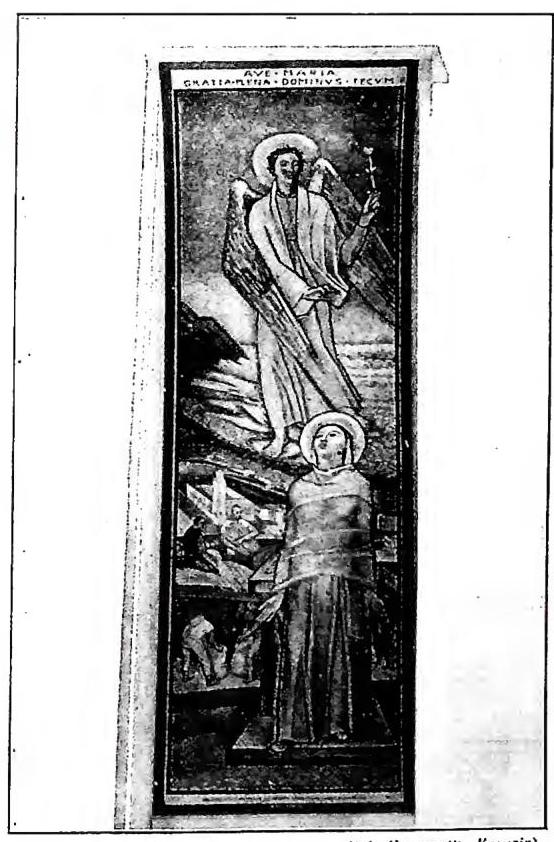
The feast of the Order is celebrated on 25 March, the solemnity of the Annunciation of the Most Blessed Mary.