
AVIGNON, ARCHDIOCESE OF. - A city in southern France, on the Rhône, at the intersection of important natural routes and in an easily defensible position.
SUMMARY: I. History -
II. Councils of A
III. The sanctuary of Notre-Dame-des-Doms
IV. The University of A
V. The Palace of the Popes.I. HISTORY
A. is the see of an archbishop and the capital of the department of Vaucluse (3,578 sq. km.). The diocese numbers 200,000 Catholics out of a total population of 245,508; it has 176 parishes, 161 diocesan priests, and 60 regular clergy (1948).Its Christian origins are shrouded in legend. The identity of St. Rufus, around whom the first Avignonese Christians are thought to have gathered, remains unknown. The first bishop whose name has come down to us is Nectarius, who took part in the Councils of Riez in 439, of Orange in 441, and of Vaison in 442. He appended his signature to the letter which the bishops of the Gauls, assembled at Arles in 451, addressed to Pope Leo I concerning the controversy over the Incarnation. After him, the series of bishops continues almost without interruption until the 6th century; it then lapses, leaving only the name of St. Agricolus, who was to become the city’s patron saint.
Contested in turn by the Burgundians, Visigoths, Ostrogoths, and Franks, A. was occupied in the 8th century by the Muslims; Charles Martel succeeded in driving them out in 737.
Legally belonging to the ancient kingdom of Arles, it nevertheless fell under the control of the counts of Provence. Situated in a rich district on the navigable stretch of the Rhône and protected by those counts, it had been able to develop considerable economic activity and had formed a commune almost entirely autonomous.
In the 11th century, Notre-Dame-des-Doms was restored and the abbey of St. Rufus arose. Urban II visited A. in 1095 and 1096, Gelasius II in 1118, and Innocent II in 1132.
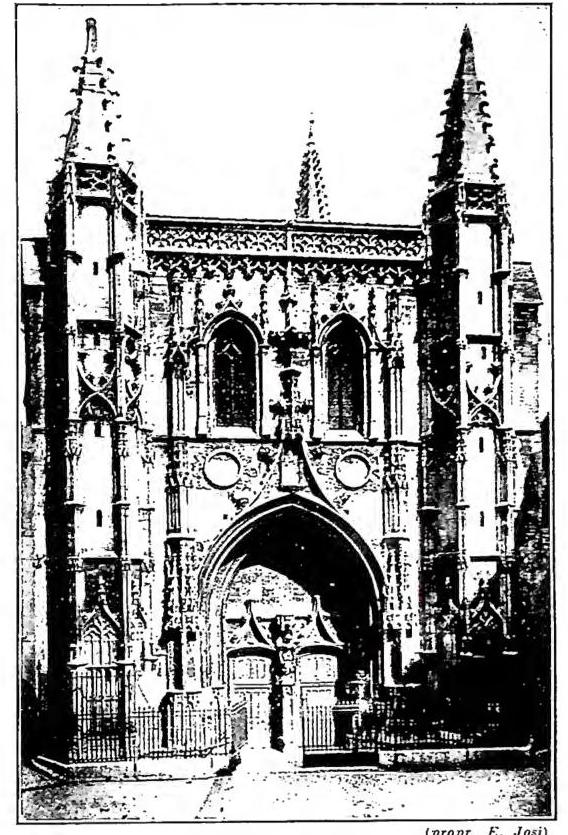
AVIGNON – Façade of the church of St Peter, designed by Philippe Garcin (1512).
It emerges into the great history of Europe at the beginning of the fourteenth century, when it became the seat of the papacy.
In 1309, after staying in various towns of southern France, Clement V made his way to Avignon, where he was the guest of Robert of Anjou, count of Provence and king of Naples, and took up residence in the Dominican convent. His successor Jacques d’Euse, who had been bishop of Avignon since 1310, was elected pope as John XXII (1316) and decided to keep the papal see in the city he loved, living in the episcopal palace. On 2 October 1316 he made his solemn entry into Avignon and set about organizing the curia there. Benedict XII (1334–42) then began the construction of the towered palace on the Rocher des Doms, while the cardinals also began to build palaces outside Avignon, at Villeneuve on the right bank of the Rhône, which had already passed into the hands of the kings of France. On 13 May 1348 Pope Clement VI bought the city from Joanna I, countess of Provence and queen of Naples, taking advantage of her need for money to fight the king of Hungary who disputed her kingdom. He paid 80,000 florins and obtained the emperor Charles IV’s approval for the transfer.
The two pontificates of Benedict XII and Clement VI (1334–52) represent a period of great importance for Avignon. The papal court, including all those who had business with the curia, numbered as many as 4,000 people; pilgrims, ecclesiastics, prelates, businessmen, politicians and merchants flocked there from every quarter. The little Provençal town became a great cosmopolitan centre. Beyond the old city walls new suburbs sprang up; popes and cardinals built or embellished churches and monasteries, summoning artists from every land. During the Avignon exile and the subsequent Western Schism, the popes reserved the bishopric of Avignon for themselves, entrusting it to an administrator of their confidence. A moment of severe crisis for Avignon was the outbreak of the plague in 1348: the city was afflicted for seven months and lost half its population. Yet life soon revived in cheerful fashion. The manners of the papal court provoked violent attacks from Petrarch and St Bridget, who called Avignon “impious Babylon, hell of the living, cesspool of vice.” An improvement in morals came under Innocent VI (1352–62) and a more visible one under Urban V (1362–70), who earned Petrarch’s praise for II.
The major reform of Urban V was his decision to return the papacy to Rome. The king of France did all he could to persuade the pope to remain on the banks of the Rhône, but Urban V left Avignon on 30 April 1367, resisting the pressure of the cardinals who were unwilling to follow him to Rome. Finding the situation in Italy and at Rome so difficult, however, he soon decided to return to Avignon, re-entering the city on 24 September 1370. His successor Gregory XI very soon took up the plan to return to Rome: he announced his decision in 1374, but only carried it out in 1376, also at the urging of St Catherine of Siena (q.v.). Once again the French government, the cardinals and his relatives tried to dissuade him; on 13 September he left Avignon and arrived in Rome on 7 January 1377. When, after Gregory XI’s death, Urban VI was elected amid tumults (1378), the French cardinals withdrew to Fondi under specious pretexts and elected their own pope, the cardinal of Geneva, who took the name of Clement VII. Failing to overcome his rival, Clement VII transferred his see to Avignon (20 June 1379). He lived there until his death (1394), as did his successor Benedict XIII, who only abandoned Avignon during the Council of Constance, retiring to Peñíscola in Catalonia.
With the end of the schism, Eugenius IV reorganized the government of Avignon in 1433, entrusting it to a papal legate who was usually an Italian cardinal on whom the rector of the Comtat Venaissin depended. From 1391 onwards only a vice-legate was sent to Avignon; the last of these, Filippo Casoni, was driven out by insurgent Avignonnais on 12 June 1790. In 1475 Sixtus IV raised the see of Avignon to metropolitan status, with Cavaillon, Carpentras and Vaison as suffragans, in favour of his nephew, Cardinal Giuliano della Rovere, the future Julius II. From 1634 to 1637 Mazarin held the office of vice-legate.
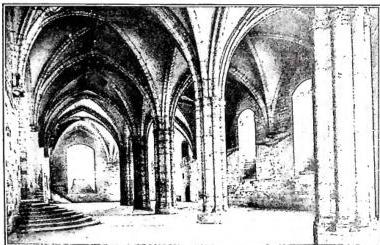
AVIGNONE - Palace of the Popes. Hall of the Grand Audience (14th century).
The first French occupation of Avignon occurred under Louis XI from 1476 to 1483, and again in 1536 under Francis I. More significant occupations took place in the 17th century through the actions of Louis XIV: the first in 1662 as retaliation against the Pope over the affair of the Duke of Créqui, and the second in 1668 due to a conflict with the Pope regarding the extraterritorial rights of the French embassy. On both occasions, the king provoked decrees of annexation by the Parliament of Provence. Again in 1768, after the Pope protested against the anti-clerical legislation of Philip of Bourbon, Duke of Parma, the government of Louis XV decided on the occupation and annexation of Avignon; however,
in 1774, when the Pope granted the requested suppression of the Jesuits, the French government consented to the return of Avignon to the Holy See. Yet, with the outbreak of the French Revolution, disturbances and protests against papal rule began in Avignon; the States General and later the National Constituent Assembly debated the annexation of Avignon, which was decreed by the Assembly itself. Pope Pius VI protested against the violation of the Holy See’s rights, but in the Treaty of Tolentino he was compelled to recognize the fait accompli (19 February 1796). The Holy See attempted to revive the question after Napoleon’s downfall at the Congress of Vienna, but without success.
The department of Vaucluse constitutes the diocese of Avignon, which was reduced to a simple bishopric under the Concordat of 1801, restored as a metropolitan see in 1822, with the suffragan dioceses of Montpellier, Nîmes, Valence, and Viviers. It also holds the titles of Apt, Cavaillon, Carpentras, and Vaison.
The city preserves the memory of its university and the remarkable flourishing of religious institutions that, through the initiative of the archbishops, in the 16th and 17th centuries opposed the Protestant heresy; it also preserves the memory of twelve councils.
In 1080, under the presidency of Hugh of Die, Gibelin of Avignon was elected bishop in place of the intruder Acardus, Lantelmus of Embrun, Hugh, bishop of Grenoble, and Desiderius, bishop of Cavaillon were elected; the legates took the newly elected with them to Rome to have them consecrated by the Pope himself.
In 1209, in the presence of the archbishops of Vienne, Arles, Embrun and Aix, together with a considerable number of abbots, under the presidency of the two papal legates Milo and Hugh, 21 canons on discipline were promulgated at Avignon. The second of these canons obliged bishops to exact from counts, castellans, and burghers an oath to expel and remove Jews from every office. On this occasion, the count of Toulouse was excommunicated for his weakness toward heretics.
The third Synod of 1279 concerned itself with safeguarding the rights, privileges, and immunities of the clergy, imposing censures against those who usurped ecclesiastical goods. The other canons contain ancient ordinances published at Bourges, Valence, and Arles.
In 1283 Bertrand Amalric, archbishop of Avignon, presided over a provincial synod and in 10 canons renewed the ancient laws against usurers and the alienation of church goods.
On 18 June 1326 a general synod was held in the abbey of Saint-Ruf for the three ecclesiastical provinces of southern France: Avignon, Aix, and Embrun. A regulation of 59 articles was published, almost all concerning the temporal goods of the Church and its jurisdiction.
A general synod in the same monastery of Saint-Ruf was held in 1337, where 70 canons were promulgated, almost all taken from the preceding synod.
The Synod of 1403 voted pecuniary subsidies for the king of France. In 1457 a provincial synod was held, presided over by Cardinal Peter of Foix. Its principal aim was to renew the decree of the Council of Basel regarding the Immaculate Conception.
III. THE SANCTUARY OF NOTRE-DAME-DES-DOMS
The date of origin of this sanctuary is certainly earlier than the residence of the Popes in Avignon. It was called Our Lady “des Doms,” or better “des Dons,” on account of the multitude of heavenly gifts granted in that place. Others suggest a different etymology: of the “Domini” or Lords, that is, the bishop and clergy who lived near the church, “de domo episcopali.”John XXII was buried near II. Benedict XII was raised to the supreme dignity here and wished to remain there after his death. The kings of France, from Louis VIII to Louis XIV, came to venerate this image of the Virgin. The Revolution stripped the ancient statue and reduced the building to wretched conditions. Restored by Msgr. Dupont, the Sanctuary was raised anew to the rank of a basilica by Pius IX in 1854.
IV. THE UNIVERSITY OF A
A. had a celebrated university, one of the oldest in France. Its origins can be traced to the beginning of the 13th century, when the papal legate Cardinal Romano, by ordinance of 4 January 1227, organized theological teaching there (« in theologica facultate ») to combat heresy. Charles II, King of Naples and Count of Provence, by letter of 5 May 1303 granted the school of A. various privileges, while Boniface VIII, with the bull Conditoris omnium of 1 July 1303, elevated it to the status of a Studium generale, with faculties of civil and canon law, medicine, and the arts. The faculty of theology was added by John XXIII with the bull Dum attente of 6 September 1413.The statutes, drawn up « doctorum consilio et assensu » by the city’s bishop Bertrand Aymin in 1303, were somewhat modified in 1376. The chancellor of the university was ex officio the archbishop of A.; the rector, called primicarius, was normally chosen from among the professors of law (Decretales of Gregory IX, lib. I, tit. 25). Further reforms of the statutes took place in 1407 at the initiative of Bishop Gilles de Bellemère, in 1441 through the efforts of Bishop Alano de Coetivi with the cooperation of the university doctors, and in 1503 by order of Cardinal Archbishop Giuliano della Rovere, who entrusted the task to his nephew Galeotto della Rovere: these last statutes are valuable for understanding the condition of the University of A. at the end of the Middle Ages.
By a bull of 6 September 1413, John XXIII granted the University of A. the privileges enjoyed by those of Toulouse and Orléans, which were similar to those of the University of Paris: thus, in practice, the Pope granted A. all the university privileges of the time.
A characteristic feature of this university was its numerous colleges, each with its own history: 1) the College of St Martial, erected by Clement VII with the bull Pia devotorum of 21 April 1379, for the monks of Cluny; by agreement of 7 September 1427, this college housed the university library; 2) the College of St Nicholas of Annecy, founded on 23 July 1424 by Cardinal Giovanni de Brognay, Bishop of Ostia, for students from Savoy (Magnum Collegium Sabaudiae); 3) the College of St Michael, founded by the jurist Giovanni Isnard in his will of 8 April 1453 for students of civil law; 4) the College « de Jujon » (or Dijon), founded on 9 September 1471; 5) the College « du Roure » (Collegium de Rovere), founded on 22 August 1476 by Cardinal Archbishop Giuliano della Rovere for 36 poor students; the cardinal, nephew of Sixtus IV, obtained from the Pope for this college the library of the papal palace (bulla Ad Apostolicae Sedis apicem, 6 May 1481); 6) the College of « Notre-Dame de la Piété », founded by the Dominican Bartolomeo de Riquetis, professor of theology (1491–1494); 7) the College of Sénanque (or St Bernard of Sénanque), founded in 1496 for the Cistercians; 8) the College « de la Croix », established in 1500 by Guglielmo Ricci. In the 18th century, only the Annecy college was functioning regularly; in 1709 it was united with the du Roure college.
To foster the piety of the young, on 21 March 1441 a guild or confraternity of « St Sebastian » was established for law students, while between 1450 and 1480 another was founded for the doctors of the university.
As the university had declined from its original splendor, Sixtus IV sought to restore its prestige with the bull Cum rationis of 5 June 1475, while his nephew Giuliano della Rovere, as cardinal, became its great patron and restorer. Among its most illustrious alumni and masters was the Blessed Urban V (Guillaume de Grimoard). The university distinguished itself, especially in the 17th century, for its teaching of law. It disappeared during the French Revolution (1792).
Its documents have been fairly well preserved: the Archives de Vaucluse hold the richest collection. M. Fournier published the principal ones in Les Statuts et Privilèges des Universités Françaises depuis leur fondation jusqu'en 1789 (II, Paris 1891, pp. 301–535, and III, ibid. 1892, pp. 647–66).
Igino Cecchetti
V. THE PALACE OF THE POPES
It is one of the principal monuments of French medieval architecture.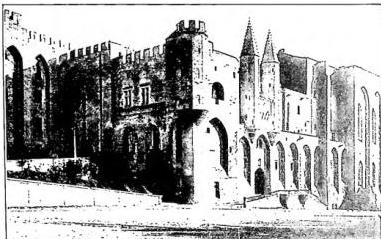
The Avignon palace of the Popes consists of two clearly differentiated groups of buildings, yet united by a single architectural vision. They are known as the Old Palace and the New Palace, and are the work respectively of Benedict XII and Clement VI (1342–52); Innocent VI and Urban V completed these works and made some additions that, however notable, did not substantially alter the overall design. The Old Palace, or Palace of Benedict XII, stands to the right of the cathedral and occupies much of the site of the former episcopal palace. It is arranged around a trapezoidal courtyard whose sides are formed by the flanks of four large structures: the papal chapel, at whose extremities rise the Bell Tower and the Trouillas Tower; the wing of the Consistory; the wing of the Conclave; and the wing of the Familiars. At the angle formed by the Consistory wing and the Conclave wing stand the buildings that constitute the papal apartments, dominated and protected by the massive Angel Tower. This complex group of constructions, executed by the architect Pierre Poisson, may at first glance appear disjointed, as if each building had been conceived independently, yet closer inspection reveals not only a logical distribution of spaces but also a coherent architectural
AVIGNON – Western façade of the papal palace, built under Clement VI (1342–52).
Indeed, externally it is rendered unitary by the motif of the giant buttresses or piers, set very close together, which rise with admirable vertical thrust along the smooth walls and are joined at the top by elegant pointed arches. Moreover, this part of the building is clearly governed by that taste for picturesque architecture, for the lively distribution of plastic masses, and for surprising scenographic effects which medieval architects held in the highest esteem and which we too often regard as the fruit of chance. On the other hand, the building erected by Benedict XII faithfully reflects the taste and temperament of that Pope; more than a palace it might be called a monastery or a fortress. Different in character is the New Palace erected in the time of Clement VI (1342–52). This is a veritable palace; its rooms are grand, and in its architectural and decorative elements the most refined care has been lavished. The palace of Clement VI consists of two large wings: the wing called that of the Grand Dignitaries, to which is contiguous the hall of the Petites Audiences; and the wing containing the hall of the Grandes Audiences, which also abuts the tower of St Lawrence. These two wings, together with the wing called the Conclave and the complex of papal apartments built in the time of Benedict XII, enclose the main courtyard of the palace. The architect of the buildings erected in the time of Clement VI was Jean de Loubières. He resumed on the exterior the motif of the great piers joined at the summit by pointed arches, thereby maintaining a unitary character for the vast edifice. As has been said, this second part of the construction, especially the wing containing the hall of the Grandes Audiences and the chapel above it, is the one of greatest architectural and decorative ambition. Even in the hall of the Grandes Audiences, as in other rooms of the palace such as the oratory of St John and the tower of the Gnardoroba, interesting fourteenth-century frescoes appear, though unfortunately much deteriorated. They are due, in their overwhelming majority, to a team of Italian painters Viterbo (v.), who, as general director of the paintings, had taken up residence in the palace in the time of Clement VI. Matteo Giovanetti worked in the style of the Sienese painters of his day, the greatest of whom, MARTINO V, PAPA (v.), had already been at Avignon in the papal court in 1339, engaged in works that exercised a wide influence on the development of painting in the French region. At Avignon Simone met Petrarch (v.) and there died in the year 1344.
When the papal court definitively returned to Rome, the palace of the Popes at Avignon entered a phase of decline that could not be arrested by the works carried out over the centuries by the cardinal-legates and vice-legates. Disastrous was the period of the French Revolution, during which the palace was abandoned and plundered.
Napoleon, by decree of 23 April 1810, included it among the public buildings belonging to the commune. In 1818 the Ministry of War took possession of it, converting it into a barracks, while part of it continued to serve as a prison.
From 1876, when its high historical and artistic value was finally recognized, the palace became the object of the care of the Fine Arts authorities, and systematic restoration was begun which, so far as possible, has repaired the regrettable damage.
For the archives and library of A.: V. VATICAN ARCHIVE; VATICAN LIBRARY.