
CORPORAZIONE. – It may be defined as the voluntary and organized association of those who practice the same profession, with the purpose of facilitating their activity from a technical and economic standpoint, protecting it vis-à-vis the other members of the c. and entities and persons external to it, and finally integrating it into the entire economic, social, political, and religious life of the city.
I. CHARACTERISTICS
The c., of arts and crafts (paratici, arti, and ghilde, as they were called according to the period and locality), may be regarded as the most characteristic economic and social institutions of the Middle Ages, those which to a great extent encapsulate its features and pursue its rational ordering inspired by the Christian ideal. For this reason, when c. are discussed in a historical context, reference is normally intended to be to the medieval c., even though the corporative organization is a phenomenon that dates back to a much more remote period.The question of whether the medieval c. derived from the Roman collegia, whether or not through the Byzantine c., is still debated, in part because the documentation, which is very scant,
is such as to support either hypothesis. Indeed, although several common elements are found in the corporative organizations of the various cities, it is certain that there are others that distinguish them, and this makes it difficult to discern a logical continuity among them.
In particular, the principle of autonomy (the same principle that in the city had given rise to the commune) also distinguishes the medieval c. from the Roman collegia, especially those of the imperial age, as well as from the Byzantine c., and from the Roman and Ravennate scholae of Byzantine inspiration and the Pavia ministeria—all organizations in which the intervention of public authority, for purposes of control and taxation, deprived the c. of a substantial part of its freedom. This, however, does not exclude the possibility that the associative spirit, the common foundation of every organization established to facilitate the members’ activities and defend them against other bodies, was transmitted from one period to another, giving rise to different corporative forms according to the political and social conditions prevailing at the historical moment and in the environment in which and within which they came into being.
Precisely because of the particular characteristics displayed by the political, economic, and social environment, both in Italy and elsewhere, beginning in the 11th century the medieval corporative organization assumed the specific character and importance that make it a typical phenomenon. These characteristics were, in addition to the autonomy from public authority and the Christian ideal already mentioned, the revival of urban centers and the multiplication of independent workers, both of them cornerstones of the renewal of society beginning in the 11th century.
The c. therefore arose in the cities and, among these, especially in the city-states, although they were not absent from population centers dependent upon a political authority above and outside them.
The number of arts varied. Few at first, they gradually increased, although their number was subsequently limited by the political authority. From this limitation there arose, alongside the legal, that is, recognized c., the unrecognized c., usually formed through separation from the former and likewise tending toward recognition.
The importance of the arts also varied, its basis being their economic potential. For this reason, the c. of merchants, which brought together the select portion of the economically active population of the cities, everywhere held primacy. They were followed by the c. of physicians, notaries, and apothecaries, while those of the artisans proper came some distance behind, with the exception of the categories connected with the textile industry, which, because of the importance acquired by that industry, soon attained a leading position.
Hence the distinction between major arts, middle arts, and minor arts—a distinction which, beginning from the foundation of their differing economic importance, gradually acquired legal significance.
| Q. undiano | diaduno | 39 |
|---|---|---|
| Q. undiano | diaduno | 40 |
| Q. undiano | diaduno | 41 |
| Q. undiano | diaduno | 42 |
| Q. undiano | diaduno | 43 |
| Q. undiano | diaduno | 44 |
| Q. undiano | diaduno | 45 |
| Q. undiano | diaduno | 46 |
| Q. undiano | diaduno | 47 |
| Q. undiano | diaduno | 48 |
(from C. Pedrazzini, La farmacia storica ed artistica italiana, Milan 1935, p. 39)
CORPORAZIONE – Certificates of Giotto’s enrollment in the Guild of Apothecaries – Florence, State Archives.
II. FUNCTIONS
But an exact understanding of the nature of the medieval corporations, as well as of their development, can be attained only through an examination of the functions they performed.These functions may be grouped as follows: economic functions, political functions, judicial functions, and welfare and religious functions.
The economic functions are the most important and, as such, those that essentially justify the vitality of the association; moreover, they are those in which the ethical and religious nature of the world that the corporations in some way represent emerges most clearly. They consist, in fact, in defending the particular interests of the individual members (defence against third parties and defence against the members themselves, as in the case of the regulation of competition), in recruiting labour, in regulating the supply of raw materials, in fixing the purchase prices of the latter, as well as the prices of products and of wages themselves, according to the criterion of the just price, which is one of the mainstays of medieval economic thought; in regulating the processing of materials or, more generally, the practice of the craft (e.g. provisions concerning the practice of the barbers’ craft when they acted as physicians and surgeons, concerning that of the apothecaries in the manufacture of various medicines, provisions regarding the techniques of cloth manufacture, provisions concerning the inspection and use of weights and measures, etc.); and in maintaining outlets for the products.
With regard to political functions, a distinction must be made between the corporations that arose and developed in cities where the predominance of central power was limited, and where the latter therefore had to share its functions with the corporations, and the cities in which, on the other hand, central power had succeeded in maintaining all its prerogatives, so that, if the corporations possessed political functions, this occurred only by concession of that same central power.
The corporations of Milano, Firenze, Piacenza, Bologna, Siena, Pisa and Perugia, as well as those of the cities of Flanders and of certain cities in Germany, belong to the first category. In these cities, the construction of the State constitution on the basis of the corporations is in fact merely the final phase of the process by which, first through political emancipation and then through the incorporation of the corporative organization into the State constitution, the corporation itself participated ever more closely in power, eventually, as at Firenze, limiting political rights to its own members alone.
The political «position» of the various guilds was, however, different: that of the major guilds was one of absolute pre-eminence, and they sometimes even came to direct the whole of foreign policy, a fact of fundamental importance for the economic interests of the category, which were closely linked to foreign markets; that of the intermediate and minor guilds was secondary, their entry into the administration of the State (temporary, moreover) taking place at a later stage, either by taking advantage of the economic crisis of the major guilds (as at Firenze, through the middle class after the crisis of the fourth decade of the fourteenth century), or through revolutionary action (again at Firenze, with the Ciampi revolt, carried out by the proletariat).
The corporate organizations of Venezia, Genova, the Kingdom of Napoli and Sicilia, France, Spain and certain cities in Germany belong to the category of corporations whose political position was limited and controlled by central power.
In the Serenissima, and partly also in Genova, this can be explained by the close union that existed among all the political and social forces and their subjection to the interests of large-scale commerce and to the administration of a colonial dominion that had greatly expanded from the thirteenth century onward.
Hence the limitation of the political function of the guilds to the mere representation before the State of their economic and religious interests. In southern Italy, the weak political power of the corporations is instead explained by the limited economic strength of the professional categories that they organized.
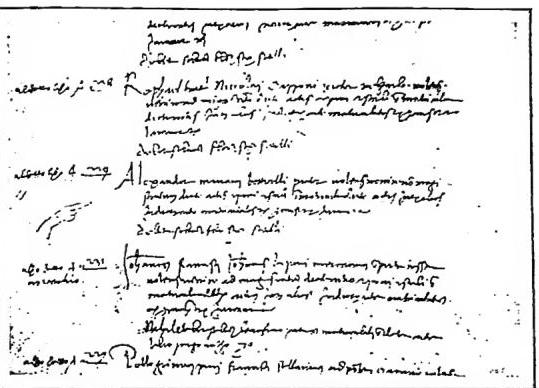
(from C. Pedratini, La farmacia storica ed artistica italiana, Milano 1931, p. 19)
CORPORAZIONE — Certificate of Botticelli’s enrollment in the C. of the Art of the Apothecaries — Florence, State Archives.
a tendency to replace the longer procedure of the ordinary courts with the swift and brief procedure of the specific tribunal of the guild. Initially limited to disputes among members of the c. concerning matters related to the practice of the craft itself, it attempts to broaden its jurisdiction, thereby bringing the association’s jurisdiction closer to that of the State. Moreover, wherever the major guilds predominate, they gradually extend their own jurisdiction over the other guilds as well, since, unlike the latter, they possess their own means of enforcement.
Welfare functions are expressed in moral and material assistance to members struck by adverse circumstances and to the poor and unfortunate in general—assistance that may assume an organized and imposing form through the foundation of hospitals and hospices.
The religious function, more extensive in the cities of Northern Europe, ranges from establishing feast days, and hence abstention from work, to celebrating the patronal feast and erecting chapels and churches and ensuring their operation.
III. ORGANIZATION
The internal organization of the corporations is revealed by the most important documentation still preserved today as evidence of the structure of the various corporate bodies and which, at the time when the guild was fully operative, legally confirmed their existence—namely, their statutes.Alongside the statute, important elements of corporate organization are the seal and the headquarters. As regards the latter, its size and richness depended on the economic position of the guild, which sometimes gave rise to notable artistic manifestations.
The patrimony, too, is a constitutive element of the guild’s structure. It was gradually formed through contributions paid by the members, tax revenues granted by the central authority, and bequests.
But the essential element of the internal organization was provided by the guild’s officers. Variable in number, they nevertheless included the actual officers, in the persons of the consuls, abbots, gastaldi, or syndics; the legal advisers or assessors for judicial functions; the notaries or scribes for drafting the corporate acts; and, finally, the treasurers. Alongside them was a more or less numerous group of persons assigned to various duties.
The criteria for appointing the various officers were extremely diverse: normally this took place either by election or by drawing lots, except in those cities or periods in which the guilds depended directly on the central government, in which case the appointment was made by the latter.
Closely connected with the internal organization was the position of the workers within the corporation.
At first, not all those who practiced a craft belonged to a corporate body; later, gradually, as a defense against competition, registration became compulsory, and this obligation was also enforced by the central authority. This did not exclude the existence of artisans who were not registered with the guild.
On the other hand, a primary condition for registration in a corporation was the practice of that craft, or of one of the crafts over which the corporation exercised jurisdiction, and consequently also—especially in the case of professions requiring specific technical knowledge—proof of the ability to practice II.
Apart from these conditions, there were others that formed part of the corporation’s ethical and social character. Among these, though not always, was being the son of a master of the guild—hence, especially in a later period, the emergence of a hereditary right of registration; from this also arose the prohibition against registration for illegitimate sons.
Registration entailed two obligations: payment of the prescribed fee and the oath to observe the corporate statute.
The position of the members within the guild was not identical for all. At the top stood the masters, who alone could hold corporate offices; next came the workers and the lads or apprentices, who were therefore not wage laborers dependent on the masters, but masters in potential themselves, and legally destined to become such, after various formalities, essentially only once they had demonstrated a thorough knowledge of the practice of the craft. In some cities of northern Europe, this took place through the presentation of a masterpiece by the aspiring master.
Beginning in the fifteenth century (though the period varied from region to region in relation to the changing conditions that determined and accompanied the phenomenon), the corporate organization declined. The causes were economic and political. The former resulted from changes in the organization of production. The rise of the merchant-entrepreneur and, consequently, though not immediately, the emergence of the wage laborer made the continued existence of an organization anachronistic which, by its nature, was supposed—apart from the very particular case of the distinction between master and apprentice—to gather within itself elements in a condition of complete equality, but which now placed side by side individuals whose economic potential, and especially whose economic autonomy, were markedly different.
On the other hand, growing competition prompted those registered with the guild, who monopolized the practice of the craft, to restrict still further the possibilities of entry into the corporation, with the logical result that, especially outside the cities, an ever larger group of free workers came into being, whose mere presence undermined the corporate structure at its foundations.
The political causes lay in the ever-greater intervention of the central authority in relation to corporate bodies. In fact, the states, already increasingly inclined to extend their intervention in the domestic economy (this was the period in which the Signorie were becoming established in Italy and the great monarchies outside Italy), found it useful for their own purposes to transform corporate bodies into instruments of their economic policy, and often indeed into genuine state organs.
At the same time, wherever—as in France and England—the state wished to promote its emerging industries, it acted outside the corporations, which consequently remained deprived of a large part of their functions.
As a result, they withdrew even further into the circle of their own privileges, which they defended both against other organizations and against the state. The latter recognized these privileges in exchange for the imposition of heavy fiscal contributions, which ultimately exhausted the guilds financially as well.
Under such conditions, the corporate body entered the eighteenth century, when naturalistic conceptions began to penetrate economic thought. And it is easy to understand how the new ideas, opposed to every form of economic restriction, evaluated the surviving corporate bodies.
In the general aspiration to freedom, the guilds—which in their final period had instead increasingly denied it to those who did not enter their orbit—became an institution that was ever more anachronistic and odious.
From this factual situation to the launching of a genuine anticorporate campaign was but a short step; thus, when reforms began in Italy and elsewhere under the various enlightened princes, the problem of suppressing the centuries-old, glorious, but by then outdated institution was ripe for a radical solution.
In France, the corporations were suppressed by Turgot, though not definitively, since this occurred only with the Revolution.
In Italy, by contrast, suppressions began in 1770 under Pietro Leopoldo in Tuscany, while at the same time in Lombardy-Venetia the guilds were deprived of every privilege, before being completely suppressed between 1778 and 1786.
Following the French Revolution, Belgium, Spain, and certain states of Germany likewise carried out the suppression, as did the other Italian states, foremost among them the Papal States in 1801 under Pio VII, followed by Ferdinando I of the Two Sicilies in 1821 and Carlo Alberto of Sardinia in 1844.
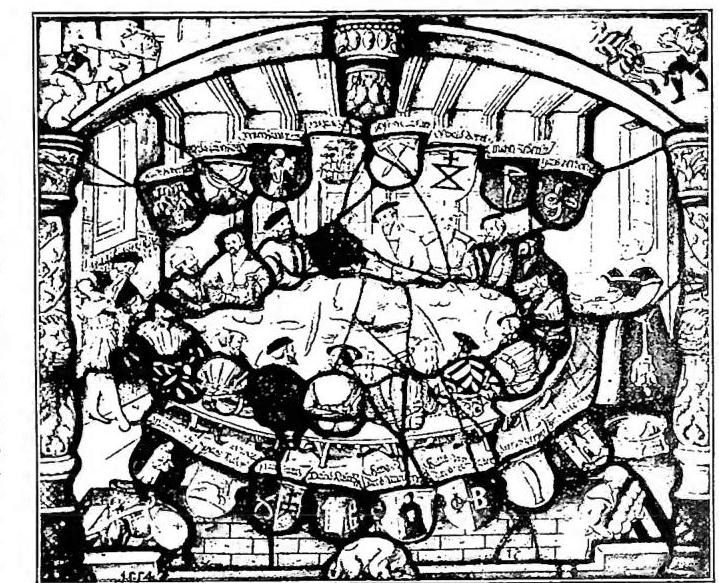
(from P. Kostner, Basel Zunftszeitlichkeit, ein Bilderbuch der Zünfte und Gesellschaften, Basel 1918, p. 81, fig. 89)
CORPORAZIONE – Stained-glass window depicting a luncheon at the headquarters of a C. (a. 1554) – Basel, Historical Museum.
in resolving the countless problems that the capitalist economy continually places on the agenda, they give rise to that movement which, through trade-union organizations, today encompasses the entire world of labour (v. SINDACATI). As such, it diverges from the medieval corporative system, which was based strictly on artisanship, insofar as the trade union brings together only employers or workers. Indeed, even the project advanced by Italian Catholics at the end of the nineteenth century—a project that fitted within the broader one contained in the encyclical Reruns Novarum, issued in 1891 by Leone XIII, to establish mixed corporations of employers and workers—was deemed impracticable by one of the most eminent sociologists of the period, Toniolo, who instead advocated the establishment of separate bodies, especially where the mass of workers was more substantial.
The content of the corporations established by the Fascist government in February 1934, as well as that of the other corporatist manifestations of our time (