
PAVIA. — City and diocese, capital of the eponymous province in Lombardy.
Over an area of 290 sq km, it has a population of 141,348 inhabitants, of whom 141,298 are Catholics, distributed among 98 parishes, 15 of them urban; it has 200 diocesan priests and 25 religious priests, one seminary, 6 male and 73 female religious communities (Ann. Pont. 1952, p. 313). It is a suffragan see of Milan.
I. HISTORY
The origins of the city are owed to the Ligurian tribes of the Levi and the Marici, merged with Gauls who arrived before the Roman conquest, which made it a «Municipium insigne» enrolled, in 23 B.C., in the Papiria tribe.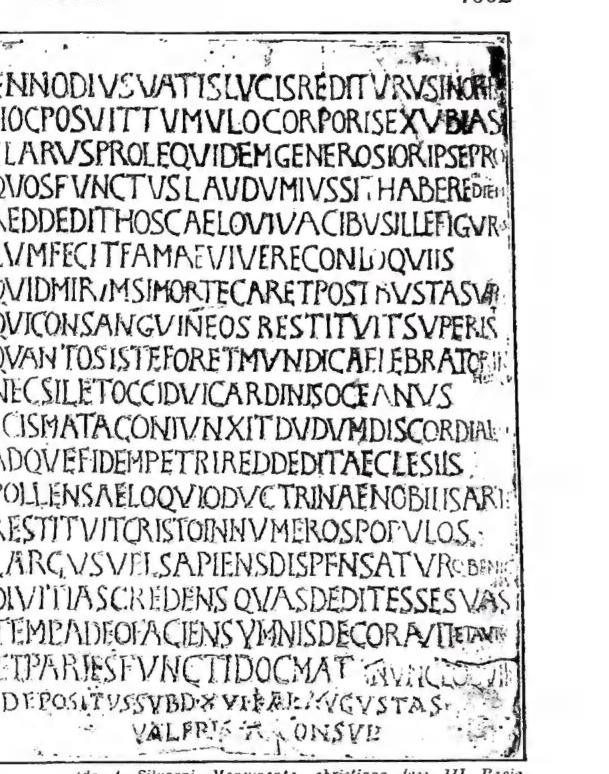
The Christian origins are traced back to the arrival of the first bishop, St. Siro, whom a tradition identified with the boy who offered Jesus the fish and loaves of the multiplication; but that bishop is not earlier than the 4th century, and he was buried in the cemetery church of SS. Gervaso and Protaso until the 9th century. In the 5th century, the see was distinguished by St. Epifanio, «pater patriae», savior of the city when King Odoacer captured there the last emperor, Romolo Augusto (476). During Gothic rule, the bishop was Ennodio (512–21), the poet and rhetorician, while Severino Boezio (v.), in the «ager Calventianus», wrote De consolatione philosophiae while imprisoned and suffered the ultimate punishment (525). Occupied by the Lombards (572), P. had an Arian bishop appointed by them; the last of these, Anastasio, became Catholic; and toward the end of the 7th century Bishop Damiano promoted the reconciliation of the dissident Aquileians (cf. Carmen de synodo Ticineni: Fliche-Martin-Frutaz, V, p. 425). The city, which the Lombards made their capital, thanks also to the Florentine market, attained great political and economic power, which increased under the Italian kings and the emperors of the Saxon house, when, after the devastation caused by the Hungarian invasion had been repaired (624), it became the seat of diets, councils, and royal coronations. In 825 it was a center of learning: «Secunda Roma» and «Mundi caput imperiale»; the bishop was granted the use of the pallium and the raised cross, which he still retains, although he did not attain the political primacy that bishops achieved elsewhere. The popes themselves sometimes took part in the commemorative councils (Giovanni VIII, Gregorio V, Benedetto VIII, Leone IX).
After the Royal Palace was destroyed upon the death of Enrico II il Santo (1024), the communal government was gradually initiated, and the bishop, whose Curia had for centuries hosted the meetings of the cives («Curia episcopi ubi Papienese faciunt contionem»), was recognized as possessing some authority and issued diplomas of a certain feudal solemnity; thus, despite its modest limits, this represented the greatest political power ever attained by the bishop in his city. During this period the diocese reached its greatest extent in the Oltrepo, corresponding to that of the Ghibelline commune, which obtained from Barbarossa a diploma of recognition that was, as it were, its « Magna Charta » (1164). To this period may also be assigned the definitive drafting of the « Charta consuetudinum », which for centuries regulated the activity of the cathedral Chapter, competing in importance with the distinguished Chapter of the palatine basilica of S. Michele; and, again thanks to sovereigns’ donations, the bishop’s power, so limited in the city, instead extended to several territories in the Oltrepo, in the area of Piacenza and Milan, which swore fidelity to him as their lord. Finally, these same centuries saw a flowering of churches in the new Lombard style, which in P. assumed a character all its own. Just as, in the city alone, one hundred collegiate and parish churches are recorded in 1250, so hospitals arose for the poor sick and for travelers, since the city stood at the intersection of the great Roman state roads. Yet, as the commune gradually asserted itself and new needs arose for offense and defense against the neighboring cities, foremost among them Milan, the bishop saw the immunities of his clergy and monasteries increasingly challenged, and his own residence, adjoining the increasingly imposing seat of the commune, itself contested; hence the voluntary exile and death of Bishop St. Lanfranco (1198), and the stern admonitions addressed to the people of Pavia by Innocent III (1208). Although the bishop’s political power seems to have revived at the beginning of the 13th century, under St. Fulco, appointed chief rector of a triumvirate governing the city, it was of imperial origin and therefore subject to the changes resulting from the rapid decline of that authority in Italy, even in Ghibelline P. With the inevitable decline of the commune and the rise of the lordship, the city, first contested between the Marquis of Monferrato and the Langosco and Beccaria families, ultimately fell under the Visconti; with them, moreover, began that early Renaissance to which the origins of the Certosa and the Castle belong. In the early period, the ascendancy of the Marcabotta faction (Ghibelline), favorable to Lodovico il Bavaro, over the Fallabrina faction (Guelph), aroused the indignation of Giovanni XXII, who placed the city under interdict (1327), an interdict that lasted for a century and a half. Nevertheless, despite these political disagreements, none of the thousand heretical movements of that time seems to have taken root there, as is in fact shown by a precious Descriptio Papiae, composed in 1330 by the Guelph priest from Pavia Opicino de Canistris, a fugitive in Avignon near Giovanni XXII, before whom he wished to present his fellow citizens in a favorable light. To the incalculable damage caused by the wars of the end of the 15th century and the first decades of the 16th, culminating in the battle of P. in 1525, in which Francesco I was taken prisoner, and the sack of P. in 1527, were added the sad consequences of the bishops’ century-long non-residence (1460–1560), one of whom was Cardinal Ascanio Sforza, who, together with his brother Lodovico il Moro, laid the first stone of the present Cathedral (1488); another was Cardinal G. B. Del Monte, later Julius III. At that time the celebrated S. Matteo hospital arose, founded in 1449 by fra’ Domenico da Catalogna of the Preachers, as did the Monte di Pietà, founded in 1493 by Blessed Bernardino da Feltre of the Friars Minor, against Jewish usury.
In the second half of the 16th century, the diocese was governed by Cardinal Ippolito De Rossi, who founded the Seminary, and by St. Alessandro Sauli, both reformers in the light of the Council of Trent; religious life was purified; and the establishment of two free colleges for university students, the « Borromeo » and the « Ghislieri », through the zeal of St. Carlo and St. Pius V, respectively (1564 and 1569), documented the reform of morals and the protection of Catholic doctrine. An attempt to introduce heretical doctrines, made by Celio Secondo Curione, a lecturer at the University, had already been suppressed after some resistance from the students. Alongside the Benedictines, the earliest residents, the Hermits of St. Augustine, the Lateran Canons, the Dominicans, the Humiliati, and the Friars Minor, the more recent Orders established themselves: the Capuchins and the Barnabites; the Somaschi for orphans, under the direction of St. Girolamo Emiliani himself and the Pavia patricians Marco Gambarana and Vincenzo Trotti; and the Jesuits for the schools. The long Spanish domination (1535–1714) saw the work of good bishops, such as Landriani and Francesco Biglia, distinguished for his victorious resistance against the Franco-Savoyard forces that unsuccessfully besieged the city in
(courtesy of Mons. A. P. Frutuc)
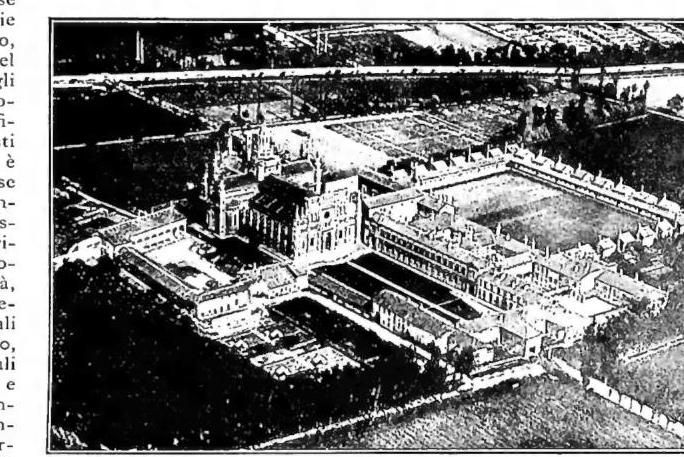
PAVIA – Aerial view of the Certosa.
Austria, which succeeded Spain in Lombardy, introduced the reforms of civil jurisdictionalism in ecclesiastical affairs, notably through the creation of the General Seminary, where Joseph II wished to concentrate the students from all the seminaries of Austrian Lombardy, under the professors Tamburini, Zola, and others. This Seminary, which lasted only five years (1786–91), seriously harmed the diocese materially, since during that five-year period it had been obliged to establish another seminary beyond the Ticino, at Valenza di Alessandria, for its clerics who were subjects of the king of Sardinia. He would not tolerate their attending school in a foreign state where, moreover, the « germana thomistica doctrina » was not taught. As a result of the political events that had brought the Piedmontese borders precisely as far as the Ticino, the diocese—which extended as far as the Siccomario, Lomellina, and Oltrepo, almost to Bobbio, and in some places into the territories of Asti, Acqui, Alessandria, Tortona, Piacenza, Lodi, and Milan, comprising 187 parishes—was dismembered, chiefly to the benefit of Vigevano and Tortona, and reduced, on its southern side, within the boundaries marked by the Ticino and the Po. During the sack of 1796, which revived the horrors of 1527, Bishop Bertieri, together with the municipal authorities, implored pardon from the enraged Bonaparte for the unfortunate Pavia, where some of the citizens and peasants who had assembled, having rebelled against the Jacobins, had held the French garrison at bay for several days.
II. SACRED MONUMENTS
The diocese of P. is rich in monuments notable for their antiquity and artistry.1. Basilicas
Of the group of Lombard basilicas, the first is S. Michele, originally built entirely of sandstone, with three naves, a Latin cross plan, and three façades laden with bas-reliefs. The interior, with matronea over the lesser naves and a tiburium resting on two successive squinches, contains mosaics and a silver crucifix (9th or 11th century). Of the primitive Christian Basilica, the present one, dating from the 11th and 12th centuries, preserves the memory of the royal coronations of the two Berengari, of Ugo and Lotario, of Arduino, of Enrico il Santo, and of the Barbarossa. S. Pietro in Cielo d'oro (“ad coelum aureum,” from the golden ceiling), as the primitive church of the 5th or 6th century was already called, was succeeded by the present one, consecrated by Innocenzo II in 1132; it is recalled by Dante (Par., X), Petrarca (Sen., V), and Boccaccio (Dec., X, 9). Built of sandstone and brick, it has three naves; in the crypt, a small marble ark in the Ravennate style holds the bones of Severino Boezio, venerated as a martyr (d. 525). In the presbytery is the ark containing the relics of s. Agostino, dated 1362 and probably the work of Campionesi masters influenced by the Pisans. S. Teodoro, built entirely of brick, with three naves and dating from the end of the 12th century, contains frescoes by Bernardino Colombani (16th century) depicting scenes from the lives of ss. Teodoro and Agnese, as well as a view of P. dating from 1522; the crypt extends beneath the side naves as well. S. Lanfranco, outside the city, has a Latin-cross plan, is built of brick, and dates from the 13th century; it contains the ark of s. Lanfranco, by Giov. Ant. Amadeo (15th century), and a delightful little 15th-century cloister with terracottas, also by Amadeo. Notable for their importance are the Gothic churches of the Carmine (14th century), built entirely of brick and richly decorated in Renaissance style, and of S. Francesco (13th–14th centuries). On the outskirts stands the basilica of the Salvatore, formerly a Benedictine abbey (15th century).2. The Castle, the park, and the Certosa
The Castle, or more properly the Palazzo Visconteo, begun in 1360 by order of Galeazzo II Visconti, was rapidly completed under the direction of Bernardo da Venezia. The grandiose halls of the Visconti and the Sforza, dukes of Milan and counts of P., now restored, are a worthy home for the civic museums. At the northern end of the great park, crowning it, Gian Galeazzo Visconti began the Certosa on 27 August 1396, dedicating it to the Virgin; he intended it as his burial place. Begun in the Gothic style with its apses, it was completed more than a century later in the most elegant forms of the Renaissance, with its façade covered in polychrome marble and bas-reliefs by Amadeo, the Mantegazza, and Briosco, true craftsmen in marble (15th–16th centuries). The interior is Gothic, with three naves, by Guiniforte Solari (15th century), and has clustered pillars in grey Angera stone. Among the painters of the 15th and early 16th centuries were Bergognone, who triumphed there with the decoration of the vaults and three altarpieces; Perugino, Cristoforo de Motis, Macrino d'Alba, Andrea Solari, and Bernardino Luini; among those of the 17th century were Morazzone, Del Cairo, G. B. Crespi, Daniele Crespi, who frescoed the entire choir, and Camillo Procaccini. Among the sculptors of the 15th and 16th centuries were Cristoforo Solari, with the recumbent statues of Lodovico il Moro and Beatrice d'Este; Cristoforo Romano, with the funerary shrine of G. Galeazzo; Baldassarre degli Embriachi, with the chryselephantine triptych; and Maffiolo da Carrara. The 17th-century artists Bussola, Rusnati, Volpino, and Orsolino produced their bas-relief altarpieces; the Sacchi family (18th century) made the remaining altarpieces in hard-stone inlay. The wooden choir, also inlaid, is among the most notable of the Renaissance. The decoration of the two cloisters, in exquisite terracottas, is by the Cremonese Rinaldo de Stauris. In the new sacristy, where an Assumption by Andrea Solari presides, are arranged the 16th-century choir books (second half), calligraphed by the Vallombrosan monk Benedetto da Corteregia and illuminated by Guarnerio Beretta, a native of Pavia. The Carthusians, expelled under the confiscatory laws of 1866 and readmitted by a convention in 1932, left the monastery in 1947 to the Discalced Carmelites, who now officiate in the church on feast days for the convenience of the faithful.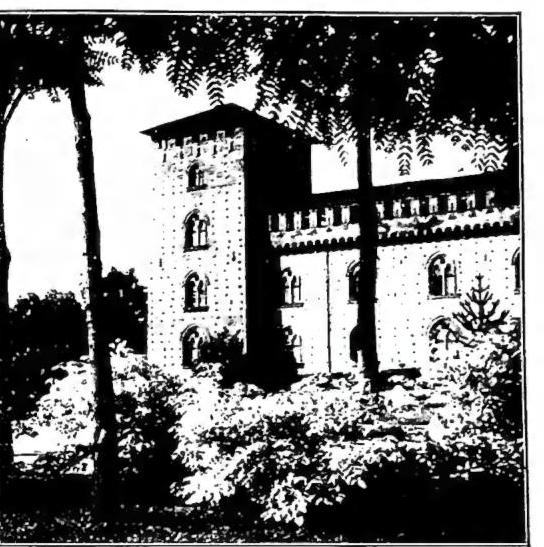
3. The Cathedral
It is a magnificent monument of the Lombard Renaissance, and its construction is associated with the names of Bramante, Leonardo, and Amadeo. Begun on 29 June 1488, on the site of the two older Lombard cathedrals, female ed cativa, it was completed with a Greek-cross plan (85 × 85 m) in 1933. The imposing interior, with a dome over galleries (95 m), and a three-naved crypt of clear Bramantesque design, contains notable paintings by Daniele and G. B. Crespi il Cerano (17th century), Faruffini and Barbotti (19th century), and Morgari (20th century); it also has sculptures by Tommaso Orsolino (17th century) adorning the altar of S. Siro, whose bones are venerated in a precious urn. In the square, which was always called “atrio di S. Siro,” stands the equestrian statue of mysterious origins, recast in 1937, of the “Regisole,” formerly the city’s palladium; and the tower, dating from the 12th century, recalling the glories of the Commune, with its late crowning of the(fot. Exit)
PAVIA - Castello Visconteo (1360-65).
Pellegrini (sec. XVI); e il Palazzo vescovile eretto da Ippolito de Rossi (sec. XVI) dopo che i vescovi ebbero cessato di abitare dietro il Duomo, attigui all'antica sede del comune, e in contesa con esso.
4. L'Università di P
Le sue origini si vogliono porre in relazione con il Capitolare di Olona dell'anno 825. Essa ebbe inizio con l'insegnamento del monaco irlandese Dungallo; illustrata da Lanfranco, maestro di s. Anselmo d'Aosta, favorita da privilegi papali del periodo avignonese, riconosciuta da Carlo IV (1361), ebbe nel vescovo, per cinque secoli, il suo gran cancelliere, il quale conferiva le lauree. Tra gli ecclesiastici vi insegnarono pure Tommaso Vio Caetano, il Della Rovere (Sisto IV), s. Alessandro Sauli, il gesuita Gerolamo Saccheri e il b. Contardo Ferrini. L'attuale fabbrica del Piermarini e del Pollack e del sec. XVIII, quando l'Università raggiunse tale splendore da meritare alla città il nome di « risorta insubre Atene » (cf. G. Parini, La laurea). I « portici solenni » accolgono ricordi marmorei dei maestri più insigni (Baldo Perugino, Giason del Maino, Andrea Alciato, Spallanzani, Mascheroni, Volta, Romagnosi, Foscolo, Bordoni). S. Carlo vi fu studente, alla scuola di Francesco Alciato. La Biblioteca, il cui fondo più antico è costituito dalle librerie dei monasteri soppressi, è ricca di codici ed edizioni rare.I due collegi Borromeo e Ghislieri (l'uno e l'altro architettura del Pellegrini) ospitano gratuitamente, per munificenza rispettivamente dei ss. Carlo e Pio V, più di un centinaio di studenti di condizione disagiata. Affreschi vivaci dello Zuccari e del Nebbia (1603 e 1604) illustrano i fasti di s. Carlo nel collegio Borromeo, ove il primo studente accolto fu Federico Borromeo e il b. Ferrini (v.), principe dei romanisti, fu il più grande. Diocesano di P. fu il card. Maffi (v.). - Vedi tav. LXXIII.
descriptione Papie, ed. F. Gianani, Pavia 1927; E. Savio, Gli antichi vescovi d'Italia dalle origini al 1300. Lombardia, II, parte 2a, Bergamo 1932; A. Solmi, L'amministrata finanziaria del Regno Italico nell'alto medioevo in P., con l'ed. degli Instituta regalia Camere regum Langobardorum seu Honorantie Civ. Papie, Pavia 1932; F. Gianani e O. Modesti, Il duomo di P., ivi 1932; E. Hoff, P. und seine Bischöfe im Mittelalter, ivi 1943; P. Vaccari, Storia dell'Univ. di P., Pavia 1948; Profilo stor. di P., 2a ed., ivi 1950; inoltre il Boll. stor. pavese (1893-94), la Riv. di Sc. stor. (1904-10) e il Boll. della Soc. pavese di stor. patria (1901-51); per l'epigrafia cristiana V. A. Silvagni, Monumenta cristiana, fasc. III, Papia, Città del Vaticano 1943. Faustino Gianani