Machine translation of the 1948–1954 Italian original. The original text is authoritative.
TAMBURINI, PIETRO. — Jansenist theologian, born on 1 January 1739 in Brescia, died on 14 March 1827. He was the brain and soul of Italian Jansenism. The dates of his life and the scope of his work (more than thirty publications) trace the curve described in Italy by the heresy of Jansen.
de' Ricci (v.) had in that movement an importance that was almost existential, territorial, political, and at the same time choreographic and propagandistic, T., through his university teaching, his varied literary activity, his participation as a Synod of Pistoia (v.), and the influence he exercised in the religious and political circles of the time, dominated it intellectually, combining in himself the merits, defects, and fluctuations of the heresy in its geographical manifestations in Italy: an impetuous polemicist, an Enlightenment theologian, now a supporter of absolutist government, now a defender of republican government. Yet he was always consistent with his Gallican jurisdictional system and with Jansenist theories, thereby making it possible to establish, within such a discordant bibliography, a constant theological and jurisdictional criterion for distinguishing Italian Jansenism. If he touched upon politics, it was through an inevitable connection with his existence, opportunistically and only marginally; this indicates the influence he exercised only indirectly on the national Risorgimento and on nineteenth-century liberalism. A disseminator, not an original thinker: in theology and canon law he referred to the French and Dutch appellants and jurisdictionalists, adding only liturgical and practical observations arising from incidental controversies. He began his education in his native city, studying with the Oratorians, until, having been ordained a priest in 1760, he went three years later to Rome, where he was prefect of studies at the Irish College. In Rome he became acquainted with several Jansenists, including de' Ricci and Count de Bellegarde. In 1778 he was a professor at the University of Pavia, and in 1781 prefect of studies at the Austro-Hungarian College-Seminary, transferred by Joseph II from Rome to Pavia. He prepared, directed, and disseminated the Synod of Pistoia of 1786, and during the French Revolution he was first holder of the chair of moral philosophy and natural law at the University of Pavia and then professor at the Lyceum of Brescia. After the French Revolution he was elected director of the Faculty of Law at the University of Pavia, where he remained until his death, as he himself said, burdened with years and excommunications and ca-
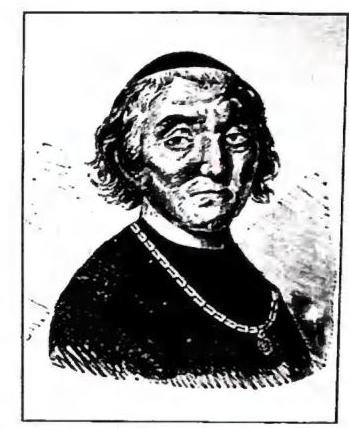
(from P. Tami, Storia generale dell'Inquisizione, Milan 1867, p. 12) TAMBURINI, PIETRO — Portrait.rying the burden of years and excommunications. He seems to have died a good death, with an inner reconciliation, even though no official and explicit retraction of errors is recorded. During his lifetime he began the publication of the Opera omnia, which was to comprise 41 volumes but remained unfinished. His principal work: Ethica christiana (4 vols., Pavia 1783). In the theological doctrine of Grace, T. depended on Baius; in his conception of the Catholic hierarchy, on Sarpi, the French Gallicans, the Jansenist Van Espen, and the work of Van Hontheim; in sacramental teaching and practice he codified his thought in the acts of the Pistoian Synod, revealing himself to be opposed to attritionism, the probabilist moral system, and limbo for children who died without Baptism; concerning relations between Church and State, he repeated the positions of Richer, Dupin, De Marca, and Febronius. In Italy he was among the first philosophers to repudiate the poor system of scholasticism and to read and recommend the reading of Rousseau, Voltaire, and Montesquieu, while not indifferent to the sensationalism of Locke and Condillac and to the theories of Hobbes. Spiritually he adhered to the schismatic Church of Utrecht, an unprejudiced advocate of ecclesiastical tolerance against the alleged intolerance of the Holy See, and a combative anti-Curialist. Yet one cannot ignore the significance of his teaching, the interest aroused by his publications, to the point of marking the decisive point of contradiction in religious polemic, or his contribution to the revival of sacred studies, even if in an excessively Enlightenment manner; nevertheless, first during the French Revolution and then in the orientation of early nineteenth-century liberalism, he never arrived directly at an idea of freedom and national independence, but only indirectly, behind the old barriers of ecclesiastical and political absolutism.
BIBL.:Mem. e docum. per la stor. dell'Univ. di Pavia e degli uomini illustri che vi insegnarono, Pavia 1878, pp. 330-36; E. Rota, P. T. di Brescia e teologo piacentino e la controversa giansenista a Piacenza, in Boll. d. Soc. pavese di Stor. patria, 1912, pp. 343-64; B. Ricci, Il maggior teologo giansenista d'Italia P. T., in La scuola cattolica, 20 (1921), pp. 14 sgg., 100 sgg., 276 sgg., 358 sgg.; E. Rota, Il giansenismo in Lombardia sulla fine del sec. XVII, Brescia 1927; C. A. Jemolo, Il giansenismo in Italia prima della rivoluzione, Bari 1928, pp. 261-332; G. Mantese, P. T. e il giansenismo bresciano, Milan 1942. Benvenuto Matteucci
Cite this article
“TAMBURINI, PIETRO.” Enciclopedia Cattolica, vol. XI (1953), p. 1039. Azione Romana digital edition, https://azioneromana.com/article/tamburini-pietro.