
LOCKE, JOHN. — Philosopher, born on 29 August 1632 at Wrington (Bristol) to a Puritan family, died on 28 October 1704 at Oates (Essex). He studied at Westminster College in Oxford and then devoted himself to the study of medicine; but he did not complete them, nor did he ever obtain a doctoral degree. Meanwhile, he collaborated assiduously on the works of R. Boyle and Th. Sydenham, and subsequently continued to devote close attention to the work of the scientists, physicists, and physiologists of his time. Through a daring surgical operation he appeared to save the life of Lord Anthony Ashley, who shortly afterward became Earl of Shaftesbury. When the latter became chancellor, he wanted L. as his secretary. Thus he also gained experience of political life. These different directions of his education were unified in his reflective intelligence, and at a memorable gathering of friends, in the winter of 1670–71, during a discussion of the principles
Among his contemporaries, the writings concerning the religious question and the relations between the Churches and the State had no less of an impact: in 1695 the essay The reasonableness of Christianity appeared, likewise followed by a lengthy controversy; and between 1685 and 1704 he wrote the four Letters for toleration, the first of them anonymous, in Latin, published in 1689,
But already in 1691, needing assistance, he had accepted the hospitality of Sir Fr. Masham, at the manor of Oates, about twenty miles from London. In his final years he devoted himself entirely to the study of Holy Scripture. He retained clarity of mind to the very end, and took leave of all those dear to him with moving serenity.
L. is the foremost representative of modern empiricism. But it must immediately be added that his importance derives precisely from the fact that he represents the most thorough purification of earlier empiricism from all undue presuppositions, and its reduction to its fundamental epistemological principle, which is the act of sensory perception. What is called the “world of experience” (in the cognitive sense) is the world given in the act of perceiving it, or a derivation and construction of it made by us on the basis of this act. This alone is the world of which we are certain; beyond the limit of this absolutely certain knowledge, only knowledge of probability can take place, greater or lesser according to the judgment of reason, which alone, in this case, can induce us to give our assent to this or that “belief” or “opinion” (Introduction to the Essay).
Hence, the structure of the Essay. It opens, in bk. I, with the celebrated refutation of innatism: there are no principles, forms of knowledge, ideas, or notions, theoretical or practical,
that precede experience. The soul comes into the world as a tabula rasa: everything it acquires, it acquires through experience. L. does not deny that the soul has innate the faculty or disposition to know in general: he wants only that its result not be anticipated, as it is with innatism. Bk. I is merely negative, and serves as an introduction to bk. II, where the origin of ideas is examined positively. This origin is traced back to only two sources: sensation and reflection; by the former, L. means what today is properly called perception, which gives us the existence of things outside ourselves; by the latter, in addition to the capacity to make the data of the former the object of examination (which is its most common meaning today), he means consciousness of the acts or operations of the spirit (perceiving, remembering, comparing, judging, desiring, willing, etc.). He therefore also calls these two sources, respectively, “external sense” and “internal sense” (a distinction retained by Kant: but for L. sense and intellect, or rather intelligence, are not two distinct faculties).
This fundamental consideration should not be overlooked: whereas L.’s starting point is the concrete act of knowing (objective perception), he subsequently, in analyzing this act, resolves it into an aggregate or complex of ideas that have, in themselves, only a subjective meaning. Hence a continual interference between the two points of view, which give rise, the one, to a critical empiricism intended to clarify the proper object of cognitive experience; the other, to a subjective idealism that will find its most immediate application in Berkeley, and its reduction to skepticism in Hume. But in L. the position is different, and he never doubted the existence of things outside ourselves.
A broad analysis of ideas follows, divided first of all into simple and complex ideas. Simple ideas are those received either from a single sense, or from several senses together, or those that concern the fundamental operations of the spirit, or those that refer jointly to data of sense and reflection. Famous in this section is the distinction between ideas of primary qualities and those of secondary qualities: the former we regard as belonging to the reality of things (extension, solidity, figure, motion, etc.); the latter (sweet, bitter, hot, cold, etc.) are ideas that depend upon our particular bodily constitution. L. expressly declares that here he follows the standpoint of the physics of his time.
Complex ideas are divided into modes, substances, and relations: only complex ideas of substances intend to refer to the reality of things outside ourselves; ideas of modes and relations are our constructions (in general, for practical reasons), independent of objective consideration of things. In this section, particular notice should be taken of the critique of the idea of substance, as a quid underlying the qualities and properties of things, which L. seems to wish to dispense with, declaring it confused and obscure, but from which in reality he cannot free himself because it involves existence itself; this is followed by the treatment of the ideas of space, time, cause, identity (including here that of human personality), and others, which would later also be subjected to Kantian criticism—indeed, by the whole of modern philosophy—so that L. deserves credit for having identified them.
Bk. III considers the relation of ideas to the words by which they are expressed. Here ideas, insofar as they are merely “mental objects,” are all general and more or less abstract, insofar as they disregard, to a greater or lesser extent, the circumstances of time, place, and other features of the individual reality (abstraction here, since there is no intellectual faculty distinct from that of sense, is something different from scholastic abstraction). L. is not a nominalist in the medieval sense (of the flatus vocis), quite the contrary: for him, what matters is the idea expressed by the word. Nevertheless, he attaches such importance to the question as though the disparity of opinions and controversies could be reduced to the different use made of words.
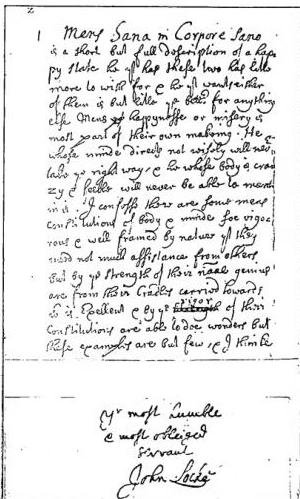
(from F. G. Kenyon, John Locke, Directions concerning education, Oxford 1933, caption, centre in front.)
LOCKE, JOHN - Autograph - London, British Museum, ms. 38771, ff. 2, 52 b.
It may be divided into three parts. The first concerns absolutely certain knowledge, which occurs when one perceives the relation between two ideas either immediately (intuition) or by means of other intermediate ideas (demonstration). At this point, under the Cartesian influence dominant in this part, L. declares that science, properly speaking, is only mathematics, to which he wishes morality to be added, insofar as its ideas, like mathematical ideas, are merely productions of our mind; on the other hand, in contrast with the original inspiration of his empiricism, it seems to him that experimental science will scarcely ever be able to establish itself as certain science. The second part (chs. 9–11) concerns knowledge of existence, and is entirely beset with difficulties (since existence, too, is here an idea), over which L., certainly without perceiving them, passes lightly. First comes the existence of the self, which, L. says, is known in Cartesian fashion through immediate intuition; then comes the existence of God, which can be known through demonstration. In the third place comes knowledge of the existence of things outside us, of which we have certainty in the act of perceiving them—but only in that act (outside it, he says, I am no longer certain of their existence...). Hume’s scepticism, contrary to L.’s intention, is here amply prepared.
The third part of the book deals with probability (that is, when one does not have certainty regarding the relations between our ideas), and includes, besides knowledge of physical facts, that of historical facts and religious doctrines. Here L. also speaks of faith, but he speaks of it in the same sense as «opinions», that is, as knowledge that is not absolutely certain. For him, then, there do indeed exist truths that exceed the limits of our reason: such are the truths of Revelation;
but their acceptance must nevertheless always be presided over by our reason, which is like a lamp that the Lord has placed within us to discern, in every case, truth from falsehood. This concept, as is well known, is of Augustinian origin; but here it is merely a lumen naturale, which goes to swell the current of rationalism, already threatening in this century.
This philosophy has its centre in the individual, in the autonomy of reason or personal conscience: it therefore achieved greater success in the political sphere, where the idea of freedom had made its way, together with that of a «natural right» and of the contractual origin of civil society. The «divine» rule of law declined: the source of sovereignty passed to society, that is, to individuals who, by limiting their own freedom, constituted themselves as a social-political body. According to L., this does not involve a total alienation of one’s rights (as in Hobbes’s Leviathan), but a partial alienation, limited to the advantage that the individual expects from a communal life regulated by law. Outside this purpose, the individual retains his natural rights, freedom of conscience, and the right of property justified by his labour, and therefore forming a single whole with the life of the personality. Hence also the idea inspiring his treatise on toleration, understood in the simply social-political sense, as the necessity of a clear separation between what concerns civil government and what belongs to religion: religion is a matter of conscience and can in no case be imposed or determined by a civil power.
But where, above all, this individualism, understood as the very principle of human personality, was able to produce its best results was in the pedagogical question. The Thoughts concerning Education derive their greatest originality from this concept of spiritual autonomy, to which the child’s development must be directed: mastery of himself, of his feelings, and of his reason. Hence the rigorously disciplinary method that L. advocates: an internal discipline, to be sure, which must nevertheless be promoted with a firm and careful hand by the educator, the father, and the tutor. First of all, physical education, which gives the child mastery of his body and accustoms him to endure the inevitable hardships; then moral education, which gives the young man a character in conformity with the laws of virtue and social honour; finally, intellectual education, which provides the young person with the indispensable elements of culture for the formation of the intellect and for the fullness of life (the Lockean ideal is embodied in that of the «gentleman», that is, the man of the «bourgeois» class then taking shape).
This philosophy responded to a general movement of the spirit of that age; it interpreted it in the simplest and most persuasive form and facilitated its further development. Hence its success in the 18th century, especially in France.