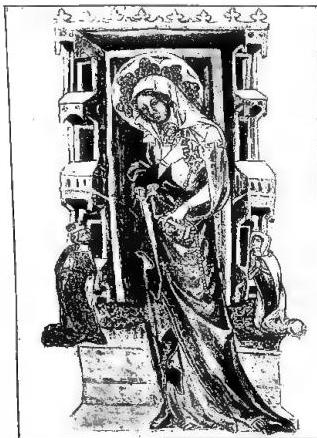
EDUCATION. — The art of forming in the child the human being as such: that is, with all the perfection that his nature entails.
SUSCHARO:
I. Concept of education
II. Relationship between the pupil and the educator
III. The human faculties to be developed
IV. Coordinated and methodical action
V. The end of education
VI. Totalitarian education
VII. Religious education
VIII. The right to educate
IX. Credicazione
X. Physical education
XI. The contribution of medicine to education.I. CONCEPT OF E
Etymologically, some derive the term e. from the Latin educare, which in its proper sense means “to care for, rear, nourish” and, by extension, “to form, instruct”; and in this sense it is preferably used by the ancients, for example, Quintilian: « nec alter quam si mihi tradatur educandus orator » (De instit. or., I, 1); « de pueris, inter quos educabitur ille, huic spei destinatus » (ibid., I, 1); others, and more appropriately, derive it from educere, “to draw out, to bring to light what is within and hidden,” because this is more expressive of the characteristic concept of educational action.Several consequences immediately follow from this: 1) e. entails a duality of elements: one active, which forms, namely the educator; the other passive, which is formed, namely the educand; 2) strictly speaking, one can speak of e. only between human beings, between a perfectible human being and a perfected human being. It is true that the term e. is also used in speaking of plants and animals (educating roses, the dog, the horse); but, when applied to the plant kingdom, the term e. simply means “cultivation,” which is the work by which the necessary and favorable conditions are established so that the germ may develop into flowers and fruits as perfectly as possible; and this work can be called e. only with reference to the care exercised in it by a rational being, the cultivator. When applied to the animal kingdom, the term e. means “rearing” if the work is directed toward preserving and strengthening physical energies; “domestication” if it is directed toward restraining and eliminating certain psychic acts; and “training” if the aim is to promote and intensify the development of particular qualities (e.g., training a hunting dog or a racehorse). Even in these cases, one may speak of e. only insofar as the attention and care employed proceed from a rational being who knows the end toward which he is striving and the relation of the means to the end, namely, the breeder, the domesticator, or the trainer. When, on the other hand, not only the subject who exercises care and solicitude but also their object is rational and spiritual, then we have true e., because only in this case does the educand actively participate in the educator’s work through his consciousness, will, and freedom. E., in fact, neither tends nor ought to tend to form a being that acts or reacts mechanically or instinctively to the various impressions coming from outside and within, but rather a person who knows the external and internal world, is conscious of what he knows and does, and can therefore judge actions and recognize whether they conform or fail to conform to the dictates of conscience; 3) if e. is a perfection, one cannot say that every perfection is e., because the latter, as daily experience teaches, requires an influence proceeding from an agent who exercises it deliberately, methodically, continuously, and rationally. Hence a systematic order of actions and influences is required in order to obtain that determinate effect which is the harmonious intellectual, moral, and physical development of the human being.
Hence the comprehensive definition of e.: the art by which an adult human individual (teacher, educator) exercises his action upon an adolescent or minor individual (pupil, educand) in order to bring all his faculties into operation, developing determinate intellectual (science) and practical (morality) habits with a view to the true and complete end of human life.
This has enumerated all the elements of e.: the relationship between educand and educator; the concept of human spiritual habits and faculties to be developed, together with the means suited to the purpose; the concept of coordinated and methodical action, or influence embodied in a method; and the concept of the end toward which one must strive, which is none other than the integral end of human life itself.
II. RELATIONSHIP BETWEEN THE EDUCAND AND THE EDUCATOR
This constitutes the intimate essence of education. In education, there is, on the one hand, the subjective factor, the person who is its active subject, namely the educand, with all his instincts, faculties, natural and hereditary tendencies, character, and temperament. He does indeed constitute the object around which the norms of educational action are applied; but he is not so much its object that he is not at the same time, and predominantly, its subject, because, by the law of spontaneity, he gradually educates himself, organizing within himself the entire world of his experiences, and thus conquering himself and his personality. On the other hand, there is the extrasubjective factor, namely the conscious and deliberate action of the educator. But this action does not and must not replace the action of the educand; rather, it must cooperate with II. Another extrasubjective factor is constituted by the physical environment into which one is born, and by the family and social environment in which one lives, with all the achievements attained, its traditions, and its culture.Education therefore involves an action in which physical, spiritual, and moral factors come into play; by exerting their influence through a series of coordinated acts, they determine another action in the educand, who, so to speak, reacts by gradually developing and educating himself. The educator does not do everything, as though he had to pour into the educand all that constitutes knowledge and virtue; his action is not met by mere passivity or reception; rather, two activities are manifested, one of which assists, controls, guides, and develops the other.
Hence the solution to the question: “autoeducation or heteroeducation?” Certain pedagogical theories, founded on erroneous philosophical ideas, seek to insinuate or maintain that in education the work of the educator is entirely secondary and that the whole educational process consists in the free development of the educand’s activities, or in their adaptation to the external reality (nature) that surrounds and presses upon them (materialists and positivists). Others go even further and simply abolish the educator, declaring that all education is merely “self-education” (idealists). The alternative just mentioned has no correspondence in reality. In the educational relationship, as has been said, two factors must be distinguished, which complement each other and, thus integrated, contribute to producing a single result: the formation of the complete human being. This result is certainly something immanent in the educated subject (physical, moral, and intellectual perfection); it does not come to the educand solely from outside. But, on the other hand, it is certain that it cannot be achieved without the influence of the educator factor. There will therefore be autoeducation and heteroeducation together. Autoeducation is to be understood as a series of acts through which the educand realizes himself and achieves his own perfection, but under the necessary influence of heteroeducation; the latter, in turn, is to be understood as a series of acts which neither extinguish nor replace the self-developing activity that has arisen in the educand, but awaken, direct, and strengthen it through the use of every educational means.
III. THE HUMAN FACULTIES TO BE DEVELOPED
The concept of the faculties to be developed to the perfect flourishing of man as such (external senses, imagination, memory, intelligence, and will), of the methods to be followed in order to attain this end, and of the habits to be acquired for the formation of character, is supplied by rational and experimental psychology, and is dealt with under the individual headings. Here it is only necessary to follow a proper middle course between exaggerated conservatism and an excessive, indiscriminate love of novelty for novelty’s sake. Not everything ancient and traditional is bad, nor is everything among the novelties and achievements of modern times good; therefore the golden admonition of s. Paolo applies: «provate tutto e tenete quello che è buono» (I Thess. 5, 1 sg.). What is newly good should be amalgamated with and augment what was good in the past, not destroy it in order to begin everything anew. This is evidence of a genuine historical sense, because history is the teacher of life and, rather than merely illuminating it, it is our duty to draw from it the light that emanates from II.IV. COORDINATED AND METHODICAL ACTION
The methods by which educational activity is to be exercised can be reduced to two: subjective-introspective and objective.1) Introspection, which serves to induce the subject being educated to direct his attention to things or facts on which he generally does not dwell on his own, may be, so to speak, spontaneous or induced. Spontaneous, when a person, withdrawing into himself, recalls past experiences relating to the educational sphere and studies, in the light of the present, their elements and fruits (e.g., the Confessions of s. Agostino, and the various diaries and autobiographical memoirs). Indeed, many educational theorists base their systematic constructions on this introspection, taking as their rule what they learned from their educators, more or less critically examining the impressions they received from them, and reproducing the elements that appear good to them because they produced good results. These constructions, however, because of the large share they may have of the subjective, can lead to errors and misguided assessments. More useful, therefore, is the introspection induced in the person being educated by appropriate devices, which oblige him to express what he feels, helping him to observe himself carefully, giving him guiding ideas, providing him with a guiding thread, and correcting whatever constitutes a deviation from the right path.
2) The objective method consists in studying educational facts insofar as they are examined outside ourselves: continuous observation of the person being educated, of what he says and does, of his conduct in the various circumstances of the day, of his bodily posture, of changes in his facial expression, of words that escape him among his companions, and of the varying degree of intensity and attention that he displays according to the different subjects discussed. In this way, a wide body of knowledge can be gathered, serving to adapt the general norms of e. to different individuals.
V. IL FINE DELL'E
The two methods mentioned, as well as others that could easily be cited, are good and effectively efficacious insofar as they are adapted to the end to be achieved by education. This is not simply a matter of technique or of particular philosophical conceptions, but of logic and consistency with the living reality of human nature. Now, for one who takes man as he is, the end of education can be none other than to set the person being educated on the path to absolute perfection in the life to come through his relative perfection in the present life.For, given—and this is demonstrated elsewhere—that the whole of human life is not enclosed within the sphere of material and earthly things, that there are higher values, the values of the spirit; that man is endowed with a spiritual and immortal soul, with free will and a moral conscience, and is destined for eternal happiness; and that above contingent beings there is a necessary and absolute Being from whom everything proceeds and in whom everything converges—God—true and complete education cannot disregard these truths, but must conform to them. These considerations acquire greater significance and efficacy when illumined by the light of Revelation. This enables us to know wh-
(Int. Galt. Mont. Vaticani)
EDUCAZIONE — La Invenua bene che combatte i vizi. Frescoes symbolizing good and bad education (16th century) — Vatican, Terza Loggia.
how man has been elevated to the supernatural order as an adopted son of God, endowed with supernatural faculties and means for attaining his supernatural end, namely, the possession of God through the beatific vision. With all the greater reason, therefore, must an education that wishes to be true and complete take account of this complex of higher truths, in order to lead man to that perfection which this state of elevation demands.
Consequently, any education that aims at purely naturalistic ends and considers the highest supernatural values of man and of life either negatively (by disregarding them) or positively (by denying or combating them) will be deficient, whatever particular and determinate aspect it may assume in the various systems, insofar as it addresses itself unilaterally to physical culture (animal-man), or to the intellect (man-as-knower) and the will (man as will to power), or to the civic aspect (citizen-man), or to the national and racial aspect (racial man), or to the economic aspect (economic man), or to the professional aspect (working man), precisely because it would proceed from partial considerations that would not embrace the whole man and therefore not the whole end of education either. For education must in fact be totalitarian.
VI. TOTALITARIAN EDUCATION
The twofold end of man—of present and future life—characterizes one of the fundamental requirements of education, namely, its totality. And first of all, with regard to the person being educated. Educational activity must extend to the whole child and not merely to one part or to one or another of his faculties. Now the child has a body and a soul; through the latter he thinks, reasons, wills, and is free. Education must therefore be physical, moral, and intellectual. Moreover, the child is a being destined not for an egoistic and solitary life, but for social life, first in the family and then in the State; he is essentially a religious being, who must practise religion both as an individual and as a member of the society in which he lives: the Church. Education must therefore also be familial, civic, and religious (v. FAMIGLIA; ISTRUZIONE RELIGIOSA; SCUOLA; STATO).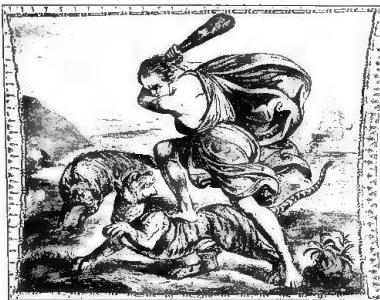
And since the spirit of the child to be educated is one, even amid the manifold forms and aspects mentioned, education must likewise be unitary—that is, it must possess a unity that harmoniously combines everything and avoids any excess in individual parts; otherwise there can be no genuine formation of human spirits. A poem, in fact, is not created simply by placing and piling up words, rhymes, and verses beside one another, but by permeating the whole with the inspiring breath that synthesizes multiplicity into an organic whole; nor can a song, if it is to be harmonious, dispense with unity amid the multiplicity of its notes. The same is true of the poem and the song expressed by human consciousness. The harmony of life is achieved only when ideas, affections, notions, and volitions, though manifold, do not flow from the same source and do not possess a vivifying soul.
VII. RELIGIOUS EDUCATION
A wholly particular consideration is merited by religious education, especially in the face of theories and systems that would relegate it to the attic among things indifferent, useless, or even harmful, on the grounds that it cannot be put into practice without suppressing or diminishing the natural faculties and without renouncing the works of earthly life, and is therefore alien to social living and temporal prosperity, contrary to every form of progress in letters, the sciences, the arts, and every other work of civilization. Christian education has as its proper and immediate end to cooperate with divine Grace in forming the true and perfect Christian, for whom life is Christ (Col. 3:4) and all actions are manifestations of Christ in him (II Cor. 4:11); it therefore embraces the whole sphere of human life,sensible, spiritual, intellectual, and moral, individual, domestic, and social—not to diminish it, but to elevate, regulate, and perfect II. Thus the true Christian, far from renouncing the works of earthly life or diminishing his natural faculties, develops and indeed perfects them by coordinating them with supernatural life, so as to ennoble natural life itself and secure for it more effective benefit, not only of a supernatural and eternal order, but also material and temporal.
“We are not strangers to life; we repudiate no fruit of God’s works. We merely exercise restraint, so as not to use them immoderately or improperly. And so we live in this world not without our forum, slaughterhouses, baths, shops, stables, markets, and all our other commercial activities. We too sail and serve in the army with you, cultivate the fields and conduct business, and therefore exchange our labor and place our works at your disposal” (Tertullian, Apolog., 62).
Religious education, while reminding us that man has fallen through original sin and has consequently remained weakened in his will and shaken by disordered tendencies, nevertheless knows how to add the necessary antidote: there-
(phot. Gull. Marcel Vaticani)
EDUCAZIONE – Virilitas mala caressing the vices. Frescoes symbolizing good and bad education (16th century) – Vatican, third loggia.
for, in addition to natural means and human motives, which have their incontestable usefulness, it knows how to add supernatural means of far more intimate and profound efficacy: the life and doctrine of Jesus Christ; prayer, worship, the Sacraments, among which Penance and the Eucharist possess the highest pedagogical value, as do its rites, its feasts, and its art. Moreover, the history of the Church, which is identified with the history of true civilization and genuine progress down to our own times, bears magnificent witness to this. And the saints remain ever the most perfect models in every class and profession, in every state and condition of life: from the simple, rustic peasant to the scientist and man of letters, from the humble artisan to the commander of armies, from the private individual who is a father of a family to the monarch who rules over peoples, from the simple girls and women within the domestic sphere to queens and empresses.
In conclusion, it must be said that, in the formation of the Christian, religion must not be regarded as a practice or a habit added to, or put upon, a life that adopts a manner of living according to the model offered by worldly fickleness; rather, it must be regarded as a cohesive and unifying principle, which stamps its character upon the whole of life and upon its individual actions according to their various professions.
VIII. THE RIGHT TO EDUCATE
Since the work of education is an eminently social activity, insofar as it does not aim at perfecting individuals by considering them as solitary beings, but as elements that form and in turn enhance the perfection of others with whom they live, the question naturally arises as to which of the three distinct and necessary societies (family, State, and Church), among which man is born and lives, possesses the right to educate.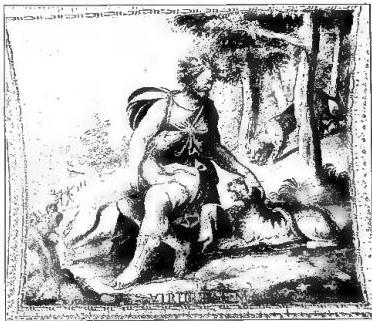
1. Education belongs to the family by natural right
To the family, in fact, God immediately communicates fecundity, which is not only the principle of life, but also the principle of education for life and of authority. The child naturally belongs in some sense to the father and mother; he is like their extension and is so strictly theirs that no one may take him away from them. They therefore have the right not only to raise him, but also to educate him according to their wishes and preferences.It is true that the family is an imperfect society and does not itself possess all the means necessary to form fully the citizen, the educated man, the professional, etc., in accordance with the purpose and requirements proper to social life, and must therefore seek the competence and assistance of the State; but this does not deprive it of its primordial and innate right to initiate these various aspects of education, to supervise them, and to have recourse to those particular institutions and persons whom it considers most consonant with its own way of thinking. This right, however, is not despotic, but, like every other human right, is subordinate to the natural and divine law and to the ultimate end established for all by the Creator. This truth, which finds the common sense of the human race consenting and unanimous, is confirmed and sanctioned by the CIC (can. 1113), according to which parents are gravely obliged to care, with all their power, for the religious and moral as well as the physical and civic education of their offspring; and it has always been openly defended by the Church.
2. Education belongs to the Church by divine positive right
She was constituted by her Divine Founder as teacher of all nations (Mt. 28, 18-20); moreover, she possesses a spiritual motherhood, because she gives birth to souls in Christ and nourishes and educates them in the divine life of Grace through the Sacraments and her doctrine. Hence she has the right to fulfil her mission independently of every earthly authority, both with regard to her proper object (faith and morals) and with regard to the means necessary and suitable for attaining her purpose, among which are culture and instruction. Accordingly, by full right she promotes science, letters, and the arts; establishes her own schools and institutions in every discipline and at every level of culture; also concerns herself with physical education and sport, since all these are means that may either benefit or harm Christian education; and by full right she exercises supervision in every public or private institution, not only with regard to religious instruction, but also with regard to every other discipline and orientation (CIC, cann. 1381–82).It might seem that such supervision is unwarranted,
and that this pre-eminent right of the Church is harmful to the progress of humanity. But this is not true, because such supervision protects her children against every doctrinal and moral poison; and this pre-eminence respects every legitimate freedom of science, of study, of scientific methods, of research—in a word, of all secular culture. Nor does it oppose the adaptation of her own institutions and schools, when they serve the laity, to the legitimate regulations of the civil authority in each nation, always ready to reach agreement with them when difficulties arise. Not only this: the supernatural order, from which the rights of the Church derive, far from destroying or even diminishing the natural order and the rights belonging to it, elevates, perfects, and completes it, since both orders proceed from the same God.
3. Education belongs to the State by virtue of its authority
The State has as its proper end the temporal common good, which consists in the peace and security of citizens, in the exercise of their rights, and in their spiritual and material well-being insofar as this is possible in the present life. Yet, just as it is not a father, since it presupposes rather than generates its citizens, so it does not create education; it finds it already existing as the prior natural right of the family and the supernatural right of the Church. It therefore can neither have nor claim a primary, much less an exclusive, role in education; its role is secondary in relation to that of the family and the Church, although it remains necessary and of the greatest importance.The State shall therefore be responsible: a) for protecting and perfecting the work of the family and the Church in all that concerns the advantage of the common good, fostering their activities and creating suitable conditions in which they may be carried out in the best possible manner; b) for making up for the deficiencies of the family when the work of the parents is physically or morally lacking; c) for supplementing the work of the family and the Church (especially where it does not reach or is insufficient) through its own schools and institutions, all the more since it is better supplied than anyone else with means placed at its disposal by the citizens for the common needs, and it is therefore just that it should employ them for the benefit of all; d) the State has the full right to reserve to itself the instruction and direction of those schools that prepare people for the proper administration of public affairs (civil officials, departments, ministries) and for the internal and external defence of the homeland (the army), because these objectives directly concern the temporal common good over which it presides. Naturally, in this it must take care not to infringe the prior and superior rights of the family and the Church; it must therefore avoid excessive militarization, and the use of a period of time either too extensive or badly timed, which would impede the fulfilment of religious or domestic duties. Indeed, one must not confuse the spirit of fortitude, the sense of military valour, and the art of legitimate offence and defence with the spirit of violence, with the instinct
(Ist. Coll. Materi Vaticani)
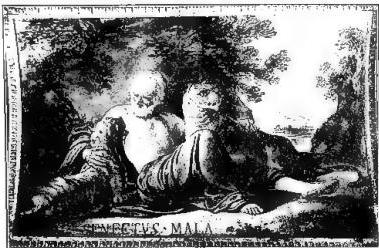
EDUCAZIONE — The Senectus mala that caresses vices. Frescoes symbolizing good and bad education (16th century) — Vatican, third loggia.
or love of struggle for its own sake, with exaggerated and often brutal athleticism. e) The State also has the right to demand—and therefore to employ the appropriate means—that all citizens possess the necessary and suitable knowledge of their civil and national duties, and a certain degree of intellectual, moral, and physical culture, as required by the conditions and progress of the times and by the common good. As for higher and specialized education, which cannot be imposed on everyone, the State should seek to make it possible for all who request II.
But it does not follow from all this that it has the right to monopolize education and the schools (v. SCUOLA, LIBERTÀ della).
IX. COEDUCATION
The simultaneous education of individuals of both sexes in the same environment and under the same educators. Welcomed by a few pedagogues in the most ancient times (Platone, T. Campanella, J. M. Condorcet, J. Fichte) and opposed by the majority, coeducation, as a practice, began to gain popularity at the beginning of the nineteenth century in the United States of America, more for economic reasons and a shortage of personnel than for anything else; and throughout the century it made only slow progress, despite attempts to justify it by new theories of union and social well-being, the leveling of the two sexes, better preparation for life, and the emancipation of women.The Church’s position, even without seeking to determine a uniform practice, is nevertheless in principle clearly opposed to coeducation. And not without reasonable grounds: the theory of coeducation is in fact based either on naturalism, which denies original sin and its consequences, or on a confusion of ideas that mistakes legitimate human coexistence, as it occurs in the family and in society, for promiscuity and a leveling equality that is contrary to nature and therefore becomes dangerous. In the Creator’s intention, the perfect coexistence of the two sexes was ordained only within the unity of marriage. Nature, moreover, has made the two sexes different in their organism, inclinations, and aptitudes; hence they can neither be called nor considered equal, but complementary. It is precisely this complementarity that requires a distinction also in education, if future spouses are to enter marriage in their full masculine and feminine formation. Moreover, in the psychological and educational sphere the two sexes differ in their manner of understanding, in their conception and interpretation of facts, and in their aptitude for profound study; this differentiation increases with the onset of puberty, which occurs at different ages in the two sexes. It is therefore easy to understand how education must necessarily differ both in method and in content.
Promiscuity, moreover, although it may sometimes effeminate the young man, more easily masculinizes the young woman, who loses that grace, that femininity, that reserve which, besides constituting her charm, is her best defense. Hence an exaggerated camaraderie, which may be danger-
(photo by Gull. Vatican Museums)
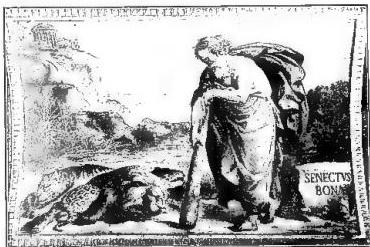
EDUCAZIONE — The Senectus bona that has conquered vices. Frescoes symbolizing good and bad education (16th century)—Vatican, third loggia.
to other and worse harms. Not to mention that the constant proximity of the two sexes can easily cause premature irritability, especially during the age of development and adolescence.
These principles and observations must, naturally, be applied with discernment, at the proper time and place, with prudence, according to the various ages and circumstances; above all in gymnastic exercises, amusements, and bathing, where every display and all publicity are especially unbecoming to female youth. Moreover, the results of coeducation, insofar as they can be learned from experience, especially in countries where it is more widely practiced, are by no means reassuring.
X. PHYSICAL EDUCATION
Modern physical education is thescience that employs movement to educate the psychic faculties of man and to promote the harmonious development of the body, with the aim of improving the individual’s overall psychophysical performance.
It differs considerably from sport, understood both in the sense of recreation and in that of competition and spectacle (v. GINNASTICA; SPORT),
although it includes much of sporting practice.
Knowledge of anatomy, physiology, anthropology, constitutional science, hygiene, kinematics, pedagogy, psychology, pathology of the locomotor apparatus, and physical therapy constitutes the basis on which the theory and practice of physical education rest; and it is by virtue of this foundation that physical education rises to the status of a science.
Historical notes. — As a science, physical education has existed for little more than a century and a half, whereas as an art it is extremely ancient. The roots of physical education reach back to the very sources of civilization. As early as several millennia before the Christian era, physical exercises were practiced among the Chinese with genuinely hygienic and therapeutic aims.
The phenomenon appears successively as a religious, political, and social phenomenon. In Greece, physical exercise attained considerable maturity and was realized in an act of perfection and education for body and spirit within the harmonious unity of the individual. In the Gymnasium, the teaching of physical culture held pride of place alongside philosophy, rhetoric, and music, until it degenerated into the cult of athleticism at the expense of the values of the spirit. Once the balance between spirit and body had been broken, physical exercise was violently rejected. Something similar occurred, though with a different orientation, in Rome, where physical exercise was placed at the service of the purposes of the State. And when the exercises on the Campus Martius came to an end and the evolution of Roman customs led the citizen toward the splendor of the baths and the idolatry of the circus performer, the decline of physical exercise was under way. Emerging Christianity accelerated this process of disintegration when it reacted energetically and tenaciously against the disgraceful spectacle of the circus and the baths, proclaiming the preeminence of everything that is an achievement of the spirit over what is instead care of the body. In 393, by prohibiting the Olympic games, Theodosius dealt a decisive blow to the practice of physical exercises.
In the Middle Ages, physical exercises did not form part of school education properly speaking, being reduced solely to competitive activities such as tournaments. With the age of chivalry, physical exercise became the privilege
and necessity of the knight.
Two humanists, Guarino Veronese (1374–1460) and Vittorino da Feltre (1373–1446), deserve the credit for restoring physical exercise to educational practice. The latter in particular, through the «casa soiosa», succeeded in realizing that marvelous system of education celebrated by the finest Italian tradition. Vittorino, alternating literary and scientific studies with physical exercises (wrestling, running, swimming, horseback riding, dancing)
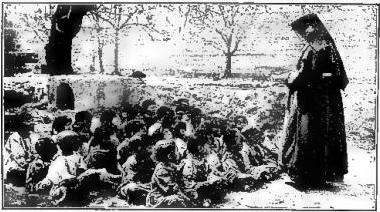
EDUCATION - Catechism lesson at the port - Lan chow (China).
and singing, he prepares not only learned and good men, but also robust ones, rich in grace of bearing. Through Rambaldoni, that harmony in the spirit-body binomial, which had been lost, returns. The example is not isolated if, later, Maffeo Vegio (1407-1458) in his six books De educatione liberorum et eorum claris moribus encompasses the entire educational process, from the physical care of upbringing to the highest forms of instruction, and Leon Battista Alberti (1404-1472) has Lionardo say in the first book Della Famiglia that "exercise preserves life, kindles natural warmth and vigor, purges superfluous and harmful matters, strengthens every virtue and sinew," and later Girolamo Mercuriale (1530-1606), physician and humanist, drawing on his vast erudition from having translated into Latin, from the best codices, the works of Greek authors, especially Hippocrates, compiles his celebrated treatise De arte gymnastica, which is a true encyclopedic collection of physical exercise.
Francesco Bracciolini (1566-1645) in Instruzione alla vita civile (1637) also advises physical exercises, as Parini would do later. It is at the end of the 18th century that interest in physical exercise becomes noticeable. Rousseau's Émile, with its return to nature, dates from 1762; in 1774 Basedow founds the first philanthropinum in Dessau, in 1793 Guts-Muths writes Gymnastik für die Jugend, in 1794-95 the Enzyklopädie der Leiberübungen appears. In 1798 F. Nachtegall founds the first Turmanstalt in Copenhagen. Heinrich Pestalozzi (1746-1827), in the schools of Burgdorf and Yverdon, develops his system of education in which the educator must care for the whole man: body, intellect, heart, will. In Germany, Ludwig Friedrich Jahn (1788-1852), valiant patriot and father of German gymnastics, founds the first gymnastics institute and the so-called German or "inducement" system, based on the use of apparatus such as parallel bars, horse, rings, etc., aimed at the military training of youth in the spirit of national resurgence. Meanwhile, in Stockholm in 1813, Pehr Henrik Ling (1776-1893), a former pupil of Nachtegall, founds, by government commission, the Central Institute of Gymnastics, initiating that system of hygienic gymnastics known as the
"Swedish system," which is based on the knowledge of anatomy and physiology, aiming to remedy organic deficiencies and strengthen young people. In Paris, the exiled Spanish colonel Amorós, coming from Madrid where he had already founded a military institute by order of Charles IV, following Pestalozzi's method, creates the teaching of rational and practical gymnastics, publishing in 1838 a Manuel d'éducation physique, gymnastique et morale. In 1868, in France, gymnastics teaching enters lycées and colleges, remaining under the influence of the Swedish method until, later, Georges Hébert introduces the "natural method," which consists in the practice of natural exercises such as marching, climbing, jumping, running, throwing, and swimming. In England, as a legacy of a secular tradition, the so-called sports system prevails.
In Italy, it is the Swiss R. Obermann who, in 1833, by commission of the Government of Turin, introduces the systematic practice of physical exercises in military training, since until that time physical exercise was practiced only in colleges, particularly those run by religious orders. Only in 1898, with the De Sanctis law, is gymnastics teaching made compulsory in secondary, normal, teacher training, and elementary schools.
Interest in physical education becomes very keen among statesmen and scientists as well: figures such as Senator Francesco Todaro, Angelo Mosso, Luigi Pagliani, and other university professors dedicate much of their scientific activity to the diffusion and study of physical education. Contrasts are evident regarding the path to follow: followers of the Swedish method clash with those of the German system, while the English one finds, in part, an advocate in Mosso. In a climate heated by ideas and actions, one figure of scholar and precursor stands above all, the doctor of medicine Emilio Baumann (1843-1917) from Canonica d'Adda (Bergamo), a pupil of Obermann.
Baumann, who is the true founder of Italian gymnastics, posits as a postulate of his teaching the concept of cultivating the body as a means to educate the spirit.
After the First World War, under the influence of the victorious war and new events, the problem of physical education becomes a state problem. With the establishment of the Academy of Physical Education in Rome and that of Orvieto, replacing the Magisteriums of Physical Education, the orientation of physical education in Italy asserts itself in an eclectic form extended to the masses, achieving considerable results. Scientific progress is accompanied by adequate legislation. With the resumption after the Second World War, within the framework of the new school reform, physical education decisively moves toward an educational-hygienic-sporting direction. Such an orientation fully harmonizes with the Christian idea, which sees in physical education the optimal means for the balanced formation and education of the whole man, bearing in mind, however, what Pius XII warned when addressing Roman athletes in 1945, exalting physical exercise while exhorting them to be: "always aware that the highest honor and the holiest destiny of the body is to be the dwelling of a soul that shines with moral purity and is sanctified by divine Grace."
XI. THE CONTRIBUTION OF MEDICINE TO EDUCATION
While the education of a perfectly normal individual, or one who deviates only slightly from normality, is the task of pedagogy, in particular cases—which in practice are far more numerous than commonly believed—where the individual gradually approaches clear abnormality, pedagogy becomes insufficient unless it avails itself of medicine. The latter offers useful diagnostic contributions to classify the subject in terms of constitution, temperament, and character; it provides valid assistance by supplying the means to modify, as far as possible, the physical and psychological abnormalities of the pupil. Furthermore, the medical study of the individual, for pedagogical formation purposes, can prove highly useful for better future utilization.In particular, regarding the biotypology of young people (v. TIPI INDIVIDUALI), to which the educator’s work is especially directed, it is possible to ascertain, through the medical study of the subject: a) morphological characteristics; b) endocrine formula; c) neuro-psychological characteristics and practical aptitudes; d) psycho-passional tendencies and the particular vicious inclinations proper to each individual type; e) the ability to orient oneself more easily toward this or that activity, whether physical or mental. The educator’s work will be far easier and more effective if, beforehand, through medicine’s contribution, they can know, for example, whether the object of their care is "tachypragic" or "bradypragic" in action, or "tachypsychic" or "bradypsychic" in terms of intelligence characteristics. Obstacles that are insurmountable with merely educational means can be overcome by medical intervention, which, by acting, for instance, on endocrine imbalances, can restore a given individual type on the margins of variability to the realm of normality, making them educable through normal pedagogy.
The educator can know in advance, through medicine’s contribution, that, for example, the hyperthyroid individual is tachypsychic and tachypragic, endowed with strong will in the moment but with little capacity to sustain effort; possessing good mental order, excellent memory, and intelligence predominantly of the inductive, synthetic, practical, and intuitive type; rich in affectivity and emotionality, which easily drives them toward romantic manifestations; often shy and poorly adaptable to the environment; introverted and tendentially pessimistic; naturally inclined toward hope, audacity, anger, and pride; with a prevalent development of imagination and sentiment over reason.
Different constitutional, endocrine, and neuro-vegetative equilibria induce other neuro-psychological characteristics and practical aptitudes in the individual (v. TIPI INDIVIDUALI), hence the utility—or even the necessity—for pedagogy to make extensive use of the contributions that medicine offers.
The aim is thus to achieve a true "science of education," capable of more positive applications and broader developments than what an "art of education," the prerogative of certain famous educators—such not by acquired science but by innate disposition, as demonstrated from childhood in their ability to moderate and shape their playmates—could ever provide.
In particular, chastity (v.), the educator’s work must be supported by that of the physician. - See plates VI-VII.