Machine translation of the 1948–1954 Italian original. The original text is authoritative.
SCUOLA, LIBERTÀ della. – It is a natural consequence of freedom of teaching (v. INSEGNAMENTO, LIBERTÀ d') and concerns the organization of schools in the hands of private individuals and other bodies that are not the State or parastatal bodies.
If the State has the right to inspect and supervise schools of every kind, individual and private initiative, for its part, has the right to try every means that may lead to the better formation and education of man. This is more evident in the case of the so-called paternal school, which is implemented within the family, where the State may intervene only to verify that there do not remain
all of education, without burdens on the State.
In establishing the rights and obligations of non-state schools seeking equal status, the law must ensure them full freedom and provide their pupils with school treatment equivalent to that of pupils in state schools.
A State examination is prescribed for admission to the various orders and grades of schools, or for their completion, and for qualification to practise a profession.
Institutions of higher culture, universities and academies, have the right to establish their own autonomous regulations within the limits laid down by the laws of the State'.
Art. 34: 'school is open to all. Elementary education, provided for at least eight years, is compulsory and free.
Those who are capable and deserving, even if lacking means, have the right to reach the highest levels of study.
The Republic shall make this right effective through scholarships, allowances for families and other provisions, which must be awarded by competition'.
These are principles, however, that do not entirely and perfectly correspond to the right of complete freedom of schooling (cf. the absolute denial of state subsidies); moreover, there is hesitation in applying them, because they appear revolutionary to a mentality that is still widespread, particularly in official circles, which grants state schools a privileged position and merely tolerates the other schools. These are summarily judged as having arisen solely to receive the rejects of state schools. This is not factually true of many of them and at the same time demonstrates a failure to understand the
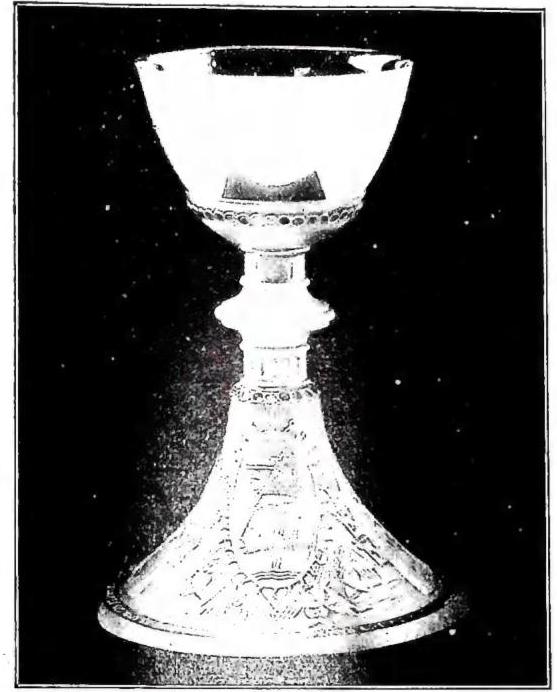
201 SCUOLA LIBERTÀ DELLA - SCUOLA SUP. D'ARTE CRIST. «B. ANGELICO» 202 SCUOLA SUP. D'ARTE CRIST. «BEATO ANGELICO» – Chalice in gilded silver, with an ivory knop and precious stones, executed by the aforementioned School in 1945 – Milan. (courtesy of the School Director)principle of freedom itself, thereby restricting the exercise of the human faculty of educating, concentrating it in certain official bodies, and excluding the advantages that arise from emulation and competition in this field as well. If the State is right to make use of state schooling in its present effectiveness, it must not, however, identify itself with II. By its nature the State stands above state schooling, precisely because its purpose is not the good of one of its possible functions, but the common good; and this requires it to take an intelligent interest in every kind of activity that is useful and in some way beneficial to the social body. The State cannot ignore the fact that free schooling corresponds in practice to a legitimate social need. Moreover, it relieves the State of a moral burden that would weigh upon it if such schooling did not exist. And also of a financial burden. For example, in Italy it is estimated that it saves the state budget an annual expenditure currently assessed at between 15 and 20 billion: the calculation is based on recently reported figures for what each pupil in its schools costs the State, and varies, naturally, according to the types of schools. This does not include the costs of school buildings. On the basis of this fact, of the common interest in helping duly recognized free schools that are viable to attain the development of which they are capable, and finally on grounds of social justice (equitable salaries for teachers), the request for a financial contribution from the State to free schools is justified. For religious instruction in schools, especially in Italy, V. SCUOLA.
BIBL.: the most explicit ecclesiastical documents on the subject are: Instructio S. C. S. Offici ad episcopos Americae Sept., 24 nov. 1875; encyclical Divini illini magistri, 31 Dec. 1929; Pius XII, Address to the Italian Association of Teachers of Catholic Schools, 8 Nov. 1946. – Fundamental on the subject is the study by G. Monti, La libertà scolastica, Rome 1949. Cf. also G. Piovano, La libertà d'insegnamento, Rome 1901; G. Zocchi, S. pubbliche e s. private. Libertà d'insegnamento, there 1906-1908; G. M. Radini Tedeschi, Il problema scolastico odierno, Bergamo 1912; A. Pavissich, S. libera, Rome 1913; G. Piovano, Libertà della s. dallo Statuto in qua, there 1914; A. Poggi, Stato, Chiesa, S., Florence 1924; cf. also the Proceedings of the Social Congresses of Venice (1912), Naples (1923, 1925), Florence (1927); and A. Bartolomei, Restituto
religione institutionis in italicis publicis scholis, Rome 1938. Cf. also the entry INSEGNAMENTO, LIBERTÀ d'. Giuseppe Bozzetti
Cite this article
“SCUOLA, LIBERTÀ DELLA.” Enciclopedia Cattolica, vol. XI (1953), p. 136. Azione Romana digital edition, https://azioneromana.com/article/scuola-liberta-della.