
SCHOOL. - An institution born from the impossibility in which families find themselves to provide, on their own, that degree of instruction and culture required by the social circumstances in which they live. As these circumstances become more demanding with the rise of civil and cultural life and the progress of letters, arts, and sciences, the number of schools also tends to increase, as do the various types into which they necessarily differentiate. And since the school is not only for instruction but also, and above all, for formation and life, it is natural that interest in the school grows on the part of both civil and religious authority, along with their intervention and oversight. Intervention and oversight that should harmoniously merge, since the subject to be instructed and educated is one and the same as both citizen and religious individual (v. EDUCAZIONE); yet throughout history, there have been—and still are—intrusions, coercions, and misplaced suspicions that violate the fundamental rights of the individual and the family.
A brief overview of the various fortunes experienced by the school will help to better understand the significance of the important problems that cluster around the school question.
I. SCHOOLS AMONG THE MOST ANCIENT PEOPLES
Leaving aside the "primitives," for whom one cannot properly speak of true schools, though a rudimentary hint initiation (v.), to which young men and women were subjected during the transition from childhood to adolescence, among other peoples one can instead observe a rich and varied flourishing of schools. A nearly universal characteristic is the fact that the education of youth remained centered in the family, considered the core of civil and social life, while the State, where it established its own schools, generally aimed to supplement and develop family education, without at all intending to replace II.Among the Babylonians and Assyrians, even without precise information regarding school organization, it is known what the subjects of instruction were, which formed the culture of the "magi" or wise men. These included almost all fields of knowledge: history, geography, astronomy, astrology, mathematics, medicine, theology. Study, though reserved for persons of high caste, priests, and magi, was not closed to any intelligent individual, who could freely attain that degree of culture required for access to public offices of the State. Women and the common people, however, were generally excluded from instruction. A center of particular cultural activity was Babylon, where the king maintained in his Palace a higher school of advanced studies, and students were supported at the State's expense and, at the end of the three-year course, diligently examined by the sovereign (Daniel and his companions, taken into exile in Babylon in 606 B.C., were precisely educated in this school in all the sciences of the time). Among the Persians, family education was succeeded by the care of the State with its schools, for the period from 7 to 25 years, where the intellectual and religious part of the lower course was followed by the higher course for military and civil training. Those who did not aspire to public office could freely educate themselves with private teachers. The Persian priests, called magi or wise men for their vast culture, must also have had large priestly schools. The Egyptians, who always held knowledge in high esteem, had numerous and well-developed schools, but only the sons of priests and warriors, the two privileged classes to whom alone the government of the State was entrusted, were admitted. Instruction was imparted exclusively by priests, and schools were located in temples. Higher education was directed especially toward the technical and professional fields (scribes, engineers, architects, physicians). Those who possessed science most deeply and completely (literature, natural sciences, medicine, philosophy, and music) were the priests, with their own schools, who also studied theology profoundly (famous were the theological schools of Heliopolis, Memphis, Hermopolis, and Thebes, which created various theogonies and raised or lowered their deities according to their theories). Religion also included magic, much studied from the earliest times, and divination, especially in the form of oneiromancy (one may recall the episodes of Moses and Joseph sold into Egypt).
Among the Chinese, for whom, more than any other people, all social life was centered on the family, considered the foundation of the entire religious, moral, and civil life of the nation, the school was regarded as the continuation and perfection of domestic instruction in the traditions and customs of ancestors. The State possessed an organic system of schools of various levels of instruction, founded, maintained, and directed by the State, and open to all male citizens. Those who aspired to govern the people had to undergo, at the end of higher studies, State examinations, which were very burdensome and difficult. However, families and private individuals could also open and direct schools; the State school was compulsory only for those preparing for public offices and positions; and the State examination could also be taken by those who had studied privately.
The Japanese only acquired Chinese writing in 207 A.D., imported by a Chinese scholar; until that time, most of them were entirely ignorant of II. King Mommu in 701 established a University in Tokyo and numerous national schools and colleges in every province, also dictating regulations specific to each level of schooling, thus creating a system of national education. Those who, after the first schools, wished to study particular disciplines (Chinese classics, political science, jurisprudence, etc.) had either to attend the University or rely on private teachers; likewise, the sons of merchants, farmers, and artisans, who could not attend the colleges and schools of the nobles, had to resort to private instruction.
The Indians had no State schools for preparation for public offices, as the Chinese, Egyptians, and Persians did; however, they had lower and higher schools (practically all in the hands of the priestly caste of Brahmins, the first of the four castes into which Indian society was divided) which were divided into two categories: some were reserved for children of the priestly caste, others served the sons of the two castes of warriors and farmers or merchants; the latter had an essentially religious purpose (knowledge of sacred books). Initially, higher education, very well organized in numerous colleges that soon transformed into a kind of University, was the privilege of Brahmins; but gradually, as the teaching of literature, medicine, jurisprudence, astrology, and astronomy was added to religious subjects, members of the warrior and artisan castes could also attend schools.
In Greece, the Spartans implemented an absolute state monopoly over schooling. The educational system, which was attributed to Lycurgus (d. 889 B.C.), aimed to train valiant soldiers, as the Spartans—a small aristocratic minority (the Spartiates)—could not maintain dominance over the other peoples of Laconia without significant military superiority. Thus, the child belonged to the state: after seven years of strict family education, they entered public educational institutions, maintained by the state under teachers and educators appointed and supervised by the state. Even girls belonged to the state, which oversaw their education to shape them into strong and vigorous women and mothers. Among the Athenians, by contrast, the political constitution of Solon (ca. the end of the 6th century B.C.) placed great importance on instruction and education but imposed neither official curricula nor compulso—
Even the Romans, until the end of the Republic, had no official schools or curricula. For a long time, the family itself took responsibility for the instruction of its children. The first schools, it seems, did not open until the end of the 3rd century B.C. and were naturally private, run by more educated slaves. They were called ludi, meaning amusement or diversion, to indicate their supplementary role to domestic education, and the teacher was called ludi-magister. They were held in some family’s home or in a less frequented corner of a temple or public building. The conquest of Greece brought to Rome a large number of Greek teachers of grammar (a term that included grammar proper, mathematics, geometry, astronomy, and music), rhetoric (which trained in the art of speaking and formed orators), and philosophy, who offered their instruction to families. Thus, alongside the first elementary schools, secondary and higher schools emerged, which added medicine and jurisprudence to grammar, rhetoric, and philosophy. These schools, too, were left to the free initiative of private individuals, without any State interference: "maiores nostri disciplinam puerilem nullam, aut destinatam legibus, aut publice expositam, aut unam omnium, esse voluerunt" (Cicero, De Republica, IV, 3). It is true that in 92 B.C. a censorial edict was issued against the new schools run by Greeks, but this was not aimed at restricting the freedom of teaching, but rather at moderating
SCUOLA - Teacher at the desk with disciples. Engraving from the Epigrammata of G. B. Cantalicio - Venice, printed by Matteo Capocasa, 1493, f. 2r.
the excesses that recent innovations brought to the « mos maiorum ».
Under the Empire, teachers enjoyed many privileges and immunities. Vespasian was the first to pay some teachers with public funds; Hadrian was generous with this kind of subsidy and also founded in Rome the first universities, the « Athaeneum Romanum », a large school building in the shape of an amphitheatre where teachers, lacking their own school buildings, could gather students without expense. Marcus Aurelius founded in Athens a series of chairs in philosophy and rhetoric, with teachers salaried by the State. Alexander Severus in Rome created new school buildings at the disposal of private teachers, established new chairs in medicine, architecture, etc., and provided scholarships in kind for poor students. Constantine founded a university in Constantinople, that is, an organic complex of schools and chairs for secondary and higher education. Municipalities everywhere followed the emperors' example, creating municipal schools with salaried teachers. Indeed, Emperor Gratian, to prevent injustices, legally fixed the honorarium due from municipalities to grammarians and rhetoricians, including it in the budget among mandatory expenses. Although these municipal schools not infrequently became an occasion for some more direct state intervention, they always left free scope for private schools, founded and maintained by individuals and directed by more select personnel, and thus preferred by families.
II. CHRISTIAN SCHOOLS UNTIL THE FALL OF THE EMPIRE
This full freedom of teaching also allowed Christians to embrace the career of teachers; indeed, there were teachers who suffered martyrdom, not condemned as private instructors, but for refusing to renounce their faith. St. Cassiano, martyr, was a teacher in Imola; Flaviano, martyr in Africa, was a grammarian; Origen began his career as a grammarian to support his family; and in the cemetery of St. Callistus, the epitaph of a magister primus or elementary teacher was found.It was Julian the Apostate who first attempted to restrict the freedom of teaching for Christian teachers, issuing the Edict of 362, which prohibited them, if they persisted in Christian beliefs, from continuing to teach. Renowned teachers then stepped down from their chairs, such as the rector Victorinus in Rome and the sophist Prohaeresius in Athens. But already two years later, in 364, Valentinian repealed the law and restored freedom to Christian teachers: "Whoever by morals and knowledge is worthy to teach, let him have the right to open schools" (Theodosian Code, 13, 6, 3). This regime of freedom lasted in the West until the end of the Empire. In the East, however, Theodosius implemented the official monopoly of university teaching with the two Constitutions of February and March 425 (ibid., 14, 9, 3; 15, 1, 53), by which private professors were reduced to the mere office of domestic tutors ("inter privatos parietes"); instead, all were required to attend the University he founded, staffed with 8 rhetors, 20 grammarians, 2 jurists, and 1 philosopher. A century later, Justinian, in 529, concentrated all the legal schools of the Empire in the three cities of Constantinople, Beirut, and Rome, centralizing all educational initiative in his hands and prohibiting any form of teaching "for those tormented by the insomnia of paganism" (Justinian Code, 1, 11, 2). But this reform, before it could consolidate, was overwhelmed by the Lombard invasion.
Meanwhile, the Church, for a more solid preparation of pagans for Baptism, had established the "catechumenates," in which the priest imparted instruction on the faith throughout the year, but especially during Lent. Any place—especially in the early times, sanctuaries, crypts, cemeteries, private homes, etc.—became a center of teaching. Over time, many catechumenates gradually transformed into "catechetical schools," which also admitted pagan students and aimed to provide both religious instruction and general culture. Even more: some of these catechetical schools evolved into academies or institutions of higher learning, because Christians, faced with heresy and the most advanced and refined pagan scholarship, understood that a final effort had to be made to give Christianity a philosophical, literary, and cultural foundation that could place it on par with any pagan teaching and serve to defeat the numerous enemies who opposed it in schools, books, and daily sarcasm. The most celebrated example of these higher schools is the Christian Didascalion of Alexandria, founded, according to more recent studies, by Origen in 202 at the behest of Bishop Demetrius, and which replaced the catechetical school of Pantaenus. The professors there taught, alongside sacred sciences, Platonic and Aristotelian philosophy, physics, astronomy, grammar, and rhetoric, drawing abundantly from classical pagan authors; the study of Sacred Scripture crowned the curriculum. Since a similar need for a scientific demonstration of the truth of the faith was felt in other cities, the Church founded similar institutions; thus arose the Academies of Caesarea, Antioch, Jerusalem, Edessa, Smyrna, Nisibis, and Rome.
III. CHRISTIAN SCHOOLS IN THE EARLY MEDIEVAL PERIOD
The void left by the dissolution of the Roman Empire (476) transferred the entire responsibility for public education to the Church. Various types of schools can be noted:1. Presbytery or Parochial Schools
Where Christianity accounted for almost the entire, or at least the majority of the population, purely Christian schools had already been established for elementary studies, in which children learned, in addition to religion and liturgical chants, reading, writing, and the basics of arithmetic. These schools naturally multiplied as those of the pagans declined, until in many places they remained the sole beacon of education. A Council held in Italy in 443 ordered priests to gather the children of the surrounding areas in their homes to provide them with suitable instruction. Before and after this Council, parochial schools must have been numerous in Italy and produced good results, if the Councils of Vaison, Orange, and Valence in 529 established that priests in pastoral care should admit young lectors who were unmarried into their homes to instruct them as good fathers instruct their sons, « secundum consuetudinem, quam per totam Italiam satis salubriter teneri cognovimus » (Hefele-Leclercq, II, pp. 1111-12). The young lectors were then free to pursue an ecclesiastical career or to embrace marriage. The same was prescribed by the Council of Constantinople in 680.2. Episcopal or Cathedral Schools
Parochial schools did not go beyond the subjects taught at the elementary level; however, higher schools with more suitable and profound teaching were also needed. Moreover, the preparation of the clergy required that studies be conducted in a worthy manner. Thus, so-called episcopal schools arose alongside the bishop’s seat, great seminaries and universities intended especially for candidates to the priesthood but increasingly frequented by laypeople as well. One such school had already been established by St. Augustine in Hippo; another existed in Imola, where St. Peter Chrysologus studied; still others in Paris, Poitiers, Clermont, etc. The Second Council of Toledo (531) prescribed their foundation, adding that students, upon reaching the age of 18, were to be questioned in the presence of the bishop and clergy as to whether they preferred the priesthood or marriage (Mansi, VIII, p. 785). The school was under the control of the bishop himself, and beneath him was the immediate superior, called magister scholae, divided into schola minor (elementary) and schola maior, which either included only the courses of the trivium or developed the full program of the trivium and quadrivium, crowned by the study of Sacred Scripture and pastoral theology.3. Canonical Schools
Where no cathedral existed, the canons of the local church themselves established their own schools, following the model of the episcopal schools, which thus took the name of collegiate and canonical schools and assumed a more secular than ecclesiastical character. Later, they merged with the episcopal schools.4. Monastic Schools
The greatest burden of public education, however, was borne by monastic schools, first in the East, where most of the Church Fathers and ecclesiastical writers received their education, and later in the West, especially through the work of Benedictine monasteries, which spread rapidly throughout Europe. They had an « internal » school (schola claustri) for the religious and an « external » school (schola canonica or externa), separate from the first and under the monastery’s jurisdiction, to avoid unnecessary contact with the monks who were particularly devoted to study, prayer, and work. The head of the school was called magister scholae or capiscola or proscolus and, by the end of the 9th century, scholasticus. The curricula of the two schools were roughly the same: trivium or quadrivium. Alongside male monasteries, female monasteries were also to have their own schools, and the English Council of Cloveshoe (747) ordered that not only bishops and abbots but also abbesses take particular care to cultivate the study of letters in their religious communities (Hefele-Leclercq, III, p. 907).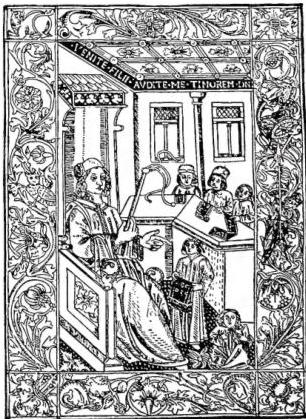
Hefele-Leclercq, Histoire des Conciles, II, Paris 1908; Mansi, Sacrorum Conciliorum nova et amplissima collectio, VIII, Florence 1762; Montalembert, Les moines d'Occident, Paris 1860-1877; A. Hauck, Kirchengeschichte Deutschlands, I, Leipzig 1904; G. Bardy, L'Église et l'enseignement au Moyen Âge, Paris 1936; V. MONASTERO, MONACHESIMO, EDUCAZIONE.
IV. CHRISTIAN SCHOOLS IN THE CAROLINGIAN ERA
In addition to reorganizing the Palatine School, intended particularly for princes and nobles who were preparing for military life and the governance of the people, Charlemagne issued many ordinances aimed at promoting or reorganizing parish, episcopal, and monastic schools. In the Epistola de colendis litteris, addressed between 780 and 800 to bishops and abbots, he urged them to provide literary instruction to all who could learn according to each one’s capacity; more explicitly, in the Capitulare of March 23, 789, he ordered that in every bishopric and monastery schools for children be founded and that well-emended textbooks be used (cf. MGH, Capitularia, I, pp. 72 and 79). The bishops complied, and in the first half of the 9th century many councils in France, Germany, and Spain also reminded parents of their duty to educate their children. In Italy, the Roman Council of 846 prescribed that all bishoprics and the parishes subject to them have their own schools, for they had learned that in some places teachers were lacking and the study of letters was neglected.During this period, state schools also emerged; indeed, in the Capitulare ecclesiasticum primum of Lothar in 825, promulgated at the great assembly of the Kingdom of Italy held in the fields of Olona (Pavia), the prevailing neglect in many places was lamented, and those who had been entrusted by the state with teaching were ordered to apply the utmost care so that students might acquire the culture demanded by the times. Moreover, the locations of the schools were even specified, listing the cities that were to send their pupils to each of them: Pavia, Ivrea, Torino, Cremona, Firenze, Fermo, Verona, Vicenza, Cividale del Friuli (cf. MGH, Leges, I, p. 249). Indeed, the French episcopate itself, gathered at the Sixth Council of Paris (823), earnestly implored Emperor Louis the Pious to follow his father’s example and establish public schools by his own authority in at least three of the most suitable locations in the Empire (Mansi, XIV, p. 599).
V. SCHOOLS FROM THE 9TH TO THE 13TH CENTURY
From the second half of the 9th century to the end of the 11th, a rather profound and increasingly widespread decline of schools is noted, due to the very grave political, social, and religious crisis that followed the disintegration of the Carolingian Empire. But as soon as, at the close of the 11th century, social and religious conditions permitted, the Church found itself in its place of honor in reviving and promoting schools to their former vigor and splendor. Important were the scholastic provisions of the Third Lateran Council (1179); the Church, as a "pious mother," had the duty to care for the instruction of poor children; therefore, every cathedral was to assign a suitable subsidy to a master so that instruction, open to both clerics and laypeople (provided they were poor), would be free; for the wealthy, the convenience of being educated at home or in private schools or in monastic schools remained; moreover, all persons were granted ample freedom to open schools, provided they were suitable and had requested the due license; teachers were exempt from taxes, and no emolument was to be exacted for the conferral of this teaching license (Mansi, XXII, p. 227). The Fourth Lateran Council (1215) reaffirmed the prescription, adding that even in non-cathedral churches with sufficient revenues, a suitable master was to be appointed by the bishop for free instruction (Mansi, XXII, p. 999).As a result of this pontifical scholastic legislation, parish and episcopal schools flourished and multiplied; monastic schools, too, despite their decline,
SCHOOL — Teacher with ferula and pupils with the alphabet primer. Engraving from Summa perutilis in regulos distincta totius artis grammatices et artis metrics — Rome, printed by Giovanni di Besicken and Sigismondo Mayr, 1494.
(Int. Bildarchiv d. Ö. Nationalbibliothek)
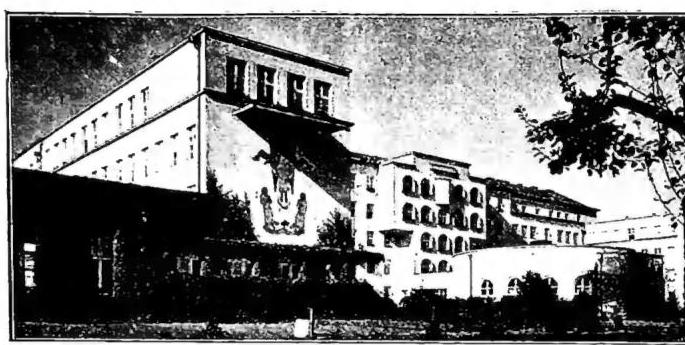
SCHOOL - Complex of buildings of a modern school, work by C. Holzmeister (1930-40). School of the Sisters of the Holy Cross - Lina.
Those Benedictine schools received fresh and youthful vitality from the Cluniacs, Cistercians, Dominicans, and Franciscans. However, all these schools, in which classical teaching prevailed, were no longer sufficient to satisfy the new desires for an education more suited to the flourishing of industries and commerce and the renewed revival of civil life. Therefore, beginning in the 13th century, a notable development of private schools is observed—schools that had truly never entirely disappeared even during the period of decline but were now becoming more numerous and more frequented. From these arose the communal schools, first in small centers and later in larger cities. Often, in fact, private schools struggled economically due to the scarcity of students; on the other hand, not everyone could attend episcopal or monastic schools, which were too distant and inconvenient. Thus, from the early 14th century, many municipalities began to consider the teacher as any other municipal employee and therefore to intervene in the organization of schools, subjecting them to their inspection. Sometimes, many private schools were municipalized and lost their didactic, disciplinary, and economic freedom. Alongside or in place of communal schools, there were also corporate schools, when particular guilds subsidized them.
VI. THE UNIVERSITIES
The broad diffusion of knowledge, particularly driven by the impetus given to studies by Scholasticism—from its initial formative period in the 9th–11th centuries, through its evolution in the 12th century, and especially to its peak of splendor in the 13th century—led to the creation of those higher institutions now called Universities, but which at the time bore the names of Studium and later Studium generale. The models for others were those of Paris and Bologna. Even in this fruitful and prosperous movement, the predominant role of the Church was not lacking. Some would see in this new flourishing of higher studies a movement of emancipation from religious dominance, a kind of substitution of lay corporations for the clerical schools of chapters, canons, and abbeys, and attribute rather skeptical and rationalist theories to some of the founders. The truth, however, is different: the university movement did indeed emancipate itself from the no longer sufficient claustral and episcopal schools, but it passed under the care and jurisdiction of the universal Church, represented by the Pope. Indeed, the presence—or at any rate the agreement and cooperation—of a universal entity like the Church greatly facilitated the recognition of academic degrees conferred upon students, who flocked from the most diverse countries to the same University. It is noteworthy that of the 52 universities established before 1400, at least 29 owed their foundation to the Pope; and another ten were founded either by papal diploma alone or by both papal and imperial (or princely) diploma.VII. THE SCHOOL IN THE RENAISSANCE PERIOD
The Renaissance continued along the path traced by the preceding century, and the school in its organization did not undergo particularly notable upheavals. However, the number of schools increased considerably; greater emphasis was placed, indeed a preponderant role, on classical studies, with a tendency to grant an almost absolute dominance to the Trivium over the Quadrivium, accompanied by a breath of freshness through the teacher’s lessons and the selection of readings, far removed from that rather mechanical learning in which the previous school had too often become mired. Thus emerged erudite teachers, skilled orators, and learned ecclesiastics, enlivened by a spirit of serene and understanding humanity. Nor were physical exercises neglected, aimed at forming a healthy, unconstrained, and agile body, together with a sound and open mind attuned to the new contingencies of life.The Church, in addition to directly founding numerous institutions, continued to exhort and encourage the study of literature and languages (at the Council of Vienne in 1312, for example, the Pope ordered the establishment of chairs of Hebrew, Chaldean, and Arabic at Rome, Bologna, Paris, Oxford, and Salamanca; in Spain, Cardinal Ximenes added to the University he founded the College of the Three Languages: Latin, Greek, and Hebrew). It was assisted in this by the work of religious Orders, which largely followed their glorious traditions.
The advent of the "Reformation" brought no innovations in the scholastic field; it did not create schools nor give birth to elementary education, which, as mentioned, had existed since the early centuries of the Church. Instead, it initially caused significant damage to culture, as it led to the disappearance, in the territories where it took hold, of monastic, episcopal, and parish schools, without being able or willing to replace them, provoking the bitter regrets of Luther himself, Melanchthon, and the most illustrious Reformers. Furthermore, the "Reformation" bequeathed to the following centuries certain pernicious principles, by which schools became the servants of civil authority, and princes interfered with their laws and prescriptions, no longer content, as before, merely to encourage or support initiatives originating from religious authorities or private individuals.
VIII. THE SCHOOL IN THE PERIOD OF CATHOLIC REFORM
The damage caused by the Protestant "Reformation" spurred the Church's zeal to accelerate that "Catholic Reform," which had already begun long before Luther's secession. The Council of Trent strongly recommended that priests devote particular attention to children, rallying all persons and institutions capable of restoring new value to Christian schools. These were to be re-established where they had disappeared; reinvigorated where they had languished; directed by pious and learned teachers; every church was to have a teacher for the free instruction in grammar to all, poor and rich alike; religious Orders intending to or already engaged in education were to be favored and encouraged; Catholic universities were to increase in number and remain free from contact with heretics while upholding their ancient prestige.The response to these injunctions was full and timely, especially through the work of new religious Institutes wholly dedicated to teaching with great fervor: the Barnabites, the Piarists, the Somaschi, and above all the Jesuits with their numerous colleges opened everywhere. The humanistic tradition was preserved, a clear and well-defined program was established, executed with the best insights from experience, thus creating the model that would more or less be adopted even by modern classical schools. Meanwhile, in Pavia, two celebrated and renowned university colleges emerged: the Collegio Borromeo, founded by St. Charles, and the Collegio Ghislieri, founded by St. Pius V.
IX. THE SCHOOL IN THE 17TH AND 18TH CENTURIES
During this period, the school was enriched by new recruits, new types, and new methods more suited to the circumstances. A highly significant contribution came from new religious institutes, not only male but also female: Oratorians, Brothers of the Christian Schools, etc.; Ursulines of various branches, Sisters of the Company of Mary, Visitandines, etc. The tendency to replace Latin with the national language was increasingly implemented, both as a means of transmitting instruction and as a subject of study and exercise in its own right. This innovation,Under certain aspects, this was a bold and, at the time, even contested innovation, paving the way for technical, commercial, and industrial education. Another novelty was the secularization of teaching in the sense of religious institutes (no longer composed of priests but solely of laypeople, e.g., the aforementioned Brothers of the Christian Schools) so that they could devote themselves entirely to education without being distracted by the duties of sacred ministry. This period also saw the creation of teacher training institutes for the preparation of future male and female teachers; the founding of their own vocational schools to train future farmers, merchants, industrialists, and artisans; and even evening or Sunday schools to cultivate the minds of workers and craftsmen occupied during the week by their labors. Particular merit in this enrichment belongs to Fr. N. Barré of the Minims and St. Giovanni B. de la Salle, founder of the Brothers of the Christian Schools. An extraordinary gain was then achieved in female education, extended to all girls of the nobility and the people, with the consequent better formation of the family.
Toward the end of the 18th century, not only did the number of schools called public or state schools increase, along with the study of the relationships between education and social, political, and even economic life of the nation; but the Enlightenment theories of Rousseau, especially in their application by the French Revolution, led to a violent reaction against all private schools, particularly those run by the Church, and claimed the monopoly of education for the State. While the State did not entirely neglect religious education, it subjected it to its own programs and supervision.
SCHOOL - SCHOOL IN MISSION TERRITORIES
X. THE SCHOOL IN THE 19TH AND 20TH CENTURIES
In this period, the school makes remarkable progress, exploiting, refining, and expanding the systems and achievements obtained in the preceding century, and enriching them with new experiences. Public authorities show increasing interest in education and strive to disseminate it universally with the intervention and supportive assistance of governments. Yet, the insidious and violent monopolistic will of States also advances, leaving no stone unturned in their efforts to absorb everything related to the school. The Napoleonic monopoly is succeeded by that of the "restored" or newly emerged States from the incessant conflicts among peoples, then by that of governments hostile to religion or simply "secular," "liberal," or "progressive," which, by distorting the meaning of words and historical facts, caused the repeated suppression of schools run by religious institutes. They proclaimed and continue to proclaim the unassailable supremacy of the "neutral" or "secular" school, suppressing so-called "private" schools or burdening them with restrictions and conditions that make their existence difficult, or at least diminish their effectiveness and hinder their assistance out of a misguided and unacknowledged fear. Well-known are the struggles waged against the school monopoly and in favor of "private" or "confessional" schools (and won entirely or partially overcome) in Belgium, the Netherlands, England, Spain, France, Italy, and India. This succession of events has created the problem of freedom of teaching and freedom of the school, sometimes resolved with partial solutions, but not always with the clarity that excludes all suspicion, distrust, and ulterior motives.The Church's teaching on this issue has never wavered, offering comfort to Catholics and clarifying ideas. It suffices to cite the documents of Pius IX, the epistle Quem non sine of 14 July 1864, as well as proposition 48 of the Syllabus; of Leo XIII, the allocution Summi Pontificatus (20 August 1880), the encyclicals Nobilissima (2 February 1884), Quod multum (22 August 1886), and Charitatis (19 March 1894); of Pius XI, the encyclical Divini illius magistri (31 December 1929); V. also CIC, can. 1374 and the sources cited therein. - See plate X.