
ISTITUTO DELL'ORATORIO DI SAN FILIPPO NERI. - Its first nucleus was formed at the church of S. Giovanni dei Fiorentini in Rome, when several priests, drawn by his
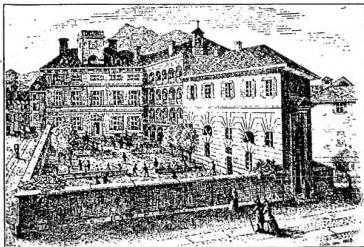
ISTITUTO DELLA CARITÀ - Collegio Convitto Mellerio a Domodossola, in una stampa del 1860.
zelo and the novelty of his priestly apostolate, to collaborate with him in the work of the Oratory (v.). The first rules were dictated by the Saint in 1565 and concerned only divine worship, preaching at the Oratory, the exhortation not to desire honors, and the reading and discussion of moral cases in the refectory. On July 15, 1575, when Gregory XIII donated the church of S. Maria in Vallicella to the community, the canonical erection of the Congregation took place. A first draft of constitutions was produced in 1583, but until 1612 the fathers were governed by customs, which only then were definitively codified and approved by Paul V.
The Oratorians, or Priests of the Oratory, are simple priests, without vows, living a common life, united solely by the bond of fraternal charity, but voluntarily coordinated and subordinated to a provost and his collaborators, freely elected by those entitled in the community. The sanctification of individual members is achieved through the free practice of the evangelical counsels and the common life, lived in the spirit of family and fraternal charity. Oratorian asceticism is based on prayer, simple and profound piety, always along the lines indicated by the liturgy, humility and contempt for human glory, and self-abnegation. The aim is to promote by every means the good of souls according to the norms of the Constitutions, the spirit of the I. and that ample freedom granted by the community to individual initiative. The apostolate of the Priests of the Oratory is eminently priestly: administration of the Sacraments (with a particular predilection for Confession), preaching (according to the familiar style used by the founder), sacred worship (to bring the people closer to the liturgy), and youth apostolate (in all forms of the time, both cultural and recreational).
In the mind of s. Filippo there was no idea of founding a new religious family, as he repeatedly declared, but only of providing for his Oratory in Rome. Nevertheless, the Philippian idea found application and favor in every country, and thus, while the Saint was still alive, other houses of the Oratory arose, which by analogy to the position of the members in the community were autonomous, though connected by the bond of fraternal charity. Just as the Oratorian is a priest of his own diocese, so the community finds its natural environment in the diocese where it arises, despite being of pontifical right, thus giving rise to an institution sui generis, which clearly demonstrates the entirely peculiar character of this priestly coexistence, a connecting link between the way of life of the secular clergy and that of regulars.
According to the new norms added to the Constitutions in 1942 and called General Statutes, a kind of federation of all the Congregations, which nevertheless remain autonomous, has been achieved through a common desire, discussed as early as 1895. This federation represents the juridical elaboration of a moral union that times have shown to be very useful. The premise has thus been laid for closer cooperation and spiritual, cultural, and material assistance, while always safeguarding the respective autonomy. The organ of this union is the decennial Philippian Congress, which appoints a commission upon which the procurator general depends. These bodies have no jurisdictional powers, but only the task of maintaining connections and protecting and representing the interests of the individual communities before the Holy See.
The Congregation of the Oratory, having already spread at the end of the 16th century to France, gave rise, due to the particular circumstances and needs of that nation, to the derived family of the Oratory of Jesus and Mary (v.), Bérulle (v.). While remaining in every way similar to the primitive stock, the French Oratory has had its own particular and most fruitful life.
The Philippian houses, connected to Rome, spread to every Catholic country, reaching their maximum flourishing in the 17th and 18th centuries; then general or local revolutions shattered much energy, which, lacking the help of a strengthening union, succumbed. Today the houses of the I. are: 15 in Italy, 9 in Spain, 5 in Germany, 5 in Mexico, 2 in Poland, 2 in England, 2 in Colombia, 1 in Bolivia, and 1 in the United States. The members of the various communities are approx. 400. The I. also has a student hostel and training center, called the Pius XII International Philippian College, near the mother house of the Vallicella in Rome.