
PRESBITERO, PRESBITERATO. – A Greek term (πρεσβύτερος: elder) denoting the second degree (priest) of the hierarchy of Order (v.).
I. ORIGIN
In the New Testament the πρεσβύτεροι of the various Churches are mentioned several times: in Jerusalem they take an active part in the administration of the Church, alongside St. James, brother of the Lord (Act. 11:30; 15:2, 4, 6, 22, 23; 16:4; 21:18). In the Churches founded by St. Paul, the Apostle himself regularly establishes a college of p. for the spiritual governance of the Christian community (Act. 14:22; 20:17; I Tim. 5:17; Tit. 1:5). Since St. Paul also gives them the name of ἐκτάχαστοι (Act. 20:28; Tit. 1:7), from the earliest centuries there was vigorous debate concerning the distinction, in the apostolic age, between the two grades (cf. L. Marchal, Evêque, in DBs, II, cols. 1298–1318). Whatever judgment one may wish to make on this difficult question, there is no doubt that at the beginning of the second century, in the Churches of Asia Minor, under the influence of the Apostle St. John, the p., united almost as a single body (presbyterium), appear as sacerdotes secundi ordinis, subordinate to the bishop, who alone exercises the supreme direction of the Church over which he presides (monarchical episcopate). Numerous and precise are the testimonies of St. Ignatius the Martyr concerning the Churches of Ephesus (2:2; 4:1; 20:2), Magnesia (3:1–2; 6:1; 13:2), Tralles (2:1–3), Philippi (4; 7:1–2), and Smyrna (8:1–2; 9:1; cf. A. Casamassa, I Padri Apostolici, Rome 1938, pp. 185–89). Ignatius himself also makes explicit statements (Smirn. 8:1; Eph. 6:1; Magn. 6:1; Trall. 3:1; Phil. 7:12) concerning the divine origin of the presbyterium, as well as of the diaconate and the monarchical episcopate (the three grades of the hierarchy of Order). This conviction, in a direct disciple of the Apostles, presupposes an oral communication of what Jesus Christ had established concerning the constitution of the Church during the forty days in which he spoke with the Apostles about the kingdom of God (Act. 1:3). The Council of Trent therefore rightly defined: «Si quis dixerit in Ecclesia Catholica non esse hierarchiam, divina ordinatione institutam, quae constat ex episcopis, presbyteris et ministris, anathema sit» (sess. XXIII, can. 6; cf. chap. 4; Denz-U, 966 and 960).II. FUNCTIONS
From the beginning, presbyters assist and support the bishop: “they are the council of God and the assembly of the Apostles” (St Ignatius, Trall., 3, 1), who surround Jesus Christ, represented by the bishop (ibid.); they are to be honored as the Apostles, as the bishop’s counselors and the crown of the Church (Didascalia, 2, 28, 4). Liturgically, they celebrate together with the bishop and consecrate the Eucharist (Canones Hippolyti, 20; Constitutiones Apostolicae, VIII, 12, 4); together with him they lay hands in the ordination of other presbyters (St Hippolytus, Traditio apostolica, 8) and in the reconciliation of penitents (St Cyprian, Epist. 16, 2; Epist., 17, 2). Authorized by the bishop, they also confer Baptism on their own (Tertullian, De Baptismo, 17); moreover, they administer the Sacrament of Extreme Unction (Iac. 5, 12-15). They also exercise the function of catechists and teachers: St Paul alludes (I Tim. 5, 17) to presbyters, probably sacerdotes secundi gradus, who “labor in word and instruction”; in the Passio sanctae Perpetuae, 13, a presbyter doctor is mentioned; furthermore, it is well known that Tertullian, Hippolytus, and Origen taught as true διδάσκαλοι while being merely presbyters.(from F. Hendrichs, La voce delle chiese antichissime di Roma, Rome 1933)
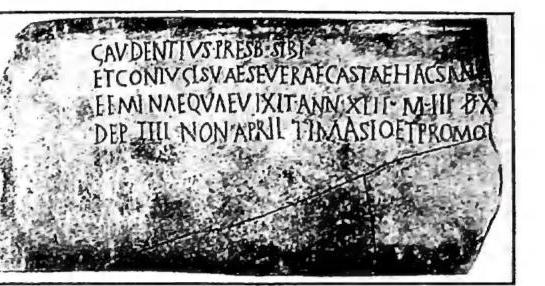
PRESBITERO, PRESBITERATO - Funerary inscription of p. Gaudenzio (389) - Rome, Monastery of S. Paolo.
III. LITURGY OF ORDINATION
In Rome, the Ordination of priests was performed publicly on the Saturdays of the Ember Days, especially those of Advent.The rite was simple: oath (Monday), presentation to the people (Wednesday or Friday). The Ordination took place before the singing of the Alleluia. After removing his dalmatic, the candidate received the chasuble from the archdeacon; this was followed by the rites of the invitation, the litanies, the laying on of hands by all the priests, and the consecratory formula. The kiss of peace concluded the rite. At the Offertory, the newly ordained priests made their offering before the others.
In Rome these simple rites continued until the tenth century. In Gaul, on the other hand, the rites and prayers were much more developed (Statuta Ecclesiae antiqua [sixth century], Missale Francorum, Gelasiano antico). The principal additions are: a) the specific instruction concerning the corresponding powers and duties; b) the handing over of the sacred objects with imperative words: Accipe (for the deacon, the book of the Gospel; for the priest, the chalice with wine and the paten with the host; for the bishop, the insignia); perhaps in imitation of, and as a consequence of, the administration of the minor Orders in the Gallican Church. Here the following came especially into use: 1) the anointing (from the eighth century in Gaul, England, and Germany); 2) the handing over of the sacred instruments and the solemn investiture proper to each Order, which took place under the influence of Germanic feudalism, permeated by ceremonies signifying feudal investitures. With these successive additions, the rites became more splendid. In the tenth and eleventh centuries, through the influence of the Ottonians and the German popes, they were also introduced in Rome and eventually became the rites of today.
In the presbyterate, the rite, more complex than the diaconal rite, proceeds in its preparatory part in the same way as the diaconal rite. In the principal part, both hands of the consecrating bishop and of all the priests present are imposed; as a rite proper to it, after the handing over of the vestments, the hands are anointed with the oil of the catechumens, preceded by the singing of the Veni Creator. In the handing over of the sacred vestments, the stole is arranged in the priestly manner; the back part of the chasuble is kept folded over the shoulders; the anointing of the hands follows, and then the chalice with the wine and the paten with the host are placed in the anointed hands. From
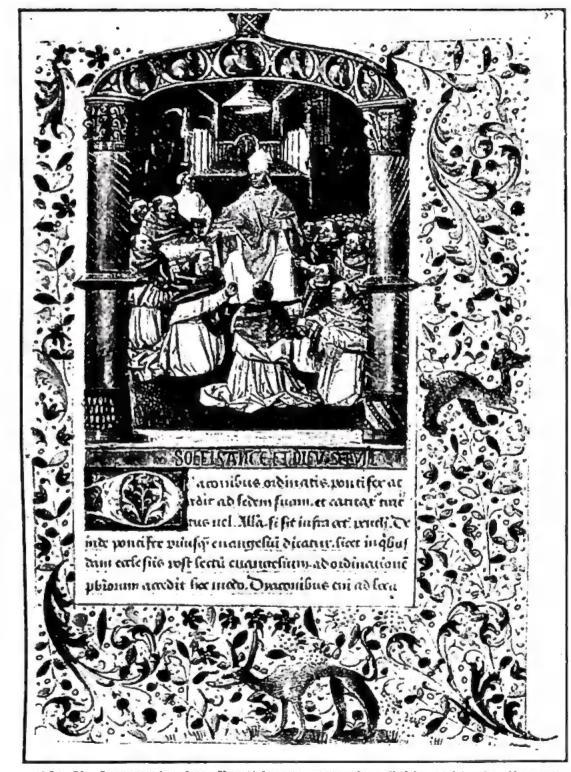
PRESBITERO, PRESBITERATO - The bishop anoints the hands of the ordinands. Miniature from a Roman Pontifical (15th century) - Lione, Bibl. munic. ms. 5144, f. 155.
In the 13th century the newly ordained priests concelebrate with the bishop. After Communion, a second laying on of hands takes place in order to confer symbolically the power of absolution (the rear part of the chasuble is unfolded); the rite ends with the homage of obedience.
Pietro Siffrin
IV. ARCHAEOLOGY
Numerous are the ancient inscriptions of presbyters in the primitive Church. At Rome, where in the middle of the third century the presbyters numbered 46 (letter of Pope Cornelius to Fabius of Antioch [Eusebius, Hist. eccl., 6, 43, 11]), ancient inscriptions of presbyters were found by G. B. de Rossi in the cemetery of Callistus, such as those in Greek of ΜΑΖΕΙΜΟC πρεσβύτερος) and of a physician named Dionysius (G. B. de Rossi, Roma sotterranea, I, Roma 1864, plates 19, 5 and 21, 9); and of a Fl. Ptolemy in Domitilla. They also occur in other cemeteries, such as those of Praetextatus, S. Lorenzo, S. Agnese, etc., though without indication of the title, which appears much later in undated inscriptions and in those dated only to 491, a few years before the signatures of the titular presbyters at the Synod of 499. In the first half of the sixth century (521–25), within the tituli, the presbyter prior is distinguished from the secundus, tertius, and quartus, as in the well-known inscription of S. Pancrazio (A. Silvagni, Inscriptiones christianae, nova series, II, Roma 1935, no. 4279). Noteworthy is the series of presbyters who scratched their names near the sanctuaries of the martyrs (G. B. De Rossi, op. cit., I, pp. 285–86; II, Roma 1867, p. 387; O. Marucchi, La cripta storica dei SS. Pietro e Marcel-lino recentemente scoperta sulla via Lubicana, in Nuovo bull. di arch. crist., 4 [1898], pp. 164–66; E. Josi, Il cimitero di Panfilo, in Riv. di arch. crist., 1 [1924], pp. 79–81; 93–96; B. Bagatti, Il cimitero di Commodilla, Città del Vaticano 1936, p. 115 ff.), abbreviating their dignity with PRB or PBR and only later with PRST, as at S. Sebastiano (M. Colagrossi, Di un monumento recentemente scoperto presso il monumento apostolico dell'Appia, in Nuovo bull. di arch. christ., 15 [1909], p. 53).Outside Rome, inscriptions of presbyters are known from Ficulca, Velletri, Veroli, Amiterno, Capua, Nola, Mirabella Eclano, Tropea, Ravenna, Voghera, Como, Biella, Vercelli, Milano, Tortona, Gaul, Salona, Spain, Roman Africa, Philippi, etc. Characteristic are the expressions indicating the duration of the presbyterate: «sedit presbyterio» (G. B. De Rossi, Inscrip. chr., I, Roma 1857–61, no. 879); «cuius anni fuerunt in presbyterio» (loc. cit., no. 1351); «ministravit in presbyterio», in inscriptions from Spain (E. Diehl, Inscrip. lat. christ. veteres, Berlino 1924–31, nos. 1175, 3265, 3274); «vixit in presbyterio», in African inscriptions (CIL, VIII, 23563–64); out of humility, a presbyter calls himself «indignus» (CIL, XI, 326); while others are given the title «vir venerabilis» (Notizie degli Scavi, 1918, p. 169; CIL, V, 5204, 5219, 5405, 5426; XIII, 11211). The expression «famulus Dei» is also occasionally used (E. Diehl, op. cit., nos. 1175 a and b, in Spain; 1175 d, in Portugal); a presbyter of Como is called «Sanctae Comensis Ecclesiae» (CIL, V, 5219), as is one from Rome who died in Spain (E. Diehl, op. cit., no. 1176).