
TROPEA, DIOCESI of. — City and diocese in the province of Catanzaro, united aque principaliter since 1818 with the diocese of Nicotera (v. ivi i dati statistici).
Located in the territory of the Bruttii, now Calabria, T. has yielded in the last century numerous Christian funerary inscriptions of the 4th–5th centuries, found in the locality of Torre Lunga and elsewhere, with features characteristic of the place; a priest Morasis and an Irene, «condutrix m(assae) Trapeianae», are mentioned there (cf. Bullett. Archeol. crist., 3ᵃ serie, 2 [1877], pp. 85 and 148; G. B. De Rossi, Roma sotterr., III, Roma 1877, p. 406; Nuovo Bullett. di Archeol. crist., 6 [1900], p. 271 ff.), which, together with the Nicoteran estate, certainly formed part of the patrimony of the Bruttii. When the Christian hierarchy was introduced there is unknown. A bishop Lorenzo, known in 499 as being present at the Roman Council, must be assigned to Treba, not to T. It is instead supposed that the see of Meria or Myria, already «desolata» in the time of St. Gregory I, was transferred to T. This Pontiff in fact mentions in 591 a «Monasterium sancti Arcangeli quod Tropeis est constitutum» (Reg., II, 3, ed. P. Ewald, in MGH. Epp., I, 1, p. 102). Bishop Giovanni signed the acts of the Roman Council of 649, and Teodoro the synodical letter of Pope Agatho in 679. A second Teodoro signed the acts of the Second Council of Nicaea in 787; and at least at this time the Greek element was predominant and the see was by then suffragan to the metropolitan see of Reggio, like the others in Calabria. During the 9th century the Saracens settled there; in 885 they were driven out by Nicephorus Phocas, but in the following century the Byzantines were unable to prevent further incursions, until the Normans settled there. In November 1066 a certain Calochirio is mentioned as bishop, successor to a Pietro, evidently a Greek, but in 1094 a Giustino reopens the series of Latin bishops. In December of that year Ruggero the Norman united the see of Amantea with T. This place, a Byzantine stronghold at the end of the 7th century, had passed under the dukes of Benevento, from whom it had been taken by the Muslims, who had made it the capital of an emirate. Nicephorus Phocas’s expedition in 885 had placed it under Byzantine rule, and the Byzantines had established there a bishopric subject to the metropolitan see of Reggio. Its bishops and history are unknown; however, toward the end of the 1400s an attempt was made to restore at least its memory, but without success. In this region too, with Norman rule, Latinity again prevailed, notwithstanding the influence of the Basilian monasteries, which were gradually supplanted by Cistercians, especially those of the Florensian Congregation. Having freed itself from the rule of Catanzaro, T. began to govern itself as a commune in 1255. Among its bishops, from 27 December 1455 to 9 September 1479, the Pisan Pietro Balbo stands out: he was well acquainted with Greek, from which he published several translations, known through the earliest Roman printings.
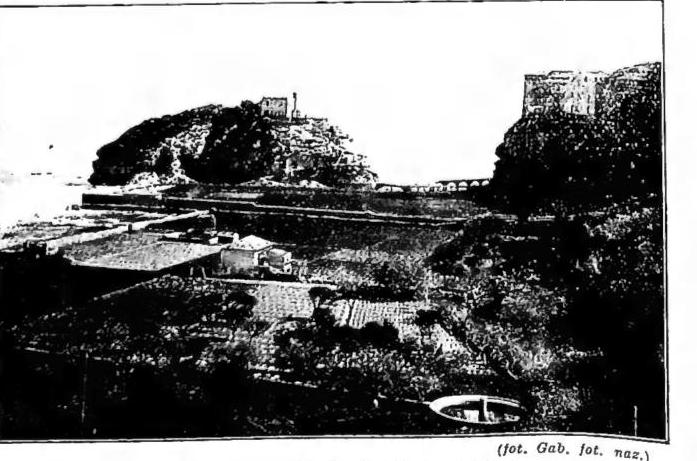
The cathedral church (formerly S. Maria dei Latini and today the Madonna di Romania) is the city’s principal monument. It stands on a cemetery site near the sea gate. It resulted from the lengthening of a centrally planned church of the 6th century, which in the 11th–12th centuries assumed almost its present form, except for the transept, which was omitted during the restorations of 1926–29. Artistic fragments from the early Middle Ages are preserved there. Beside and attached to the Duomo stands the ancient bailiwick of the Knights of St. John, with an airy Gothic portico from the mid-13th century, above which was the hall for the general assemblies of patricians and commoners.
In T., on 6 July, the relics of a St. Domenica (v.), a virgin believed to have been martyred there, are venerated; she must be regarded as the same person as St. Ciriaca (χυριακή), a martyr venerated in the East on the same or the following day. This was certainly a cult introduced by the Byzantines. The bishop of Locri was called of St. Ciriaca in 787, when GERANO (v.). At Gerace, however, as happened at Acireale and Lecce, St. Venera was venerated (Lanzoni, p. 339), who in the East was venerated under the name of St. Parasceve. At Rome she was once made into a Roman martyr. Here too, this is a case of an Eastern cult.
The memory of the Accademia degli Affaticati, founded during the Renaissance and surviving until the establishment of the Kingdom of Italy, is preserved in T. The philosopher Pasquale Galluppi, a native of the place (1770) who died in Naples in 1846, was a member of II. Various notable sacred monuments embellish the city, as do numerous palazzi of patrician families from the 16th and 18th centuries.