
TROPISMS. — The phenomenon of t. is closely connected with that of the excitability of living matter. Excitability is a fundamental or elementary property of organisms and comes into operation when a manifestation of the physical world, of the environment, becomes a stimulus.
Living matter does not react to all physical modifications of the environment, but to particular categories of stimuli. These are mechanical, vibratory (radiations of certain wavelengths), or chemical in nature. There are also stimuli of a biological nature, but most often these stimuli are translated into chemical or physical stimuli. Stimuli may provoke a definite and specific reaction in relation to the type of differentiation of the cell. Thus, for example, the same stimulus, if it acts upon a glandular cell, provokes secretion; if it acts upon a muscle cell or fibre, it provokes contraction (specificity of the reaction). It is known that, for an action to have the value of a stimulus, it must have a certain intensity—that is, it must exceed a “threshold” value—and it must not exceed a limit of maximum intensity, lest it cease to be a stimulus and instead have a harmful effect. Moreover, a stimulus must have a certain duration and must not exceed II.
(Ist. Gab. Ist. naz.)
TROPEA, DIOCESE OF — The Resurrection. Marble bas-relief of the school of the Gagini (15th–16th century) — Tropea, Cathedral.
When this movement has a direction determined by the exciting action, it is called t. It may be positive, if the movement is toward the stimulus, and negative if it is in the opposite direction. According to some authors, the term “tactism” is used when the movement is that of a free organism which moves from place to place, whereas t. would refer only to the orientation with respect to the stimulus of a fixed organism. But this difference in the meaning of the two words, especially when used by botanists, is not generally observed by zoologists, who regard them as synonyms. The enormous importance of t. is readily understood, both for the study of the “behaviour” of organisms, by demonstrating the wholly reflex nature of many movements, and for the analysis of the causes that produce the phenomenon. The study of ecology, that is, of the behaviour of the various species in their characteristic environment, places the problem of t. in the forefront. Thus the distribution of organisms in the various habitats is regulated by the conditions of t., with account being taken of the optimal stimulus condition. Finally, in embryonic and post-embryonic development, the phenomena of t. are major factors in the morphogenesis of a very large number of structures.
Thus the nervous connections, fundamental to the life of the organism, arise through neurotropic actions (which result in chemo- and thigmotropic actions). In the analysis of t., we shall first recall the effects of t. due to mechanical stimuli. The effect of material support on the growth of many tissues, known as thigmotropism, is clearly demonstrated by many experiments. For example, to permit the proliferation of cells cultivated “in vitro,” it is necessary to provide them with a support, such as the fibrin stroma that forms in the plasma clot on which the explanted cells are placed. Likewise, in the experiment involving the “reconstitution” of a sponge passed through a sieve, as carried out by Wilson, it is necessary to provide the cells with a support on which they can reunite. Similarly, a substratum is required for the growth of nerve fibres in the embryo, the dorsal cord for the regeneration of the caudal spinal cord in urodele amphibians, and a support for the growth of climbing plants.
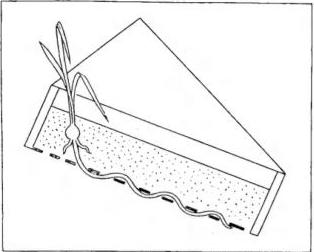
Very often behaviour is the result of the combined effect of two or more stimuli. Thus the direction of a root is determined by the component geotropism and
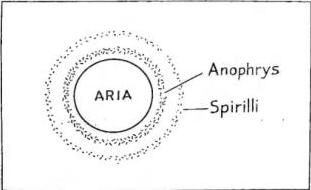
Chemotropism is fundamental in the defensive processes of higher organisms and of man. Leucocytes rush to sites of infection, attracted by chemical substances emitted either by the germs (toxins) or by the organism’s own cells undergoing destruction. The classic observations of Metschnikoff, Bordet, and Buchner are recalled. There are, however, bacteria, such as those causing fowl cholera, which act negatively upon leucocytes.
(from G. Cotronei, Biologia e zoologia generale, Rome 1919, p. 269)
TROPISMS - Fig. 2. Chemotropism.
The normal mechanism by which amoebae obtain nourishment through phagocytosis is likewise determined by chemical tropisms. Finally, chemotropisms are of great importance in pathology, not only in the aforementioned phenomena of defensive phagocytosis, but also in determining the sites preferentially colonized by parasites. Thus, for example, the rabies virus localizes in nervous tissues (Di Vestea and Zagari), and the cholera bacillus in the lymphoid organs of the digestive system (Sanarelli).
Of fundamental biological importance are thermotropisms and phototropisms. Every form has its own temperature optimum and consequently moves toward this optimum. One factor, though not the only one, in many migratory phenomena (fish, birds) is the search for the optimum temperature and light.
Phototropic phenomena of great magnitude and extreme importance, also from a practical standpoint for fishing, are the bathymetric migrations of fish and plankton in the sea and in lakes. Phototropic and heliotropic + phenomena are readily observed in all plants equipped with chloroplasts and in which photosynthetic processes take place.
Of the greatest importance are the phenomena of dilation or concentration of the pigment cells of many animals, in darkness or in light (reptiles, among which the typical-
(da G. Cotronei, op. cit., p. 221)
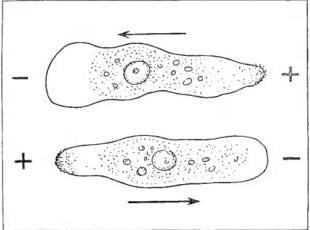
TROPISMI - Fig. 3. Galvanotropism.
in particular the chameleon, fish, amphibians, crustaceans, etc.). Galvanotropisms are of interest, that is, t. determined by a galvanic electric current. It can be observed that the condition may in some forms be +, as in many flagellates (Politoma uvella according to Vervorn), or —, as in Amoeba proteus (Vervorn, fig. 3).
It has been established that the sign may sometimes change, since the sign of galvanotropism is conditioned by other factors. Thus paramecia (ciliated Protozoa), to give an example, have negative galvanotropism in fresh water and positive galvanotropism in salt water. Some theories that have been proposed to explain the phenomenon of t. are of interest. The Vervorn-Loeb theory, for example, places primary importance on the symmetry of organisms and the symmetry of receptors. If stimuli act on one side, they provoke an asymmetrical reaction that will lead the animal to be equally excited on both sides. Such movement is entirely involuntary. Child and his school attributed great importance to the chemical and metabolic gradient of organisms, as a result of which there is a difference in behaviour between the anterior and caudal parts. The different susceptibility of the axial parts is fundamental in phenomena of forward and backward movement. Jennings’s theory of “trial and error” is also of interest. The material used by this author consists of protozoa. If paramecia in a culture are examined, one observes the behaviour of the animal as it moves in one direction, stops at a certain moment, retreats, and then takes a new direction. According to Jennings, this fact is related to the paramecium’s encounter with a source of stimulation that makes the animal retreat; the appearance is one of continual correction of incorrect directions. According to Jennings, these reactions ultimately become habitual, and the protozoa behave in the same way, with this coming and going, even without the modifying causes of direction.
Even in the behaviour of higher animals, many apparently conscious or voluntary phenomena are the product of an automatism established through the habitual repetition of a series of responses to stimuli, which must be regarded as t.