SENESCENZA, PROBLEMA BIOLOGICO of. — The problem of the s. of organisms is linked to the condition of the life cycle (v. CICLI BIOLOGICI). Each species has its own developmental cycle: it grows, reproduces and then, after a period of s., dies. There is also a relationship between s. and growth, in the sense that, as long as manifestations of growth are present, there is no s.
A problem of natural interest, which helps clarify the concept of s., is that posed by protozoa. According to Weissmann’s conception, these animals would be immortal, in the sense that (naturally, from a theoretical point of view) they never grow old and never die, because through reproduction they escape this fatal destiny of all living beings. Indeed, at a given moment, while still in full vitality, a protozoan divides and gives rise to two organisms, themselves as young as the parent. Thus two new organisms have been formed, without the first having aged or died. Although one cannot speak of senile phenomena in these unicellular organisms, the phenomenon of death can nevertheless be observed in the sense that, after a certain number of generations, nothing remains of the matter that constituted the body of the original parent. In multicellular animals, on the other hand, a life cycle is established that culminates in death. In general, death is preceded by a period of s.
An attempt has been made to explain the phenomenon of s. by a process of dehydration to which the organism is subject from the earliest age, or, more precisely, even before birth, during embryonic and fetal development. It should be considered that, whereas in a human embryo 97% of its body weight is due to water (almost entirely water), at eight months of intrauterine life water accounts for 83%, in the newborn for 70%, may reach 65% in the adult and nearly 58% in the old person. The phenomenon of colloidal «hysteresis» has also been regarded as a factor in s.: this word denotes the increasing difficulty experienced by a hydrophilic colloid in passing from a gel state to a sol state and vice versa, that is, the increasing difficulty of reversibility. And since it has been demonstrated that continuous reversibility exists in the living cell, while, on the other hand, all colloids are subject to this law of aging, it is easy to understand how this phenomenon came to be applied to explain aging in the biological sense. Other factors invoked are gradual mineralization and gradual
accumulation of catabolites, in connection with a growing difficulty in the permeability of the cell membrane to the passage of these products, which are thus retained within the cells themselves.
Although these facts can certainly be recognized during the phenomena of s., they should not nevertheless be assigned the value of causal factors. The true and sole factor is another, and all the phenomena considered so far are merely consequences. The true factor is cellular differentiation: this is a notable privilege of multicellular animals, which permits the highest functions but condemns the organism to a limited life cycle. The cells of metazoans, associated in a higher organization according to the principle of the division of labor, differentiate themselves by assuming the structures best suited to the various functions, in which they specialize. But with this cellular specialization the cell loses the ability to divide and reproduce, and this leads to the s. of the cell, during which the phenomena just described—dehydration, colloidal hysteresis, mineralization, etc.—take place and lead inevitably to death.
That this is the true cause of s. and death is demonstrated by many experiments: if a culture is made of cells from a higher organism, as Carrel did with heart cells from a chicken embryo, and these cells are prevented from differentiating by means of embryonic juices, they multiply theoretically indefinitely: one strain was cultivated for more than 26 years, that is, for a period much longer than the normal life cycle of the chicken. This also explains how, through their proliferative activity, conditions of s. do not arise in cells of the germ line, and theoretically all of them could give rise to new organisms; this condition led Weissmann to extend his principle of immortality also to the germ-line cells of metazoans.
By studying the life cycle of an animal and the cycle of its cells, it is found that the cycles coincide in only a few tissues. Among these are nervous tissue and striated muscle tissue. In these tissues the cells lose the capacity to multiply from the first days of embryonic life, differentiate, and accompany the individual throughout life. These are the tissues that Bizzozero defined as having «perennial elements». In the cells of these tissues, senile phenomena are observed that coincide with the senility of the organism. In many other tissues, however, the life cycle of the cells is very short, and many are produced, differentiate, grow old and die within the brief span of a few weeks. These are Bizzozero’s tissues with «labile elements», in which functional wear necessarily leads to a short life cycle. The cells of our epidermis are cited as an example: they continually die and, after forming the horny layer, are shed and eliminated from the organism. This continual «death» of our tissues is possible because a zone of the tissue is preserved in which cell differentiation does not occur and proliferative activity is maintained. Thus even these cells of «cambial» tissues, to use the botanists’ term, which continually multiply actively, never grow old, just as the cells of the germ line do not grow old. It is their proliferative activity, which continually renews them, that prevents the fatal process of s. from appearing. Thus the germinative layer of the skin of an octogenarian has the same structure and the same youthfulness as that of a newborn.
Therefore, in order to study the phenomena of cellular s., we must refer above all to perennial cells, that is, those that accompany the individual throughout the entire life cycle. The pattern of aging in nerve cells, for example, is of interest: the cellular form is modified, special processes, the parafites, are produced, cavities known as «fenestrations» are formed, and granules of melanic pigment and droplets of fat accumulate. The accumulation of pigment and fat are two of the most conspicuous and common manifestations of cellular s.
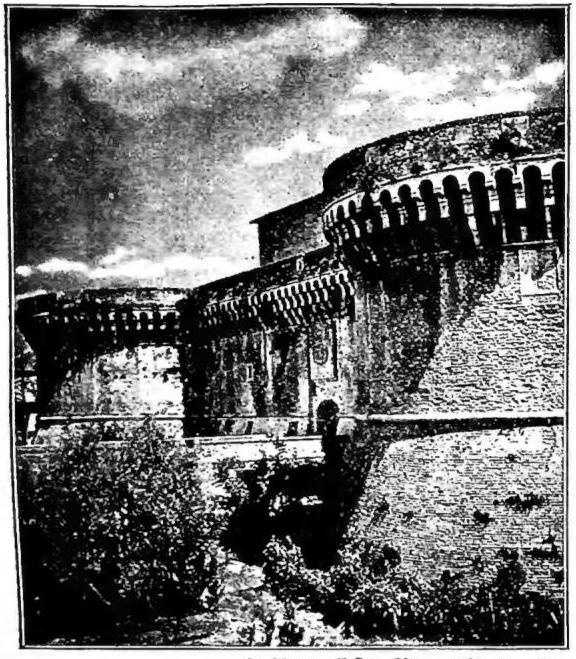
(from Marche, T.C.I., Milan 1953, fig. 165)
SENIGALLIA, DIOCESE of — The Rocca, built for Giovanni Della Rovere by Baccio Pontelli between 1479 and 1491, on the remains of Roman fortifications and a fortress of Albornoz.