
SENECA, LUCIUS ANNAEUS. – Roman philosopher, son of Anneo Seneca the rhetorician, born at Cordova, in Spain, between 4 and 8 A.D., died at Rome in 65. He came to Rome at an early age and studied philosophy under the Stoics Attalus and Sotion, from whom he learned a taste for an austere life. Devoting himself to political life, he attained the rank of quaestor; but a speech delivered in the Senate nearly cost him his life. Involved in a political plot by Messalina, he was accused by her of complicity in the affair between her niece Giulia Livilla and was banished to Corsica in 41, where he wrote a Consolatio ad Polybium, disgracefully adulatory toward the emperor Claudius. After Messalina was killed, he was recalled to Rome and appointed by Agrippina as Nero’s tutor; having become his chief minister in 54, after the death of Claudius, he remained at his side even when his presence, by then useless, might have seemed a dishonourable acquiescence in his crimes. His withdrawal from political life produced, for three years, a rich harvest of works and meditations. But in 65, falsely accused of complicity in the conspiracy promoted by Calpurnius Piso, he received the order to cut his veins.
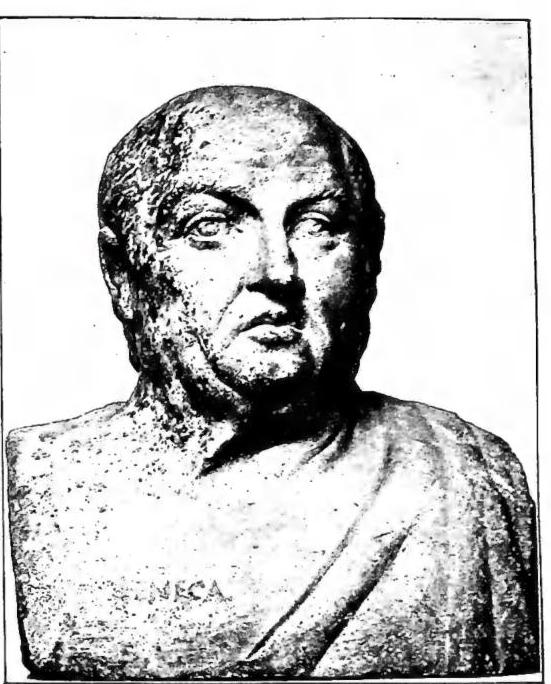
(from Les écrivains célèbres, edited by R. Qurnesu, I, Paris 1951, opposite p. 52)
SENECA, LUCIUS ANNAEUS - Portrait, Copy from the 3rd century, from an original attributed to the 1st century - Berlin, State Museum.
Also the nine tragedies (Hercules furens; Troades; Phoenissae; Medea; Phaedra; Oedipus; Agamemnon; Thyestes; Hercules Oetaeus), which exerted a singular influence on the theatre of the Renaissance and the Elizabethan age; the Naturalium quaestionum libri, composed after 60, one of the few scientific works of the Roman world; and the Ludus de morte Claudii (Apocalyptosis).
S. is one of the greatest moralists of all time. In Stoicism (v.), from which he accepts not a few metaphysical and moral themes. In reality, his thought arises rather from direct knowledge of the soul and of human affairs, as well as from an uninhibited understanding of the investigations of others. He writes: « I can dispute with Socrates, doubt with Carneades, find serenity with Epicurus, overcome human nature with the Stoics, surpass it with the Cynics » (De brev. vitae, XIV, 2). With the Stoics, he accepts the division of philosophy into three parts: physics, logic, and ethics. monism (v.): no distinction between the corporeal and the incorporeal. The universe is indeed composed of a passive principle, matter, and an active principle, God; but these principles are the two inseparable and correlative faces of a single reality (Epist., 65, 12). God is the soul of the universe, reason diffused through all things, the immanent source of life (Nat. quaest., I, 13-14): he is Destiny, which connects all events in a chain of causes and conditions the organic unity of the cosmos; he is Providence, which sustains every being in life and preserves it (De benef., IV, 4): he is the great All that we see, the support of everything and sufficient unto himself (Nat. quaest., II, 45-46). But the vivid sense of moral inwardness carries S. beyond pantheistic naturalism and dictates to him thoughts that seem to announce a personalistic theological exigency: God is near us, is with us, within us; « sacer intra nos spiritus sedet, malorum bonorumque nostrorum observator et custos » (Epist., 41, 1-5). Ultimately, God is unknowable (Nat. quaest., I, praef.). metaphysics (v.) are not the most pressing object of his investigations: his solutions, which are not univocal, reveal the hesitations of a mind as far removed from systematic dogmatism as it is fearful before the unknowns of being. The fate of the soul is uncertain, the problem of its freedom in relation to Destiny obscure, and the problem of the hereafter insoluble. S. struggles naturalism (v.) and seems to demand a personal immortality (Epist., 120, 14-16: « dies iste quem tamquam extremum reformidas, aeterni natalis est ») in opposition to the omnipresence of death, the soul’s freedom from the bonds of inexorable Destiny, and the personality of the spirit in relation to the impersonal order of the world.
S. is the philosopher of individual freedom and salvation: in the corrupt and deranged society of his time, he taught man how it is possible not to desert society and concrete human duties while at the same time preserving one’s inner independence amid the crowd. He is the teacher of the few, or rather of anyone who wishes to rise above the anonymous multitude in order to save himself. Yet there is in him no distrust of man, pessimism (v.), no appeal to supernatural grace. The sad tone that accompanies his pages does not arise from a metaphysical attitude, but is the feeling of one who had the misfortune to be born outside his own time. He believes in human nature: if God is the reason immanent in the universe and the absolute condition of cosmic harmony, he is likewise immanent in the human soul and the first condition of universal solidarity. This is the foundation both of virtue and of freedom. Every man is free, because every man is capable of virtuous actions. S.’s struggle against slavery, that is, against the effects of conventions and positive law, is unconditional: « quid est enim eques Romanus aut libertinus aut servus? nomina ex ambitione aut ex iniuria nata. Subsilire in caelum ex angulo licet » (Epist., 31, 11). « Servi sunt'. Immo homines » (ibid., 47, 1). Human equality is a matter of natural right: solidarity finds its foundation therein. In society, man must realize that unity of nature of which God is the absolute condition, and realize it through love. « Age, infelix, ecquando amabis? » (De ira, III, 28): it is an urgent appeal that seems Christian. Enemies too must be loved, and good must be returned for evil: « si deos imitaris, da et ingratis beneficia: nam et sceleratis sol oritur » (De benef., IV, 24; cf. Mt. 5, 44-45), since the law of love is a law of nature (Epist., 95,52). For love of his neighbour, man must even endure the gravest evils of life and renounce suicide, which is nevertheless the supreme form of liberation: « hoc quoque imperet sibi animus, ubi utilitas suorum exigit... Ingentia animi est aliena causa ad vitam reverti » (ibid., 104,3). It cannot be said, however, that S. places the ultimate end of morality in social life. Society does indeed constitute a duty and an occasion for the exercise of moral activity, but it is equally true that it is a recurrent threat to the individual’s inwardness and spiritual independence. « Meliores erimus singuli » (De olio, I, 1). Solidarity and love, therefore, are also an aspect of inner consistency. The ultimate end of moral autonomy (v.) of the person in relation to men and events; it is the freedom of the spirit from everything that can profane the divine serenity of the soul. individual (v.), thirsting for salvation. In his tendency to realize within himself the very condition of the Absolute, the individual rejects all those characteristics of contingency and relativity that belong to inferior activity: pleasure, utility, reward, fame... The wise man gives, like God, through the superabundance of his being, unbound from the results of his actions and unconcerned with human gratitude: « beneficiorum simplex ratio est: tantum erogatur... Ego illud dedi, ut darem » (De benef., I, 2); « conscientiae satis fiat, nihil in famam laboremus » (De ira, III, 41). Virtue is a value so complete in itself that it requires nothing beyond itself: « contentus eris te teste: aliquoi non bene facere delectat, sed videri bene fecisse... Haec enim beneficii inter duos lex est: alter statim oblivisci debet dati, alter accepti numquam » (De benef., II, 10). Thus the wise man acts not in order to become worthy of God, but rather to become like him. The purity of the intention that constitutes the value of the act is identified with the act’s absoluteness: « non videtur dedisse beneficium, qui a malo animo profuit; casus enim beneficium est, hominis iniuria » (De benef., II, 19); « exercetur et aperitur opere nequitia, non incipit » (ibid., V, 14). Although he asserts that « bonus vir sine deo nemo est » (Epist., 41, 2), although he grounds the law in nature, S.’s morality seeks to celebrate the autonomy of human reason and to exalt pure activity: in this respect it announces Kant’s second Critique.
From the same attitude arises S.’s unqualified aversion to national polytheism: he combats external rites, religious fanaticism, and the cult of tradition in the name of a wholly interior piety, consisting in knowledge and good works: the temple of God is in the human heart; offerings and the blood of victims are of no use, but the sacrifice of the passions and of hatred; we can draw near to the unknowable Divinity only with a pure soul (Epist., 31, 10; and in Lactantius, Iust., VI, 25, 3). It is therefore no wonder that people have spoken of a Senecan Christianity and of a presumed correspondence between S. and s. Paul. In reality, the substance of the moral doctrine of the pagan philosopher is far removed from Christianity. The sapiens, in S.’s ideal, although he does love (v.), is alone with his own heroic will and with the pride of his inviolable freedom; he does not engage in personal conversations with God, nor does he aim to build the cristos Dei on earth; God’s self-sufficiency is his own self-sufficiency; his virtue either dissolves under the force of the determinism that threatens every moral value, or declares itself an absolutely human work, valid only insofar as it is human. His perpetual awareness of death, which makes him lucidly conscious of his ephemeral condition and leads him to the brink of nothingness in order to reinvigorate the sense of moral duty, fulfills no religious function, as Christianity understands it: it kindles neither faith nor hope; it leaves him within his human dimensions. In many respects he is a Heideggerian avant la lettre, even when he rises up against the anonymous crowd and rediscovers his authenticity by asserting himself in his unconditional autonomy. « Non it qua populus, sed, ut sidera contrarium mundi iter intendunt, ita hic (sapiens) adversus opinionem omnium vadit » (De const. sap., XIV, 4). S.’s moral doctrine goes far beyond the metaphysical premises that ought to justify it: born not so much of theoretical presuppositions as of the very dialectic of life and a keen sense of inner freedom, it heralds the problematic of modern ethics.
Because of the poverty of its ideas, the work appears not only
utterly unworthy of the Apostle, but also unbecoming to S.’s elegance and seriousness. The letters, in fact, concern trivialities. S. takes pains to advise Paul to adopt greater linguistic propriety (letter VII), and indeed sends him a genuine stylistic model entitled De verborum copia (letter IX). Paul appears concerned about the emperor Nero’s reaction to the reading of some of his writings (letter VIII), while S. lingers over citing examples of pagan fortitude to console Paul and the Christians persecuted after the burning of Rome (letter XI). In the late Middle Ages, the apocryphal work enjoyed undeserved circulation and contributed to the formation of the legend of meetings between Paul and S. and of the latter’s secret conversion to Christianity. According to some, the work arose around the 8th century and should therefore be distinguished from the collection of letters already known to s. Jerome (De viris ill., 12: PL 23, 662) and s. Augustine (Epist., 153, 14: CSEL, 44, 412). But such a distinction does not seem necessary, although it is somewhat surprising that the two great Doctors should have approved, not entirely unconditionally, so insipid an apocryphal work. No ancient translations of the work exist; it was written in Latin before 392, the year in which the Hieronymian De viris illustribus was composed.
BIBLI, E. AMANN, Apocryphae du Nuor. Text., in DBL, I, coll. 320-22; L. Vouvaux, Les actes de Paul, Paris 1913, pp. 332-69 (introduction, text, and translation with commentary); C. W. Barlow, Epist. Senecae ad Paulum et Pauli ad Senecae (quae vocantur), Rome 1938 (introduction and critical edition); E. Franceschini, Un ignoto codice delle Epistolae Senecae et Pauli, in Mélanges J. De Ghellinck, I, Gembloux 1951, pp. 149-70. Angelo Penna