
KANT, IMMANUEL. - Philosopher, born in Königsberg, capital of East Prussia, on April 22, 1724, and died there on February 12, 1804. He is universally regarded as the greatest thinker of the modern age; indeed, with him a new epoch in philosophy begins. His life was almost devoid of external events: K., who lived almost always in his native city, remained detached from the great historical events of his time. The pietism (v.) of his mother (his father was a saddler) exerted a strong influence on his spirit; pietism also shaped the education he received at the Collegium Fridericianum, where he completed his secondary studies. He subsequently attended the Faculty of Philosophy at Königsberg, where the teachings conformed to the methods of Wolff’s rationalism, a popularizer of the Leibnizian system but with a greater emphasis on the Enlightenment dogma of reason’s supremacy as the sole source of truth. During his university years, K. also devoted himself to the study of mathematics and physics, and especially to Newtonian physics, considered the model of human knowledge. After completing his courses and working as a private tutor in noble households, he embarked on an academic career. In 1755, he obtained the venia legendi in philosophy; after two failed attempts (in 1756 and 1758) to secure the official chair of philosophy, he was only able to obtain that of logic and metaphysics in 1770, still at the University of Königsberg, where he taught until 1796, the year in which, due to physical and mental decline, he left teaching.
Of a jovial and serene disposition, a man of few affections and friendships, meticulous almost to excess, and open to the interests of culture, especially scientific, this was K.’s character. Pietist education, on the one hand, and the influences of the Enlightenment, on the other, led him to reduce everything to the moral value of men and to the uninhibited knowledge of nature. K., both as a man and a philosopher, lacked a profound sensitivity for the human and the divine (he is the philosopher of external experience, not of inner experience) and thus lacked an authentic concept of man and of Christianity.
In K.’s intellectual formation, three important points must be noted: a) the pietistic education in the sense of human dignity and the inner life, of duty fulfilled in absolute independence from any external construction or authority, confirmed by the reading of Rousseau’s (v.) works, the critic of civilization and of rational "enlightenment," the defender of human "nature" as intimacy and spontaneity of sentiment, consciousness of duty and freedom; b) the Wolffian-Enlightenment formation, in some respects contrasting with the former, exalting the supremacy of reason, a principle to which K. remained ever faithful; c) the study Newton (v.), to whom K. always looked even when he "critically" elaborated the problem of knowledge. Taking these three formative elements into account, to which must be added the strong influence of English empiricism (especially Hume’s), one can already see how K. was oriented in two directions that were not conflicting but disorienting (two senses, but not one against the other): the supremacy of reason (Enlightenment-Wolff) and of physics as the model of rational knowledge (Newton), and at the same time the problem of the conditions, value, and limits of reason itself (empiricism-Hume); the supremacy of human dignity as revealed in autonomous and inner moral consciousness (pietism-Rousseau). In his intellectual formation are implicit the elements that explicitly explain the conclusion of the Critique of Practical Reason: "the starry heavens above me, the moral law within me," words that, rightly, were chosen as the epitaph for the philosopher’s tomb, for they express the profound and essential meaning of his system.
I. THE SO-CALLED "PRE-CRITICAL WRITINGS"
### a) The Writings of 1755-56
In addition to the Latin dissertation De igne (1755) and the other Monadologia physica (1756), notable from this period is the Allgemeine Naturgeschichte und Theorie des Himmels (1755), published anonymously, in which the hypothesis (later made famous when it was taken up 41 years later by Laplace; hence known as the Kant-Laplace theory) is expounded that the solar system and other celestial bodies originated from a primitive nebula; and the Latin dissertation Principiorum primorum cognitionis metaphysicae nova dilucidatio (1755), where the argument for the existence of God, which would be developed in a later work, is already formulated, and where interest in the problem of knowledge, and especially in that of "metaphysical knowledge," is already alive.
### b) From the Writings of 1762 to the "Dissertatio" of 1770
If the writings listed above are considered as belonging to the period of "dogmatic rationalism," those that follow are indicated as testimony to the so-called period of "skeptical empiricism"; specifically: Die falsche Spitzfindigkeit der vier syllogistischen Figuren (1762); Der einzig mögliche Beweisgrund zu einer Demonstration des Daseins Gottes and Versuch, den Begriff der negativen Grössen in die Weltweisheit einzuführen, both from 1763; Untersuchung über die Deutlichkeit der Grundsätze der natürlichen Theologie und der Moral (1764); and finally Träume eines Geistersehers, erläutert durch Träume der Metaphysik (1766). This group of writings presents in-
Immanuel KANT began to subject the principles of Leibnizian-Wolfian rationalism to critical revision—not in the sense that he doubted the validity of reason, but rather that he no longer saw its efficacy and validity beyond the limits of experience. Notably, in the essay on Negative Quantities, while not denying the objective validity of the principle of causality, he highlighted how the cause-effect relationship remains incomprehensible, since the "synthesis of reality" it expresses cannot be reduced, as rationalism demanded, to the analytical procedure of pure logical thought. For now, KANT merely posed the problem without offering a solution. It should also be noted that the critical stance within rationalist dogmatism was directed not so much against metaphysics as against the knowledge of the sensible world; that is, rationalism encountered its limit precisely in explaining the sensible, not the supersensible. Evidence of this is that in the same year, KANT returned to extensively develop what he considered the only possible argument for demonstrating the existence of God, in the eponymous essay. This argument can be formulated as follows: to think is to affirm the possibility of an object; now, nothing can be thought without the thought itself implicitly containing the absolute necessity of a being, hence necessarily existing; this being is the "being in general," common to all our concepts, of which they are determinations; therefore, being in general is the rational possibility, the foundation of particular possibilities. Such a being cannot be denied without denying thought itself, since there is something thinkable for being in general; thus, possible being is absolutely necessary; but since every possibility has its foundation in a reality or existence, God exists as the principle of absolute possibility, the source of all reality. However, already in the Investigation of 1764, KANT deemed it more necessary to "persuade oneself" of God's existence than to "demonstrate" II. In the satirical essay Dreams of a Spirit-Seer, confidence in reason's capacity to know the supersensible and demonstrate its existence was shaken. Indeed, by examining the fantasies of Swedenborg—a Swede then famous in Europe for his spiritualist faculties and author of the eight volumes of Arcana Coelestia—KANT found occasion to satirize the constructions of metaphysicians, who claimed to know everything about the supersensible. Instead, it eludes our cognitive faculties and can neither be affirmed nor denied. Already at this stage, for KANT, metaphysics had a negative value (demonstrating that its objects surpass the possibilities of reason) and a positive one, not with respect to itself, but to the concepts of experience. The dual Kantian position (which is ultimately one) of metaphysics as the "science of the limits of human reason" and of philosophy as the determination of the concepts of experience, upon which our judgments rest, was already taking shape. As can be seen, the two phases outlined here do not present great discrepancies: fundamentally, as some scholars have argued, critical elements are found in the writings of the so-called dogmatic rationalist period, and rationalist elements in those of the so-called empiricist-skeptical period. KANT recognized the truth contained in both the rationalist and empiricist stances and, amid oscillations and uncertainties, sought the point of resolution. One cannot yet speak of a conscious "criticist" position (at most, it is implicit or barely glimpsed), nor of absolute dogmatism or genuine skepticism.
The criticist position, however, becomes manifest in the Dissertation on the Form and Principles of the Sensible and Intelligible World (1770), with which the so-called "critical" period is unanimously said to begin. Indeed, it contains the fundamental intuition of the a priori, even if the thorough exploration and extensive application that would follow are still lacking. In the Dissertation, one finds what will become the "transcendental aesthetic" in the Critique of Pure Reason: space and time are a priori forms of intuition, and with them, the sensible world is constituted as phenomenality. Therefore, sensibility does not allow us to know reality as it is in itself (the supersensible), which instead is given to us by the intellect through innate concepts (virtual or Leibnizian innatism) of existence, substance, cause, etc. (with their correlatives and opposites), provided they are kept free from contamination by the sensible phenomenon constituted by the forms of space and time. From this perspective, the Dissertation, despite containing the discovery of the a priori and the phenomenality of sensible knowledge, represents, with respect to the problem of metaphysics, a less "critical" position (in the Kantian sense of the term) compared to earlier writings. This explains why KANT meditated for ten years on the discovery of 1770 before writing the first Critique.
II. WORKS OF THE CRITICAL PERIOD
This period begins with the Kritik der reinen Vernunft (1781), Kant’s masterpiece, in which the a priori is developed in its full critical dimension and also encompasses metaphysical knowledge. It was followed by the Prolegomena zu einer jeden künftigen Metaphysik, die als Wissenschaft wird auftreten können (1783), which revisits the problems of the Critique in a new form, designed to facilitate understanding and dispel misinterpretations and obscurities. The Grundlegung zur Metaphysik der Sitten (1785) and the Kritik der praktischen Vernunft (1788), another fundamental work, apply the principles of critical philosophy (the name by which Kant’s philosophy is known) to the moral problem. The Kritik der Urteilskraft (1790), the last of the major works, addresses the problem of finality in nature. Among the minor writings, the following should be noted: Metaphysische Anfangsgründe der Naturwissenschaft (1786); Die Religion innerhalb der Grenzen der blasen Vernunft (1793), the most notable of this group; Die Metaphysik der Sitten, comprising the Metaphysische Anfangsgründe der Rechtslehre and the Metaphysische Anfangsgründe der Tugendlehre, as well as the Logik (1800) and the Pädagogik (1803).III. THE PROBLEM OF THE "CRITIQUE"
Critical philosophy presents itself first and foremost as a question of method, and in this it continues historically the great dialogue between rationalism and empiricism, divided yet united (from Descartes and Bacon onward) precisely by this problem, posed in the following terms: to form true ideas about reality, must we proceed from reason or from experience? In the first case, our ideas correspond to real things (as rationalism maintained), so that the deductive process of thought mirrors that of reality; or is this given only by experience (as empiricism countered), but limited to what appears, leaving unresolved the question of whether ideas ("sensible impressions") truly correspond to things as they are in themselves? Rationalist deductivism, whose typical procedure was the geometric method, had no doubts about the efficacy of analytical apriorism, as it establishes a necessary connection among all beings, the only objective and therefore true knowledge. Empiricism, in turn, advanced its critical demands, namely the impossibility of deducing concrete reality from abstract principles, so that experience emerges as a double limit of reason, both with respect to the sensible and the supersensible.The insufficiency and one-sidedness of these two methods re-present to Kant the problem of method in precise terms: the aprioristic "analysis" of concepts cannot make us know reality; knowledge is "synthesis" or "connection" of data that only experience can provide, but synthesis is impossible (and cannot have objective validity) without rational elements. If the innatism of concepts nourished the rationalist illusion of an a priori and purely analytical knowledge, the synthetic character of knowledge itself gave rise to the empiricist illusion that sensory experience alone is sufficient to constitute knowledge. "Judging" (which for Kant is "knowing") is neither "adding" to a representation (subject) another (predicate) according to a purely empirical connection, nor "decomposing" analytically into its elements the concept that serves as subject and predicating one of them. Those of empiricism are "synthetic judgments," but a posteriori (they contain only sensible elements or states of consciousness) and therefore valid only subjectively; in them, connections are casual, of "succession" and "coexistence" of data without anything necessary or uni-
versal; those of rationalism are "analytic a priori judgments," but precisely because they are "analytic," merely "explicative," even if objective because deduced from rational principles independent of experience (Critique of Pure Reason, Introd., § 4, Italian trans. by G. Gentile, Bari 1924, I, pp. 44-47). In short, the former are synthetic judgments, but only a posteriori; the latter are a priori, but only analytic. And here the problem is posed: by deepening the concept of experience, might it not be possible to discover conditions independent of it or a priori that make experience itself possible? The question is no longer whether there are innate (a priori) cognitions within us, but whether in experience there are pure a priori elements, conditions of experience that confer objectivity upon human knowledge. Therefore, the objectivity of knowledge is given by reason (the only source capable of providing it, according to the legitimate demand of rationalism), but, on the other hand, since it is sensibility that supplies the data, there is no knowledge without an a posteriori content to which those a priori elements are applied, constituting it as experience. Thus, the activity of reason is "synthetic" (or connective of sensory data) a priori, insofar as the elements of connection are proper to reason itself and immanent to II.
possible judgments of this kind—that is, syntheses of an a priori element or form and an a posteriori content? In other words, are synthetic a priori judgments possible, and not merely "analytic a priori" (rationalism) or "synthetic a posteriori" (empiricism)? This is precisely one of the two central problems of the Critique of Pure Reason (Intro., § 6, ed. cit., I, pp. 51-52): to determine what the a priori elements or forms of our mind are and how they constitute experience. On the other hand, given that a priori forms require a sensible content, the question arises: "whether metaphysics as a science is possible," since the objects of metaphysics are supersensible. This is the other fundamental problem of the Critique. Criticism thus presents itself as a "critique of experience," insofar as the "synthetic a priori judgment" is possible through the forms of reason, and as a "critique of metaphysics," insofar as the concept of "synthesis" posits metaphysics as the limit of reason itself, since its objects are pure, that is, not mixed with anything derived from experience. The demands of criticism are therefore established through the new concepts of experience and synthesis: experience is not the addition of one sensible to another (empiricism), but the construction of the rational subject, because it is made possible by the necessary and universal relations established among sensibles (phenomena) by the a priori activity of thought; and synthesis does not mean that a form is added to a content (like a liquid poured into a container), but implies the activity of the subject, which constructs experience. This is the most original point of criticism: the order of things is formed by the activity of thought, which organizes sensory data—data that in themselves are not experience—according to its own universal and necessary laws or forms. It is not nature that imposes laws on thought, but thought that gives laws to nature. This is what K. himself calls the "Copernican revolution" in philosophy: not the subject conforming to the object, but the subject as the orderer and constructor of the world of experience, which is an irreducible synthesis of form and content, so that pure form without content is "empty," and content alone without form is "blind." To demonstrate that the human subject is capable of a priori synthetic knowledge means, for K., to demonstrate that mathematics and physics are possible as sciences (ibid., ed. cit., I, pp. 49-51), but not yet that metaphysics is possible, since its objects are supersensible. On the other hand, there is a "natural metaphysics," as a spontaneous and profound human demand for the supersensible, which, whatever the failures to which every metaphysical construction may be subject, is indestructible. Can this demand be satisfied? And to what extent is pure a priori knowledge possible? Before reason "dogmatically" abandons itself to metaphysical flights beyond the limit of experience, like the dove that "might imagine it could fly much better in empty space" (ibid., Intro., ed. cit., I, p. 43), it is necessary that it "critically" examine its capacities before the "tribunal" of itself to decide, according to its eternal and immutable laws (ibid., pref. to the 1st ed., ed. cit., I, p. 7), whether it is permitted to found a metaphysics as a science or whether it is condemned to experience, every a priori construction being a mere "illusion" (ibid., pref. to the 2nd ed., ed. cit., I, p. 31). The critique of reason is therefore a critique of pure reason as an activity independent of experience. But it is evident that the problem of metaphysics thus posed refers back to the solution of the other problem, to which we have alluded: what are the conditions of the objective validity of knowledge in general? In this sense, the first two parts of the first Critique are an introduction to the solution of the problem of metaphysics, which remains the central problem of criticism. Thus, for K., it is no longer a matter of constructing a theory of knowledge, but of establishing the critique of knowledge in general to ascertain to what extent man is capable of objective knowledge and whether reason has the means to construct a metaphysics as a rational science. Hence the parts of the Critique of Pure Reason: "Transcendental Aesthetic" ("aesthetic" in the sense of the doctrine of "sensibility" in general) or philosophy of mathematics; "Transcendental Logic" or philosophy of pure physics, divided into "Transcendental Analytic" (analysis of a priori concepts) and "Transcendental Dialectic" (or critique of the dialectical illusion of reason or of its use of a priori concepts beyond experience).
IV. THE A PRIORI FORMS OF KNOWLEDGE AND THE LIMITS OF PURE REASON
Knowledge that refers to objects and which every thought aims at as a means is what K. calls intuition (v. INTUITION). The capacity (receptivity) "to receive" representations in the way we are affected by objects is called sensibility. Therefore, objects are given to us through sensibility, and it alone provides us with intuitions; but these are thought by the understanding, and from them derive concepts. The action of an object on the representative capacity, insofar as we are affected by it, is sensation. That intuition which refers to an object by means of sensation is called empirical. The indeterminate object of an empirical intuition is called phenomenon, of which "matter is what corresponds to sensation," while "form" is that "by which the manifold of the phenomenon can be ordered in determinate relations." All representations in which nothing belonging to sensation is mixed are called "pure," and therefore the pure form of sensible intuitions is found in the mind, and this is what K. calls pure intuition. Transcendental aesthetics is the "science of all a priori principles of sensibility" (Critique of Pure Reason, I, part 1, § 1, ed. cit., pp. 63-65). "Transcendental" is the term with which K. designates the a priori, meaning: it is not "empirical," since it is not derived from or dependent on experience; and it is not "transcendent," since, although not derived from experience, it is valid only if applied to it, as a law or form by which we know the objects of experience itself. There are two forms of sensible intuition: space, or external sense, by which we represent objects outside ourselves, which is not an empirical concept but a "necessary a priori representation" underlying all external intuitions, making geometry possible "as synthetic a priori knowledge" (ibid., I, part 1, sect. 1, §§ 2 and 3, pp. 67-69); and time, or internal sense, also non-empirical and a necessary a priori representation, in which "two contradictory opposite determinations can meet together in a thing, one after the other" (ibid., sect. 2, § 5, p. 75). Outside these two transcendental forms (or a priori conditions) of sensibility, no experience is conceivable.To intuit an object sensibly is not to think it, and therefore other relations are needed to transform intuitions into concepts. It is the understanding that, by means of its own "functions" or categories, unifies the various intuitions and formulates synthetic a priori judgments. K. distinguishes (in the second part of the Pure Reason, called "Transcendental Logic," and precisely in that section of it called "Transcendental Analytic") judgments according to: 1) the
According to their quantity; 2) their quality; 3) their relation; 4) their modality—and from these classes of judgments, he derives twelve categories respectively: 1) totality, plurality, unity; 2) reality, negation, limitation; 3) substance and accident, cause and effect, action and reaction; 4) possibility and impossibility, existence and non-existence, necessity and contingency. Through these universal and necessary categories, the understanding constitutes sensory impressions into thought objects. However, for the manifold representations to be unified, they must be referred to a point of reference. For KANT, this center is the consciousness that I have of always being the same. Therefore, through the identity of my consciousness in the succession of representations, I can establish relationships among them and thus unify them into an object. The I think (Ich denke) is the condition of their unity. Yet it is not enough that representations exist within me: in the act of unifying them, they are mine but distinct from me—my representations, yet of something. The manifold individual subjects presuppose a deeper unity, which KANT calls consciousness in general (Bewusstsein überhaupt) or transcendental I, the organizing activity, according to universal laws, of all possible representations of all possible empirical consciousnesses. This consciousness in general expresses itself in every subject as the transcendental unity of self-consciousness, which manifests itself through the "I think." This consciousness does not act outside individual consciousnesses, since the I think cannot be abstracted from the inner sense proper to empirical consciousness, which becomes self-consciousness because through it the universal consciousness acts (ibid., I, part 2, §§ 17-18, pp. 133-35). The I think is the legislator of nature, the constructor of the world of experience, the unifier of the manifold into concepts of objects. However, it is not known in itself, as a res cogitans or substantial soul, but as a transcendental activity, that is, in its modes of "functioning."
Yet there is heterogeneity between the pure concepts or categories—forms of possible concepts—and sensory impressions. Thus, "how is the subsumption of the latter under the former possible, and therefore the application of the category to phenomena?" (ibid., I, part 1, bk. II, ch. 1, p. 159). KANT resolves this problem with the doctrine of schematism: there exists a third term, homogeneous on one side with the categories and on the other with the phenomenon, which makes the application of the former to the latter possible; this is the transcendental schema. The schema is itself a product of the imagination, but it must be distinguished from the image. "Now, I call the schema of a concept the representation of the general procedure by which the imagination provides an image for that concept. In fact, at the basis of our pure sensible concepts there are no images of objects, but schemata" (ibid., p. 161). The schematism of our understanding is "a hidden art" in the depths of the human soul. "We can only say this: the image is a product of the empirical faculty of productive imagination; the schema of sensible concepts (such as figures in space) is a product and, so to speak, a monogram of pure a priori imagination, through which and according to which images first become possible; these images, however, are only referred back to the concept by means of the schema, which they designate, and in themselves never coincide perfectly with it (the concept)" (ibid., p. 162). For example, the schema of substance "is the permanence of the real in time, that is, the representation of the real as the substratum of the empirical determination of time in general; a substratum that therefore remains while everything else changes," and "the schema of cause and of the sensibility of a thing in general is the real, to which, once it is posited, something else always follows. It thus consists in the succession of the manifold, insofar as it is subject to a rule" (ibid., p. 163), and so on. "Schemata, therefore, are nothing but a priori determinations of time according to rules, and these refer, according to the order of the categories, to the series of time, its content, its order, and finally to the totality of time with respect to all possible objects" (ibid., p. 164).
From what has been said, two conclusions can be drawn:
a) The objectivity of knowledge (mathematical and physical) is given by the a priori connections that the subject establishes among sensory data;
b) The transcendental a priori forms are valid only if applied, as unifiers, to sensory data. Consequently, our knowledge is only of phenomena. However, KANT does not identify all reality with the phenomenon. We receive sensory impressions, and thus there is a reality in itself from which these impressions come; yet we always apprehend reality as it appears to our consciousness, that is, through the subjective forms of space and time. But man naturally aspires to the knowledge of the unconditioned or the absolute, the object of metaphysics. Is it possible to satisfy this aspiration? As we know, for KANT, if one of the two elements of synthesis is lacking, there is no longer knowledge; now, the unconditioned is not given to us by any experience, and therefore to claim to know it with the forms of the understanding is to make the latter function in a void, since content is lacking. Criticism thus recognizes the inextinguishable demand of metaphysics but declares unjustified and impossible to realize the pretension of reason to know the supersensible. KANT calls these pretended knowledges Ideas (pure form devoid of sensible content) and reduces to three the Ideas of pure reason, corresponding to the three fundamental problems of special metaphysics, according to the system of WOLFF, namely: a) the idea of the absolute unity of the thinking subject or the idea of the soul as substance (rational psychology); b) the idea of the absolute unity of the series of phenomena (rational cosmology); c) the idea of the absolute unity of all objects of thought (rational theology). In short, the ideas of the soul, the world, and God. In attempting to resolve these problems, reason becomes entangled in false reasoning (paralogisms and antinomies) and contradictions, as it extends the a priori forms of the understanding beyond experience. It fashions and deludes itself into knowing objects corresponding to them (KANT devotes more than half of the Critique of Pure Reason to the treatment of the ideas of reason, specifically the other part of Logic, which he calls "Transcendental Dialectic").
BIBL.:
Per una bibliografia generale V. KANT, IMMANUEL; inoltre: H. COHEN, Kants Theorie der Erfahrung, Berlin 1885; E. CASSIRER, Kants Leben und Lehre, Berlin 1918; M. HEIDEGGER, Kant und das Problem der Metaphysik, Bonn 1929; N. KEMP SMITH, A Commentary to Kant’s Critique of Pure Reason, London 1918; H. J. DE VLEESCHAUWER, La déduction transcendentale dans l’oeuvre de Kant, 3 voll., Anvers-Paris 1934-37; G. LEIBSNIZ, Nouveaux essais sur l’entendement humain, Paris 1921 (per il confronto con K.); A. C. EWING, A Short Commentary on Kant’s Critique of Pure Reason, London 1938; H. J. PATON, Kant’s Metaphysic of Experience, 2 voll., London 1936; V. MATHIEU, La filosofia trascendentale e l’«Opus postumum» di Kant, Torino 1958.
A. MASNOVO
Indeed: a) rational psychology turns the soul into a simple, immortal substance, etc. The paralogism lies precisely in making the I think, which is known as the synthesizer of experience, into a substance—that is, in claiming to know the soul beyond experience and illegitimately employing the category of substance, which is valid only for unifying phenomena. "I think myself in service of a possible experience, while I still abstract from all real experience, and conclude that I can be conscious of my existence even outside experience and the empirical conditions of the same. Thus, I confuse the possible abstraction of my empirically determined existence with the presumed consciousness of a possible existence separate from my thinking Self, and believe I know what is substantial in me as a transcendental subject, whereas in thought I have only the unity of consciousness, which is the foundation of every determination as the mere form of knowledge" (ibid., II, p. 327). b) Similarly, rational cosmology claims to attain an unconditioned principle representing the totality of phenomena and their conditions. From this claim arise what K. calls the antinomies or conflicts of pure reason, in each of which thesis and antithesis are equally justifiable. But both thesis and antithesis proceed from a mistaken presupposition, namely, that it is possible to know the idea of the totality of phenomena (the unconditioned), when such an idea is never given by intuition. c) Finally, rational theology claims to demonstrate the existence of the Supreme Being or God. For K., three proofs are possible: ontological, cosmological, and physico-theological. We will limit ourselves to mentioning the critique of the ontological proof, which considers the proposition "God exists" analytic—that is, the predicate of existence is contained in the essence of the subject. K. observes: "you have already committed a contradiction when, in the concept of a thing that you wished to think solely in its possibility, you introduced, even under a hidden name, the concept of its existence" (ibid., II, p. 371). In logical usage, "being" is not a real predicate but the copula of a judgment. Therefore, when I say "God is," I do not affirm a new predicate of the concept of God, and thus "the real does not contain anything more than the merely possible. One hundred real thalers do not amount to anything more than one hundred possible thalers... The object of reality is not contained, simply put, analytically in my concept, but is synthetically added to my concept (which is a determination of my state) without this being intrinsic to my concept causing these same one hundred thalers of thought to be in the least increased" (ibid., II, pp. 472-73). In the case of the Most Perfect Being or God, existence cannot be synthetically added because there is no sensible content for God; He is beyond experience. Pure reason, therefore, cannot demonstrate the existence of God: experience is the limit of human knowledge. K. concludes that the claim of pure reason to know the objects of metaphysics (the soul, the world, freedom, God) is unjustified and that, consequently, metaphysics as a science is impossible, precisely because science exists only of what is an object of experience. The use of the ideas of pure reason is not gnoseological, insofar as these ideas are not constitutive principles of our knowledge but merely regulative or normative. He distinguishes between "natural theology" and "transcendental theology," the latter having "an important negative use, namely, a constant censorship of our reason when it has to do simply with pure ideas, which, precisely for this reason, admit no other measure than the transcendental" (ibid., II, p. 499). If transcendental theology convinces reason of the impossibility of demonstrating the existence of God, on the other hand, it also convinces reason of the impossibility of denying II. "The Supreme Being thus remains, for the merely speculative use of reason, a mere but perfect ideal, a concept that closes and crowns the whole of human knowledge, and whose objective reality, though not demonstrated, cannot be contradicted either; and if there is to be a moral theology capable of remedying this defect, then transcendental theology, previously only problematic, demonstrates its necessity for the determination of its concept and for the incessant censorship of a reason often deceived by sense and not always in accord with its own ideas" (ibid., II, p. 500).
BIBL.:
In addition to the works of K. cited in the article, V. RIEHL, Der philosophische Kritizismus, Leipzig 1876-87; H. COHEN, Kants Theorie der Erfahrung, Berlin 1885; P. NATORP, Kants Ideenlehre, Leipzig 1921; E. CASSIRER, Kants Leben und Lehre, Berlin 1918; M. HEIDEGGER, Kant und das Problem der Metaphysik, Bonn 1929; N. K. SMITH, A Commentary to Kant's Critique of Pure Reason, London 1918; H. J. PATON, Kant's Metaphysic of Experience, London 1936; G. MARTIN, Immanuel Kant, Berlin 1965; and the studies in Kant-Studien, Cologne 1896 ff.
A. MASNOVO.
V. PRACTICAL REASON AND ITS POSTULATES
Only an a priori form or a law can confer upon the will the character of universality and necessity. Consequently, morality cannot be founded on subjective principles, such as sentiment in all its forms: sentimentalist, sympathy-based, hedonistic, eudaimonistic, utilitarian, and other such moralities are therefore insufficient (Critique of Practical Reason, Part I, Italian trans., 3rd ed., Bari 1924, pp. 26 ff.). For an action to be moral, it is necessary that the will be independent of any particular object and that it determine itself unconditionally according to the law, which, for K., is duty (Groundwork, ch. 1 § 4). "Thou shalt" is the categorical imperative ("imperative" because it is a command demanding obedience; "categorical" because it is unconditional), the tone that the law of practical reason assumes within us, valid for the will of every rational being (ibid., ch. 2, § 3-4). However, man is not only pure will but also possesses natural "inclinations," which drive him to act not out of duty but out of sympathy, pleasure, utility, etc. Morality is a severe discipline, the subordination of inclination to law. The first formulation of the categorical imperative thus reads: "Act in such a way that the maxim of your action may always hold at the same time as a universal principle of conduct" (ibid., § 6). For this to occur, it is necessary that no particular content determine my action. If, for example, I act for my own advantage, the maxim of my action holds for me—and for me in those particular circumstances—and cannot hold for everyone (another in my place might act differently). But in that case, the maxim of my action is empirical and subjective and therefore not a universal law of conduct. Consequently, the categorical imperative does not command any specific action or any determined good, since there is no good or action, however noble, that can hold universally and always for all rational beings. Every particular good is always conditioned by specific circumstances: for example, you must also die when the fatherland is in danger. This command does not hold universally but only in a particular circumstance ("hypothetical imperative"). In every action, therefore, one must always distinguish the law or form from the content. The content or matter of the will is particular and a posteriori; the form is the universal a priori law. Now, a particular action is moral when it is willed according to the form or rational law, not for the effects we expect from it, but out of the duty to perform II. Only in this way can a particular end be subsumed under a universal order. In short, only an action conforming to the law is good, and only the will that determines itself according to the law is a good will. Only the rational being is a moral person and therefore only he is an end. Hence the second formulation of the categorical imperative: "Act in such a way that you treat humanity [rationality], whether in your own person or in the person of another, always at the same time as an end and never merely as a means" (ibid., II, § 10). Now, the subject of all ends is every rational being as an end in itself (based on the second principle): from this follows the third practical principle of the will as the supreme condition of its agreement with universal practical reason, namely, "the idea of the will of every rational being as a will that legislates universally" (ibid., § 12).The will that determines itself according to the law is autonomous, unconditioned; if for any other motive, it is heteronomous (Critique of Practical Reason, Part I, ch. 2, § 8, pp. 40-41). Therefore, according to K., placing the motive of action in the feeling of pleasure or pain, utility or interest, instinct, or anything else, is to deny the autonomy of the will. Even if the command is placed in God, such autonomy ceases. All ethics different from his own are, therefore, heteronomous. The fact that the will must not depend on external circumstances and that the law commands nothing in particular has led to accusations of "formalism" against K., and not entirely without reason. However, it must be recognized that for K., content is indispensable to moral action. He does not say to act without inclination but to act out of duty. One can therefore act even with inclination, provided that the end of the action is always the fulfillment of the law. Morality thus conceived is distinct from legality, which is the external conformity to the law (ibid., Part I, ch. 3, p. 26). Law requires only legality, external sanction. Therefore, an action may not be legally condemnable but may still be morally condemnable. If I do not steal only out of fear of prison, I cannot be punished, but morality nonetheless condemns my intention to steal. The legal order, which imposes respect for the law through external coercion, is necessary for society, as it makes possible the coexistence of individual freedoms—that is, it prevents the abuses of one from obstructing the freedom of others. However, for law to fulfill this function, a power that enforces it is necessary, namely, the authority of the State. For K., the function of the State is limited solely to the protection of law.
With morality, we have entered the world of the supersensible, the unconditioned, and it is therefore legitimate to reexamine the problems of metaphysics within the domain of practical reason. Morality and the autonomy of the will are impossible without freedom, which is therefore a postulate of morality. Furthermore, virtue, the unconditioned moral good, is not the highest good, even if it is the "supreme good"; it must be accompanied by happiness (Critique of Practical Reason, Part I, bk. IV, p. 133 ff.). The perfect conformity of the will to the moral law is holiness. However, no rational being in the sensible world is capable of this perfection at any point in its existence. From the need to realize perfection and attain the highest good, and from the impossibility of achieving it in this life, arises faith in the immortality of the soul (second postulate of morality), which leads us to believe that we continue, beyond this life (ibid., ch. 2, § 4, p. 146 ff.), the progress toward perfection. For the realization of the complete good—that is, the attainment of virtue accompanied by happiness—a third postulate is necessary: the existence of God. Indeed, since nothing in nature guarantees the union of virtue and happiness, it is necessary to postulate the existence of a cause of the world distinct from the world itself, as the principle of the connection between happiness and virtue. This cause is God (ibid., ch. 2, § 5, p. 148 ff.). Freedom, the immortality of the soul, and God are the three postulates of morality.
Thus, the three regulative ideas of speculative reason are now necessary truths for practical reason. This does not mean that there is objective knowledge of metaphysical ideas, but only a practical necessity to admit their existence. Speculative reason recognizes the legitimacy of the demands of practical reason, but moral faith is not demonstrated truth; therefore, an extension of pure reason in the practical respect is conceivable without thereby extending its knowledge as speculative (ibid., Part I, bk. II, ch. 2, § 6, pp. 160 ff.). In other words, for practical purposes, man acts as if the will were free, the soul immortal, and God existent. Thus, it is practical persuasion (one is "subjectively" persuaded that God exists) and not rational demonstration valid "objectively." "Transcendental theology" authorizes only "moral theology" and not "natural" or "rational theology."
BIBL.:
E. Adickes, Kants Systematik als systembildender Faktor, Berlin 1927; H. Cohen, Kants Begründung der Ethik, Berlin 1910; M. Heidegger, Kant und das Problem der Metaphysik, Bonn 1929; P. Menzer, Kants Ethik, Berlin 1924; H. J. Paton, The Categorical Imperative, London 1947; A. Riehl, Der philosophische Kritizismus, Leipzig 1876-87; F. Paulsen, Immanuel Kant, Stuttgart 1898-99; N. Hartmann, Die Philosophie des deutschen Idealismus, Berlin 1923-29; V. CRITICISMO, ETICA, FILOSOFIA, LIBERTÀ, MORALE, POSTULATO, RAZIONALISMO.
A. Guzzo
The theoretical and practical principles already expounded contain a pedagogical conception, as the autonomous formation of personality. Kant’s pedagogy (a collection of lecture notes compiled by a disciple) is a speculative deepening of Rousseau’s Emile (v.). Kant opposes every form of sentimentalism: the autonomy of the person is realized in the strict and conscious subordination to the law of duty, which coincides with freedom. Only respect for the law is capable of forming character, of making man feel his own dignity, and of enabling the spirit to find an unsuspected strength to free itself from every sensible affection and to find, in the independence of its intelligible nature and in the greatness of the soul, compensation for its sacrifices. For Kant, man is by nature neither good nor evil. He becomes good when he elevates himself to the idea of duty and law. The aim of education must therefore be to render man morally good, that is, to give him possession of virtue, which is self-mastery, autonomy, and freedom of the person.
The problem of religion is also treated by Kant from the standpoint of critical philosophy; Religion within the Limits of Reason Alone is a rationalist interpretation of Christian doctrine (the supersensible can be represented only symbolically: and the dogmas of positive religions are "symbols" of moral virtues, having only a practical value), to the extent that, due to its Enlightenment spirit, Frederick William II of Prussia had the elderly philosopher admonished to refrain from undermining the foundations of Christianity.
VI. THE FINALITY OF NATURE
The world of phenomenal nature is governed by necessity, while the moral world is governed by freedom; thus, the two worlds are antithetical. Man participates in both, and it is therefore not indifferent to him whether nature hinders or facilitates the realization of his ends. That is: is a teleological representation of the world possible, in which the mechanism of natural causes does not present itself as an obstacle to the attainment of the ends of moral life? This is precisely the problem that Kant seeks to resolve in the Critique of Judgment. To this end, he introduces a new form of judgment, the reflective judgment (distinct from the determining judgment, in which the universal—the category—is determined in the particular to which it is applied), wherein, given the intuition of the particular, the mind reflects upon it to connect it with a universal that is not a concept but is experienced in feeling (Intro., IV, Italian trans., Bari 1923, p. 17). The Critique of Judgment takes as its object reflective judgments, through which the particulars of nature are referred to a universal order of finality in which they are comprehended.Two forms of reflective judgments make possible a teleological representation of nature: aesthetic judgment and teleological judgment. Aesthetic representation is the intuition of the pure form of the Beautiful: given only the particular, judgment finds in it the universal, that is, it refers it to the pure form of the Beautiful. "The pleasure of the beautiful is neither a pleasure of enjoyment, nor of an activity in accordance with laws, nor of rational contemplation according to ideas, but a pleasure of mere reflection; and, without being guided by either an end or a principle, it accompanies the common apprehension of an object, which results from the imagination, as the faculty of concepts, through a procedure of judgment that must also be found in the most common experience; with the difference, however, that in the latter case judgment aims at an objective empirical concept, whereas in the former (in aesthetic judgment) it has only the purpose of perceiving the finality of the representation with respect to the harmonious action (subjectively final) of the two cognitive faculties in their freedom, that is, of feeling with pleasure the state of the representative activity" (ibid., part 1, sect. I, bk. II, § 39, p. 145). It is a disinterested enjoyment that suggests an accord between nature and our faculty of knowing, as if nature were constituted to evoke this enjoyment in us. Aesthetic feeling (as feeling and pleasure) is subjectivity that is not subjective but objective, insofar as for Kant the Beautiful is a universal form like the true and the good. This correspondence between us and things is even more manifest in living organisms, where the accord among the various parts of a being is thought by us as determined by the concept of an end (teleological judgment). But reflective judgments always have a "regulative" rather than a cognitive value. Not a "theological physics," but a "physical theology (properly physico-teleological)," which "can at least serve as a propaedeutic to a true theology, by providing, through the consideration of the ends of nature of which it offers rich material, the idea of a final end that nature cannot establish; and thus it can make felt the need for a theology that sufficiently determines the concept of God for the supreme practical use of reason, although it cannot produce it or ground it sufficiently upon its proofs" (ibid., part 2, sect. II, p. 368).
VII. The key to the entire Kantian system, architectural, complete, and powerful in its depth and originality of inquiry (it is an obligatory passage in philosophical research and has influenced global thought), lies in the discovery of the a priori as transcendental, that is, as the objective form of a sensible content. From this derive: a) that knowledge is of the phenomenon; b) experience is the limit of knowledge; c) thus, metaphysics as a science is impossible, and only moral faith remains. However, the reduction of the a priori or of the categories to a pure transcendental condition is an unjustified assertion, not critically deduced or demonstrated. Kant reduced the real elements of knowledge to functions of the understanding, and it is evident that the objectivity of knowledge no longer escapes a fundamental subjectivity; indeed, the knowledge of things is knowledge of phenomena, and the world is our "representation." If ideas are empty forms of a sensible content, their functioning remains blocked by experience, and knowledge is valid only within these limits, that is, within the limits of physico-mathematical science. But in this way, the critical concept of the a priori, which has its limit of functionality in experience, and the critical concept of experience, which has its limit in the a priori that organizes it, are only half-critical: they are critical of the concept of science, not critical of the concept of metaphysics; the a priori finds its adequation in the world (in the natural order: "the starry sky" and "the moral law"), and consequently, the world is its supreme finality, and thus also its initial one. In short: with this, God is eliminated from the order of thought and from the order of reality; it is no longer even explained how the demand for God and the Ideas of reason can arise,
which are not justified within the Kantian system, not even as postulates of practical reason: Kant introduces them, but they remain extraneous to the Critique as he understands it, which resolves itself into the system of "cosmicity" (M. F. Sciacca, Filosofia e metafisica, Brescia 1950, pp. 188-189). "Critical" reason is not that which denies itself the capacity to transcend experience, but that which knows it cannot but transcend experience and itself. Only if reason knows that truth is more and not less than itself does it rediscover itself and God. Therefore, the problem of the existence of God is not added to experience (as if from the outside), but is implicit in the very problem of experience and in experience itself. In this sense, experience is witnessing: by the fact that I am (and the world is), God exists. If God were only an idea of reason in the Kantian sense, He would be a mere possible: but to say that God is only possible is to say that He is impossible; and everything suddenly becomes impossible and inexplicable. The true critical problem is not that of the experience as the limit of reason, but of the critique of experience, that is, of proving that the problem of experience, adequately resolved, demonstrates rationally (and not as a pure and pragmatic moral demand) the existence of God. The fact is that the Kantian system tends to do without God, who is replaced by the I think, legislator of nature and of the moral world. The autonomy of pure and practical reason is significant in this regard: it signifies the foundation of natural and human science (morality, law, etc.) independently of metaphysics and thus of natural theology. Kant's thought is fundamentally atheistic and skeptical, and for this reason, it has nourished all subsequent forms of secular (and dogmatic) rationalism, as well as those of pragmatism and fideism. Kantian transcendentalism is therefore irreconcilable with the natural order of reason and with Catholic dogmatics.
Italian translations: Critique of Pure Reason, trans. by G. Gentile and G. Lombardo Radice, Bari 1909; Critique of Practical Reason, trans. by F. Capra, ibid. 1908; Critique of Judgment, trans. by A. Gargiulo, 4th ed., ibid. 1907; Minor Writings, trans. by P. Carabellese, ibid. 1923; Prolegomena, trans. by P. Martinetti, Turin 1913; Groundwork of the Metaphysics of Morals, trans. by G. Vidari, Bari 1908; Metaphysics of Morals, trans. by G. Vidari, ibid. 1921; Religion within the Boundaries of Mere Reason, trans. by A. Poggi, Modena 1941; Pedagogy, trans. by N. Abbagnano, Turin 1930.
Bibliographical guides: E. Adickes, German Kantian Bibliographie, New York 1895-96; Überweg, III, 12th ed., Berlin 1924, pp. 709-49.
Principal monographs: C. Cantoni, K., 3 vols., Milan 1883; F. Paulsen, K., sein Leben und seine Lehre, Stuttgart 1898; T. Ruysen, K., Paris 1909; A. D. Lindsay, The Philos. of K., London 1913; J. Ward, A study of K., Cambridge 1922; P. Lamanna, K., 3 vols., Milan 1925; E. Boutreux, La philos. de K., Paris 1926; P. Carabellese, La filosof. de K., I, Florence 1926; A. Renda, Il criticismo, fondamenti etico-religiosi, Palermo 1927. — Still valuable today: K. Fischer, I. K. und seine Lehre, Heidelberg 1880; E. Caird, The critical philos. of K., London 1889.
On the precritical period: A. Guzzo, K. pre-critico, Turin 1924; E. Oggioni, K. empirista, Milan 1947.
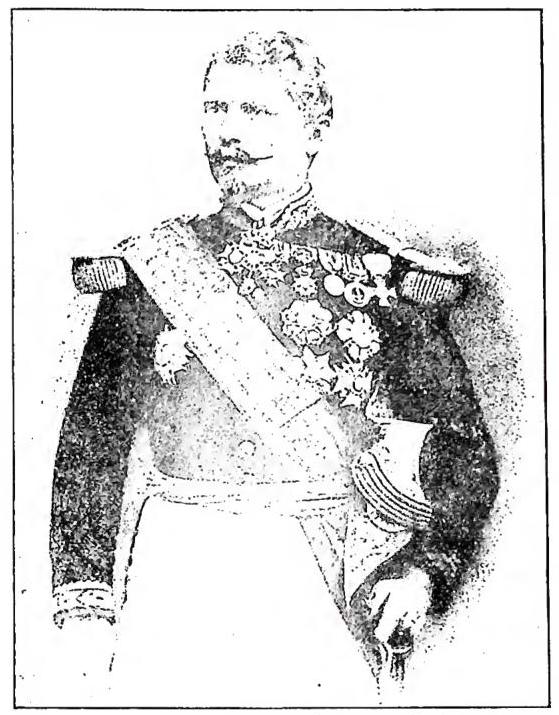
(courtesy of Count P. Dalla Torre)
HERMANN KANZLER - Portrait.
doctrine of religion: C. J. Webb, K.'s philosophy of religion, Oxford 1926; C. Sestroul, La phil. rel. de K., Bruxelles 1912; W. Reinhard, Über das Verhältnis von Sittlichkeit und Religion bei K., Bern 1927. Michele Federico Sciacca