
IRRAZIONALISMO. – A term whose meaning is not easily definable because of the many senses it has acquired in the history of philosophy and, above all, in modern and contemporary thought. In an absolute sense, it condemns itself: a pure i., or a philosophy
as a “system” of the “irrational,” is in fact reduced to the “rational” systematization of the “irrational,” that is, to an irrationalism rationally demonstrated! Therefore, every form of I. ultimately presupposes the use and value of reason. As such, it has almost always a necessarily limited scope and aims precisely to affirm: a) that there is something (real or ideal) that cannot be reduced to (or conflicts with or transcends) properly rational activity; b) and that, consequently, rational activity is not the whole of spiritual activity, but only a part of II. It is evident that, where instead this partiality of reason is excluded, every irrationalist element disappears, since reason comes to be identified with spiritual activity and with reality in its entire extension, without anything remaining foreign to II. Such, p.
(Ist. Enc. Catt.)
On the other hand, there are rationalistic philosophies (or philosophical currents) that admit a field of activity not reducible to reason. For example, for ancient and even modern Stoicism, the “passions” are irrational; for modern rationalism (Cortesio, Spinoza, Leibniz), sensations cannot be reduced to the clarity of reason; for the Enlightenment, history is the domain of the irrational, because it eludes every exhaustive systematization and does not establish necessary and universal relations among events, which remain outside calculation and predictability, in the realm of the uncertain and obscure, etc. But these philosophies, precisely because of their rationalism, devalue the irrationalistic elements
and regard them as an inferior activity, a lowest degree that must be surpassed or from which one must free oneself. It is therefore improper and inaccurate to speak of “residues” or of the “presence” of i. in them. It is likewise erroneous to call absolutely irrationalistic those philosophies (for example, those of Bergson and, in part, Blondel) which, without denying the value of rational knowledge, include the latter within a form of knowledge superior to it and more comprehensive than it (it has recently been possible to speak of Bergsonian “intellectualism” [Husson] and Blondelian intellectualism [Dumery]); similarly, intuitionism (v.) must not be confused with i.; otherwise, in this sense, Platonic idealism would also be i., to cite one example, since it not only admits the original intuition of ideas, but also exalts (Phaedrus, 224 a–256 b) ἔξως as μανία or delirium, superior to the “mediocrity” of reason. All these clarifications are necessary, given the ambiguity of the term i., and given that, ultimately, it is not possible to reduce the whole activity of the spirit to purely rational activity in the strict sense; and given, further, that reality itself, in its concreteness, cannot all be transcribed in terms of pure rationality—quite apart from the essence of God and Revelation, which belong to an order that transcends that of natural reason.
It should also be noted that reason and rationalism are often devalued not as such, but insofar as they are identified with a particular use and meaning of reason itself, that is, insofar as the terms are given a limited or restricted scope (for example, Pascal makes statements that may seem to constitute a total devaluation of reason, but in fact they concern only Cartesian reason or the pure esprit de géométrie; some anti-Hegelians combat reason and rationalism precisely because they identify them with Hegel’s reason and rationalism; Bergson is anti-intellectualist because he has in mind the scientific and positivist intellectualism of the second half of the last century, etc.); or else, even without going so far as devaluation or condemnation, the term reason is taken in a precise sense and whatever cannot be reduced to it is called irrational. Thus, the ancient mathematicians (for example, Euclid) considered reason (λόγος) as the “calculating” faculty, capable of reaching absolutely exact conclusions; consequently, for them, whatever eluded calculation was “irrational” (ἄλγος). In order to speak of i., in the proper sense of the term, it is necessary not only to admit a form of knowledge (or a reality) different from, or superior to, or irreducible to reason, even when reason is taken in its full meaning (and not in a restricted or limited one), but also to deny validity to reason and to consider it contrary or opposed to another (or other) form of knowing, a true obstacle to be eliminated and, in its structure, dissimilar from the structure of reality. I. in this sense is characteristic of contemporary (post-Hegelian) philosophy, where it has assumed a multiplicity of meanings and an extension unparalleled in any other period in the history of thought. Indeed, it may be said that what has been defined as the “revolt against reason” is one of the characteristics of speculation during roughly the last century, in the course of which activism and vitalism have claimed and exalted whatever is spontaneous, immediate, instinctive and, in a word, irrational in human beings and in universal life. The “philosophies of reason” have been polemically opposed by (and this must be taken into account as a set of extremist positions reacting against the extreme rationalism of-
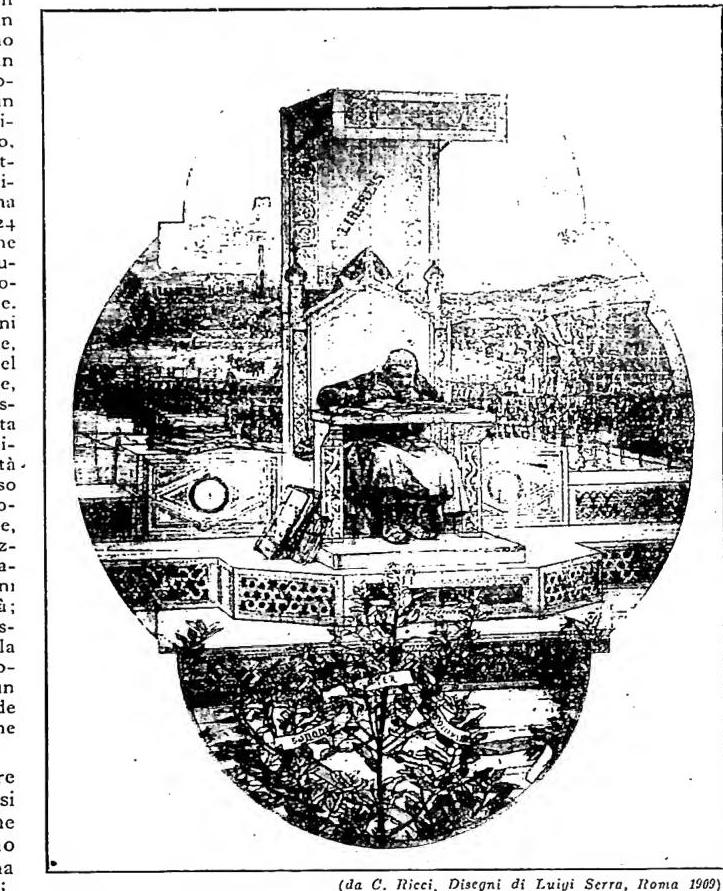
IRNERIO — I. glosses the laws. In the background: the Bolognese militias returning from Fossalta. Drawing by Luigi Serra for the ceiling of the hall of the Provincial Council of Bologna (1888) — Rome, National Gallery of Modern Art.
to Hegelianism, scientism, etc.) multiple forms of so-called “philosophies of life.”
Their immediate origins are to be sought in German Romanticism (Schlegel and Novalis), in the theory of evolution, and in biological doctrines. Schopenhauer and Nietzsche, in different respects, may be regarded as the two masters; subsequently, the influence of Kierkegaard was added to theirs. Schopenhauer’s “will,” the metaphysical root of the world, is present in every being in nature as a blind and irrational principle that wills for the sake of willing, without any purpose: it has no object; it is pure irrationality. But while Schopenhauer considers the will “unhappy,” so much so that living and prolonging life, besides being evil, is also a crime, Nietzsche exalts the irrational and intuitive forces of life as life’s own “Dionysian” happiness. Nietzschean vitalism, in certain respects, represents the maturity of some Romantic currents and one of the major stages in the revolt of irrationalism
against the rationalism of every age, whether Greek or Cartesian, Kantian or Hegelian. To the “concept” (of Socrates, the “corrupter”) and to the Idea (of Hegel), Nietzsche opposes Life, which bursts forth in antithetical directions that expand into infinity: in a world that has discovered itself to be infinite. The “will to power” proper to the “superman,” in a certain respect, is the violent, cruel, barbarous, and primitive revolt of instinctive life and passions in their natural state against the frigidity and the shirt of Nessus of reason. The antitheses are not composed in synthesis (Hegel), but are heated to white heat in collision: history is not the rational development of the idea, but a process of conflicting and irrational forces.
In contemporary thought, especially German thought, irrationalism has fermented alarmingly: broad currents of historicism, sociology, and existentialism are deeply influenced by II. For example, Spengler (v.), to cite one significant position: the author of the apocalyptic The Decline of the West (Munich 1918) bases his view on the concept of the fatality of doctrines and of history as the purposeless manifestation of predestined symbols. “The logic of natural science, the chain of causes and effects, appears to us extremely superficial; only the logic of the organic, destiny, instinct, whose omnipotence we feel in the vicissitudes of things, demonstrates to us the depth of becoming. What matters is to give man a new vision from which another must necessarily spring. Life has no purpose” (op. cit., p. 152). For Spengler, intelligence is merely a late and derivative activity; reason is the crystallization of vital elements (instincts, impulses, passions, values of the blood or of feeling, etc.). The conclusions of certain minor forms of irrationalism (for example, those of Klages), of the so-called “German neoromanticism” (Ziegler, etc., for whom reason prevents man from living a spontaneous and immediate life in intimacy with nature and from becoming God), and of the vitalism of the Spaniard Ortega y Gasset (born in 1885) are no different; yet he does not go so far as these disconcerting exaggerations, even though he exalts the unexpected, the risky, and the barbaric, or, as he puts it, “ascending life.” An enemy of all rationalistic absolutes, Ortega condemns the attraction exerted by the necessary and universal truths proper to “rational man,” to whom he opposes the non-intellectual “organic man.”
Unamuno’s irrationalism has an almost religious and Pascalian character, under the influence of pragmatism and Spanish mysticism. Life is action, and it is absolute faith in action, of which reason is the mortal enemy. The rationalists of the latter do not persuade, “because they are nothing but reasons, and it is not with reasons that the heart is nourished” (The Tragic Sense of Life, I, Florence 1922, p. 64). Against logic, even in the face of the absurd, one must have faith, an immense, boundless, robust faith, even to the point of madness—the only faith possessing an irresistible “redeeming power,” as we read in the Comentario. “Shameful logic,” with its deadly and torturing “whys,” poisons the will and extinguishes generosity, heroism, and madness. The world, Unamuno further says in the Comentario, “is always, in turn, what it appears to each person, and true wisdom consists in shaping it according to our will, departing from reason without any motive, full of faith in the absurd.” Truth is not a logical relation, nor is it obtained by the method of logic, but by the “method of passion,” of faith.
Decidedly religious (Protestant) is Kierkegaardian irrationalism, hostile to “speculative philosophy” (which he identifies with Hegelian philosophy) and to objective thought, which levels existences and turns them into so many paragraphs of a “system.” It is not “objective” truth that interests man, but his truth: what matters, we read in the Diary, “is to understand what I am destined for, to see what God truly wants me to do: what matters is to find a truth that is truth for me, to find an idea for which I can live or die” (Diary, 1 Aug. 1835, Innsbruck 1923, p. 28). “Not reason, but faith: whoever objectively affirms God does not believe.” “Objective insecurity,” incomprehensibility, and the “absurd” are necessary; it is precisely in the absurd that the passion of faith is expressed. An exaggeration of Kierkegaard and Nietzsche together is Chestov’s “religious existentialism,” always engaged in passionate polemic against “rational evidence,” the daughter of sin and expression of “diabolical pride.” Truth is faith, and faith is subjective; it is believing despite everything, against everything: “The promised land does not exist for the man who knows. The promised land is found where the one who has faith has arrived; it has become a promise because he has arrived: Certum est quia impossibile” (Athènes et Jérusalem, Paris 1938, p. 456). Renunciation of reason and despair at being unable to know the truth constitute the state of grace in which one opens oneself to faith; Chestov exalts this in an anarchic manner, in tones shared with the so-called “theology of crisis” of Barth and in more direct points of contact with the “religious philosophers” (Soloviev, Berdiaeff, Bulgakoff, etc.) of the Russian Orthodox Church.
Contemporary science as well (especially physics) makes room for the irrational, in the sense that some aspect of reality eludes the scientific process and its principles. MEYERSON, EMILE (v.), for example, finds that the principle of identity (the supreme principle of science), at a certain point in its process, encounters something irrational, something irreducible to identity and rationally unassimilable. It is not accurate, however, to regard Einsteinian relativity and the philosophical and scientific applications made of it as irrationalistic: relativism is not irrationalism. Nor are the recent neopositivist or mathematical logical doctrines, which have replaced the category of “necessity” with that of “probability” or “conventionality.”
Irrationalism, as a denial of the cognitive validity of reason or as a condemnation of rational knowledge, whether in the name of the rights of spontaneous life or in the name of religious faith, is a philosophically erroneous, practically ruinous, and religiously heterodox position. It is not a matter of denying reason in order to defend concrete life, but of vitalizing it within life itself, so that reason may give light to life and life concreteness to reason. Nor is it a matter of affirming faith against reason or reason against faith, but of finding the precise point of active collaboration between the two orders, distinct but not separate and both present in concrete spiritual life, which is more than reason in the strict sense, but is not without reason. To defend reason is also to defend faith. Often irrationalism, rather than being a genuine philosophical position, is a subjective passionate state or an exasperated polemical attitude.